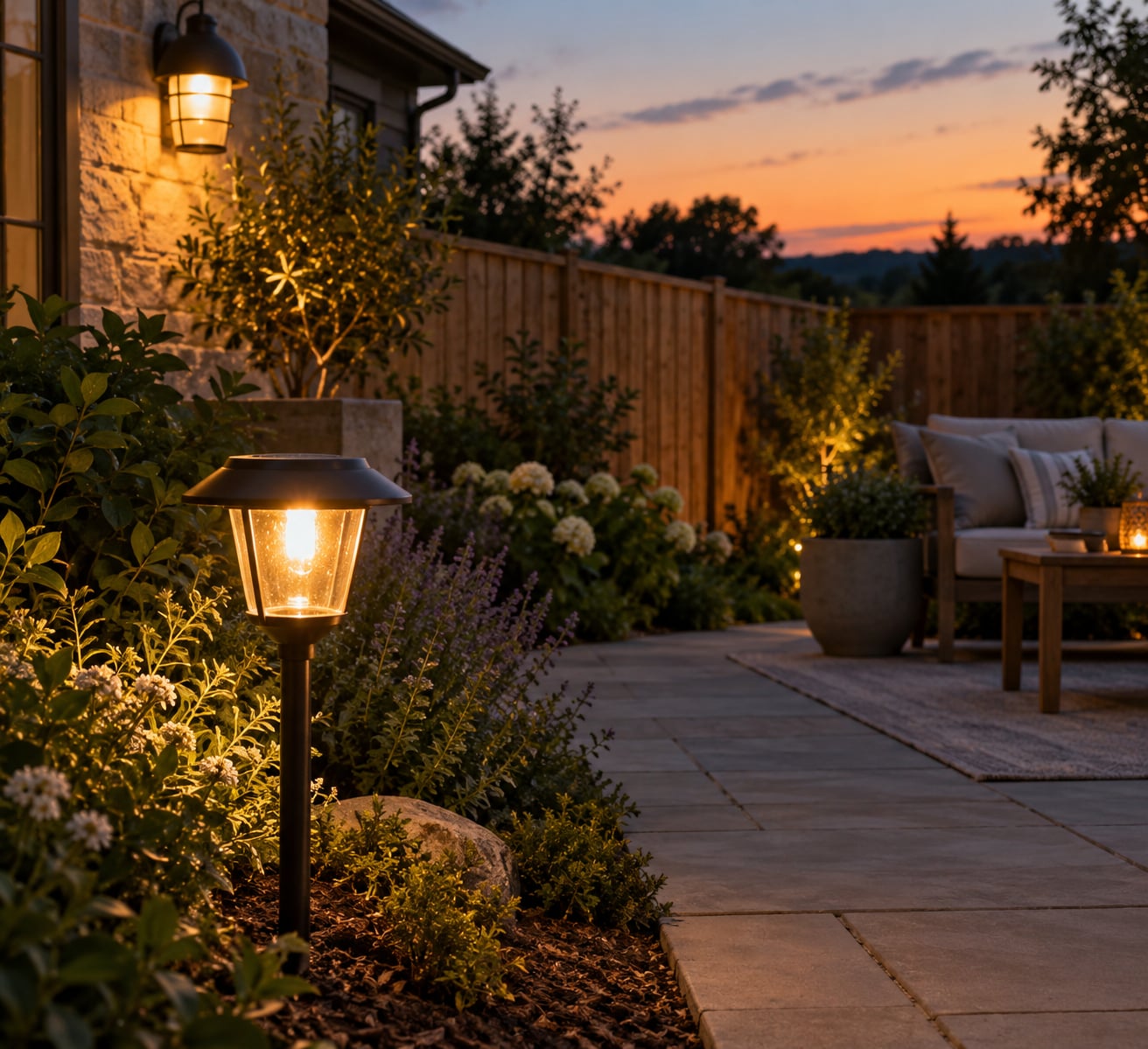
Short answer: partly. A yellow or amber lamp genuinely does attract fewer flying insects than a bright white bulb, because most nocturnal bugs perceive short blue wavelengths far better than the long amber ones. It repels nothing, and it does nothing for mosquitoes.
That distinction matters, because the box a yellow lamp comes in usually implies the second thing too. I have swapped bulbs on my own porch and back steps, and the result is a calmer radius around the fixture rather than an empty patio. People noticed a change within about a week. Nobody on that porch stopped getting bitten.
Here is what the light is actually doing, what it is not doing, and what works better if your real problem is mosquitoes.
Table of Contents
- Do Yellow Bug Lights Really Work? What the Evidence Shows
- How they work
- Limitations
- Why Are Some Bugs Drawn to Outdoor Lights?
- How Does Yellow Light Affect Different Insects?
- Mosquitoes
- Moths
- Flies and gnats
- Beetles, fireflies and beneficials
- Why Yellow Solar Lamps Are Not the Same as Bug Zappers
- What Actually Works for Mosquitoes Near a Patio?
- How to Choose and Position Outdoor Lighting Without Attracting More Bugs
- Frequently Asked Questions
- Are yellow light bulbs less attractive to mosquitoes?
- Will a yellow solar lantern keep mosquitoes away from a patio?
- Do bug zappers really reduce mosquito bites?
- Is yellow light better than white light for outdoor bugs?
- Can I use a bug zapper indoors or near a bed?
- What is the safest way to control mosquitoes on a small patio?
- What Should You Do First?
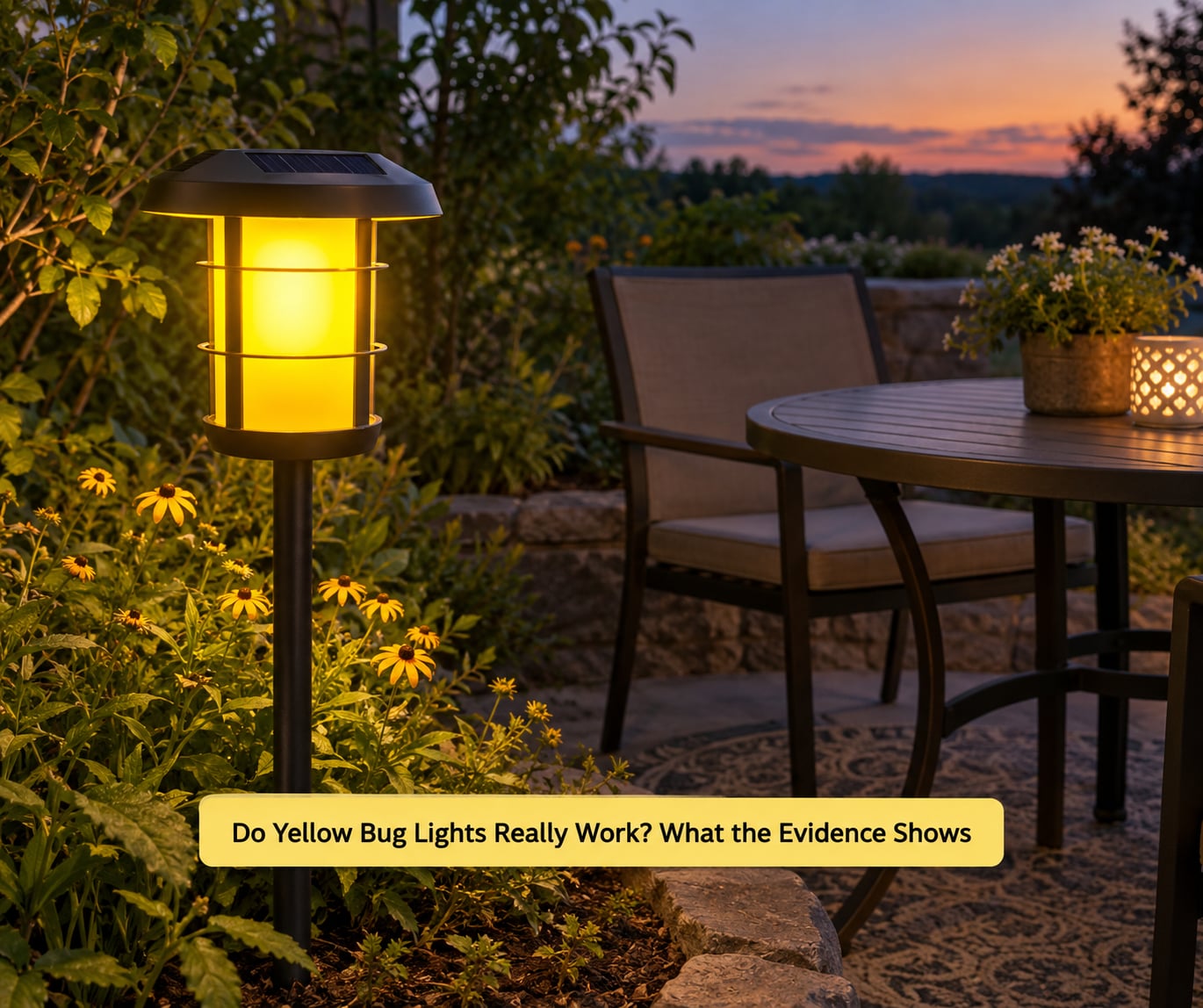
Do Yellow Bug Lights Really Work? What the Evidence Shows
Do yellow bug lights really work? They work by attracting fewer insects, not by driving them away. Field testing reported in Science found yellow-tinted bug bulbs and warm-colored LEDs roughly tied as the least attractive of every bulb type tested, while blue-rich daylight bulbs pulled in the most insects.
How they work
- Wavelength visibility. Insects perceive light from roughly 300 to 650 nanometers. Humans see 380 to 750nm. Most nocturnal species register blue and ultraviolet far more strongly than we do.
- Spectrum shift. Yellow and amber bulbs emit longer wavelengths, generally above 550nm, sitting at or past the edge of that range. Fewer insects register the fixture as a beacon.
- Reduced attraction. Because the lamp is harder to see, fewer insects orient toward it and fewer pile up inside its radius.
Limitations
- Yellow bulbs do not repel insects. They fail to attract them, which is a different mechanism entirely.
- Mosquitoes cue on carbon dioxide, body heat and scent, not on light, so yellow lighting changes nothing about your bites.
- Not every yellow bulb is genuinely low-spectrum. Some just look warm and still put out light the insects see well.
- Several insect groups are drawn to yellow wavelengths no matter what the Kelvin rating says.
| Light or device | What it is | Effect on nearby insects |
|---|---|---|
| Daylight blue and cool white (5000-6000K) | Highest share of short wavelengths | Strongest attraction, largest swarm |
| Bright white (3500-4500K) | Balanced mix, still blue-heavy | Heavy attraction |
| Warm white (2700-3500K) | More long wavelengths | Moderate attraction, noticeably calmer |
| Amber or yellow (2200K and under) | Output concentrated at long wavelengths | Least attraction; no repellency |
| Yellow solar lamp | Same spectrum as an amber bulb, usually dimmer | Same reduced attraction, at lower brightness |
| Ultraviolet bug zapper | Active lamp with a high-voltage grid | Attracts from a distance, then kills a fraction of arrivals |
Ecologist Douglas Tallamy, author of Nature’s Best Hope, frames it the way most researchers do: yellow lights do not repel insects, they simply fail to attract them. Marisano James, a UC Davis insect vision researcher, adds the detail that gets skipped in most marketing copy: insect vision varies by species, so no single color wins everywhere.
Why Are Some Bugs Drawn to Outdoor Lights?
Most flying insects use celestial light for orientation. On a moonless night, they hold a fixed angle to the moon so their flight path stays straight, and they read distant city glow the same way. A bright porch lamp breaks that system.
The bug does not decide the lamp is dinner. It simply keeps correcting its angle toward a light source that never moves, and it ends up circling. That circling is what you see at a porch light, and it is why the swarm around a fixture looks like more insects than are actually there.
Two things make the effect worse. Competing light sources confuse the insect further, because it can no longer tell which source to hold its angle to. And brightness matters independently of color, since a very bright warm bulb still lights the whole area enough for an insect to track it.
The practical consequence: light color is only one lever. Where a lamp sits, how bright it runs, and whether it is shielded toward the ground change the result just as much.
How Does Yellow Light Affect Different Insects?
The effect is species-specific, which is why one household swears by a yellow bulb and the next one says it changed nothing.
Mosquitoes
Essentially no effect. Mosquitoes find hosts through carbon dioxide, body odor, heat and sweat chemistry. Light is a weak secondary cue. Amber wavelengths in the 520 to 590nm range sit near the upper edge of what most nocturnal insects perceive well, and that edge can blunt orientation in some species without stopping a single bite.
Moths
Still very much attracted. Many moths orient toward the longest wavelengths they can detect, which is why amber fixtures and porch lights both draw them in. This is the clearest argument against treating a yellow lamp as a moth solution.
Flies and gnats
Mixed. Small biting flies gather around light more readily than many larger species, and a dim amber lamp usually cuts the visible mess without removing the swarm you can hear.
Beetles, fireflies and beneficials
June beetles, some scarabs and hovering fireflies will still work a lamp. If you are trying to protect pollinators and fireflies rather than your own comfort, amber is the least harmful choice, not a solution.
Why Yellow Solar Lamps Are Not the Same as Bug Zappers
A yellow solar lamp is passive. It sits on a stake or a wall, charges a small battery in the sun, and emits warm light all evening. Nothing about it kills, traps or zaps anything. It is a lighting decision.
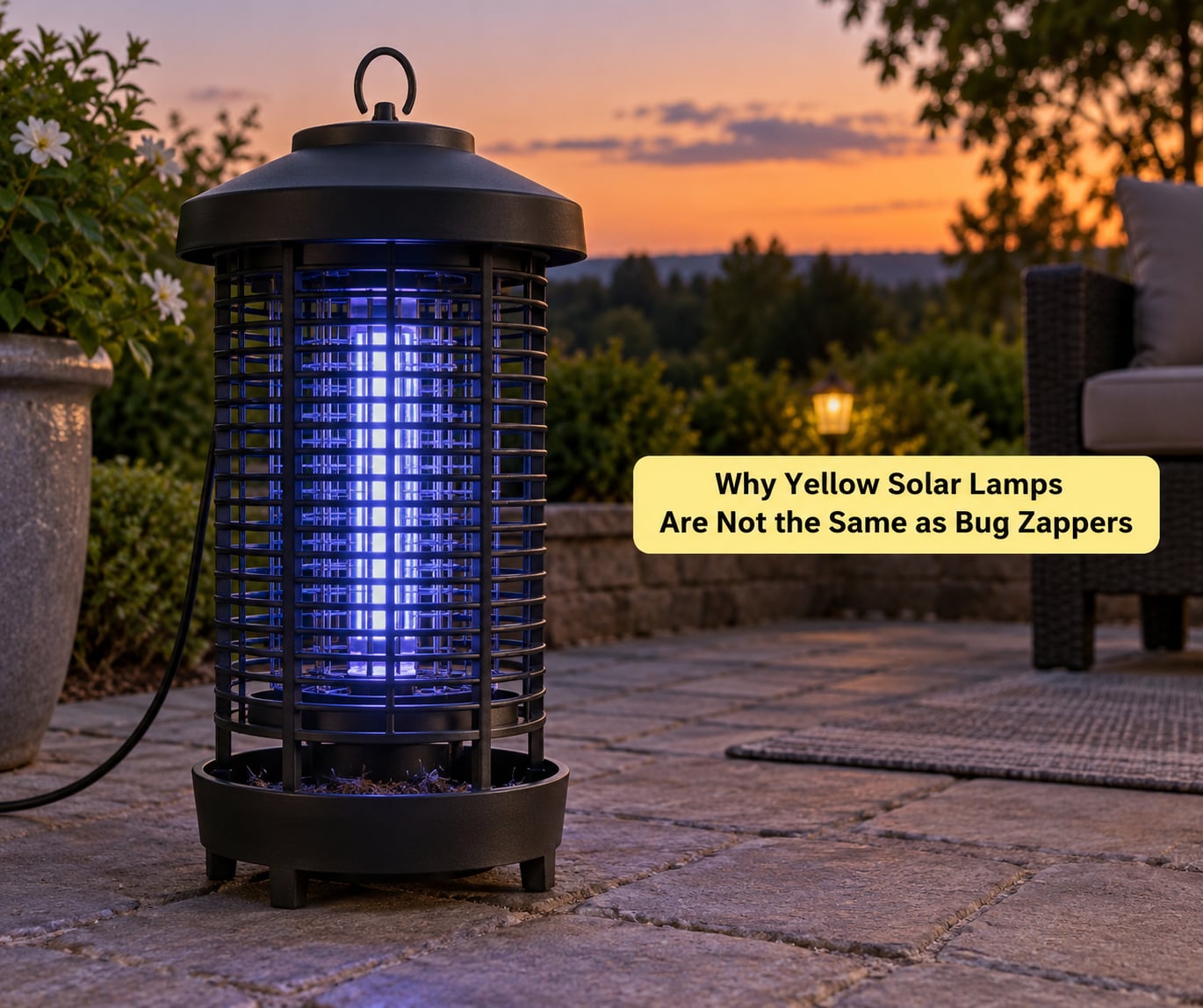
A bug zapper is active. It uses ultraviolet light to pull insects in from a distance, then a high-voltage grid, an internal fan and a collection tray to kill what arrives. The two products get confused constantly, and the confusion matters because the zapper changes the situation in a way a lamp never will.
Here is the honest limitation of the zapper category: entomology and extension write-ups put the mosquito share of zapper kills at roughly 0.13 to 0.22 percent. Most of what a zapper kills is not what bit you. Homeowner reports on forums describe the count dropping somewhat rather than dramatically, with the useful effect limited to small areas.
People also ask, reasonably, why zapper bulbs and sticky traps are yellow if yellow deters insects. The answer is contrast and visibility inside the device, not repellency. The lamp is there to be seen by the insect you already attracted.
What Actually Works for Mosquitoes Near a Patio?
If bites are the problem, light color is the wrong variable. These are the controls that move the needle.
- Remove standing water first. Birdbaths, blocked gutters, plant saucers and tires hold mosquito breeding water. Emptying them weekly matters more than any bulb you can buy.
- Use moving air. Mosquitoes orient poorly in a breeze. A fan across a seating area is cheap, quiet and genuinely effective at lowering bites nearby.
- Close the route indoors. Screen doors, seal gaps and keep entryway lights on a switch you control. Most patio bites happen after dusk as people move between spaces.
- Use registered repellents as labeled. Follow the product label and public health guidance, and skip anything you would not apply to a child’s skin. For personal protection, EPA-registered repellents are the researched option.
- Check pets and standing water together. Mosquito control products are not pet products. Keep treated areas out of reach and follow label directions on drying time before anyone walks on a treated surface.
- Shield your outdoor lighting. Aim light down, choose warm color, and keep brightness to what you actually need for safety.
How to Choose and Position Outdoor Lighting Without Attracting More Bugs
If the goal is fewer insects around the fixture and fewer bugs dying against it, pick on spectrum, output and shielding rather than on the word bug on the box.
- Read the Kelvin rating, not the color swatch. 2200K or lower is the useful range. A 2700K lamp is a compromise, and anything above 3500K gives back much of the reduction.
- Check for a stated spectrum. A low Kelvin number alone is weak evidence. Color temperature describes black body radiation, which is a model of a glowing surface rather than a full map of what a bulb emits. A source can read warm and still put out short wavelengths.
- Choose LED over incandescent. Warm LED beats warm incandescent specifically because of spectrum, not brightness.
- Distrust repellency wording. Any packaging promising that a lamp keeps bugs away, not that it attracts fewer, is overselling.
- Add a sensor. A dusk-to-dawn or motion-activated fixture keeps the light off until it is needed, which shrinks the hours of exposure.
- Shield the fixture. A downward-facing or fully shielded luminaire cuts the visible sky glow that insects use for orientation, and it helps neighbors too.
| Bulb type | Ultraviolet output | Heat | Compared with amber LED |
|---|---|---|---|
| Incandescent (warm) | Emits UV through the glass | Very high | Draws more insects and burns a lot of power |
| CFL | Small UV at the phosphor coating | Moderate, with hot spots | Worse efficiency than LED |
| Warm white LED | Very low | Low | Strong improvement over warm incandescent |
| Amber LED (2200K and under) | Minimal | Low | Least attractive option tested |
One practical warning from people who have done this: most amber bulbs are too dim to serve as your only light, so you add a second brighter lamp and the bugs come right back. Plan for two zones, a dim shielded light where you sit and a brighter one that only switches on when you move.
The thing homeowners on Reddit tend to get right is the reframe. The consensus in patio and lighting forums is not that yellow lights reduce the number of bugs. It is that they reduce the radius at which bugs get drawn to your property, rather than to a neighbour’s fixture across the street.
For exposed outdoor fixtures, check the damp or wet rating before you buy. A bulb rated for indoor use in a covered porch can fail in a fixture that takes rain, and a solar stake lamp should be positioned where its panel gets direct sun rather than under a deep eave.
Frequently Asked Questions
Are yellow light bulbs less attractive to mosquitoes?
Barely, and it is close to a non-effect. Mosquitoes locate people through carbon dioxide, skin odor and heat rather than through visible light, so a yellow bulb changes almost nothing about how many bites you get. Amber light is useful for reducing the visual mess of moths and gnats around a fixture, but it is not mosquito control.
Will a yellow solar lantern keep mosquitoes away from a patio?
No. It will make the area around the lantern look and feel calmer because fewer visible insects gather there, and the lower brightness of most solar fixtures helps too. But nothing about the lamp repels mosquitoes or interrupts their search for carbon dioxide and body heat. Treat it as a lighting choice, not a bite-control method.
Do bug zappers really reduce mosquito bites?
Only slightly, and less than most buyers expect. Research cited in outdoor forums puts mosquitoes at roughly 0.13 to 0.22 percent of the insects a zapper kills, with the rest being moths, flies and other harmless species. A zapper also actively pulls insects toward the area from farther away, so it can increase nearby traffic while killing a fraction of it.
Is yellow light better than white light for outdoor bugs?
Yes, for attraction. Field testing reported in Science found yellow-tinted bug bulbs and warm LEDs roughly tied as the least attractive bulbs, while blue-rich daylight bulbs drew the most insects. So yellow wins on the attraction side. It does not win on repellency, because it has none, and a bright white LED still beats a warm incandescent for bugs.
Can I use a bug zapper indoors or near a bed?
I would not put one near a bed. Indoor units are noisy, and inside a sealed room they remove insects without doing anything about the mosquitoes already in the room, which bite you regardless. Run one outdoors in an open area instead, keep it away from children and pets, and never handle the internal grid while it is plugged in.
What is the safest way to control mosquitoes on a small patio?
Start with source control: empty standing water weekly, keep gutters and saucers dry, and add moving air with a fan across the seating area. Close screen doors at dusk and use a registered repellent on exposed skin exactly as the label directs. Warm shielded lighting helps the atmosphere, but the water and the breeze do the real work.
What Should You Do First?
Three steps, in order. First, empty every container holding water around the patio and check the gutters, because that is where the mosquito population actually comes from. Second, if the fixture bothers you, switch to a 2200K amber LED in a shielded housing with a dusk-to-dawn or motion sensor, and keep it dim enough that you are not adding a second bright lamp for visibility.
Third, if you are still getting bitten, stop treating lighting as the fix. Use moving air, screen doors, and a registered repellent on exposed skin as the label directs. So: do yellow bug lights really work? They work in the narrow sense of drawing fewer insects to your property. Ask them to do anything beyond that and they will let you down.