Understanding how outdoor lighting affects birds starts with one fact: the damage happens mostly at night, because it replaces the darkness and starlight that migrating species rely on to find their bearings. Bright or blue-rich fixtures pull birds off course, cut short their feeding, and add to the window strikes and building collisions that kill more than a billion birds a year in the US. Here is what is actually happening in your yard, and what you can change.
Table of Contents
- How outdoor lighting affects birds
- Why nighttime brightness changes bird behavior
- Brightness, color and timing decide how outdoor lighting affects birds
- Do outdoor lights really draw birds to insects?
- Can outdoor lighting contribute to bird collisions?
- Why are migrating birds especially vulnerable?
- How to reduce the impact of outdoor lighting
- Bird-friendly outdoor lighting ideas
- How to test and adjust lighting around your home
- Frequently Asked Questions
- Can a single outdoor light affect birds?
- What color outdoor light is best for birds?
- Do motion-sensor lights help migrating birds?
- How can I stop birds from hitting windows?
- What should you do first?
How outdoor lighting affects birds
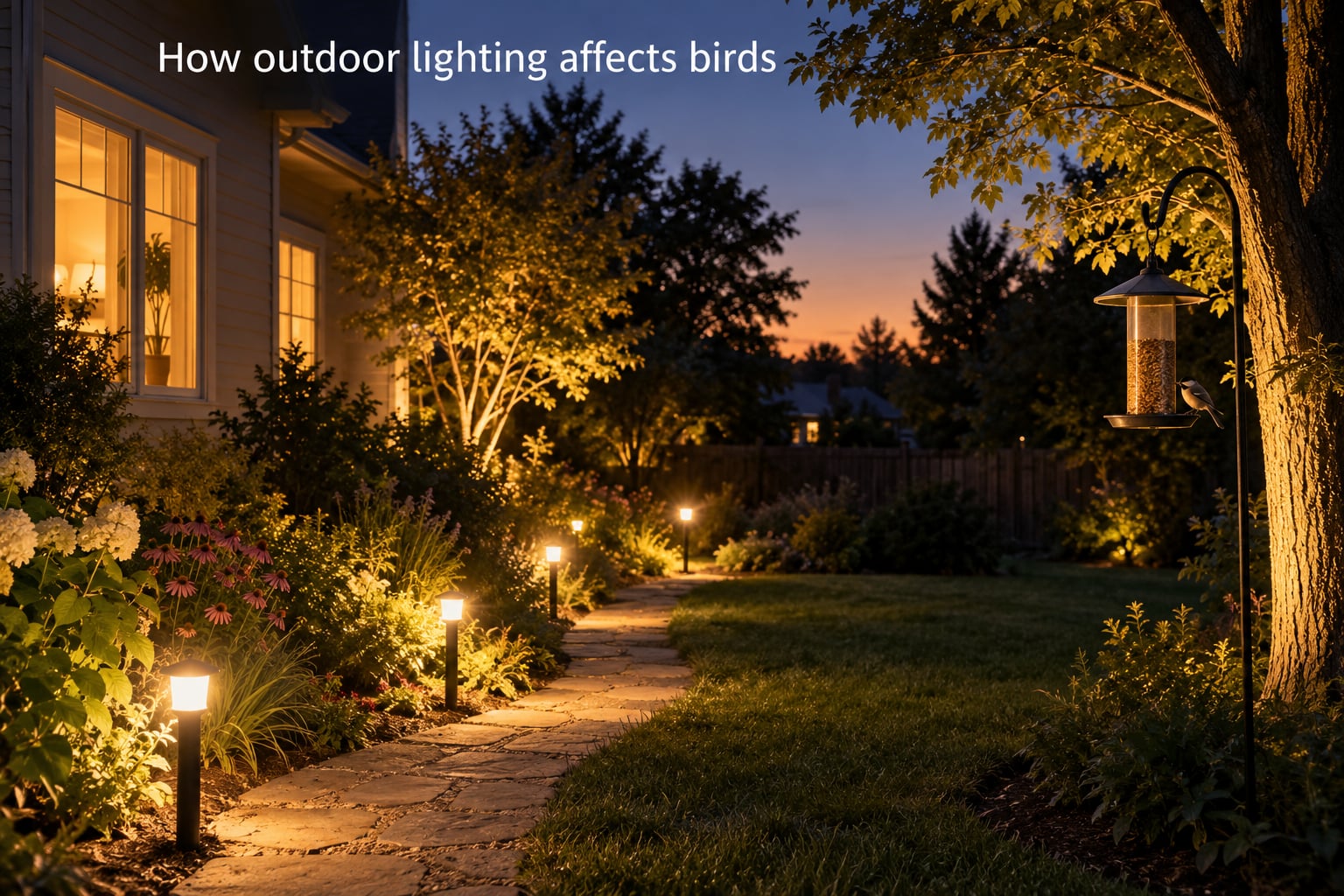
Six effects show up most often, and they rarely happen alone. A single bright fixture can send birds circling until they drop into the nearest tree, then draw exhausted birds into the lit window they cannot see through.
| Effect | What happens | Lighting conditions that make it worse |
|---|---|---|
| Attraction and disorientation | Birds leave their normal route and orient toward the glow | Bright, unshielded fixtures visible from a distance, heavy sky glow |
| Circling and exhaustion | Fall-out behavior: birds circle a light source until they tire and land low | One bright source against a dark backdrop, such as a pole or uplight |
| Building and window collisions | Birds hit glass, trees, and facades they cannot see in the dark | Light aimed at or through reflective windows, shiny siding, water |
| Interrupted feeding | Foraging shifts to lit areas, which are then picked clean | Lights burning continuously beside feeders, shrubs, or lawn |
| Predator exposure | Feeding birds become visible to cats and other hunters in open light | Evenly bright, ground-level light across a lawn or shrub bed |
| Year-round insect congregation | Moths and beetles gather at lamps, which draws insect-eating birds in turn | Any light close to vegetation, especially small solar path lights |
Audubon and other groups note that more than 80 percent of terrestrial migratory birds travel at night, so the effects overlap with the heaviest traffic of the year. The attraction is not local either: University of Delaware weather radar work put the pull of a major city at roughly 200 kilometers, with sky glow visible far beyond that.
Why nighttime brightness changes bird behavior
Nocturnal migrants steer by more than one system at once, and artificial light at night corrupts several of them together. Once a bird’s heading is wrong, its ability to judge altitude and obstacles goes with it.
The result is a loop rather than a single injury. Birds approach the glow, circle to find a landmark, lose height, land somewhere unfamiliar, and burn energy they needed for the rest of the journey. If the lights stay on, they keep circling instead of leaving.
Five factors set the size of the effect: intensity, color, timing, direction, and duration. None of them is decisive on its own, which is why a modest warm porch light and a 4000K floodlight pointed at the sky can produce completely different results from the same property.
Brightness, color and timing decide how outdoor lighting affects birds
Brighter light sends light farther, and a fixture that is visible from a distance can redirect birds well beyond your property line. Spreading the same total brightness over a wider area is not always better, because sky glow is what birds see first.
Color matters as much as brightness. Birds have a high sensitivity to short wavelengths, so blue-rich white light is the most disruptive kind on the market today. Warm amber tones around 2100K to 2200K are the least disruptive, and red and amber light deters most insects as well.
Direction decides whether the sky even sees the light. A shielded or full cutoff fixture sends light down and hides the bulb from view; an unshielded wall pack or an uplight aimed at a tree sends plenty skyward. Direction also controls light trespass, the spill of light leaving your property and landing on a neighbor’s windows, a road, or a neighbor’s tree where birds are nesting.
Timing and duration decide how long a bird has to deal with it. A fixture that shuts off at eleven gives a disoriented bird darkness to recover in. One that burns from dusk to dawn holds the trap open all night. Birds do adjust to a steady source over days, but that adaptation is a coping mechanism, not a fix.
Do outdoor lights really draw birds to insects?
Yes, and this is the effect most homeowners notice first. Many insects navigate by light and end up concentrated around any lamp, which turns a normally scattered food supply into a dense, predictable gathering. Insect-eating birds follow, and the concentration itself is the problem.
A crowded lamp attracts birds away from feeding areas that were working fine, and it also makes them easier targets. Cats and other predators learn where the reliable crowd is. Once the insects thin out, the birds that stayed lose their reason to be there and have wasted energy at the worst possible time.
Small solar path lights deserve a specific mention here, because they are the quietest large group of light sources on a typical suburban property. They switch on automatically at dusk, burn all night regardless of whether anyone is outside, and sit low in shrubs where moths gather. Turning them off during the season, or leaving them off and using one shielded fixture where you actually walk, removes a surprising amount of stray light.
Can outdoor lighting contribute to bird collisions?
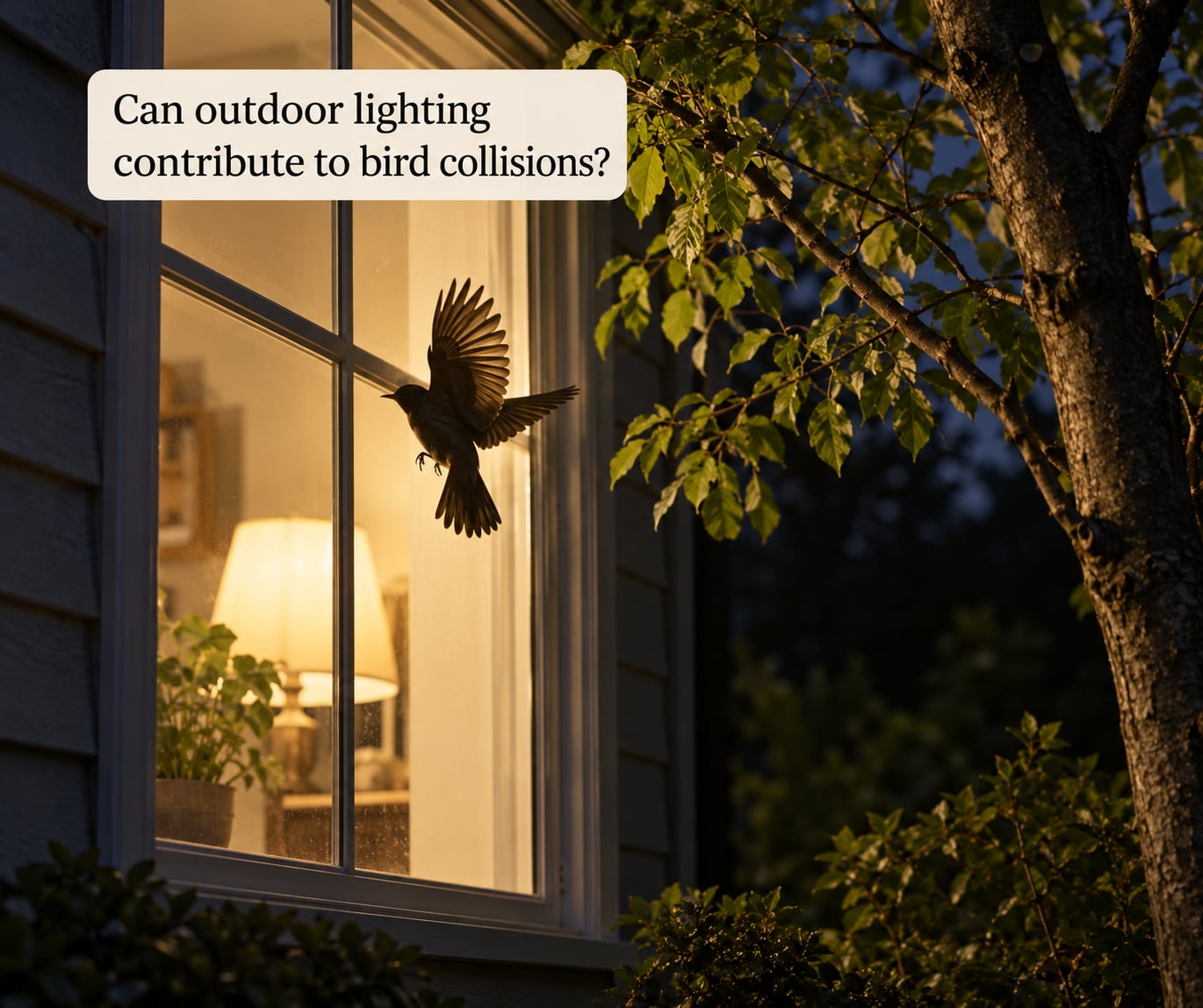
Yes, and the mechanism is visibility rather than confusion. At night a bird normally sees through a window to whatever is behind it. Interior light makes the glass act like a mirror, so a lit window at night can reflect trees, sky, or another lit window, and the bird aims at the reflection.
The same thing happens with trees, buildings, fences, and car surfaces near a bright light. Collisions have several causes at once, including glass, habitat, feeding pressure, and predators, so no single fixture change prevents them. But light intensity and reflective surfaces are both on that list, which means lighting changes are one lever a homeowner can actually pull.
That is the practical side of how outdoor lighting affects birds: not every strike can be blamed on a lamp, but a lit reflective surface is one of the few causes you can switch off. Work from the outside in. Cut the light that shines onto or through a window, aim fixtures away from reflective surfaces, and switch off or dim indoor lights in rooms facing trees after dusk. Inside, curtains, blinds, or screens break up the reflection during the day when the room is dark and the glass is a mirror. Audubon’s guidance has been that interior and exterior measures work better together than either does alone.
The scale is worth keeping in mind. US Fish and Wildlife Service researchers estimated that up to a billion birds die from building collisions in the US each year, and Chicago’s convention center dropped from roughly 1,280 collision deaths to 18 after bird-friendly window treatments were applied, an example of how large the effect can be when buildings change their lighting along with their glass.
Why are migrating birds especially vulnerable?
Most songbirds, thrushes, and warblers migrate at night precisely because the air is calmer and the stars are visible. They orient partly by the pattern of the night sky, partly by the Earth’s magnetic field, and partly by landmarks that look different by day.
Artificial light at night interferes with several of those systems at once. A bright patch low on the horizon competes with the star compass, and blue-rich wavelengths appear to disrupt the magnetic compass birds carry in their eyes. The bird does not make a bad decision so much as two disagreeing systems give it two different headings.
Risk climbs when several conditions overlap. Fog and low cloud raise the altitude a bird flies at and blur the horizon. Cloud cover hides the stars the bird needs, and unfamiliar terrain removes the landmarks that would otherwise correct a mistake. Wind pushes birds off their intended route into areas they were never going to cross.
Add lighting across the yard and the overlap becomes lethal. Spring migration generally runs from March into June, and fall migration from August into November, with peak nights shifting by region and species. Outside those windows birds still use the sky, but the volume of traffic is what turns a bad night into a dangerous one.
How to reduce the impact of outdoor lighting
Turn things off before you buy anything. This is the single cheapest change available, it costs nothing, and it also trims your electricity use. Work down this list in order.
- Switch off what nobody needs. Decorative uplights, lit-out windows, and solar stakes that sit empty all night are the easiest wins.
- Shield what stays on. Choose fixtures that are fully shielded or full cutoff, so the bulb is hidden and light goes down and outward only.
- Aim fixtures downward. Turn or replace any fixture that throws light at the sky, at a tree canopy, at the road, or at a neighbor’s windows.
- Move to warm color. Aim for 2100K to 2200K where you can, and 3000K as a compromise. Amber fixtures around 590 to 610 nanometers are the most selective option.
- Lower the brightness. If the path is visible without lighting the whole garden, use the dimmer or the lower-output setting.
- Add a timer or occupancy control. A timer ends the night; a photocell ends it at dawn; a motion sensor limits it to movement.
- Avoid repeated night flashes. Sensors that re-trigger on birds or insects create a strobing effect that repeatedly restarts disorientation.
- Consider quiet windows during peak nights. Many Lights Out programs ask residents to dim non-essential lights on the busiest migration nights, and a handful of US municipalities now have ordinances covering non-essential outdoor lighting.
On the electrical side, do not open, rewire, or replace fixtures yourself unless you are licensed to do that work. Follow the manufacturer’s instructions and your local electrical code, and hire a licensed electrician for anything hardwired. If you want to add shielding, buy a fixture designed for it rather than taping or clamping a homemade baffle onto a hot bulb, which is a fire risk that Audubon specifically warns about.
Bird-friendly outdoor lighting ideas
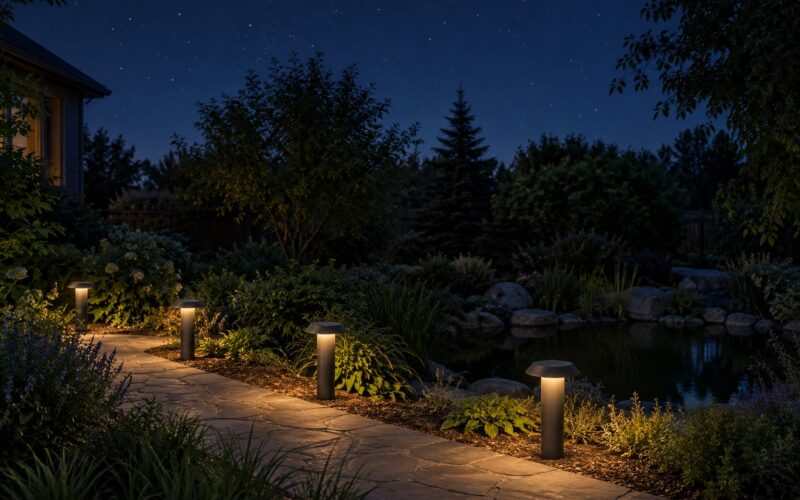
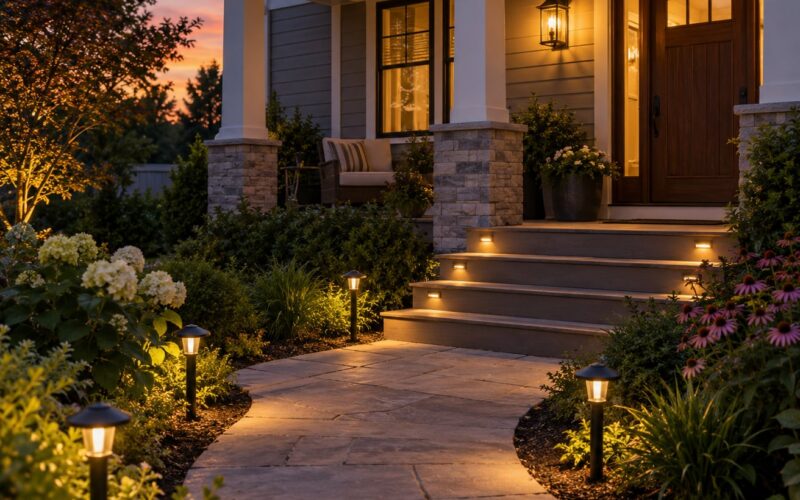
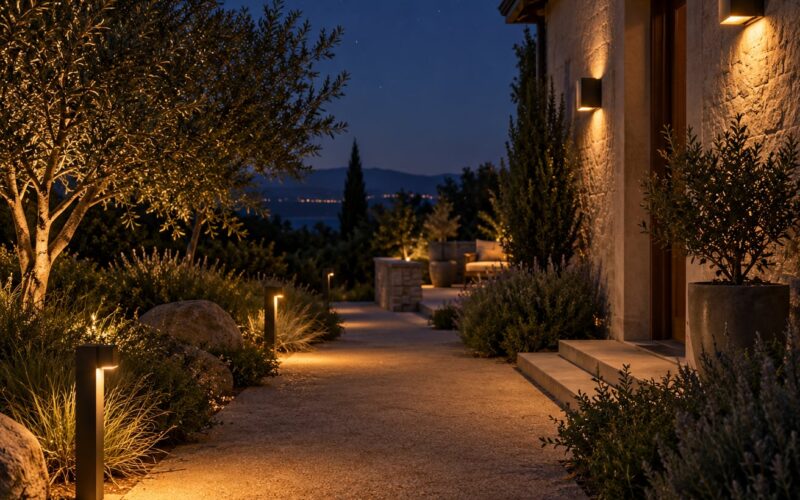
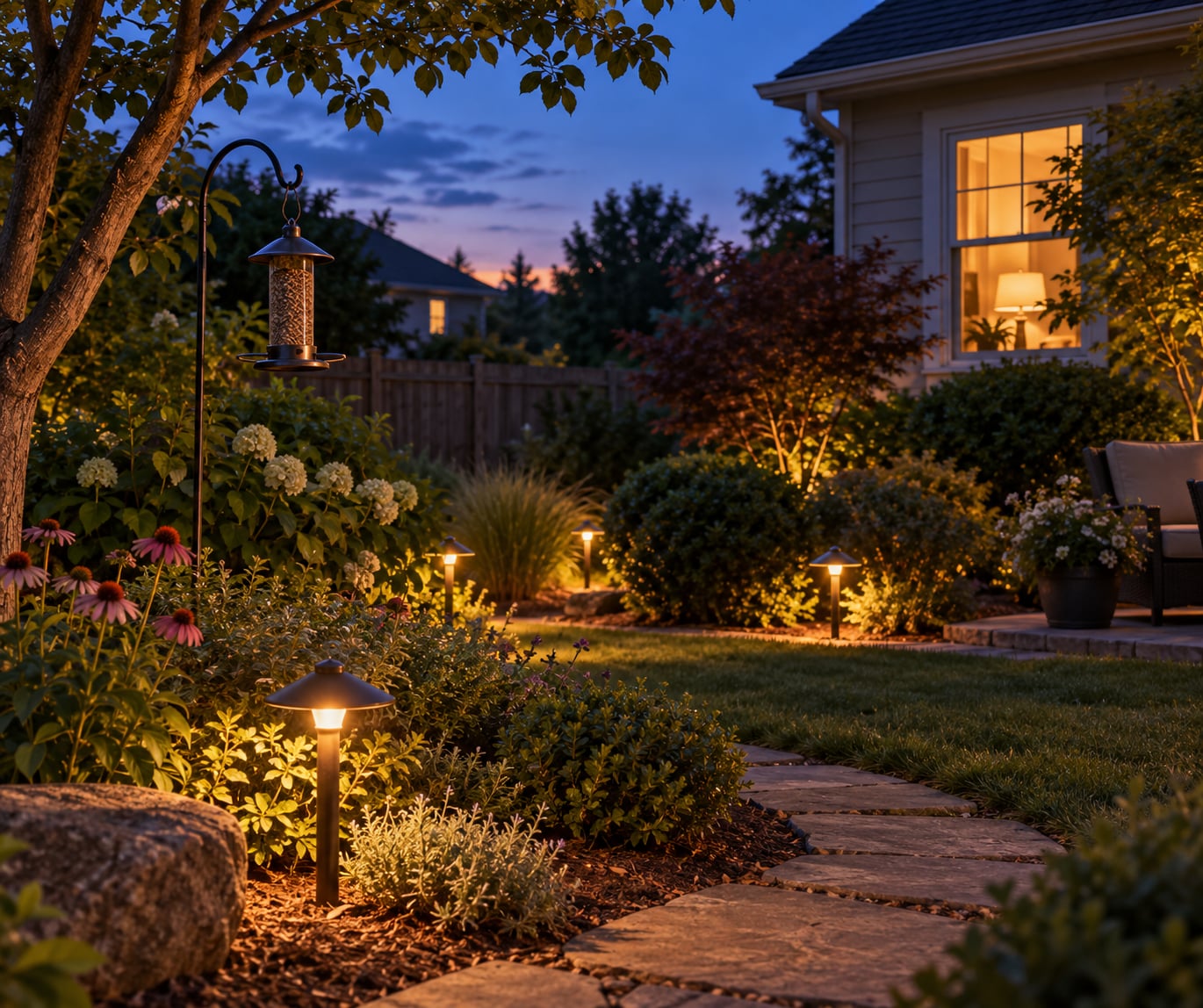
Most of the work is done by aiming light down and keeping it short. For paths and walkways, low bollard or step lights with a shielded lens are the simplest choice, since they light the ground rather than the sky. For decks and porches, a downward wall light above eye level removes the glare that shows a bird the bulb itself.
For a driveway, one shielded floodlight switched by a sensor and pointed along the drive beats three always-on ones. For gardens, treat any uplight as a sky-facing light until you know its beam angle, and check from across the street whether you can see the source. String lights and seasonal decorations belong on a timer, and they should stay below the canopy where possible.
| Control method | Best for | Limitation to plan around |
|---|---|---|
| Manual switch | Rooms and lights used only briefly | Depends entirely on habit |
| Timer switch | Porch and step lights on a fixed schedule | No response to activity |
| Photocell or dusk-to-dawn sensor | Switching off at dawn and on at dusk | Still burns all night |
| Motion or occupancy sensor | Driveways, back gardens, side paths | Re-triggering on birds and animals |
| Dimmer or two-level driver | Fixtures that must stay on all night | Needs a compatible dimmable fixture |
| Astronomic timer | Seasonal shift in sunset times | Costs more, needs setup |
If you are replacing bulbs rather than fixtures, read the lumens as well as the Kelvin number. Wattage tells you how much energy the bulb draws, lumens tell you how much light it gives, and for wildlife purposes a lower lumen figure at the same color temperature is a smaller disturbance than a brighter one.
How to test and adjust lighting around your home
You can audit your own property in about fifteen minutes after dark. Start at the street and walk toward the house so you see the property the way a bird approaching it would.
- Stand back and look up. Any fixture whose bulb you can see directly is sending light upward.
- Note the direction of the beam. Look for light landing on tree canopies, rooflines, water, or a neighboring wall.
- Count the lit hours. A fixture burning from dusk to dawn matters more than the same fixture burning for an hour.
- Look for reflections. Bright lines in a window or a mirror effect on siding tell you a collision surface is lit.
- Check the insects. A cloud of moths around one lamp marks a feeding trap.
- Note the color by eye. Anything reading as white or bluish-white is above 3000K.
Change one thing at a time and let it run a few nights. Swapping a color temperature changes how birds respond, shielding changes how far the light reaches, and a timer changes how long the exposure lasts, so bundling all three at once leaves you unable to tell what helped.
Watch the yard in the early morning rather than only at night. Repeated circling, calls after dark, or a quiet patch where birds normally feed are the signals worth noticing. Local birding groups and Audubon chapters publish night migration reports by region, which tell you when the busiest nights are where you live.
If you find an injured bird, check that it is breathing and is not bleeding. Place it in a ventilated box, keep it quiet and warm, and contact a licensed wildlife rehabilitator the same day. Do not feed it or give it water, and keep cats indoors until a rehabilitator gives you the go-ahead. Handle wild birds with bare hands only as a last resort, and wash your hands afterwards.
Frequently Asked Questions
Can a single outdoor light affect birds?
Yes, when it is bright, cool in color, visible from a distance, or left on all night. One fixture cannot explain a whole neighborhood’s problem, but it can hold a disoriented bird circling until it drops. Its effect also depends on what surrounds it, including trees, buildings, water, and any other light nearby. Dimming it, shielding it, or switching it off still matters.
What color outdoor light is best for birds?
Warm amber and red light in the 2100K to 2200K range is the least disruptive, because birds are especially sensitive to short blue wavelengths. 3000K is a reasonable compromise, and bulbs or filters in the 590 to 610 nanometer amber range are the most selective. Color alone does not make a fixture safe, though. Direction, brightness, and hours of operation still decide the effect.
Do motion-sensor lights help migrating birds?
They help when they cut the total hours of exposure, so a sensor that keeps a dark yard dark between visitors is a real improvement. They can also hurt, because birds crossing a beam trigger the light and startle or redirect them, and repeated triggers keep restarting the disorientation. Aim the sensor low so it detects people and not flight paths, and pair it with a shielded, warm fixture.
How can I stop birds from hitting windows?
Start with the light. Cut any outdoor light aimed at or shining through reflective windows, especially at night, and dim interior rooms facing trees after dusk. Inside, curtains, blinds, or screens break up reflections during daylight hours, when birds see glass as a mirror. Exterior measures such as netting or decals help too. Collision also has causes beyond lighting, so keep other fixes in place as well.
What should you do first?
Switch off the lights nobody needs tonight. That is the whole first step, and it costs nothing.
Then work through the rest in order: shield and aim the fixtures that stay on, move them to warm color temperatures, drop the brightness to the lowest useful level, and add a timer so the yard goes dark rather than running until dawn.
If you take one idea away from how outdoor lighting affects birds, make it this one: darkness is the default, and light is something you switch on when you need it. Watch what changes over the next few nights and adjust one variable at a time. Peak nights arrive in spring from March into June and again in fall from August into November, so this is worth getting right before then rather than during. Any change to fixed or hardwired outdoor electrical equipment should follow the manufacturer’s instructions and your local requirements, with a licensed electrician handling the work.