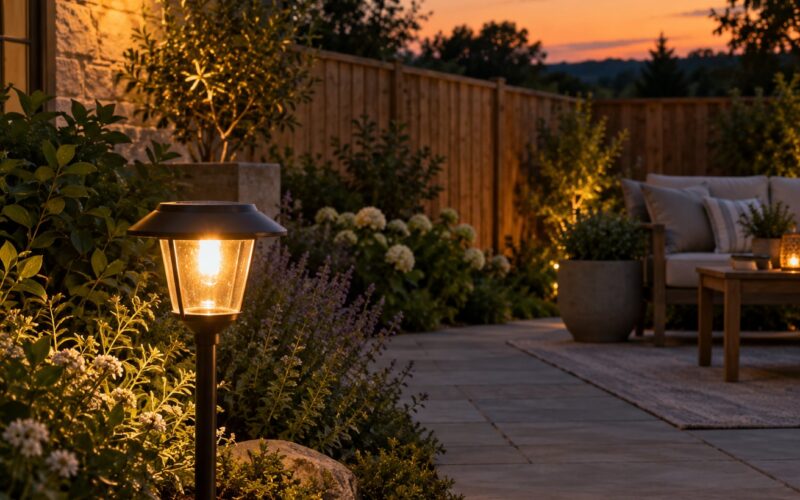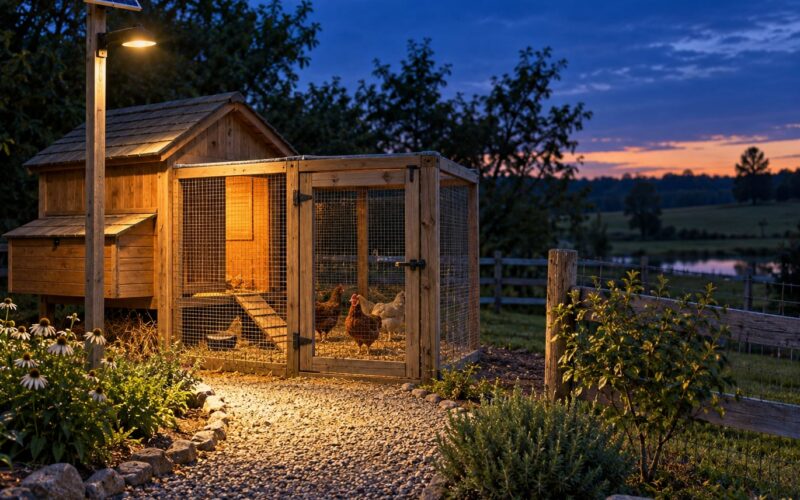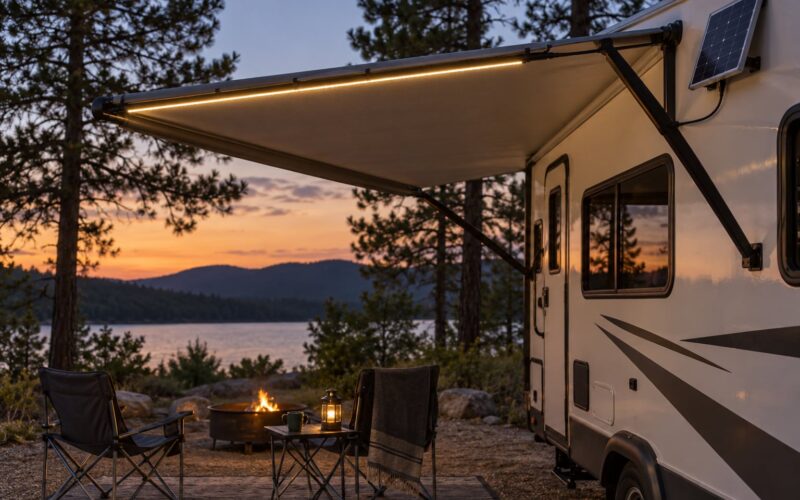
If you want fewer bugs around your porch, deck, or path, aim for the warm end of the spectrum: amber, yellow, orange, or red, roughly 1800K to 2700K on the Kelvin scale. Those bulbs emit very little blue and ultraviolet light, and most insects barely register them.
Cool white, blue, violet, and anything UV-rich sit at the opposite end of the scale and pull insects in hard. I’ll walk you through how to choose the right warm tone for your fixture, how bright it should be, and what else on the box actually matters.
Updated for October 2026.
Table of Contents
- What Light Color Attracts the Most Insects?
- Which Light Colors Are Best for Outdoor Lighting?
- How to Choose Insect Friendly Light Color for Outdoor Lighting
- Does Lower Color Temperature Mean Fewer Bugs?
- How Bright Should an Insect-Friendly Outdoor Light Be?
- What Should You Look for on a Light or Solar Lamp Box?
- Do Yellow Bulbs or Special Bug Lamps Actually Work?
- How to Reduce Insects Around Outdoor Lights
- Frequently Asked Questions
- What color light is least attractive to bugs?
- Is amber light better than yellow light for insects?
- Do 3000K LED lights attract fewer bugs than 5000K lights?
- What color is best for outdoor path and security lighting?
- Can a solar garden light be changed to a warmer color?
- Conclusion
What Light Color Attracts the Most Insects?
Insects navigate at night using the sun and moon, and they do it with receptors tuned to short wavelengths. Blue and ultraviolet light flood those receptors and scramble their heading, so a lot of flying insects end up locked onto your lamp instead of flying straight. That behavior has a name: positive phototaxis, movement toward a light source.
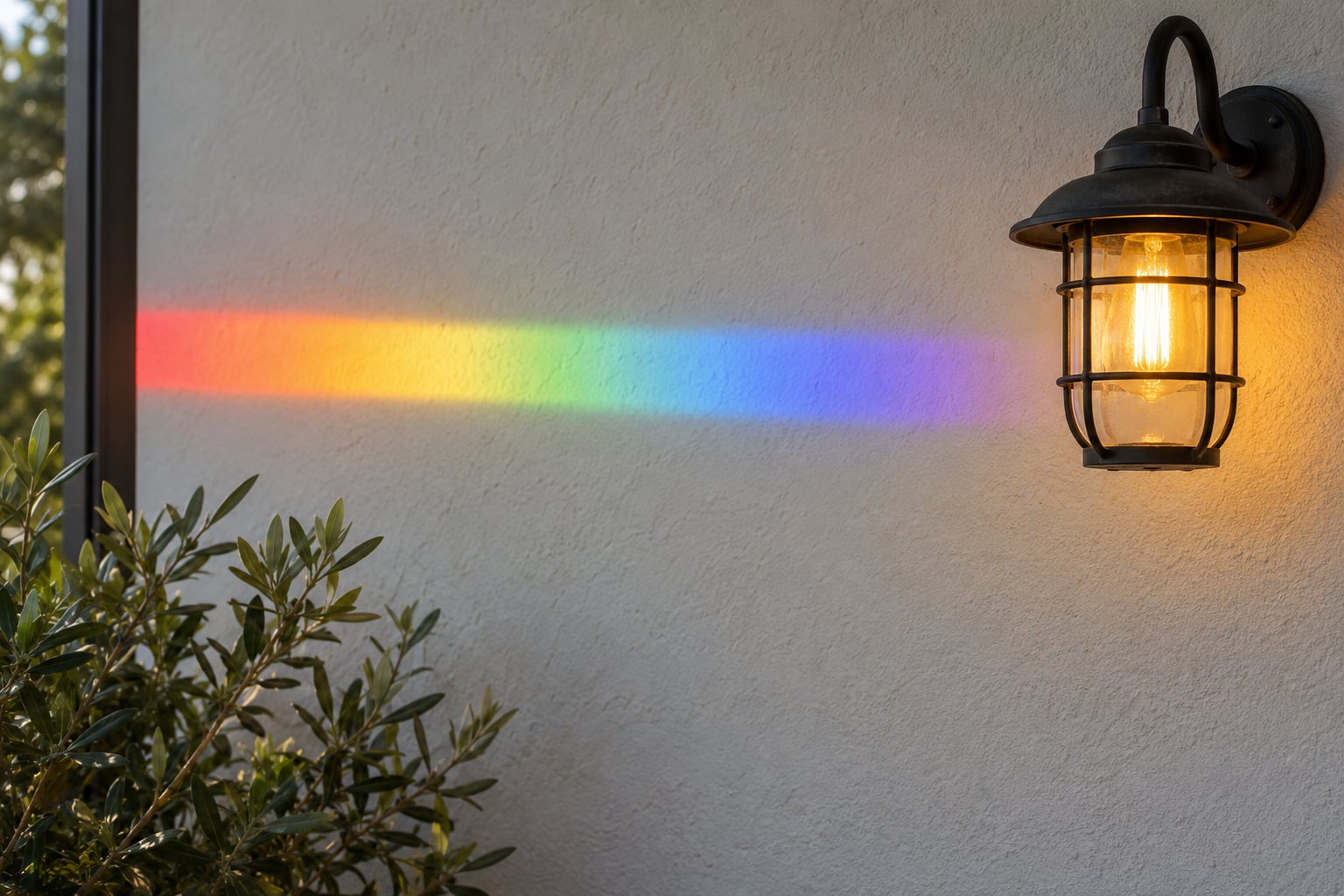
Wavelength is the whole story underneath the color name. Here’s the ladder most researchers use:
- Ultraviolet, around 350 nm — invisible to you, very visible to many insects
- Violet, around 445 nm — strong insect pull
- Blue, around 475 nm — the strongest attractor in most field tests
- Yellow, around 570 nm — weak pull
- Orange, around 597 nm — weaker still
- Red, around 650 nm — near the bottom of the list
A 2005 field study out of the University of Agriculture Faisalabad tracked insects at colored lamps and found roughly 70 percent of the catch at blue lamps, 18 percent at white, 10 percent at yellow, and 2 percent at red. Numbers like that are why the advice below keeps pointing you in the same direction.
Blue wins because it is short, bright, and close to the part of the spectrum insects use to orient. Red loses because it is long wavelength and mostly invisible to them. It is not that red insects cannot see at all, it is that the signal is weak enough that they often pass by.
Which Light Colors Are Best for Outdoor Lighting?
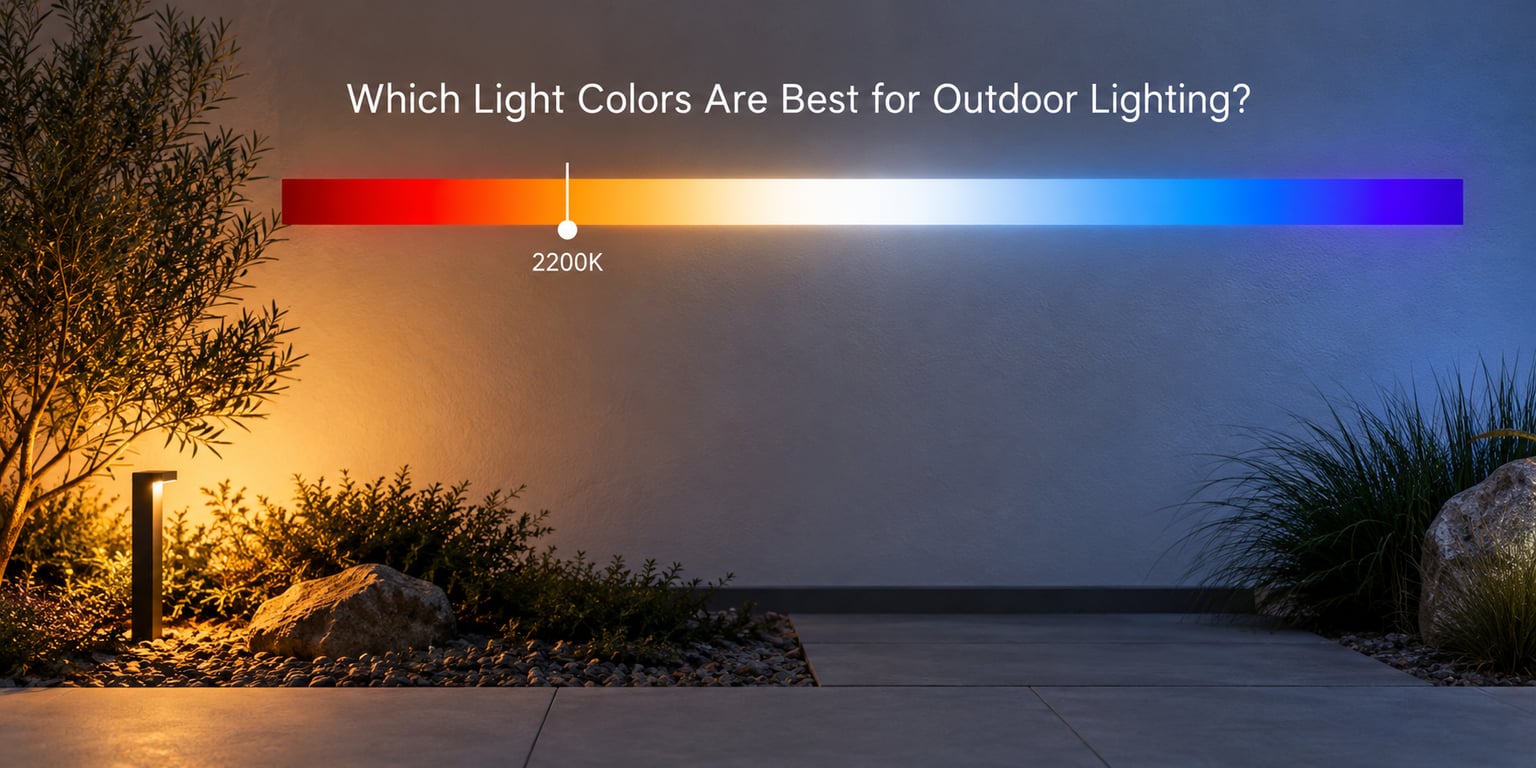
Here is how the common outdoor color options stack up. Read the insect pull column as a relative ranking, not a promise of zero bugs.
| Light color | Color temperature | Approx. wavelength | Insect pull | Best outdoor use |
|---|---|---|---|---|
| Candlelike amber | 1800K–2000K | 590–620 nm | Very low | Pathway bollards, decorative lanterns, low-wattage accents |
| Warm white | 2200K–2700K | 570–590 nm | Low | Porch lights, patio sconces, doorways, solar garden lamps |
| Soft white | 3000K | around 560 nm with more blue spill | Moderate | Decks, dining areas where you want food and skin to look right |
| Neutral white | 3500K–4100K | around 500–530 nm | High | Garage or workshop lights where color accuracy beats insect reduction |
| Cool white daylight | 5000K–6500K | 450–480 nm | Very high | Mostly indoors; avoid over entryways and patios |
My rule of thumb: if the fixture sits near a door, a seating area, or anything you want insects kept away from, go 2700K or warmer. If the fixture lights a driveway or a back alley for security and nobody is eating on it, you can accept a brighter tone and handle the insects with shielding instead.
How to Choose Insect Friendly Light Color for Outdoor Lighting
Five steps, in the order I would actually do them.
1. Name the job the light has to do. Decorative, visibility, security, or insect deterrence. A fixture cannot be excellent at all four at once, and picking the job first tells you how much freedom you have on color.
2. Start at amber or 2200K, then work up only if you need more visibility. The 2200K to 2700K band is where the reduction in insect traffic shows up without the light looking like a candle. Going to 3000K buys a bit more brightness and clarity, at a small cost in attraction.
3. Balance it against what you need to see. If the light has to reveal a house number, light a step edge, or light a path for someone with low vision, brightness and beam control matter more than another 200K of warmth. Shielding and aiming let you keep a warmer bulb and still get the visibility.
4. Check the fixture before you buy the bulb. Confirm the base type, the maximum wattage, whether the fixture is enclosed (enclosed fixtures run hotter and choke some LEDs), and whether it sits on a dimmer. Many warm LED and amber bulbs need a dimmer rated for LED loads, and older wall switches cause flicker.
5. Plan the aim before the install. A shielded, downward-facing fixture does more for your evening than the color label ever will. Mount it so the beam lands on the ground or the wall you care about, not out over the yard where insects are circling.
Does Lower Color Temperature Mean Fewer Bugs?
Directionally, yes. Warmer bulbs sit further up the spectrum toward red, and red is where insect attraction bottoms out. So moving from a 5000K bulb to a 2700K bulb in the same fixture usually means fewer bugs, holding brightness and placement steady.
But color temperature alone does not decide how many insects show up. A dim 2700K bulb tucked behind a shield can outperform a bright 2700K bulb aimed at the sky. Distance from the nearest doorway matters too, as does the season and how much light is already coming from inside the house.
One more thing worth knowing: a warm LED is not the same thing as a warm incandescent. Classic filament bulbs emit a broader spread of radiation, including some ultraviolet, so a warm LED out-performs a warm incandescent of the same wattage on both insect attraction and energy use. That gap is where most of the “I switched to warm LEDs and the bugs did not disappear” confusion comes from.
How Bright Should an Insect-Friendly Outdoor Light Be?
Bright enough for the task, no brighter. Insects are drawn to the total light output, so every lumen you do not need is an extra reason to fly over.
- Pathways, steps, and garden edging: roughly 100 to 300 lumens
- Porch and front door: roughly 400 to 800 lumens
- Driveway, side yard, or security flood: 1300 lumens and up, mounted high and aimed down
Beam angle matters as much as raw lumens. A wide flood spreads the same light over more airspace, which is where the circling happens. Narrower beam spread and a full cutoff fixture that hides the bulb from view both cut the visible source without reducing the light reaching the ground.
Glare is the other half of the problem. A bright bulb you can see directly from a window or a neighbor’s yard pulls insects from a much wider area than the patch of ground it lights. A full cutoff fixture solves both problems at once, which is why it belongs higher on the list than bulb color.
What Should You Look for on a Light or Solar Lamp Box?
Here is how to read the label, feature by feature.
Color temperature in Kelvin. Look for a number, not a vague word. “Warm white” on a box can mean anything from 2700K to 3500K. Anything at or below 2700K is a safe read for insect reduction.
UV content. Most consumer packaging says nothing about it. That is one reason experienced buyers lean toward LEDs, which emit very little ultraviolet compared with incandescent, CFL, or halogen lamps of the past.
Color rendering index (CRI). CRI says how true colors look under the light. A bulb at CRI 80 or above will make a patio table and skin tones look natural. A very warm bulb can look harsh on faces, so if you eat outside often, balance warmth against CRI.
Lumens and beam angle. Pair them. A 600-lumen flood and a 600-lumen downlight create very different amounts of visible sky glow.
Dusk-to-dawn sensor and motion sensing. A photocell that switches the lamp off at dawn stops it from calling insects to an empty yard all morning. A motion sensor means the light only exists when someone walks up, which removes the attractant entirely for the hours nobody is outside.
Weather rating for solar garden lamps. Look for a stated IP rating, a matching panel-to-battery size, and a stated number of nights of runtime. Solar lamps with a small panel often dim dramatically by the third night, and a dim light at the wrong color temperature gives you the worst of both worlds.
People shopping in forums also note the compatibility trap: an existing fixture or dimmer that is not LED-rated can flicker or fail outright with a warm LED. Check that before the bulb arrives.
Do Yellow Bulbs or Special Bug Lamps Actually Work?
They work, but not for the reason most people assume. A yellow “bug bulb” is usually an incandescent lamp with a yellow coating that filters out some blue and ultraviolet light. It helps, and it is a real improvement over a clear bulb, but it still runs hot, uses more power, and ages fast.
A warm LED does the same filtering job far more efficiently, and modern warm LEDs beat most of the classic bug bulbs on insect attraction per lumen. That reversal surprises people who assumed the bulb with “bug” printed on the box was the specialist choice.
Separate the two products that get called bug lights. Amber bulbs are meant to reduce attraction at an ordinary fixture. Bug zappers and insect traps use ultraviolet light to attract insects into a cage or an electric grid, and that light pulls in everything in the neighborhood, including mosquitoes you were hoping to keep out. Zappers also work indoors, where no outdoor light is competing for the same insects.
Expect a small residual population. A few moths and gnats will still find any lit fixture, and users in lighting forums commonly report that far fewer insects, not zero, is the realistic outcome of switching to warm LEDs.
How to Reduce Insects Around Outdoor Lights
Color is the lever you pull first. These are the adjustments that take care of most of the rest.
- Shield the source. A full cutoff fixture or a hood that hides the bulb from side view is the single biggest improvement. Forum users report the biggest change came from moving the light source away from the house and aiming it downward, not from swapping bulb colors.
- Keep white light away from entrances. A common rule of thumb is to avoid white light within roughly 50 feet of a door, or to mount the fixture on the hinged side of the door so the beam crosses the entry rather than pointing at it.
- Add motion sensing or a timer. Both cut hours of unnecessary light, and hours of unnecessary light are hours of unnecessary attraction.
- Use the lowest brightness that works. Dimming a path light to half after midnight is often enough, and nobody notices.
- Close the indoor light leaks. An open door or a gap in the screen porch sends warm interior light straight outside, and it pulls insects toward the house no matter what your outdoor bulb looks like.
- Keep the fixture clean and sealed. A dusty or cracked lens scatters light in every direction, including upward. Replace cracked lenses rather than living with the glare.
One last point from the forums that is worth repeating: cool-tinted bulbs in the same brightness range draw dramatically more insects than warm ones. If two of your fixtures perform very differently, compare their color temperatures first.
Frequently Asked Questions
What color light is least attractive to bugs?
Red is generally the least attractive color to insects, followed by orange, amber, and yellow. In practical outdoor lighting that means picking a warm LED at 2200K to 2700K rather than a cool white bulb. One 2005 field study found only about 2 percent of captured insects came to red lamps and 10 percent to yellow, compared with 70 percent at blue lamps. The ranking holds, but brightness and shielding still change how many bugs show up.
Is amber light better than yellow light for insects?
Slightly, and the difference is small. Amber sits slightly further toward the red end of the spectrum than yellow, so it tends to register a little less attractive. Both are good choices, and either beats cool white by a wide margin. If you can only find one, choose whichever the fixture is designed for and keep the color temperature at or below 2700K. Color name matters far less than the Kelvin number printed on the box.
Do 3000K LED lights attract fewer bugs than 5000K lights?
Yes, usually noticeably. A 3000K bulb still carries some blue content, while a 5000K bulb is essentially daylight white with a lot of it, so the 3000K version pulls fewer insects in the same fixture. The gap narrows as you move colder, which is why 2700K or lower is the safer target for porches and patios. If you need 4000K or brighter for visibility, add shielding and downward aiming rather than assuming the bug problem is solved.
What color is best for outdoor path and security lighting?
For paths, warm white around 2200K to 2700K at low output works well, because you only need enough light to see the edge of the step. For security lighting, color matters less than coverage, height, and shielding, so a brighter neutral white mounted high and aimed down is a reasonable compromise. Mount any fixture near an entrance on the hinged side of the door and keep white light roughly 50 feet away from the door itself.
Can a solar garden light be changed to a warmer color?
Sometimes, and it depends on the design. Most plug-and-go solar garden lamps use a small integrated LED board, so color is fixed and you would have to replace the whole lamp head. A minority use a standard screw or bayonet base, and those you can swap for a warm LED as long as the wattage stays within the fixture’s rating. If the lamp has a dimmer or brightness setting, that changes output, not color, so it will not help with insect attraction.
Conclusion
Start here: put a shielded, downward-facing fixture in place and fill it with an amber or very warm white LED at about 2200K or lower. That single swap does more than any spray, zapper, or lantern you can buy.
Then tune it. Move the light away from the door, add a motion sensor or timer, and drop the brightness to the lowest level that still lights the path. A few insects will still find any light you leave on, and that is normal.