A bifacial solar panel is a photovoltaic module that generates electricity from both its front and rear surfaces. The front collects direct sunlight the way any panel does, while the back picks up light reflected off the ground, a roof or snow. A conventional monofacial panel has an opaque rear and only ever collects from one side.
That single design change is the whole idea, and almost everything else worth knowing follows from it. It is a genuinely good technology on the right site, and close to pointless on the wrong one. The difference between those two outcomes is mostly about light bouncing upward, and how much room you left underneath the panel.
Table of Contents
- What Are Bifacial Solar Panels?
- How Do Bifacial Solar Panels Work?
- What Are Bifacial Solar Panels Compared With Monofacial Panels?
- What Determines Bifacial Solar Panel Output?
- What Are the Main Benefits and Limitations?
- Where Can Homeowners Use Bifacial Solar Panels?
- How Do You Choose and Install a Bifacial Solar System?
- Frequently Asked Questions
- Do bifacial solar panels produce twice as much electricity?
- Do bifacial panels work in cloudy weather or with less direct sunlight?
- Can bifacial solar panels be installed on a balcony?
- What surface gives bifacial panels the most reflected light?
- Are bifacial solar panels worth the extra cost for a home?
- Conclusion
What Are Bifacial Solar Panels?
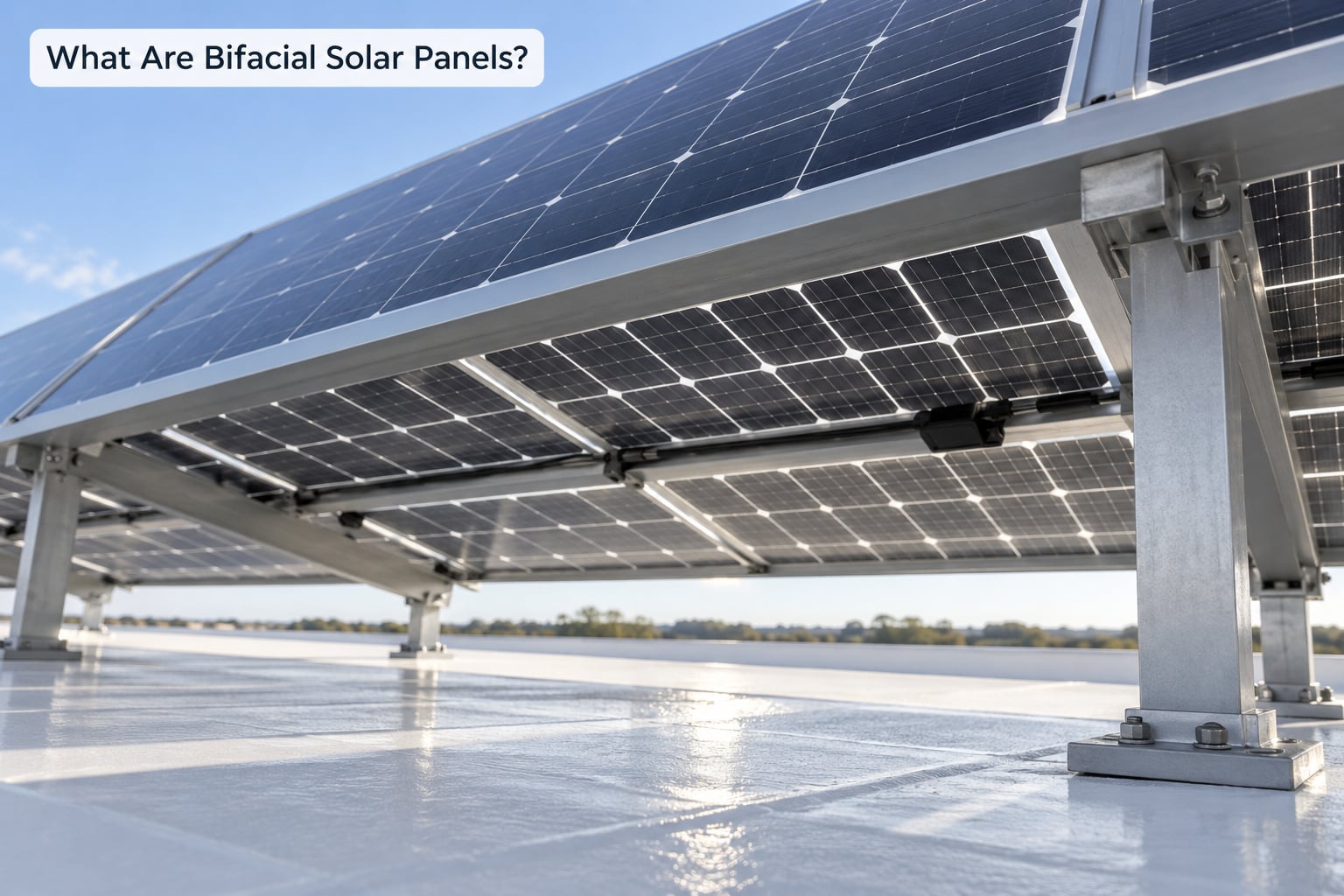
Bifacial solar panels are two-sided photovoltaic modules. Sunlight hits the front cell layer directly, and light reflected from whatever sits below and around the array reaches the cell layer on the back. Both sides feed the same electrical output through the same junction box and the same inverter connection.
Two construction styles are common. Dual-glass, or glass-glass, modules have a tempered glass layer on the front and another on the rear, bonded around a thin cell layer. Transparent-backsheet modules keep a single front glass layer and replace the usual opaque white backsheet with a clear one, so the rear cells can see through it. A few designs use a single front glass with a clear rear laminate, which sits between the two.
Dual-glass modules usually carry longer performance warranties and shrug off hail and UV exposure better, which is why they dominate new residential and utility installs. Transparent backsheets cost less but are more sensitive to moisture over a long life.
How Do Bifacial Solar Panels Work?
The process runs in four stages, and the first three are where most confusion happens.
Front-side capture. The front glass has an anti-reflective coating, and the cells beneath it absorb direct sunlight exactly as they do in a monofacial panel. This is usually the larger share of the day’s energy, and it is unaffected by the bifacial design.
Rear-side capture. Light that misses the front, bounces off the ground, roof deck, gravel or snow, and strikes the rear cells. Some of that is direct reflected sunlight. Some is diffuse skylight, which reaches the back even under cloud cover and even in low-light conditions, because the rear face is open to the whole hemisphere rather than to one narrow beam.
One output, not two. The front and rear currents combine inside the module and leave through a single set of leads. A 400 W bifacial panel is not a 400 W panel plus another 400 W panel, and it does not feed two inverters. The rear side typically delivers around 70% to 85% of the front side for the same irradiance. That ratio is called the bifaciality factor, and it varies by manufacturer.
Reflections depend on albedo. Albedo is the share of light a surface reflects, expressed as a number between 0 and 1. Fresh snow sits near 0.8, a white roof membrane near 0.7, sand around 0.4, pale gravel around 0.3, concrete roughly 0.3, grass about 0.2, and dark asphalt close to 0.1. A panel mounted over a dark surface is a monofacial panel with a second bill attached.
Advertised rear-side gains sit somewhere between 5% and 30%. Measured field trials have landed nearer 9% to 15% for well-set-up systems, which is a more useful expectation for a homeowner planning a purchase.
What Are Bifacial Solar Panels Compared With Monofacial Panels?
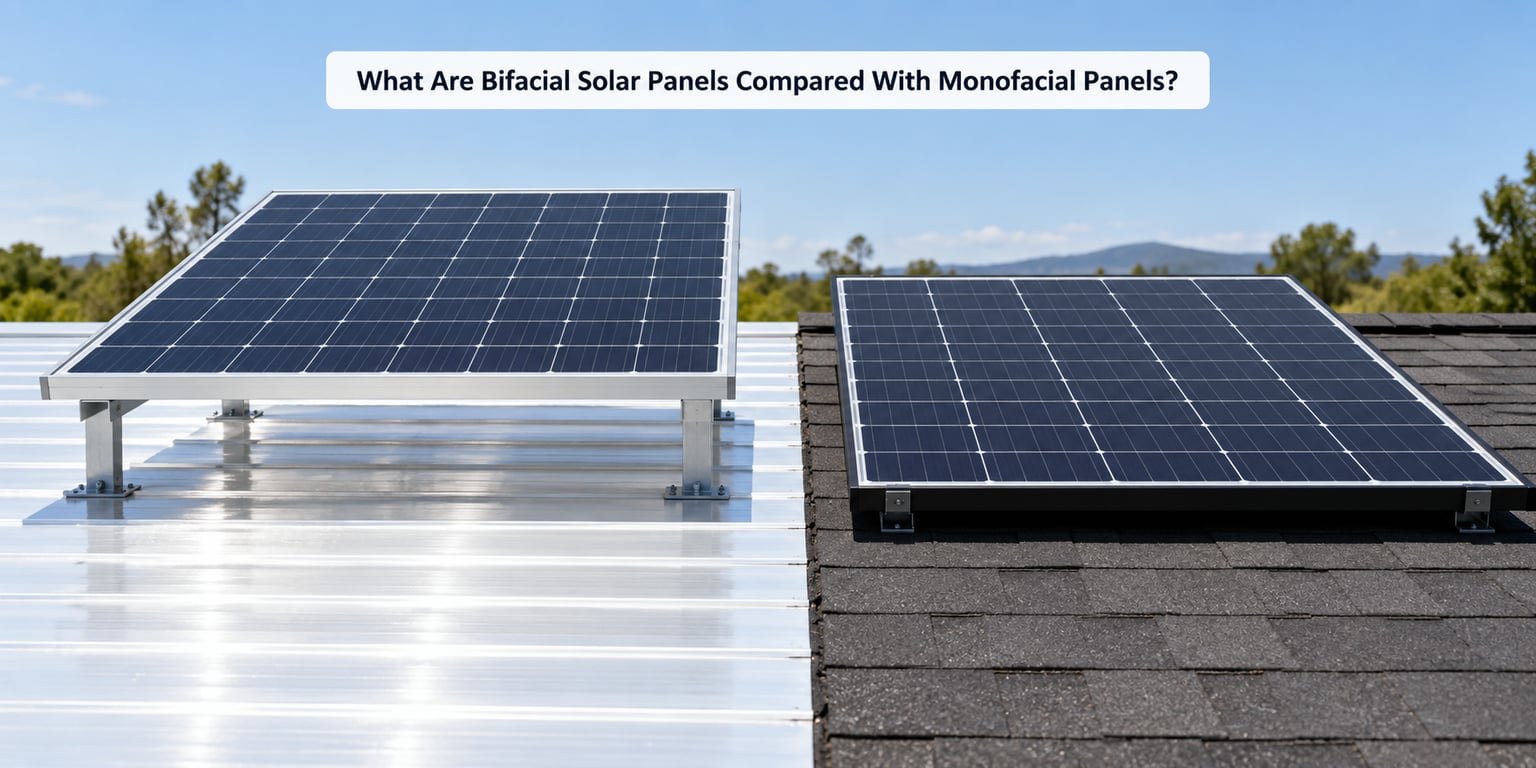
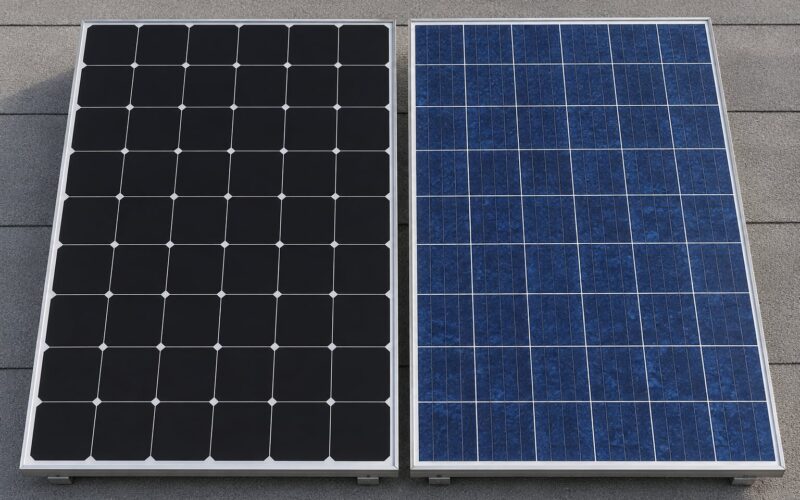
The comparison is really about construction and mounting, not about cell quality. One note first, because it causes constant confusion: monocrystalline describes the silicon cell technology, and bifacial describes the module design. The two are not alternatives. A monocrystalline bifacial panel is simply a monocrystalline panel built to collect from both sides.
| Factor | Bifacial module | Monofacial module |
|---|---|---|
| Light captured | Front face plus reflected and diffuse light on the rear | Front face only |
| Rear construction | Dual-glass laminate or transparent backsheet | Opaque backsheet, usually white |
| Rear output vs front | Roughly 70% to 85% of front-side output, site dependent | No rear output |
| Realistic energy gain | Commonly 9% to 15% on a good site; near zero on a flush roof | Baseline |
| Mounting height | Needs real clearance, measured in feet, not inches | Works fine mounted close to the deck |
| Row spacing | Wider spacing to stop rows shading each other’s rear side | Tighter spacing is acceptable |
| Rear shading sensitivity | High; obstructions under the array cut output quietly | Low; only the front matters |
| Equipment cost | Higher per watt | Lower per watt, and widely available |
| Typical warranty | Often 25 to 30 years on power output | Often 10 to 25 years |
| Best suited to | Ground mounts, canopies, carports, pergolas, light-coloured ground, snow sites | Shaded, dark-surfaced or space-constrained installs |
So which is better depends on the site. A raised carport over a pale concrete driveway is a strong bifacial case. A panel lying four inches above dark asphalt on a shaded north-facing roof is a strong monofacial case, and the extra spend buys very little.
What Determines Bifacial Solar Panel Output?
Rear-side gain is a site-specific number, not a product feature. Seven things move it, and the first one moves it most.
1. Surface albedo. This is the single biggest lever, and it is the one homeowners can change. Laying light-coloured ground cover, choosing a white membrane, or selecting a pale gravel substrate under a ground array is often cheaper than upgrading the modules.
| Surface below the array | Typical albedo | Expected rear-side gain band |
|---|---|---|
| Snow-covered ground | About 0.8 | High |
| White roof membrane or light gravel | About 0.7 | High |
| Sand or dry soil | About 0.4 | Moderate |
| Light concrete or pale paving | About 0.3 | Moderate to low |
| Grass | About 0.2 | Low |
| Dark asphalt or roofing felt | About 0.1 | Very low |
These are typical values, and a wet or dusty surface will read lower than the number in the table. Measure the site rather than trusting the label on a bag of gravel.
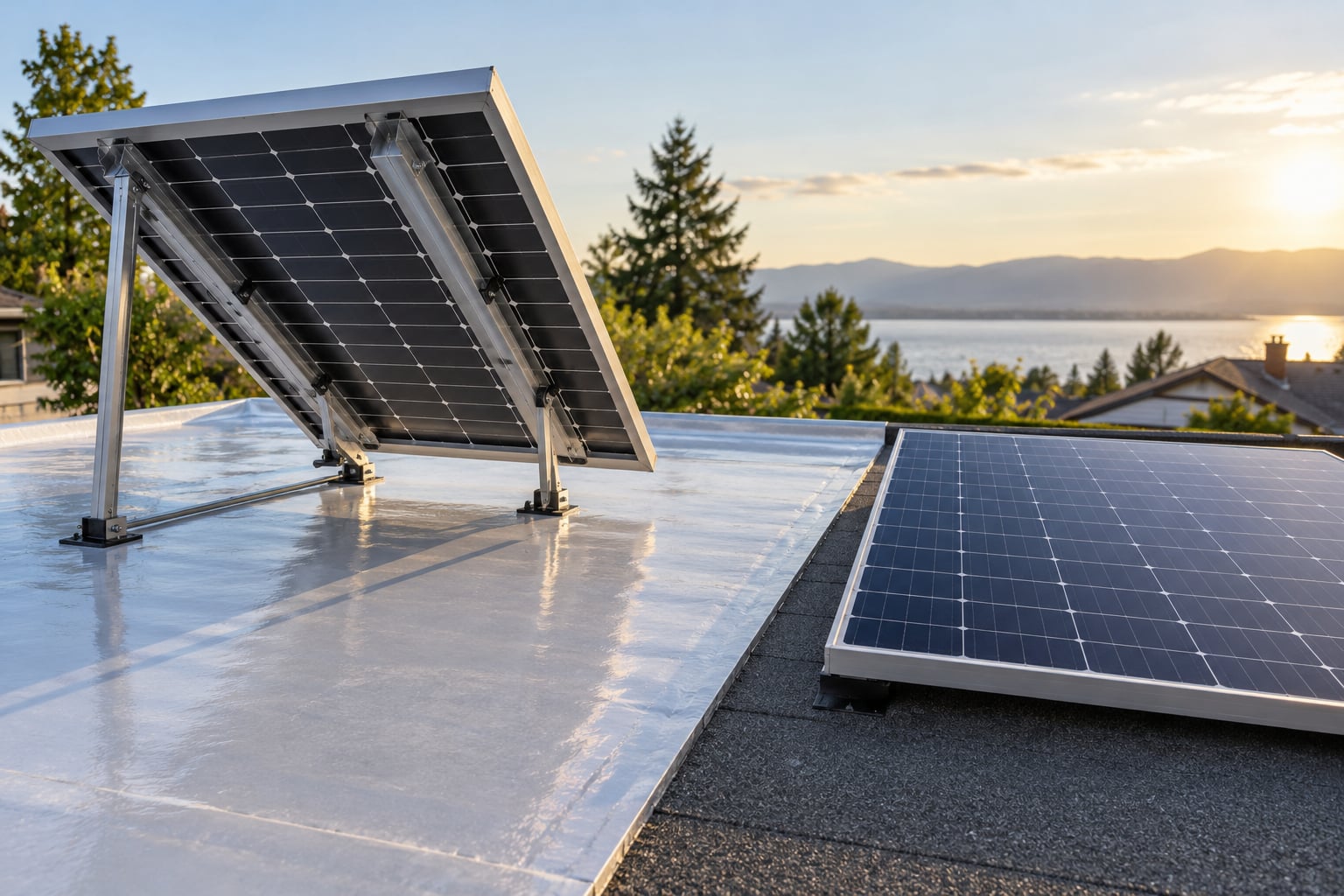
2. Mounting height and clearance. The rear face needs an unobstructed view of the ground and sky. Mounted a few inches above a roof deck, the rear sees mostly shingles. Mounted a foot or more up, it sees a wide band of surrounding surface, and the reflection available rises sharply. Row spacing matters for the same reason: a panel’s own shadow can fall across the back of the row behind it.
3. Tilt and orientation. A steeper tilt exposes the rear face to more of the sky and less of the ground, which helps in low-albedo conditions. Shallow tilt and low pitch increase ground reflection but reduce self-shading. Facing the array toward open ground beats facing it into a hedge or a fence.
4. System losses. Rear-side gain arrives as extra irradiance, not extra inverter capacity. If the inverter is already clipping on a sunny midday, the extra light produces nothing. A slightly oversized array of monofacial panels can reach the same clipped ceiling, and forum discussion keeps circling that comparison because it is a real buying dilemma.
5. Temperature. Panels lose output when they run hot, and low-clearance racks on the rear side of a module can hold heat. Airflow under and behind the panel matters more on bifacial installs.
6. Shading. Anything that blocks the rear view costs energy without a visible fault on the monitoring dashboard. This is the failure mode homeowners notice only in the monthly totals.
7. Weather and season. Overcast days reduce front-side output, but the rear face still collects diffuse light from the whole sky dome, so bifacial modules tend to hold up slightly better in poor conditions and pick up more in snow months.
What Are the Main Benefits and Limitations?
On the benefit side, the strongest argument is energy per square metre. Where space is tight, a dual-sided module puts more generation under the same footprint, and a vertical solar fence or east-west canopy can use ground that a conventional array would have to leave blank.
- More output per installed area, which matters on a small lot or a tight driveway
- Usable on two-sided structures: carports, pergolas, canopies and fences
- Better diffuse-light performance on cloudy days, since the rear sees the whole sky
- Dual-glass construction tends to age more slowly, with 25 to 30 year power warranties common
- Vertical mounting options that conventional panels cannot offer at all
The limitations are just as real.
- Higher equipment cost per watt, and the premium is rarely recovered on a poor site
- More complex mounting: real clearance, wider row spacing, and airflow behind the array
- Silent sensitivity to rear-side shading that monitoring may not flag clearly
- Rear gains are project-specific, so a datasheet range tells you very little about your roof
- Requires more planning, and some roof assemblies simply cannot accommodate the extra hardware
One caution about durability. Dual-glass modules are tough, but panels on mobile or vibration-heavy installations, buses and RVs, have been reported cracking or delaminating. Dual-glass construction helps with UV and weather, not with shock.
Where Can Homeowners Use Bifacial Solar Panels?
The pattern is simple: bifacial solar panels pay off when there is open space and something reflective underneath. The strongest home applications are the ones with a gap under the array.
Solar carports and canopies. Elevated structures over a driveway or patio give the rear face a wide view of pale concrete or paving, which is close to the ideal residential case.
Solar pergolas. Similar logic, with shade value added on top of generation. Keep the open span clear of decking and dark furniture.
Ground-mounted arrays. These are the classic bifacial layout, and the reason utility-scale solar went this way. At home, add a light gravel or pale stone substrate and the gain climbs noticeably.
Pitched and flat roofs. Workable, with conditions. A flat roof with raised rails and a light membrane below is reasonable. A panel mounted flush to dark shingles is not, and the rear gain there can be close to zero.
Balconies and patios. Possible, but do not assume. Balcony railings can shade the rear face, and balcony structures frequently cannot carry the extra load or the standoff hardware. Have a structural check done before ordering anything.
Vertical installations. A solar fence or a west-facing vertical array benefits from morning and evening light on the rear side, and suits sites where a tilted array would not fit.
Snow is worth calling out for northern sites. A reflective white ground in January can deliver the highest rear-side irradiance of the year, which is a nice reversal for a technology that sounds like a desert product.
How Do You Choose and Install a Bifacial Solar System?
Ask a series of questions before you commit to a quote. Most of them come down to whether your site can deliver rear-side light.
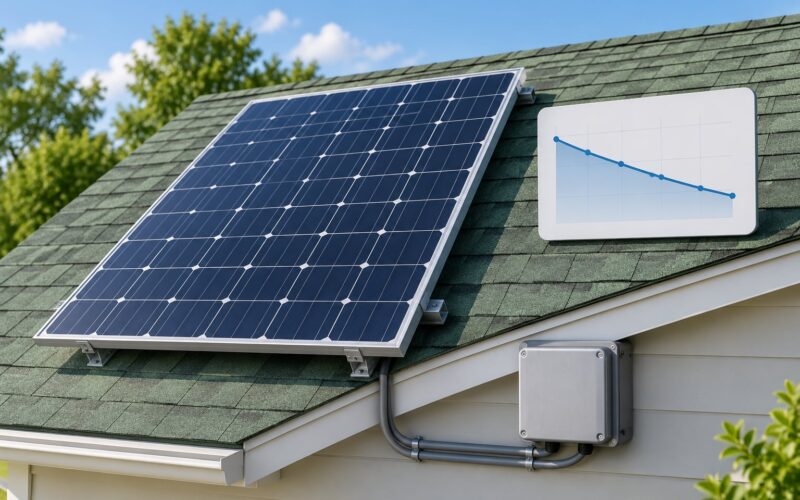
Start with the two ratings on the datasheet. Front-side rated power is the nameplate figure you may already recognise. Bifacial peak power is the total expected from both sides under test conditions, and the difference between them is the manufacturer’s claim about rear gain. Treat it as an upper bound, not a promise.
Then ask for the bifaciality factor, usually somewhere between 70% and 85%. A number at the low end tells you the rear cells are weaker, which matters on a marginal site.
Check the temperature coefficient, the annual degradation rate, and the length of the performance warranty. Confirm IEC 61215 and IEC 61730 certification, and check that the module works with your inverter or with string optimisers, since some combinations are restricted by the manufacturer.
Ask the installer for a yield assumption that includes rear-side gain, and ask how it was calculated. If the number arrives without a stated albedo, mounting height and row spacing, it is marketing rather than engineering. A model worth asking about is the one that shows both the front-side and the bifacial rating side by side, with the assumptions printed underneath.
Finally, ask for a side-by-side proposal: the same array in monofacial and in bifacial, with the yield difference and the cost difference shown separately. Design and installation belong to a licensed solar or electrical professional, and for any structural or electrical work on a roof, balcony or carport that is not negotiable.
Frequently Asked Questions
Do bifacial solar panels produce twice as much electricity?
No. Both sides feed one output through a single junction box, and the rear typically delivers 70% to 85% of the front for the same light. A 400 W bifacial panel is not 800 W. In the field, measured gains usually land between 9% and 15% on a well-sited array, and near zero on a flush rooftop mount.
Do bifacial panels work in cloudy weather or with less direct sunlight?
Yes, and they hold up slightly better than monofacial panels in poor light. The rear face is open to the whole sky, so it still collects diffuse light when direct sun is weak. What changes is the size of the gain, not its direction. On an overcast day the rear contribution shrinks, and any advantage on an unreflective surface nearly disappears.
Can bifacial solar panels be installed on a balcony?
Sometimes, with care. The panel needs open space and light underneath, and a balcony usually gives it neither: railings shade the rear face, and the balcony slab is often dark. The bigger issue is structural, since the extra standoff hardware and the module weight must be carried by an existing assembly. Get a structural check before ordering anything.
What surface gives bifacial panels the most reflected light?
Snow, at an albedo near 0.8, followed by a white roof membrane or light-coloured gravel at around 0.7. Sand sits near 0.4, light concrete and pale paving near 0.3, and grass near 0.2. Dark asphalt is close to 0.1, so a panel over a black driveway gains almost nothing from the rear side.
Are bifacial solar panels worth the extra cost for a home?
They are worth it on raised, open installations over light surfaces: carports, pergolas, canopies and ground mounts with pale gravel. On a flush rooftop mount a few inches above dark shingles, the premium is mostly wasted. Ask for both options priced, with the yield difference calculated from your actual mounting height and ground surface rather than from a datasheet range.
Conclusion
Bifacial solar panels are worth serious consideration when your array is raised above something bright and open. A carport over pale paving, a pergola, or a ground mount with light gravel is where the rear side earns its cost. A panel lying inches above a dark roof is where it doesn’t.
Two checks decide it. What sits underneath the array, and how much clearance you actually have. Take those two numbers to a qualified installer and ask for the same design priced both ways, with the yield difference calculated for your site. That proposal will tell you more than any datasheet range.