Home solar panels turn sunlight into electricity for your house. Photovoltaic cells convert light into direct current, an inverter changes that into the alternating current your appliances run on, and a meter or a battery decides where the power goes next. That chain, from roof to wall outlet, is the whole system.
Most people get the idea of that chain quickly. The part that takes longer is understanding why output on a given day rarely matches the number an installer put in a proposal. That gap usually comes down to sunlight intensity, shading, temperature and system losses, not a broken panel.
This guide walks through each part of the system, then explains what actually moves the production numbers. No wiring diagrams or electrical theory required.
Table of Contents
- What Do Home Solar Panels Do?
- How Do Home Solar Panels Work Step by Step?
- 1. Sunlight absorption
- 2. Creating direct current
- 3. Wiring cells into a module
- 4. Converting DC to AC
- 5. Reaching the distribution panel
- 6. Serving loads, charging, or exporting
- What Are the Main Parts of a Home Solar System?
- Equipment that creates electricity
- Equipment that carries electricity
- Equipment that converts and controls
- Equipment that measures
- Equipment that stores, sometimes
- What Happens Inside a Solar Panel?
- Why Does a Solar Inverter Matter?
- What Determines How Much Power a Home Solar System Produces?
- How Much Electricity Can a Home Solar System Generate?
- Do Home Solar Panels Work at Night or in Bad Weather?
- How Does Solar Power Reach Household Outlets?
- Do Solar Panels Store Electricity Themselves?
- What Should Homeowners Check Before Installing Solar Panels?
- Shading and usable space
- Roof condition
- Site light and weather
- Electrical service and utility paperwork
- Realistic goals
- Frequently Asked Questions
- How long do home solar panels last?
- Why do my solar panels produce less than expected?
- Can I plug a solar panel into a wall outlet?
- Are monocrystalline or polycrystalline panels better for a home?
- Do solar panels need maintenance?
- Conclusion
What Do Home Solar Panels Do?
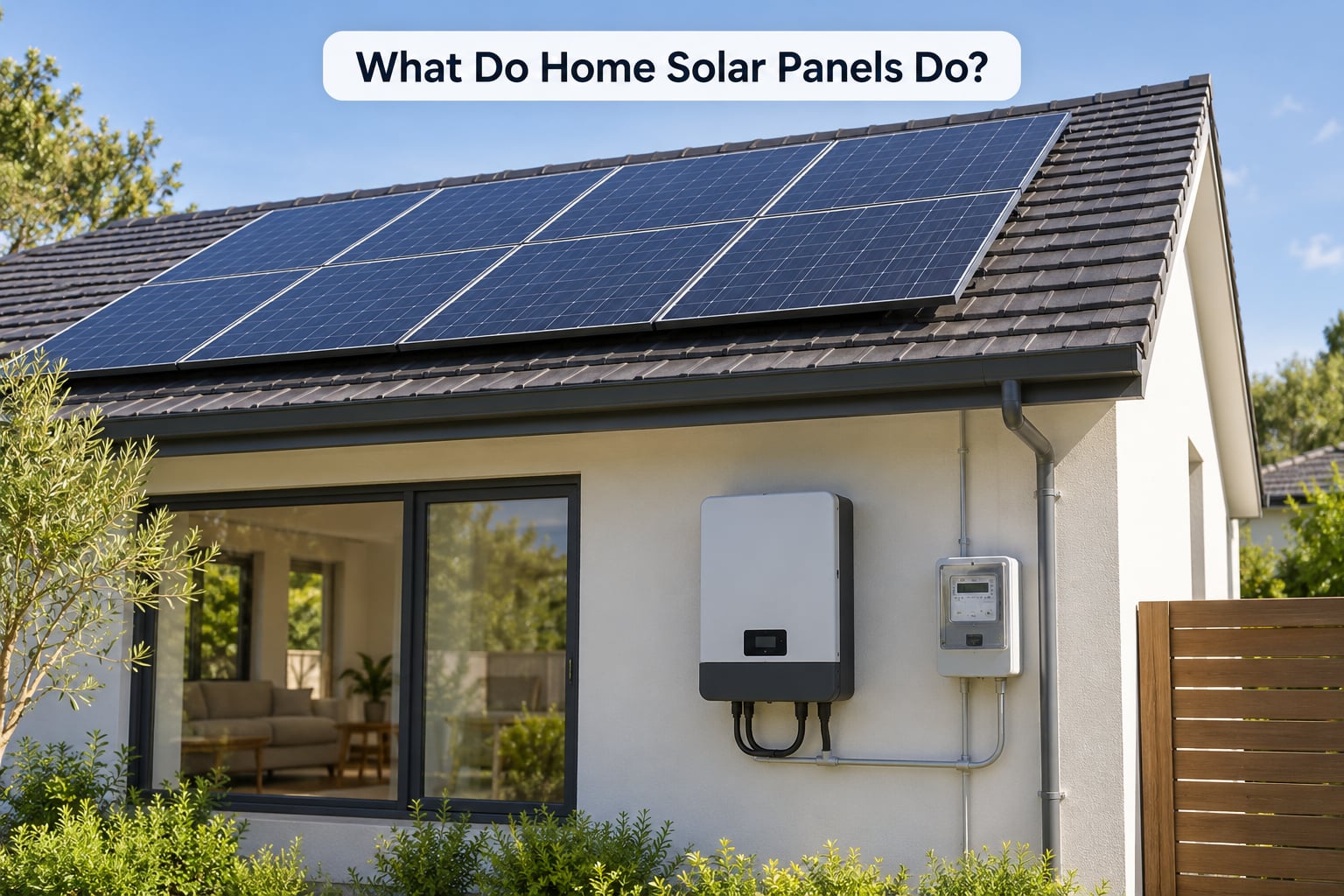
Home solar panels capture sunlight and turn it into electricity you can actually use. The panels themselves make direct current, a device called an inverter turns that into household alternating current, and the panel and meter decide which appliances run on solar at any moment and which draw from the grid.
Nothing about that process stores energy. A panel only produces while light is hitting it, and the electricity has to be used or exported in the same moment. That is the single fact behind most of the confusing parts of solar ownership.
Two things follow from it. First, a panel array produces a limited amount of power at any moment, so a bigger system captures more at the same moment rather than producing faster. Second, a house with no daytime load and a big array will simply push the surplus outward.
How Do Home Solar Panels Work Step by Step?
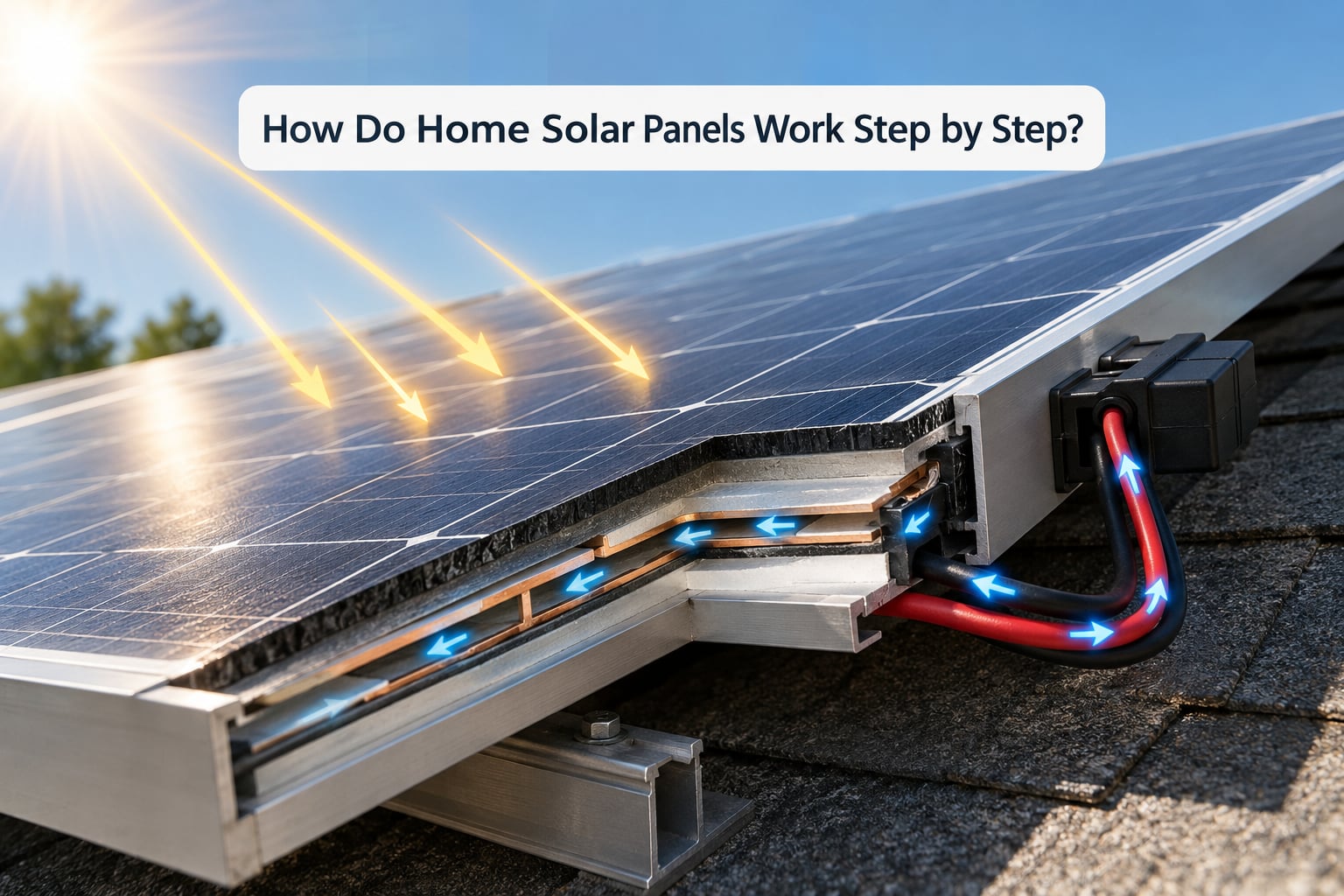
The chain runs in a fixed order, and each stage hands electricity to the next one.
1. Sunlight absorption
Light strikes the front glass of the panel and passes through to the silicon cells underneath. Photons, the smallest packets of light energy, are absorbed inside the cells. Panel output rises with light intensity, so a bright midday hour produces far more than a hazy one.
2. Creating direct current
The silicon is treated with two different chemicals so it has an unbalanced charge. When photons hit, they dislodge electrons, and the internal structure pushes those electrons in one direction only. That one-way flow is direct current, measured in volts and amps.
3. Wiring cells into a module
One cell makes a small amount of power, so cells are soldered together in series to add voltage and in parallel to add current. A typical residential module contains 60 to 72 cells, and a string of those modules feeds one inverter input.
4. Converting DC to AC
The inverter takes the direct current from the array and switches it into alternating current at a voltage and frequency your home can use. It also tracks the array’s best operating point, a function usually called MPPT, so the panels give up as much power as the light allows.
5. Reaching the distribution panel
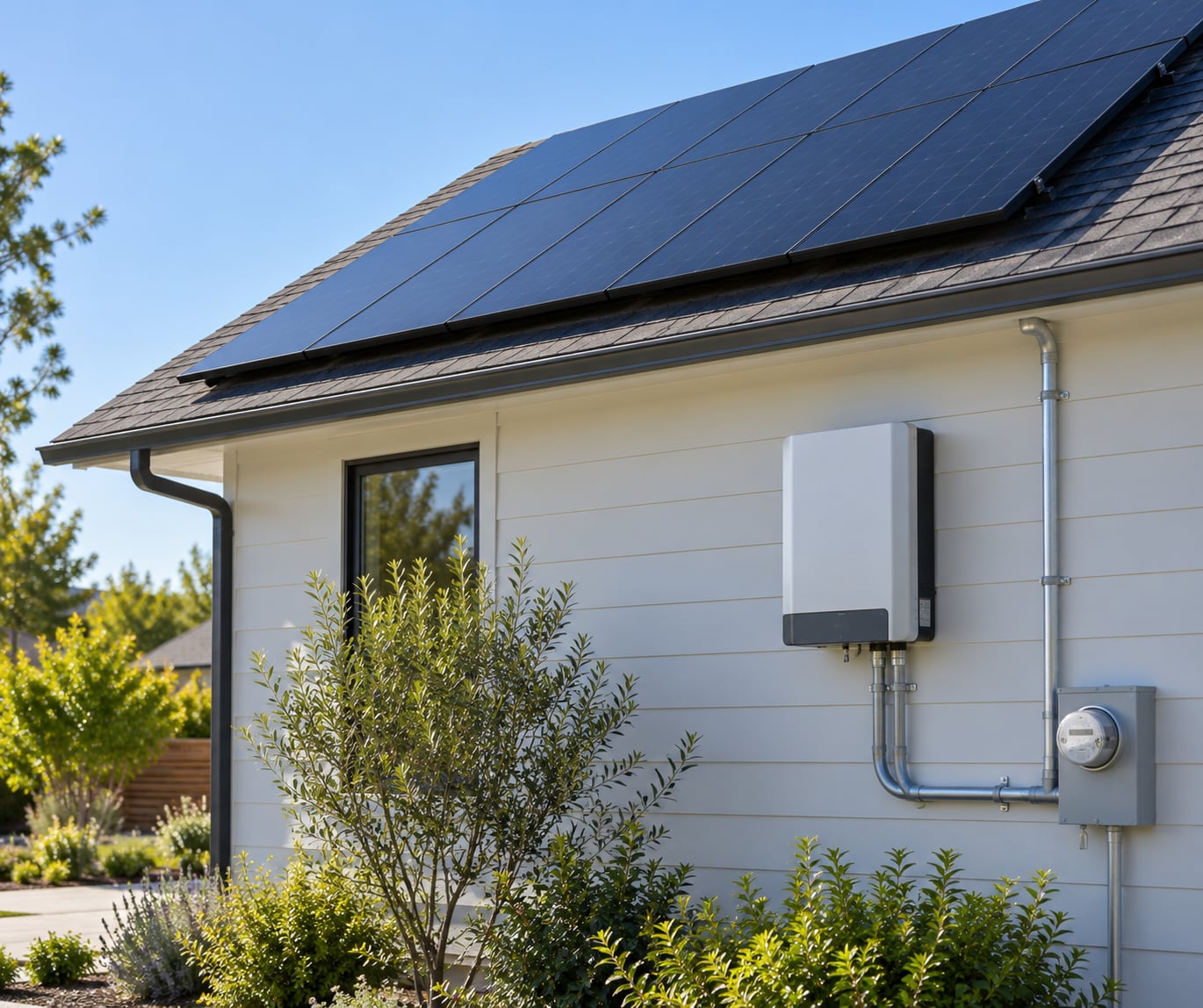
The converted current travels through conduit to a disconnect switch and then into the main breaker panel. From there your household circuits receive it exactly like power bought from the utility, with no change in voltage or outlet behaviour.
6. Serving loads, charging, or exporting
Electricity your house uses right now stays local. Surplus fills a battery if one is installed, and anything beyond that flows out through the meter to the utility, provided the utility has approved an export arrangement for that address.
Because a panel array can only capture so much light at once, system size sets your ceiling. A larger array produces more during the same sunny hour; it does not raise the power a single panel can pull from the same light.
What Are the Main Parts of a Home Solar System?
A residential system has four groups of equipment, and each one does a different job.
Equipment that creates electricity
The photovoltaic modules are the visible panels. Racking and mounting hold them at the correct angle and seal the attachment points into the roof. If the mounting is wrong, you get water intrusion later, which is why this part gets inspected.
Equipment that carries electricity
DC wiring runs from each module in strings to a combiner or directly to the inverter. Conduit protects that wiring between the roof and the equipment pad. Disconnects let a technician isolate the array safely before touching anything else.
Equipment that converts and controls
The inverter or microinverters convert DC to AC and hold the system’s operating settings. A hybrid inverter adds battery charging and backup control to that job. No inverter means no usable household power, whatever the panels produce.
Equipment that measures
The main service panel distributes current to your circuits. A generation meter, or a bidirectional utility meter, records what the system produces and what flows each direction. Monitoring equipment, usually a small display or an app, reports production and faults.
Equipment that stores, sometimes
A home battery is optional. Without one, the system stops at the meter and everything else about the arrangement stays the same. Batteries only matter for timing, and most households go years without needing one.
What Happens Inside a Solar Panel?
Each cell is a thin semiconductor, usually silicon, built to release electrons in a controlled direction when light hits it. Manufacturers treat the silicon with phosphorus on one side and boron on the other, creating what engineers call a PN junction. The imbalance is what turns light into a directional flow.
Where the two doped layers meet sits a built-in electric field. A photon with enough energy frees an electron from a silicon atom, and the field sweeps that electron across the junction instead of letting it wander back. One electron on its own is nothing. Several billion moving the same way per second, repeated across the panel, is measurable current.
A few details are worth knowing. Silicon reflects some light, so cells carry an anti-reflective coating. Electrons can also be lost back through the junction, which is one reason panel efficiency sits in the range of roughly 15 to 23 percent rather than higher. That efficiency is measured under standard test conditions, so real output is always lower.
Cells are then combined. Series wiring adds voltage cell by cell, parallel wiring adds current, and the two together let a designer hit a target voltage. Each cell contributes only a fraction of the module’s output, and shaded or mismatched cells pull the weakest links below their potential.
The module is then sealed: tempered glass on top, a weatherproof backsheet or encapsulant underneath, an aluminium frame around the edges, and a junction box on the rear where the internal strings terminate.
Why Does a Solar Inverter Matter?
Panels make direct current. Household appliances and the utility grid both expect alternating current at a specific voltage and frequency. The inverter is the bridge between the two, and it does three jobs: convert the current, match the grid’s rhythm so it can synchronise, and optimise how hard the array is being driven.
| Feature | Direct current (DC) | Alternating current (AC) |
|---|---|---|
| Flow direction | One way only | Reverses many times per second |
| Where it comes from | Solar cells, batteries | Inverter output, utility lines |
| What uses it | Electronics, battery charging | Fridges, lights, washing machines, tools |
| Typical home voltage | Low, set by string design | About 120 and 240 volts |
| Can it feed a wall outlet | No | Yes |
Which inverter design you get changes how the system behaves rather than how the physics works.
| Inverter type | Equipment count | Monitoring | Suits |
|---|---|---|---|
| String inverter | One box for many modules | Whole-system level | Unshaded roof, simpler install, lower equipment count |
| Microinverters | One per module | Per module | Shading, mixed orientations, panel-level detail |
| Power optimisers | One per module plus one inverter | Per module | Partial shading with a single central inverter |
| Hybrid inverter | One box with battery ports | Whole-system plus battery | Homes adding storage or backup |
The practical difference shows up during shading. In a string design, modules sit in series, so a shaded module can drag the output of every module in that string down. Per-module equipment removes that chain reaction, at the cost of more devices on the roof and more points that could fail.
Installers size the equipment count to the array, the roof and the shading, not to a preference. Any of the four designs will run a house correctly.
What Determines How Much Power a Home Solar System Produces?
Output comes down to how much light reaches the cells, how efficiently the cells turn that light into electricity, and how much is lost between the roof and the meter. Some factors are yours to change. Most are not.
| Factor | What it does | Can a homeowner change it? |
|---|---|---|
| System size in watts | Sets the ceiling on captured power | Yes, at design time |
| Panel efficiency rating | Watts produced per square foot | Yes, at purchase |
| Orientation and tilt | Decides how directly panels face the sun | Partly, with mounting choices |
| Shading | Blocks or cuts direct light | Rarely, by trimming trees |
| Sunlight hours at the site | Cloud cover, latitude, season | No |
| Cell temperature | Hot cells output less than rated | No |
| Soiling | Dust, pollen and grime block light | Yes, with occasional cleaning |
| Inverter and wiring losses | A few percent converted away | No |
| Panel age | Output declines slowly each year | No |
| Utility export limits | Can cap what the site may push out | No, set by the utility |
Two of these surprise people. The first is temperature: a cold, clear day can outperform a hot one because cold silicon works better, which is why alpine sites often see strong winter production. The second is the 100 watts per square foot anchor that shows up on homeowner’s forums: raw sunlight delivers roughly that much per square foot, and a 15 percent efficient panel returns about 15 watts per square foot in practice.
Soiling matters more than people expect in dry, dusty areas and near trees. Light soiling is a slow loss that is easy to miss on a monthly graph because it drifts rather than jumps.
How Much Electricity Can a Home Solar System Generate?
You can estimate annual production with three inputs: system size in kilowatts, the peak sunlight hours your location receives, and a performance factor that bundles up all the losses.
The method is simple. Multiply kilowatts by peak sunlight hours, then multiply that by a performance factor usually between 0.8 and 0.9. Peak sunlight hours are the number of hours in a typical day when sunlight arrives at the strength needed for testing a panel, and they are published for most US cities.
Here is a clearly hypothetical example. Take a 6 kW system in a city with 5 peak sunlight hours: 6 multiplied by 5 gives 30 kWh on a good day, and 30 multiplied by 0.85 gives about 25 kWh for an average day. Multiply that by 365 and the rough annual figure lands near 9,100 kWh.
That number is a starting point for a conversation, not a promise. Location, roof orientation, shading, panel brand, and the utility’s rules all move it. Real output also varies day to day with weather and season, so a monthly average matters more than any single day.
A useful sanity check is your own consumption. A typical US household uses somewhere in the region of 25 to 35 kWh a day. A system sized near that number covers a household reasonably well on an annual basis, but annual totals hide the mismatch that matters most: panels peak at midday, while homes draw their heaviest evening load after dark.
Do Home Solar Panels Work at Night or in Bad Weather?
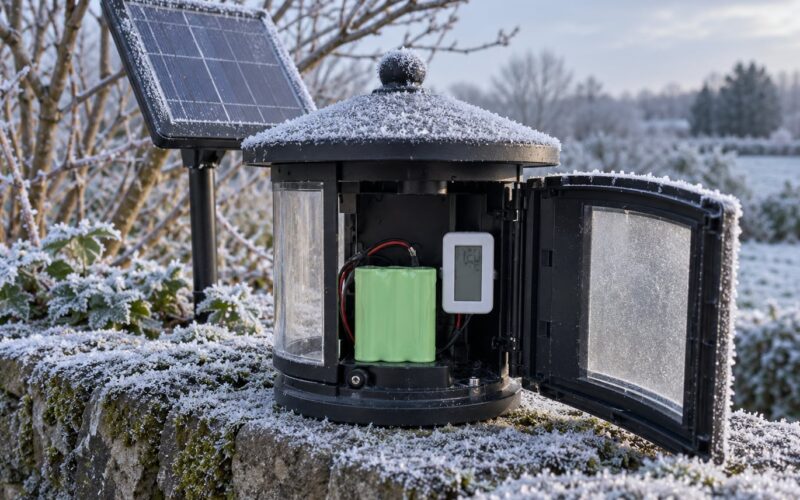
Panels need light, not heat, so output at night is effectively zero and heavy cloud cuts production sharply. On a bright overcast day you might get a fraction of clear-sky output, and diffuse light still keeps the system producing something rather than shutting down.
Rain and snow have mixed effects. Rain washes dust off and can cool the cells, both helpful. Snow sitting on the surface blocks light entirely until it clears or is removed. Falling snow and ice coming off a roof is also a hazard below the array, which is why panels are usually set slightly above the roof surface and why snow clearing needs a safe method rather than a ladder and a scraper.
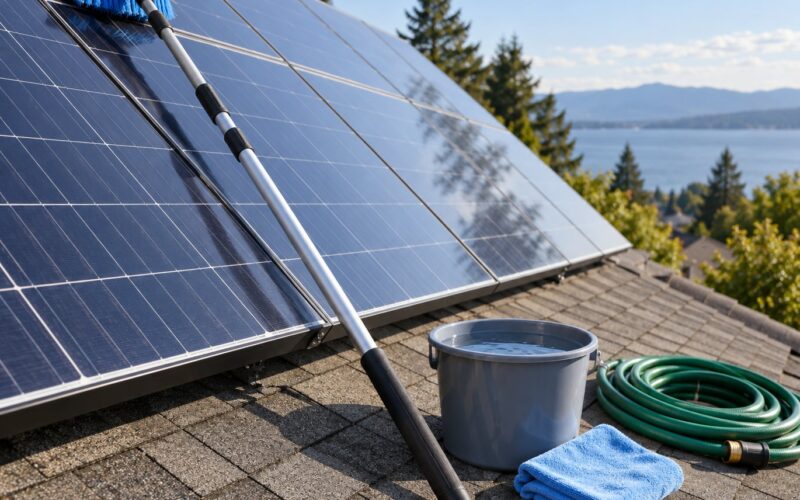
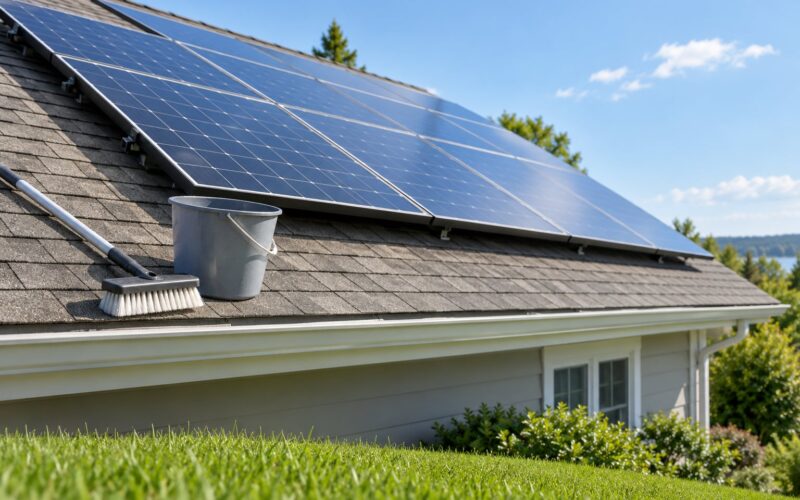
Leaves, twigs and bird droppings cut output in ways that look like a mysterious fault on a monthly graph. Clearing them is straightforward work from the ground with the right tool, and any roof-side work belongs to someone trained and equipped for it.
When production is low, the household simply draws from the grid or discharges a battery. Nothing about the panels needs to change.
How Does Solar Power Reach Household Outlets?
Solar power reaches your outlets because the inverter feeds the main distribution panel, and the panel treats it like any other incoming supply. From the main breaker onward, the wiring in your house does not know or care where the current came from.
Most residential systems are whole-home, which means the inverter connects near the main panel and every circuit can use the solar output. A selected-circuit or partial system connects only chosen circuits, usually through a subpanel, so the rest of the house stays on utility power alone.
Two meters describe the flow. A generation meter records everything the array produces. A bidirectional utility meter counts energy moving in both directions, which is what makes net metering possible: generation beyond your own use is credited against what you take from the grid, rather than physically routed to a neighbour.
Exporting that surplus needs a compatible utility arrangement, and the rules are local. Some utilities credit retail rates, some pay a lower export rate, some cap the size of the system that may interconnect. That arrangement is worth settling before the equipment is ordered, not after.
Do Solar Panels Store Electricity Themselves?
No. A panel generates electricity and that is all it does. Storing energy requires a separate battery, and plenty of homes never install one because a grid connection already covers the gap between solar production and household demand.
A battery charges from surplus solar production, usually when the array is producing more than the house needs. It then discharges to run the house during peak price periods, or to carry a few critical circuits through an outage.
There is one behaviour that catches people out. Standard grid-tied systems shut down during a power outage. Anti-islanding protection detects that the grid is dead and stops the inverter from energising a line that repair crews may assume is safe. Panels, inverter and grid all go quiet, and the house has no power even though the sun is out.
Systems with approved islanding or backup capability behave differently. They can form their own small grid and keep essential loads running without energising the downed line. That capability depends on the inverter, the battery, a transfer device and the utility’s approval for that configuration.
Storage changes timing, not physics. The generation chain stays the same whether or not a battery is fitted.
What Should Homeowners Check Before Installing Solar Panels?
Start with shading, usable space and your own energy use, in that order. Everything else in a proposal depends on those three answers.
Shading and usable space
Walk the site and note what casts shadows across the roof: trees, chimneys, the neighbouring house, a satellite dish. Any obstruction that lands on panels for part of the day costs production, and the effect is worse on a string design than on per-module equipment.
Roof condition
Panels last for decades while a roof lasts far less. If the roof needs work, do it before installation, not after. A roofer should confirm that the structure can carry the added load and that penetrations and flashing are handled properly.
Site light and weather
Check local peak sunlight hours, typical cloud cover and seasonal patterns. Orientation and tilt matter more than most buyers expect, and a wall mount or ground mount can be better on a badly oriented roof even though it costs more.
Electrical service and utility paperwork
An electrician needs to check the panel capacity, the service entrance and the condition of existing wiring. Interconnection approval, permits and any fire-access setbacks come next, and these are the items that set the schedule.
Realistic goals
Decide whether the aim is to cut a bill, to cover most annual use, or to add backup capability. Each leads to a different design, and an oversized system can produce less financial value than a right-sized one on certain tariffs.
On safety: photovoltaic and high-voltage work should follow the manufacturer’s instructions and the local electrical code, and installation or inspection belongs with appropriately qualified professionals. Roof-side work carries a serious fall risk, and live DC wiring on a roof cannot be switched off. If any part of this process feels outside what you would do yourself, stop there and call the trade that handles it.
Frequently Asked Questions
How long do home solar panels last?
Residential modules commonly carry a performance warranty around 25 years, guaranteeing roughly 80 percent of rated output by then. Actual life often runs longer. The part that usually fails first is the inverter, typically somewhere in the 10 to 15 year range, and replacing it is a normal mid-life cost rather than a sign the panels are finished.
Why do my solar panels produce less than expected?
Compare your own monthly production against a local estimate that uses your real system size and peak sunlight hours. Being below an optimistic sales estimate is normal, because those figures rarely include shading losses or a full year of cloudy weeks. A sudden step down instead of a gradual drift usually points to soiling, a shade source that grew, or an equipment fault.
Can I plug a solar panel into a wall outlet?
Not in the way most people picture it. A single panel makes direct current at a voltage your outlets cannot accept, and standard grid-tied hardware is not designed for that use. Small panels with built-in charge controllers exist for powering a phone or a battery, but anything that powers a standard outlet needs an inverter and proper wiring.
Are monocrystalline or polycrystalline panels better for a home?
Monocrystalline panels are the default choice today. They generate more power from the same roof area and tend to perform better in heat, which matters on most residential arrays. Polycrystalline panels cost less per panel but need more space for the same output. Thin film suits low-light, large ground-mount sites more than a typical residential roof.
Do solar panels need maintenance?
Very little. Panels are sealed, have no moving parts, and usually need a rinse with a hose a couple of times a year if pollen or dust builds up. The inverter may need its filter cleaned or its fan checked depending on the model. Monitoring is the useful habit, since most problems show up as falling production long before anything fails outright.
Conclusion
Home solar panels turn light into direct current, an inverter turns that into alternating current your appliances understand, and either the grid or an optional battery covers the timing gaps. That is the entire mechanism, and every question about cost, output or reliability comes back to one of those three parts.
Before you ask for a design, check three things yourself: what shades the roof through the day, how much unshaded space you actually have, and how much energy you use over a year. With those answers in hand, an installer can produce a system design sized for your site rather than a generic one.