Water heating is usually the second-largest energy expense in a home after space heating and cooling, and the heater you pick changes that line item far more than most people expect. A conventional electric tank turns nearly every kilowatt-hour it buys into hot water, while a heat pump water heater moves heat from the surrounding air and can deliver three to four times as much heat per unit of electricity. Swap a fuel, change the technology, or even size the tank wrong, and the same household can see a difference of several hundred currency units a year.
So how water heater choice affects energy bills comes down to four levers: how efficient the heater is, how much heat it leaks while doing nothing, how much hot water your household actually asks for, and what your utility charges for each unit of gas or electricity. This guide walks through each one with annual cost tables and a worked payback calculation you can run with your own numbers.
Updated for October 2026. Every figure below is an estimate built on stated rate assumptions, not a quote for your home. Rates, rebates and tax rules change, so confirm current pricing with your utility and confirm incentive rules for the current tax year before you commit.
Table of Contents
- How Much Can Your Water Heater Affect Energy Bills?
- What Factors Influence Water Heating Costs?
- Fuel type and utility rate
- Capacity and recovery rate
- Efficiency rating
- Standby heat loss
- Hot water usage patterns
- Water hardness and scale
- Insulation and pipe length
- Inlet water temperature
- Local energy prices
- How Water Heater Choice Affects Energy Bills
- Tank or Tankless: Which Uses Less Energy?
- How water heater choice affects energy bills when demand is spiky
- Gas vs. Electric vs. Heat-Pump Water Heaters
- Why the marginal rate misprices most comparisons
- The gas account question nobody answers
- Heat pumps, solar and the rest of the bill
- How to Estimate Your Water Heater’s Energy Costs
- Step 1: estimate your annual hot water use
- Step 2: convert gallons to energy
- Step 3: divide by UEF
- Step 4: multiply by your marginal rate
- Worked payback example
- Efficiency Labels: What Numbers Really Tell You
- UEF: how much heat you get per unit of fuel
- First-hour rating and flow rate
- Rated capacity and recovery rate
- How to Reduce Water Heating Costs After Installation
- Changes that need no installer
- Changes that need a professional
- Safety and Maintenance Considerations
- Frequently Asked Questions
- Does your water heater use a lot of electricity?
- How much money will a heat pump water heater save?
- Why is my electric bill so high with a heat pump water heater?
- Why are gas water heaters being phased out?
- Are water heaters affected by tariffs?
- What is the lifespan of a tankless water heater?
- Choose Based on Your Total Cost, Not Just Efficiency
How Much Can Your Water Heater Affect Energy Bills?
Water heating typically accounts for roughly 18% to 25% of a home’s total energy use — about 15% of household electricity and around 25% of household gas consumption in US homes. The reason it matters so much is that it runs constantly: a storage tank burns fuel every hour of every day just to stay hot, so small inefficiencies accumulate into a bill line you notice every month.
There is no single universal savings figure, and any article that hands you one is oversimplifying. A household on an all-electric tariff with a 140 litre electric tank can spend several times more on water heating than a neighbour with a gas tank on the same hot water use, because gas is cheaper per useful unit of heat in many regions. Another household with an electric heat pump heater can spend less than a third of what the electric tank used to cost.
The only way to know your own number is to work from your own bill and your own equipment. Pull out the last twelve bills, separate the gas charge from the electricity charge where you can, and compare that against the heater’s rated annual energy use. That is the process later in this guide, and it takes about twenty minutes.
What Factors Influence Water Heating Costs?
Nine variables move the number, and most of them are independent of each other. Knowing which ones your household controls is the difference between choosing well and guessing.
Fuel type and utility rate
The fuel you burn matters because you buy it from two different industries with two different pricing structures. Electricity is commonly sold with a fixed delivery charge, usage tiers and, in some regions, time-of-use windows where the price per kilowatt-hour swings sharply. Gas is usually sold per therm with a smaller fixed monthly charge, and the price per therm tends to move more slowly.
Capacity and recovery rate
A tank that is too small runs out of hot water during a busy evening, which is a comfort problem. A tank that is much larger than you need carries more hot water than you use, and every extra litre has to be heated after every cold start. Recovery rate — how fast the heater puts heat back — also determines whether it keeps up with two showers running while the dishwasher is mid-cycle.
Efficiency rating
Heating efficiency is measured by the Uniform Energy Factor, or UEF. A conventional electric storage tank typically lands between 0.90 and 0.95. A gas storage tank sits far lower, often around 0.60, because a share of its fuel energy escapes as flue-gas heat. A heat pump water heater jumps to roughly 3.5 to 4.0 because it uses electricity to move heat rather than to create it directly.
Standby heat loss
This is the energy a storage tank burns to keep stored water hot with nobody drawing from it. It is the single biggest reason storage heaters cost more to run than demand heaters, and it scales with surface area, tank insulation quality, and how warm or cold the room around the tank is. An uninsulated tank in a cold garage bleeds far more heat than an insulated one in a heated basement.
Hot water usage patterns
Two people who shower once a day on a low-flow head use a fraction of what four people use with two showers running and laundry in the cycle. Usage is also time-shaped: showers cluster in the morning and evening, laundry runs whenever the machine is free, and dishwashers run overnight on many timers. A heater with a big buffer can absorb those peaks; a demand heater has to produce them instantly.
Water hardness and scale
Hard water leaves mineral scale on heating elements and inside tankless heat exchangers. Scaled elements must run hotter and longer to deliver the same outlet temperature, so they use more energy for the same shower. Tankless owners in hard-water areas also report the recurring descaling habit that goes with the technology.
Insulation and pipe length
Heat that leaves a tank still has to travel down the pipes to the shower, and energy lost along the way is paid for twice: once to heat the water, once to replace the loss. Long uninsulated runs from a basement utility room to a bathroom upstairs can add meaningful demand to every draw, and a recirculation loop changes that picture by keeping hot water moving constantly.
Inlet water temperature
Cold groundwater makes every system work harder. A 10 degree change in inlet temperature can swing water heating energy consumption by around 15%. This is why the same heater performs differently in two similar houses, and why a demand heater’s rated flow rate is quoted at a specific inlet temperature rather than as a fixed number.
Local energy prices
The final variable is the one most comparisons forget. A tankless gas heater is a strong value in a region with cheap gas and expensive electricity, and a poor value where electricity is priced low and gas is not. Never evaluate a fuel switch using a national average; use your utility’s actual marginal rate per kilowatt-hour or per therm.
How Water Heater Choice Affects Energy Bills
Here is the comparison that most searchers are really after: the same household hot water demand, priced at five systems, with the rate assumption written into the table so you can swap in your own.
The estimates below assume a household of three using about 300 litres of hot water per day and a delivered water temperature of 55 degrees Celsius. Electricity is priced at 0.19 per kilowatt-hour and gas at 0.95 per therm for illustration only — your own rates will differ, and gas and electricity prices move independently.
| System | Typical UEF | Annual energy use | Assumed annual fuel cost | What drives the cost |
|---|---|---|---|---|
| Electric storage tank (50 litre) | 0.90 to 0.95 | about 2,900 kWh | about 550 | Standby loss plus heating every litre from cold |
| Electric storage tank (140 litre) | 0.90 to 0.95 | about 3,600 kWh | about 685 | More stored water, more surface area, more standby loss |
| Gas storage tank (40 litre) | about 0.60 | about 200 therms | about 190 | Cheap fuel offsets low efficiency |
| Gas storage tank (75 litre) | about 0.60 | about 220 therms | about 210 | Same pattern with a larger buffer of hot water |
| Gas tankless (condensing) | 0.90 to 0.98 | about 175 therms | about 165 | No standby loss; needs gas at the moment of demand |
| Heat pump water heater | 3.5 to 4.0 | about 1,050 kWh | about 200 | Uses room air as a heat source, so it moves heat instead of making it |
| Solar thermal with backup | Varies widely | Backup fuel still runs | Highly climate dependent | Free solar heat in summer, full fuel cost in winter |
Read that table carefully before drawing conclusions. The gas tanks and the heat pump system all land in a similar cost band on these assumptions, while the electric tanks sit at the top. But that ranking flips in a region where electricity is cheap and gas is expensive, and it flips again if your household is small enough that a heat pump heater’s large tank never fully cycles.
Solar thermal sits in a category of its own. It can displace a large share of annual hot water demand in a sunny climate, but it does not replace the backup heater, so your annual cost is a blend of free energy and your most expensive fuel. That makes it hard to summarise in a single row and easy to oversell.
Tank or Tankless: Which Uses Less Energy?
Tankless heaters use less energy only when a household leaves idle time on the clock. A storage tank pays a constant standby tax every hour of the day; a demand heater pays nothing until a tap opens, then heats exactly what was asked for and stops.
The trade-off is capacity at the moment of demand. A tankless heater delivers hot water at a fixed flow rate, quoted in gallons per minute at a stated temperature rise, and it cannot exceed that rate no matter how many fixtures open. A storage tank can deliver its entire stored volume at once, then recover over the following hour.
How water heater choice affects energy bills when demand is spiky
For a household of two with one bathroom, tankless wins on energy use, because almost none of the day goes unused. For a family of five with two bathrooms who shower back to back while the dishwasher runs, a tankless heater can throttle into lukewarm water, and owners switching back to a tank report the difference as a comfort regression rather than an energy saving.
Cold inlet water makes this worse. The same unit rated at 9 gallons per minute with warm groundwater can drop to around 4 gallons per minute when inlet water is near 40 degrees Fahrenheit, which is why cold-climate buyers see more lukewarm complaints than warm-climate buyers.
| Situation | Lower standby loss | Higher simultaneous capacity | Our read |
|---|---|---|---|
| One to two people, one bathroom | Tankless | Storage tank | Tankless on energy, tank on comfort |
| Family of four or more, two or more bathrooms | Tankless | Storage tank | Size the demand heater for the real peak or keep a tank |
| Rental or second home with long idle periods | Tankless | Storage tank | Standby loss dominates an empty house |
| Household with rooftop solar and a battery | Tankless | Storage tank | A storage tank can act as a thermal battery for the panel |
Homeowners weighing this split online tend to split along the same lines. On r/homeowners and r/HomeImprovement, the recurring argument is that tankless gas rarely pays for itself against a gas tank purely on efficiency gains, while buyers of small households still buy it for the standby saving and the never-run-out feel.
One recurring point from buyers on r/HomeImprovement is worth repeating plainly: if your gas is cheap, efficiency gains on a gas-to-gas swap are small because you started from an already cheap baseline. The saving from tankless in that situation comes from eliminating standby loss, not from a better burner.
Gas vs. Electric vs. Heat-Pump Water Heaters
Gas usually wins on raw operating cost in regions with cheap gas. Electricity with a heat pump wins where electricity is cheap or where a solar array already covers the draw. The decision hinges less on a rule of thumb and more on the marginal rate you actually pay.
Why the marginal rate misprices most comparisons
Your bill’s average rate blends your fixed charges with your usage charges. Savings, though, happen at the margin — they only reduce the volume-priced portion. If your delivery charge and taxes make up a third of the bill, a 30% cut in consumption cuts roughly a third of the total, not 30%. That is why identical efficiency comparisons produce different outcomes in two neighbouring houses.
Run the same idea through a tiered tariff: the first few hundred kilowatt-hours may be priced low while later blocks cost substantially more. Cutting consumption removes the most expensive block first, so the real saving per kilowatt-hour is often higher than the headline average suggests. Ask your utility for the per-block rates before running any estimate.
The gas account question nobody answers
Homeowners ask whether their gas bill drops if the water heater was the only gas appliance. Often it barely moves. A furnace and a gas range usually keep the gas account alive, and the fixed monthly charge — often the largest single line on that bill — stays exactly where it was. Owners on r/homeowners running that arithmetic have found the surprise disappointing but predictable after the fact.
Heat pumps, solar and the rest of the bill
A heat pump water heater pulls electricity continuously, which makes it unusually friendly to rooftop solar and a home battery. Treated as a thermal battery, the tank stores cheap midday or surplus panel energy as hot water and releases it during the evening peak, shifting load away from the most expensive tariff window. It also participates in utility demand response through control ports such as CTA-2045, where the utility can briefly curtail the heat pump during a grid event.
Two caveats. The heater moves air from the room it sits in, so a unit in a heated interior space quietly adds to heating load in winter while trimming cooling load in summer — installing it in a garage, basement or utility room changes the arithmetic entirely. And in very cold weather, resistance backup elements inside hybrid heaters can switch on and push consumption back toward conventional electric levels.
How to Estimate Your Water Heater’s Energy Costs
Estimate your water heating energy costs in four steps: find your annual hot water demand, convert it to energy, divide by the heater’s UEF, then multiply by your marginal rate. Do the whole thing annually, not monthly, so fixed charges don’t distort it.
Step 1: estimate your annual hot water use
Add up your household’s hot fixtures. A shower runs roughly 65 litres at five minutes, a clothes washer around 75 litres per cycle, a dishwasher 45 litres per cycle, a bathroom basin 4 litres per handwash, and a kitchen tap about 6 litres per minute. Multiply by frequency, then by 365.
| Fixture | Hot water per use | Everyday frequency |
|---|---|---|
| Shower, five minutes | about 65 litres | 5 to 8 uses a day, more with children |
| Clothes washer | about 75 litres | 5 to 8 loads a week |
| Dishwasher | about 45 litres | 1 to 2 cycles a day |
| Bathroom basin | about 4 litres | 10 to 20 handwashes a day |
| Kitchen tap | about 6 litres per minute | Cooking and dishes |
| Bath tub fill | about 150 litres | Occasional |
Step 2: convert gallons to energy
One US gallon of water raised by one degree Fahrenheit takes about 1.2 kWh of heat energy. Raise the volume you calculated by the temperature rise from your inlet water to your set point. A 40 degree rise across 450 litres of hot water per day works out to roughly 34 kWh of heat per day, or about 12,400 kWh of heat per year.
Step 3: divide by UEF
Energy in equals energy bought, divided by efficiency. At UEF 0.92 for an electric tank, 12,400 kWh of heat needs about 13,500 kWh of electricity. At UEF 3.7 for a heat pump heater, it needs roughly 3,350 kWh. Add the standby loss for the tank version, which a well-insulated modern tank keeps to a few kilowatt-hours a day and an old uninsulated one can double.
Step 4: multiply by your marginal rate
At an illustrative 0.19 per kilowatt-hour, the electric tank figure lands near 2,565 for the year before standby loss, and the heat pump figure near 640. Both are estimates with wide error bars, which is exactly why the next section exists.
Worked payback example
Say the heat pump heater adds 1,400 over the standard electric tank at install, and saves roughly 1,900 a year at your local rates. Payback is 1,400 divided by 1,900, which is under a year — a result most sales pages would stop at. Now run the pessimistic case: savings of 700 a year, half your estimate, and the same payback stretches to two years. Run the realistic case where your hot water use drops after the install, at 1,100 a year, and payback is about 15 months.
That spread is the honest answer. Your own usage, rate and incentive eligibility matter more than the promotional figure, so treat any single payback number as a starting point for a conversation rather than a promise.
Efficiency Labels: What Numbers Really Tell You
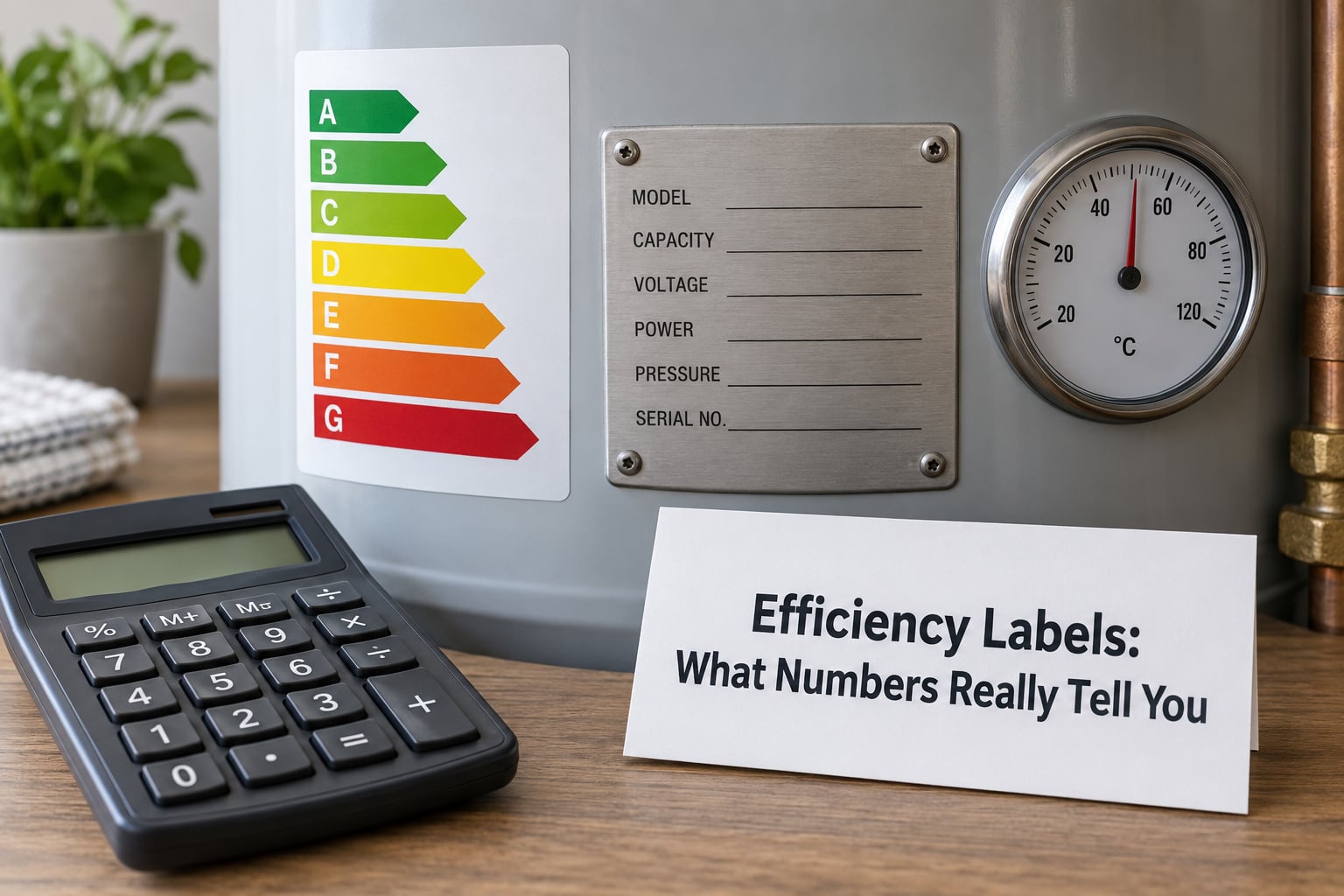
The label numbers tell you efficiency, capacity and running cost for a standard household. They do not tell you whether the heater suits your home, and the biggest number on the label is often the least important to your bill.
UEF: how much heat you get per unit of fuel
The Uniform Energy Factor is the total hot water delivered over a day, divided by the total energy consumed, including standby loss. Standard electric storage tanks sit around 0.90 to 0.95, gas storage tanks around 0.60, high-efficiency gas tanks a little above that, condensing tankless heaters 0.90 to 0.98, and heat pump heaters 3.5 to 4.0.
Fuel matters when you read it. A UEF of 0.70 means something quite different when the fuel behind it is priced per therm rather than per kilowatt-hour, because the units do not compare directly across fuels.
First-hour rating and flow rate
The first-hour rating is how much hot water a heater delivers in the first hour of operation, combining tank capacity and recovery rate. For a storage tank, size it against your household’s realistic peak hour. For a tankless heater, the comparable number is flow rate in gallons per minute at a stated temperature rise.
Neither number rewards you for buying more than you use. An oversized tank carries more standby loss every hour of the year, and an oversized demand heater just costs more up front without touching your bill.
Rated capacity and recovery rate
Rated capacity is simply the volume of the tank. Recovery rate is the input needed to raise that volume by a given temperature in an hour. Gas tanks recover faster because they deliver a higher input; heat pump heaters are slower, which is why hybrid units carry resistive backup elements for morning demand.
There is a real lesson there about the biggest label number. A heat pump water heater’s UEF of 3.7 looks like four times the performance of an electric tank’s 0.95, and for heating water it is. But the household bill depends on how often you use hot water, how much sits idle in the tank, and what your utility charges. Rating first, price second, habits third.
How to Reduce Water Heating Costs After Installation
Most households should start with the free changes before paying for hardware. The levers below are ordered by what they cost you in time and money.
Changes that need no installer
- Lower the set point. Dropping the temperature setting by 10 degrees typically cuts water heating energy use by around 3% to 5%, and almost nobody notices. On a gas tank, lower set points also reduce standby loss, which is where the older guidance estimated savings in the range of tens of currency units a year.
- Fit low-flow fixtures. A showerhead moving from about 2.5 gallons per minute to 1.5 can cut a five-minute shower from 65 litres to roughly 30 litres. Faucet aerators do the same for basins.
- Insulate the first few metres of hot water pipe. Cheap pipe sleeves on the runs a bathroom actually uses pay back quickly in any home with long pipe runs.
- Insulate an older tank. An insulation blanket on a storage tank with thin or missing foam cuts standby loss noticeably. Do not wrap a tankless heater or a heat pump unit.
- Check heat traps and the dip tube. Heat traps on the outlet prevent hot water rising into the cold line; older guidance put their value at up to about 15 a year on gas and up to about 40 on electric. The dip tube keeps cold water from displacing hot water at the top of the tank.
- Shift the dishwasher and laundry. Running them off-peak on a time-of-use tariff costs nothing to arrange and uses the tank’s stored heat rather than heating new water during peak pricing.
Changes that need a professional
- Descaling a tankless unit on the maker’s schedule, which preserves efficiency in hard water.
- Flushing the tank and replacing the anode rod on a storage tank, which limits sediment and corrosion.
- Adding a recirculation loop with a timer or demand-controlled valve, which cuts the long wait for hot water at the far end of the house. Note that an always-on loop consumes energy continuously, so it only makes sense on a timer or on demand.
- Moving or upsizing a gas line, running new venting, or adding a condensate drain when the heater type changes.
Safety and Maintenance Considerations
Follow the manufacturer’s instructions and your local codes. Gas, electrical, venting and structural work belongs to licensed professionals, and none of it is a reasonable weekend project.
Gas lines must be sized and tested for the new unit’s input, venting must match the appliance rating, and a heat pump water heater needs enough clearance and airflow for the fan to move several hundred cubic feet of air per minute. Combustion air and flue clearances exist for a reason. High-voltage wiring at the unit and any change to your panel belong to an electrician, as does any structural work to hang a heavier tank.
Annual maintenance is modest: flush the tank and check the anode rod on storage heaters, descale tankless exchangers on the maker’s schedule, and clean the heat pump filter and clear the condensate drain. A leaking pressure-relief valve or a dripping condensate line is a reason to call someone, not to tighten a fitting.
Frequently Asked Questions
Does your water heater use a lot of electricity?
More than most people expect. An electric storage tank is running almost continuously to hold water at temperature, so a household of three can easily use 2,500 to 3,600 kWh a year just for hot water. A heat pump water heater cuts that to roughly 900 to 1,200 kWh for the same demand. Gas units use no electricity at all, which is why they show up as zero on an electricity bill while still heating every shower.
How much money will a heat pump water heater save?
It depends almost entirely on your electricity rate and your old heater. Against a conventional electric tank, homeowners commonly report a drop from roughly 350 to 400 a year to under 100 a year on water heating. Against a gas tank the saving is usually much smaller, because gas is already cheap to run. Compare the installed cost against your own annual saving, and check whether rebates or credits apply before buying.
Why is my electric bill so high with a heat pump water heater?
Check four things in order. First, resistance backup elements: hybrid units switch them on in cold weather or during heavy demand, which pushes consumption toward conventional electric levels. Second, the set point: a few degrees too hot multiplies every draw. Third, location: a unit in a heated interior room adds heat to the house all winter. Fourth, scale on the tank or coil, which forces longer heating runs.
Why are gas water heaters being phased out?
The drivers are emissions policy, local building codes and utility decarbonisation targets rather than a change in how water heaters work. Several jurisdictions now restrict new gas water heater installations or require low-emission models, and some utilities push heat pump water heaters through rebates and requirements. Where gas bans are live, that effectively narrows your long-term choice of fuel for water heating.
Are water heaters affected by tariffs?
Very much so. A storage tank draws steady standby power every hour, and on a time-of-use tariff that consumption falls in the most expensive window unless you schedule around it. Demand response programmes using control ports such as CTA-2045 let your utility briefly curtail or shift the heat pump during grid events, and many utilities offer rebates for participating units.
What is the lifespan of a tankless water heater?
Manufacturers commonly rate them in the region of 15 to 20 years, and longevity depends heavily on water quality, use and maintenance. Hard water scales the internal heat exchanger, and skipping descales shortens life noticeably. In practice, units usually stop because of a failed flow sensor, a clogged inlet filter or a scaled exchanger rather than a burnt burner, so regular service matters more than brand.
Choose Based on Your Total Cost, Not Just Efficiency
The heater with the best efficiency number is not automatically the one that lowers your bill most. The decision is a lifecycle comparison: equipment cost, installation, fuel at your own marginal rate, maintenance, expected service life, and how much hot water you will actually use in the next twelve years.
So here’s what to do first. Pull twelve months of bills and find your actual rate per kilowatt-hour and per therm. Then write down your real hot water habits rather than an average household’s, size the heater to your genuine peak hour, and get two or three installed quotes that include gas line work, venting, condensate drainage and any electrical changes. Check rebate and credit eligibility for the current tax year before signing, since those programmes close and reopen on their own schedules.
Finally, run the free savings first — set point, pipe insulation, low-flow fixtures, heat traps — and measure over a season. A lower set point and a showerhead change cost almost nothing, and they shrink the payback period on whatever equipment you choose afterwards.