Short answer on how hail affects solar panels: most arrays come through a storm with little more than cosmetic marks on the glass. The outcome depends almost entirely on hail size. Quarter-sized hail is shrugged off, while stones approaching golf ball size can shatter cells, break seals and let water in. Here is how to work out which category your system is in, and what to do about it.
Table of Contents
- What Happens When Hail Hits Solar Panels?
- Hail size vs. likely damage
- How to Tell If Hail Damaged Your Solar Panels
- Start with the inverter and monitoring app
- Look for these signs from the ground
- Do hail-damaged panels still produce power?
- Hail Damage by Panel Type: What Changes?
- What Symptoms Appear in Solar Panel Performance?
- What Should You Do After a Hailstorm?
- Do You Need to Repair or Replace Hail-Damaged Panels?
- Will Solar Panel Insurance Cover Hail Damage?
- Can You Prevent Hail Damage to Solar Panels?
- Frequently Asked Questions
- Can hail damage solar panels?
- How big does hail need to be to damage solar panels?
- Do hail-damaged solar panels still work?
- Does homeowners insurance cover solar panel damage from hail?
- Can you fix hail damage to solar panels?
- Is it worth filing an insurance claim for hail damage?
- Conclusion: Start with a Safe Hail-Damage Check
What Happens When Hail Hits Solar Panels?
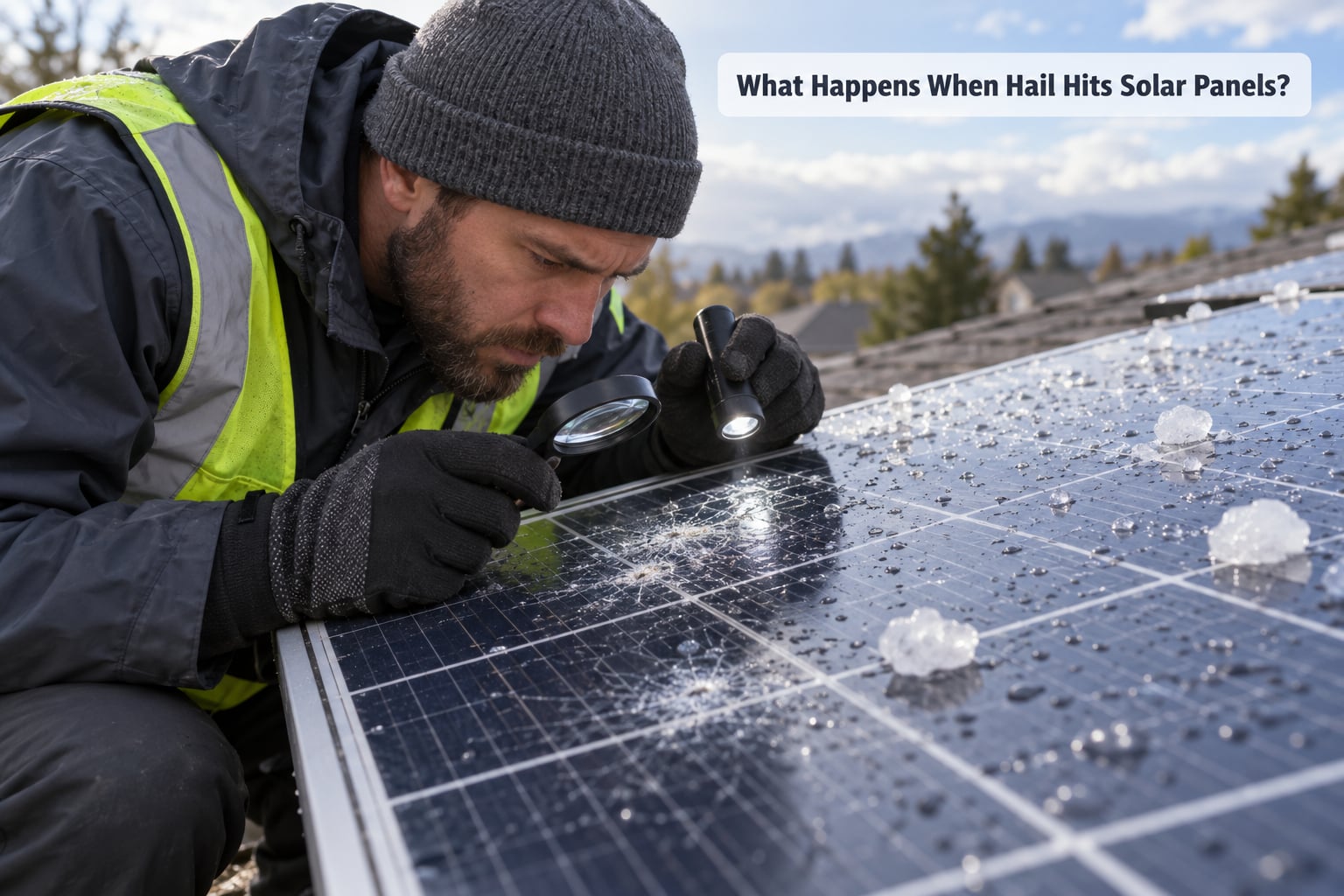
A hailstone is a small projectile, and the damage it does comes from impact energy: mass multiplied by the square of the speed at which it lands. Large stones fall faster than small ones, so a three-inch stone carries many times the energy of a one-inch stone even from the same cloud.
Photovoltaic modules are tested for this. The IEC 61215 test fires a 25 mm ice ball at the module at roughly 23 m/s, and the UL 61730 test drops a two-inch solid steel sphere from 51 inches. To pass, the module must show no visible damage and still produce at least 95% of its rated output, with no water ingress. That is a real bar, and it is why certified panels shrug off most storms.
What a passing test does not promise is immunity. Real hail can exceed the tested range, arrive at an angle the lab never replicates, and hit a panel that was installed with poor clamping or loose mounting. Size matters most, but so do panel construction, tilt angle and workmanship.
On a residential array, hail typically shows up in one of five ways:
- Microcracks inside cells, invisible from the ground but capable of shaving a few percent off output over time.
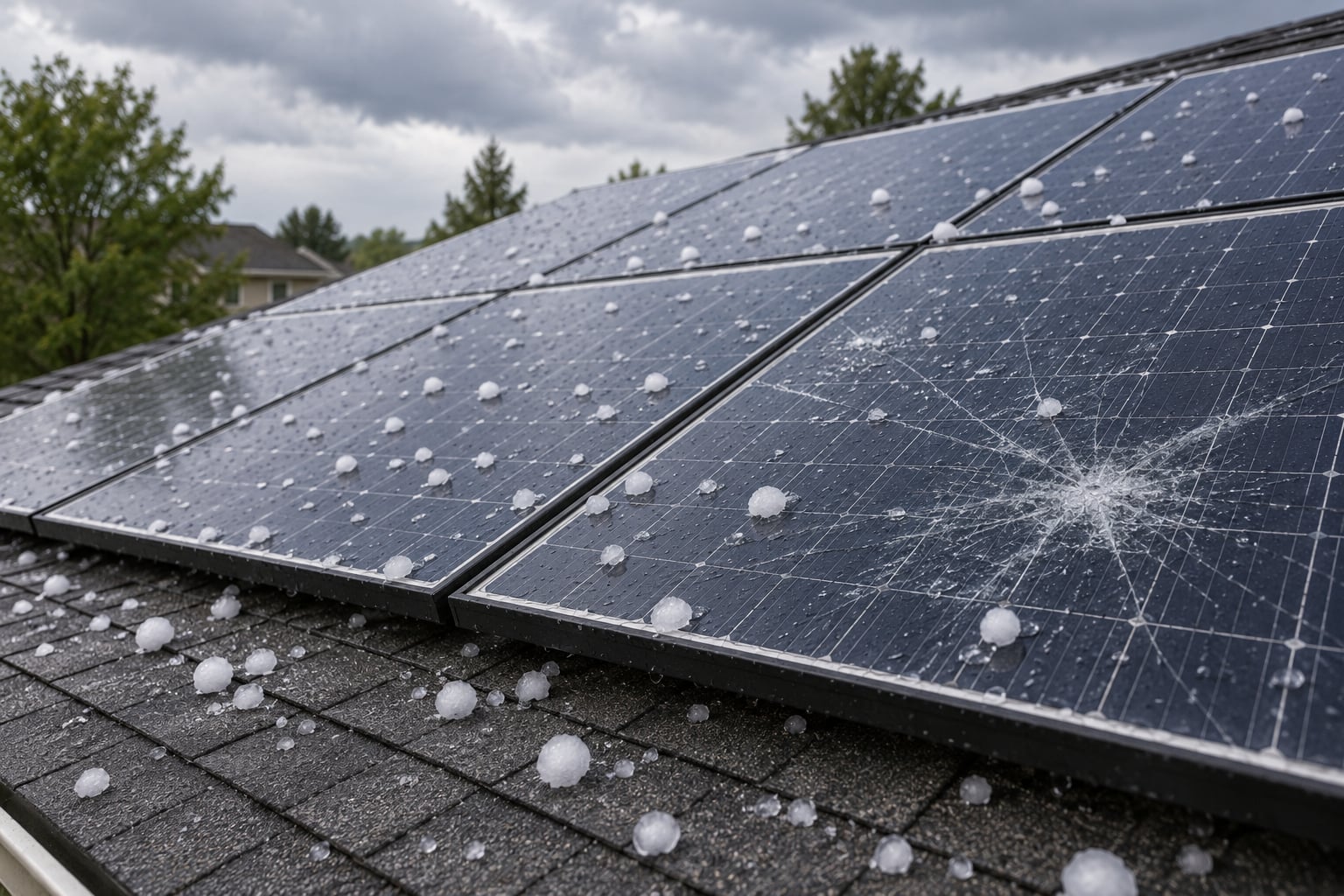
- Cracked or chipped front glass, where the tempered safety glass fractures but the cells underneath stay intact.
- Shattered cells, visible as dark patches or a spiderweb of broken interconnect lines.
- Delamination, where the encapsulant separates from the cell layer and a milky bubble appears under the glass.
- Breached backsheets or seals, allowing moisture into the junction box or frame, which is the failure mode that actually costs you money.
Hail size vs. likely damage
| Hail diameter | What it can do | Typical outcome |
|---|---|---|
| Under 1 inch (pea to marble) | Audible pitting, surface scuffing | No measurable effect on output |
| 1 to 2 inch (quarter to half dollar) | Cracks in front glass, occasional cell fractures | Usually cosmetic; minor output loss at most |
| 2 to 3 inch (tennis ball size) | Broken cells, delamination, cracked glass | Partial module failure; replacement often makes sense |
| Golf ball, about 1.6 inch | Higher terminal velocity, sharper impact | Localized damage, sometimes no visible sign at all |
| 4 inch and up (softball size) | Shattered modules, punctured backsheets | Module replacement, possible water ingress |
Real-world results match the pattern. In the 2017 hailstorm at NREL’s Colorado Mills field, one panel out of 3,168 was damaged despite hail severe enough to close a mall for a year. On a 2019 Texas storm, the numbers looked very different: around 400,000 of 685,000 utility-scale modules were damaged. The difference is scale and, above all, hail size. US hail construction losses ran past a billion dollars in a single year, so this is not a fringe risk.
How to Tell If Hail Damaged Your Solar Panels
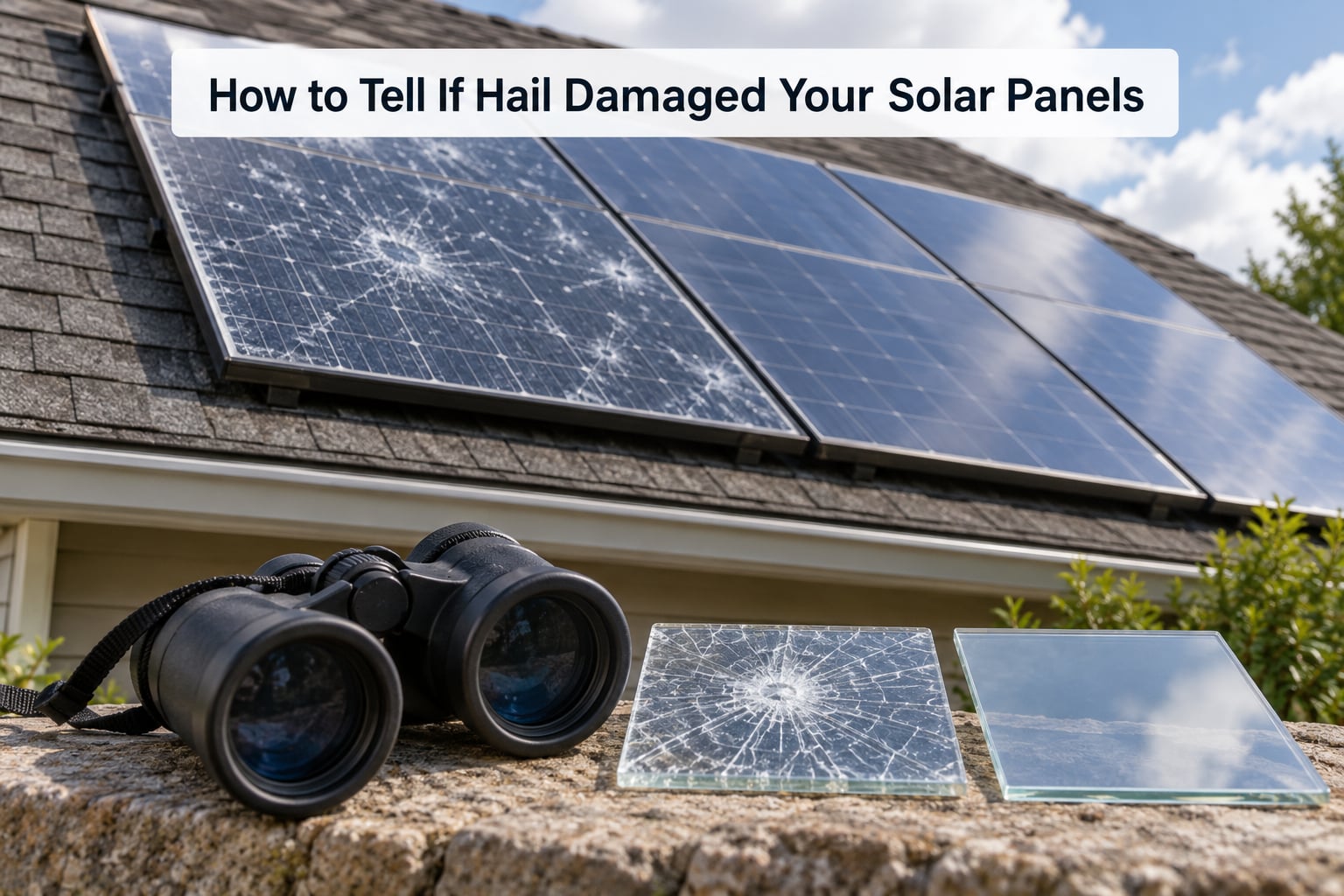
The honest answer here is that you often cannot tell from the driveway. Microcracks, bus-bar damage and small delamination bubbles are invisible without climbing up or using a thermal camera. What you can do is run a short checklist from the ground and from your monitoring software, then hand the rest to a professional.
Start with the inverter and monitoring app
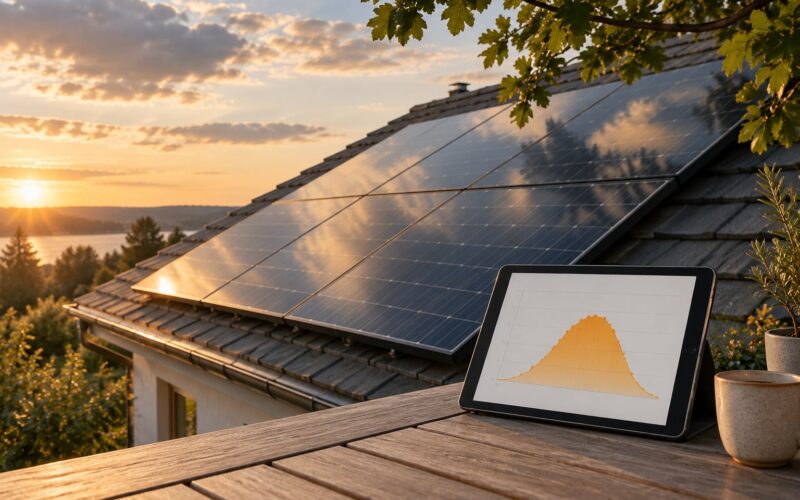
Check your inverter display and monitoring app first. Error codes such as insulation resistance faults, ground-fault warnings or a sudden string of underperforming panels tell you more than any visual inspection. Compare your last seven days of production against the same days in previous months, adjusted for weather.
Look for these signs from the ground
- Cracked or spiderwebbed glass, visible as a white or dark fracture line across a module.
- Missing or displaced panels, where an empty mounting rail shows through.
- Dark blotches or missing chunks within a panel face, indicating shattered cells.
- Cloudy, milky patches that were not there before the storm: delamination.
- Bent frames, twisted rails or flashing lifted away from the roof surface.
- A water stain on the ceiling or attic framing directly below the array.
Safety first: do not climb onto a wet or storm-damaged roof. A slick surface plus loose racking is how people get hurt, and falling tiles are the real hazard. Ground-level binoculars or a zoomed phone photo tell you most of what you need to know.
Do hail-damaged panels still produce power?
Usually yes, at least partially. A cracked pane with intact cells underneath keeps generating, sometimes at 80 or 90 percent of its previous output. Once cells shatter or a seal fails, that module’s contribution drops sharply or drops to nothing, and the inverter may fault the whole string. Cosmetic damage with steady output is the good case; falling output with rising error codes is not.
Hail Damage by Panel Type: What Changes?
Panel technology matters less than most marketing suggests. Build quality, glass thickness and installation workmanship dominate the outcome, so treat the table below as a starting point rather than a verdict.
| Module type | Hail vulnerability | What to know |
|---|---|---|
| Monocrystalline (glass-backsheet) | Moderate | The residential default; thin front glass, polymer backsheet that can puncture |
| Polycrystalline | Moderate, slightly higher | Larger cells mean more area exposed per module; older designs use thinner glass |
| Glass-glass construction | Lowest | Two panes of glass sandwich the cells; used on premium residential and utility modules |
| Integrated glass, such as solar shingles | Lowest | Part of the roof assembly, so no air gap for water to reach the deck |
| Thin-film flexible | Variable | Thin laminates deform instead of cracking, but are easily punctured and easy to crease |
Tilt angle changes the picture slightly. An array mounted at ten degrees takes a more direct hit than one at thirty-five, since the ice meets the glass closer to square. Mounting style is a weak defense, though: homeowners on solar forums who lost panels in severe storms report that moving to ground mounts would not have saved them. Large hail destroys panels regardless of where they sit.
What Symptoms Appear in Solar Panel Performance?
If output drops after a storm, check the symptoms before blaming the hail. Four signals matter: a step change in daily production that does not recover, recurring inverter fault codes, hot spots visible on a thermal image, and output that lags when neighbouring unshaded panels perform normally.
Weather mimics hail damage constantly. A run of cloudy days, a new shade source from a grown tree, dust from a nearby construction site or a grid interruption can all produce the same chart shape. That is why documenting the pattern before you call an adjuster saves argument later. Note the date of the storm, export daily production screenshots, and note any error codes with timestamps.
Microcracks are the sneaky case. A panel can look perfect and quietly lose five to ten percent, and that loss keeps accumulating through infrared degradation. Thermal imaging during a clear afternoon catches it: a functioning module reads fairly uniform, while damaged cells light up as a warm blob against cool neighbours.
What Should You Do After a Hailstorm?
Work through this list in order. It takes an afternoon and it protects both your system and any future claim.
- Stay off the roof. Wet shingles and possibly loose mounting hardware are not worth the view.
- Photograph the array from the ground. Wide shots of each roof face, then close-ups of anything cracked or missing. Include a timestamped shot of the yard and any visible hail on the ground.
- Check the inverter and monitoring app. Record error codes, daily production for the storm day and the days since.
- Look inside. Check the attic and top-floor ceilings under the array for new water staining or damp insulation.
- Check the roof surface around the array. Dented or broken shingles near panels matter for the claim, since the panels may have shielded those areas.
- Contact your installer or a solar-certified roofer. Ask for an inspection report with photos and a performance finding, not a verbal opinion.
- Call your insurer early if there is visible damage. Many policies require prompt notice, and early reporting shortens the claim.
One awkward wrinkle worth knowing: roofers often refuse to estimate a roof repair while panels are still attached, which pushes owners toward a certified solar contractor at a higher rate. Get the solar contractor involved before any roof work is scheduled.
Do You Need to Repair or Replace Hail-Damaged Panels?
Start with the cheapest option that fixes the problem. Monitor it if a module shows a hairline crack, produces within a few percent of its neighbours and throws no fault codes; a thermal image at the next annual check confirms whether anything is trending.
Replace the module when output stays meaningfully below the rest of the string, when cells are visibly shattered, when delamination has spread, or when a fault code keeps recurring. Modules are replaced individually in most cases, and a matching replacement is usually straightforward if your installer stocked one.
Look at the mounting hardware when hail has bent rails or pulled flashing loose. A panel reseated on a bent rail will keep damaging itself, and a compromised mount is a safety issue as much as a performance one.
Full-system replacement rarely makes sense for hail alone. It becomes worth discussing only when many modules were damaged, when the array is old enough that a major performance warranty is nearly used up, or when you are changing systems anyway. Your installer should make the final technical call after inspection, since only they can see the backsheet and junction box condition.
Will Solar Panel Insurance Cover Hail Damage?
Usually yes, because hail is a named peril in standard homeowners policies. The complications are about whether the solar system is specifically covered, and whether the roof and the panels are treated as one loss or two.
| Who pays | What it covers | What it usually excludes |
|---|---|---|
| Manufacturer warranty | Defects in materials and workmanship | Weather events, including hail, wind and hail-driven water damage |
| Homeowners policy | Hail damage to panels and associated roof damage | Systems not listed or scheduled on the policy; wear and tear; pre-existing damage |
| Hail or solar endorsement | Dedicated module coverage, sometimes at a set dollar amount | Deductibles apply, and premiums increase |
| Out-of-pocket | Everything, when the system was never on the policy | No help at all |
Two things decide your outcome. First, whether the array was scheduled on the policy: homeowners who upgraded an existing system without telling their insurer have paid for replacements themselves. Second, your deductible.
The economics are worth a quick calculation. One homeowner on diysolarforum described a claim where 16 panels were damaged, the deductible was 1,500 dollars, and the payout came to just over 5,000 dollars; replacement panels cost just under 4,000 dollars once delivered. The same owner paid about 60 dollars a year to add 10,000 dollars of array coverage. Whether a claim is worth filing depends on your deductible versus your repair cost, and whether a premium increase follows.
For insurers, document everything: dated photos, the storm date, monitoring screenshots, a written inspection report. Ask about premium changes before you file if you are unsure, since owners on solar forums worry about non-renewal more than they worry about the claim itself.
Can You Prevent Hail Damage to Solar Panels?
You cannot fully prevent hail damage on a residential array, but you can reduce the odds and the consequences.
- Choose certified modules. Check for IEC 61215 and UL 61730 listings and confirm the datasheet states a hail test result.
- Insist on correct installation. Torqued clamps, proper rail spacing and flashing that does not back out. Most storm damage starts as an installation weakness.
- Ask for glass-glass modules if you are installing in a hail-prone region such as Texas, Oklahoma, Nebraska, Kansas, Colorado or Alberta.
- Consider hail guards. Wire mesh or purpose-built screens absorb some impact, but they add wind load, collect debris, complicate cleaning and must be specified for your rack. Meteorologically protective covers that were deployed during a storm belong to utility-scale operators, not homes.
- Keep documentation current. Photos of the array before and after each storm season make claims far smoother.
- Run an annual inspection. Torque checks, thermal imaging and a look at the roof under the array catch slow degradation early.
One upside is worth repeating, because it is genuinely useful: the array itself acts as a barrier. Roofers and homeowners report that shingles beneath panels often come through a storm in better shape than the exposed sections around them. Hail still hits your roof, but usually at a fraction of the energy.
Frequently Asked Questions
Can hail damage solar panels?
Yes, but usually only cosmetically. Certified modules are tested to IEC 61215 and UL 61730 and routinely survive hail with no measurable output loss. Real damage becomes likely with hail around two to three inches or larger, or when panels are struck at an angle that cracks the glass or shatters cells. Size, tilt angle and installation quality decide the outcome more than panel brand does.
How big does hail need to be to damage solar panels?
Hail under an inch typically causes no measurable effect. Between one and two inches you may see cracks in the front glass with cells intact underneath. From two to three inches, expect shattered cells, delamination and modules that no longer perform. Four-inch stones can break modules outright and open a path for water into the junction box.
Do hail-damaged solar panels still work?
Often yes. A cracked glass pane with intact cells underneath keeps producing, sometimes at 80 to 90 percent of prior output. Once cells shatter or a seal fails, that module contributes far less or nothing, and the inverter may fault the entire string. Compare production data and error codes rather than judging by eye, since microcracks are invisible without thermal imaging.
Does homeowners insurance cover solar panel damage from hail?
Hail is a named peril in standard homeowners policies, so damage is normally covered as long as the solar system is included or scheduled on the policy. Manufacturer warranties almost always exclude weather, which is why insurance matters here. Keep dated photographs, production data and a written inspection report, and notify the insurer promptly after the storm.
Can you fix hail damage to solar panels?
Cracked glass with intact cells cannot be repaired in the field, so the usual fix is replacing that module. Monitoring is appropriate for hairline cracks with stable output. Damaged mounting rails or flashing do need repair before new panels go on, and an installer should make the final call after inspecting the backsheet and junction box.
Is it worth filing an insurance claim for hail damage?
Compare your deductible against the replacement cost first. A claim usually pays when the repair cost clearly exceeds the deductible, and many owners also weigh the effect of a claim on future premiums. Endorsements that schedule the array cost a small annual premium but remove the risk of paying a large bill out of pocket after a system the insurer never knew about.
Conclusion: Start with a Safe Hail-Damage Check
Do not climb onto the roof after hail. Photograph what you can see from the ground, compare your production data against recent weeks, and check the attic for new water staining. If output has dropped, fault codes keep recurring, or mounting hardware looks bent, get a written inspection from a solar-certified contractor before you contact your insurer. That is the practical answer to how hail affects solar panels: most systems are fine, and the ones that are not usually show it in the data before they show it on the glass.