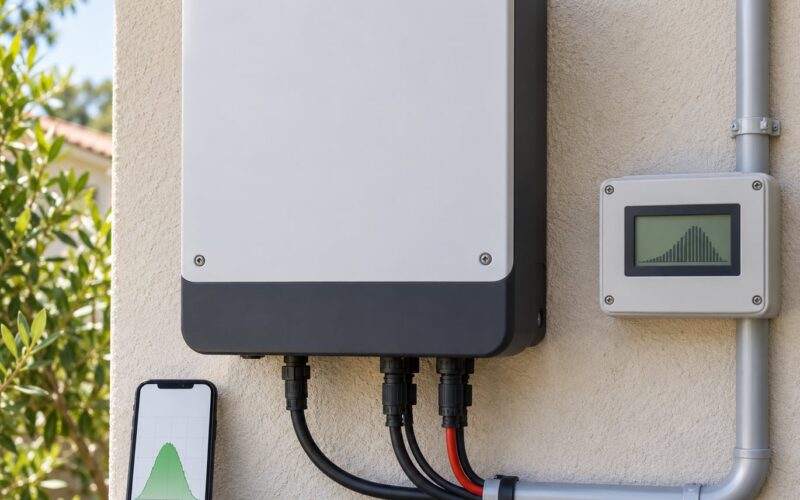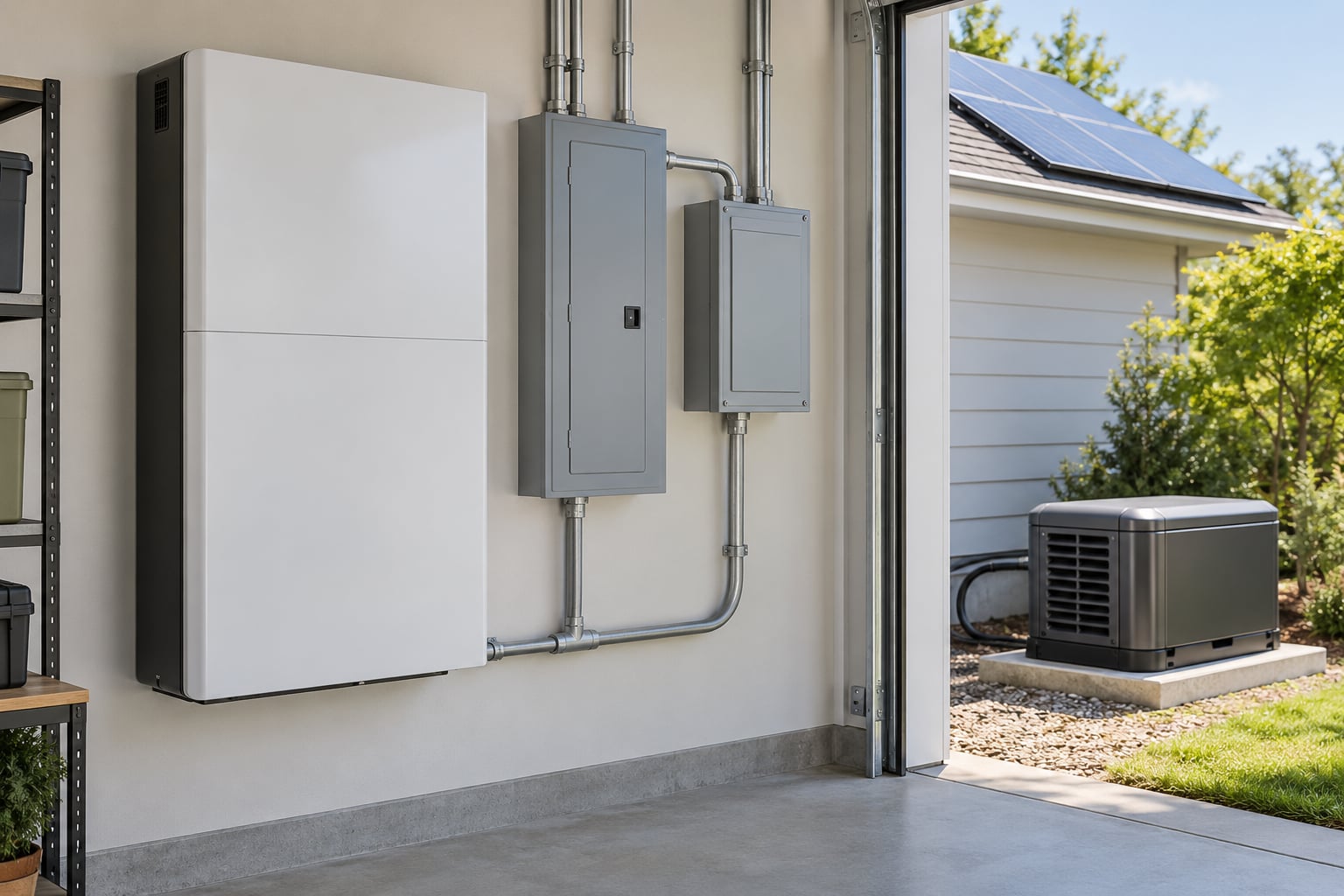
How to size a home generator versus solar battery comes down to two numbers built from the same list of essential loads. A generator needs peak watts: add your running appliances plus the biggest motor surge, then divide by 0.80. A battery needs stored watt-hours: multiply your load by the outage hours, then divide by inverter losses and depth of discharge.
Most homes do not need a full-house system either way. A realistic essential-loads list runs around 1,000 to 1,500 watts for a typical family home, and getting that list right is where the money is saved. Get it wrong in either direction and you either sit in the dark or pay for capacity you never switch on.
Here is how to work through both numbers, then decide which one the outage pattern on your street actually calls for.
Table of Contents
- How to Size a Home Generator Versus Solar Battery at a Glance
- What Does Sizing a Home Generator or Solar Battery Mean?
- How to Calculate Generator Size for Your Home
- What is the 80% rule for generators?
- Worked example: a 2,000 sq ft home
- How to Size a Solar Battery for Backup Power
- Runtime and Recharging: Which Option Is More Practical?
- Recharging from solar
- Refuelling a generator
- What About Installation, Safety, and Maintenance?
- Which Should You Choose?
- Frequently Asked Questions
- Can a solar battery replace a whole-house generator?
- What size generator do I need for a 2,000-watt refrigerator?
- How many kilowatt-hours does a home battery need for a day?
- Can I use a small generator to charge a solar battery?
- How much solar is needed to recharge a home battery?
- Is it better to have a generator, solar battery, or both?
How to Size a Home Generator Versus Solar Battery at a Glance
| Factor | Home generator | Solar battery |
|---|---|---|
| What you size | Output in watts or kW | Stored energy in kWh plus inverter output in kW |
| Starting power | Handles motor surge natively, often 2 to 3 times running watts | Limited by inverter surge rating; many units match only 1.5 to 2 times continuous |
| Continuous output | About 80 percent of the nameplate rating under the 80% rule | About 90 to 95 percent of inverter nameplate |
| Runtime limit | Fuel tank or supply line; refill as needed | Fixed until the battery recharges |
| Refuelling | Gasoline or propane delivery | Solar, grid power, or a generator plugged into the battery charger |
| Noise | Typically 55 to 70 dB, audible across the street | Silent, roughly 30 dB inside the house |
| Recharge after use | Minutes, once you have fuel | Hours to days, depending on sun and array size |
| Installation | Outdoor pad or standby unit plus transfer switch | Indoor or garage battery, inverter, and often solar panels |
| Best fit | High surge loads, heating, multi-day outages | Refrigeration, medical equipment, internet, lighting |
What Does Sizing a Home Generator or Solar Battery Mean?
Both systems start from one worksheet: the appliances that must stay on when the grid goes away. Sizing is the process of turning that list into either an output number or an energy number.
kW is instantaneous power. It answers how hard the system has to push right now. Two different appliances can draw the same kW but behave nothing alike.
kWh is stored energy. It answers how long the system can keep pushing. A 5 kW load running for four hours needs 20 kWh delivered, no matter what produces it.
Running watts versus starting watts is where most sizing errors come from. A refrigerator draws roughly 150 to 300 watts while the compressor runs, but the compressor motor may pull 600 to 1,200 watts for the second or two as it starts. A sump pump can sit near 800 watts running and hit 2,000 or more at startup. A microwave averages around 1,200 watts with no surge at all.
Depth of discharge is how far you are willing to drain a battery before it stops performing. Most lead-acid banks are rated for about 50 percent. Quality LiFePO4 banks routinely deliver 80 percent or more. That single number changes how many kWh you have to buy, and it is the biggest reason people who sized for nameplate capacity ended up short.
| Appliance | Running watts | Starting or surge watts |
|---|---|---|
| Refrigerator with freezer | 150 to 300 | 600 to 1,200 |
| Freezer | 100 to 250 | 500 to 1,000 |
| Microwave | 800 to 1,500 | None |
| Sump pump (1/3 HP) | 500 to 800 | 1,800 to 2,500 |
| Well pump (1/2 HP) | 800 to 1,100 | 2,000 to 3,000 |
| Wi-Fi router and modem | 15 to 25 | None |
| LED lighting | 5 watts per bulb | None |
| CPAP or other medical device | 40 to 100 | Minimal |
| Electric range element | 1,200 to 2,400 | None |
| Central heat pump | 3,000 to 5,000 | 6,000 to 10,000 |
Numbers from nameplates are a starting point, not gospel. The manual or a clamp meter on the circuit gives you the real answer, and your utility may also provide interval load data that shows what your house actually draws hour by hour.
How to Calculate Generator Size for Your Home
Add up the running watts of everything you want to run, add the single largest starting surge, divide by 0.80, and round up to the next available unit size.
- Split the list into essential and optional loads. Essentials keep the house safe and livable. Optional loads are convenience items you will happily live without for a day.
- Sum the running watts of each group separately. A generator only has to cover essentials at 2 a.m.; a full household load usually appears during one evening cooking window.
- Find the largest single surge in the group. Add that one surge figure, not all of them. Motors rarely start at exactly the same instant.
- Divide by 0.80. That gives the nameplate rating you need.
- Round up to a real product size. Manufacturers sell in steps of roughly 3.5 kW, 5 kW, 7.5 kW, 10 kW, 14 kW, 20 kW, and 22 kW for standby units.
What is the 80% rule for generators?
The 80% rule says divide a unit’s nameplate rating by 0.80 to get the load you can safely run continuously. A 10 kW generator therefore supports about 8 kW of steady demand, which leaves headroom for heat, altitude, fuel quality, and the accumulating wear of an aging machine.
Headroom is not only a safety margin. A generator held at a quarter of its rating burns noticeably more fuel per kilowatt-hour than one running near rated output. Keeping essential loads around half the unit’s capacity is one reason battery-plus-generator hybrids are so popular.
Worked example: a 2,000 sq ft home
| Load | Running watts | Surge watts |
|---|---|---|
| Refrigerator and freezer | 350 | 1,100 |
| Sump pump | 800 | 2,400 |
| Wi-Fi, router, two lamps | 70 | None |
| Medical equipment | 80 | None |
| Essential subtotal | 1,300 | 2,400 |
| Microwave | 1,200 | None |
| Well pump | 1,000 | 2,800 |
| Electric clothes dryer | 5,000 | None |
| Optional subtotal | 7,200 | 2,800 |
Essential only: (1,300 + 2,400) divided by 0.80 equals 4,625 watts, so a 5 kW portable or a 6 to 8 kW standby unit does it. Add the microwave and well pump and you reach 7,125 watts after the 80% rule, which lands on a 7.5 to 10 kW unit. Bring in the dryer and the same math pushes past 13 kW, so a 14 kW standby is the realistic answer.
How to Size a Solar Battery for Backup Power
Battery sizing is an energy calculation, and it has three steps: total the watt-hours, divide by inverter losses, then divide by your usable depth of discharge.
- Multiply load kW by hours per day. A 1.3 kW essential load running 24 hours needs 31 kWh delivered.
- Divide by inverter efficiency. Split-phase inverters typically convert 94 to 96 percent of battery energy to usable AC power. Using 0.90 as a planning figure is conservative.
- Divide by depth of discharge. For a LiFePO4 bank you might plan around 0.80; for lead-acid, 0.50.
- Convert to amp hours if you want a 48-volt bank. kWh multiplied by 1,000, divided by the bank voltage. A 50 kWh bank at 48 volts is about 1,042 Ah.
- Size the inverter separately. Its continuous output must cover your largest simultaneous load, and its surge rating must cover the biggest motor start.
Combined as one line: required kWh equals load kW multiplied by hours multiplied by days, divided by inverter efficiency, divided by depth of discharge. Many sizing guides fold the two divisors into a single 0.72 figure, which produces the same result more quickly.
| Battery chemistry | Usable depth of discharge | Typical cycle life | Effect on sizing |
|---|---|---|---|
| LiFePO4 | 80 percent or more | 3,000 to 6,000 cycles | Plan on the full nameplate, minus degradation |
| NMC lithium | 80 to 90 percent | 1,000 to 2,000 cycles | Similar to LiFePO4 with a tighter thermal window |
| AGM or flooded lead-acid | About 50 percent | 300 to 700 cycles | Double the nameplate kWh to get the same usable energy |
Size for end-of-life, not nameplate. A lithium bank reaching the end of its cycle life may deliver 70 to 80 percent of its original capacity. Buying 10 to 20 percent more capacity up front costs less than adding a second cabinet later, and it means your worst-case planning numbers still hold true in year twelve.
One thing rooftop solar does not do on its own: during an outage, standard grid-tied inverters shut down as a safety measure. The panels sit there doing nothing unless the inverter has islanding or backup capability and a transfer device to isolate it from the grid. If your system lacks that, add it to the sizing conversation or your battery has no energy to store after a storm passes.
Runtime and Recharging: Which Option Is More Practical?
A generator runs until its fuel is gone. A battery runs until its capacity is gone, then waits on the sun, the grid, or a generator to refill it.
| Outage length | Battery kWh needed | Generator equivalent | Notes |
|---|---|---|---|
| 4 hours | 8 kWh | 2 kW running | Grid usually returns first |
| 24 hours | 50 kWh | 2 kW running | Needs a clear-sky recharge day afterward |
| 48 hours | 100 kWh | 2 kW running | Battery cost climbs steeply here |
| 72 hours | 150 kWh | 2 kW running | Generator or hybrid wins clearly |
Those figures assume a 1.3 to 1.5 kW essential load, 0.90 inverter efficiency, and 80 percent usable depth of discharge on a LiFePO4 bank. Double the kWh for lead-acid.
Recharging from solar
Solar production depends on peak sun hours, which range from about 2 in a cloudy northern winter to 5 or more across the desert Southwest. A 5 kW array with four peak sun hours makes about 20 kWh on a good day. Refilling a depleted 50 kWh bank from 20 percent therefore takes roughly two sunny days. Design for two, not one, because a storm outage usually arrives with cloudy weather attached.
Refuelling a generator
A 10 kW generator running near full load burns roughly 1.5 to 2 gallons of gasoline an hour; half load drops that a little. Twenty-four hours of essentials at partial load is somewhere around 12 to 18 gallons. Propane avoids stale fuel and storage hassle but needs a delivery during the event, and standing refills slow down exactly when everyone in the county needs fuel. Nobody plans that part until they need it.
What About Installation, Safety, and Maintenance?
Generators run outdoors, period. Carbon monoxide is colorless and odorless, and the CDC advises running any combustion generator at least 20 feet from the house with the exhaust pointed away from doors, windows, and vents. Install battery-backed or alarmed CO detectors on every level regardless.
Any permanently installed standby unit needs an automatic transfer switch so the two power sources can never be connected at the same time. That transfer equipment is where most of the electrical work happens, and NEC Article 700 covers emergency and standby power systems. A portable unit connected through a manual transfer switch or an inlet box follows the same logic.
Portable power stations are held to safety standards such as UL 2200, while grid-connected inverter and charger equipment is typically listed to UL 1741 and interconnection equipment to UL 1547. Those listings matter more than marketing language, because they tell you what the enclosure and the internals were tested for.
Batteries have their own placement rules. Lead-acid banks need ventilation because they release gas during charging and are usually put in a dedicated enclosure. Lithium banks tolerate a garage or utility room better but still want a reasonable ambient range and no direct sun on the cabinet.
Panels go on a south-facing, unshaded roof or a ground rack with clear access to the inverter. Shading from a chimney or a neighbor’s tree costs more production than most people expect, which pushes the array size up and therefore the sizing up with it.
For anything beyond a portable unit and a manual transfer switch, use a licensed electrician and follow local permits and utility interconnection rules. Gas and structural work need the same treatment. Generators also want an exercise run monthly, and the widely quoted 20/20/20 habit is a maintenance guideline, not a sizing rule.
Which Should You Choose?
Size for the generator alone if your outages run past two or three days, you heat with electricity, you have a well pump plus central air or a heat pump, or you need a large workshop or shop running. Nothing else keeps the same loads going indefinitely.
Size for the battery alone if outages are short, your critical gear is refrigeration and medical equipment plus internet, your outage track record is one bad afternoon at a time, and a neighbor with a generator is not something you want to hear through the wall at 3 a.m.
Size for both if you want quiet overnight power plus daytime recovery. A 10 to 20 kWh battery carries the fridge, lights, network, and medical devices through the night, then a 10 kW generator recharges the bank and handles the dryer, tools, and well pump while it runs. Because the battery carries the steady draw, the generator spends its life in its most efficient band instead of idling. That is the configuration most long-term owners end up with.
Compare the two by outage frequency first, then sunlight for your roof, then the highest surge load you truly need, then noise tolerance and budget. If any device keeps someone alive through an outage, size for it separately and treat it as non-negotiable.
Frequently Asked Questions
Can a solar battery replace a whole-house generator?
Yes, for essential loads across one to three days, if you size the bank for your worst realistic outage and accept that it cannot be refueled in five minutes. It is not a replacement when you heat with electricity, run a heat pump, or need workshop tools, because those loads drain a large battery faster than panels can refill it.
What size generator do I need for a 2,000-watt refrigerator?
A refrigerator at 2,000 watts while running is unusual for a residential unit, so confirm that figure with a clamp meter or the appliance manual before sizing anything. If the running draw is around 300 watts with a 1,000-watt compressor surge, a 5 kW unit gives comfortable headroom for the fridge plus lights, internet, and a sump pump.
How many kilowatt-hours does a home battery need for a day?
Multiply your essential load in kW by 24 hours. A 1.3 kW essential list needs about 31 kWh delivered, which becomes roughly 43 kWh of nameplate LiFePO4 capacity once you divide by 0.90 inverter efficiency and 80 percent depth of discharge. Lead-acid needs roughly twice that nameplate figure.
Can I use a small generator to charge a solar battery?
Yes, and it is a common hybrid arrangement. Size the generator around three times the battery’s maximum charge current, so a 3 kW inverter charging a 48-volt bank at 60 A pulls about 2,900 W. Running it a couple of hours a day keeps the battery topped up and cuts fuel use, since the engine works at a steady moderate load.
How much solar is needed to recharge a home battery?
Divide the energy you need to refill by the array’s kW rating, then divide that by realistic peak sun hours for your site. Recovering 40 kWh on a 5 kW array with four peak sun hours takes about two sunny days. Plan for two rather than one, since outages usually arrive with cloudy weather.
Is it better to have a generator, solar battery, or both?
Both, for most homes. The battery covers the fridge, lights, network, and medical equipment silently overnight, and the generator handles big surge loads and recharges the bank during the day. Choose one only when your outage pattern and load list genuinely exclude the other, and always follow the equipment manual and your local electrical requirements.
Start with the worksheet, not the equipment catalogue. Write down every load you would not want to be without, get real watt numbers for each, and split the list into essentials and options. Everything after that is arithmetic, and the arithmetic will tell you in about fifteen minutes whether a 5 kW portable and a 10 kWh battery are enough or whether you need a standby unit and a much larger bank.
Whatever you choose, verify the figures against the manufacturer’s manual and have a licensed electrician handle any fixed wiring. If you want to revisit the method with different numbers, the sizing process for how to size a home generator versus solar battery does not change, only the totals.