A balcony solar system is a small photovoltaic setup that hangs on a railing or sits against a balcony wall and feeds electricity into your home through a standard wall outlet. Understanding how balcony solar systems work takes about a minute: sunlight becomes direct current in the panel, a microinverter turns that into grid-compatible alternating current, and your appliances quietly run on it. It offsets daytime power draw. It does not run your whole home, and it switches off when the grid goes down.
That last part surprises more people than anything else on this topic, so I want to be straight about it early. A balcony solar kit is an offset device, not a generator. If you are picturing keeping the lights on through a storm, keep reading before you buy anything.
Table of Contents
- What Is a Balcony Solar System?
- How Balcony Solar Systems Work From Sun to Power
- 1. Photons hit the panel and knock electrons loose
- 2. The panel outputs direct current through its leads
- 3. The microinverter converts DC to alternating current
- 4. The plug feeds power into the receptacle
- 5. Your running loads absorb it, and the grid covers the rest
- How Much Power Can a Balcony Solar System Produce?
- What Components Does a Balcony Solar System Need?
- Can You Install Solar on a Balcony or Rent an Apartment?
- The building or lease
- Local permission
- The outlet itself
- The physical questions
- What Are the Main Benefits and Limitations?
- What Safety Rules Should You Follow?
- How Do You Choose the Right Balcony Solar Setup?
- Start with the load you actually want covered
- Measure the sun, not the marketing
- Check the balcony
- Check the rules before the money
- Decide portable, grid-connected, or battery-backed
- Buy the inverter’s warranty, not the panel’s
- Frequently Asked Questions
- Can a balcony solar system power a whole apartment?
- Do balcony solar panels work in winter or on cloudy days?
- Can I connect a balcony solar system directly to my home?
- Is a battery required for a balcony solar system?
- How much maintenance does a balcony solar setup need?
- Conclusion
What Is a Balcony Solar System?
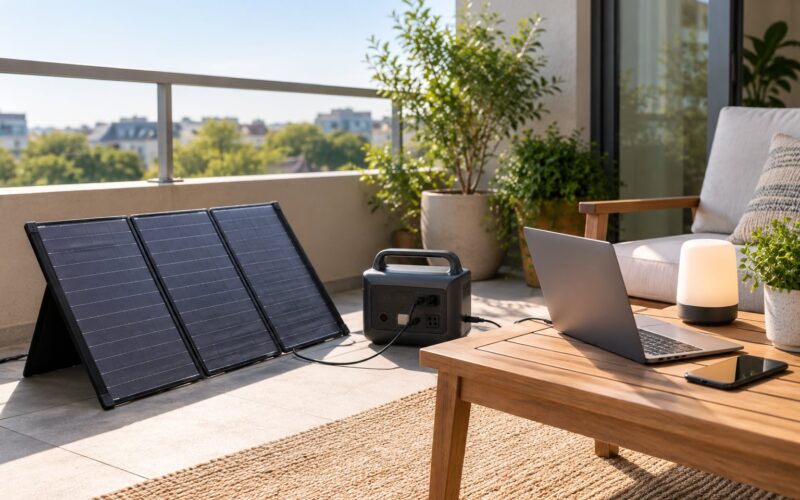
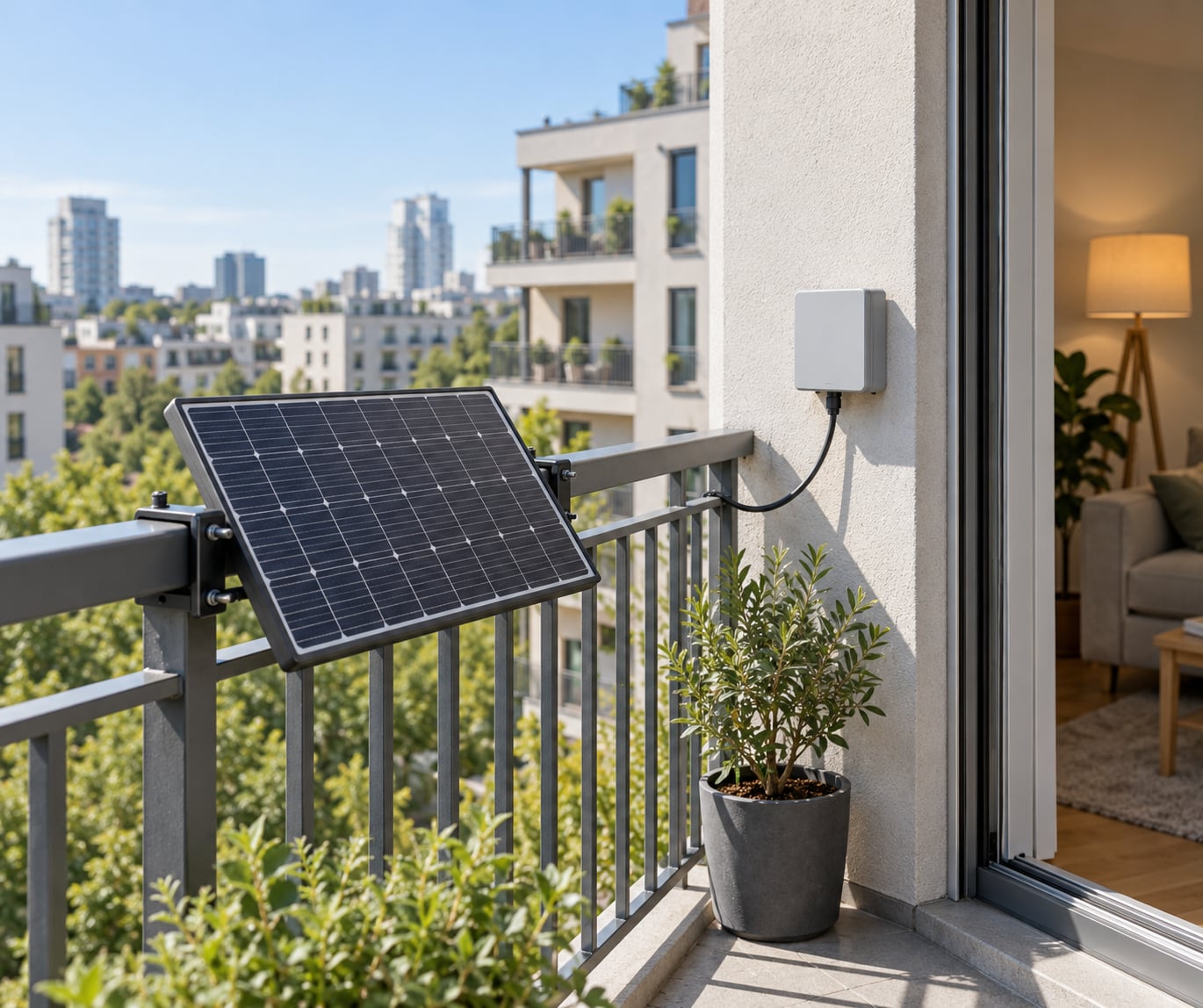
A balcony solar system is a compact solar installation sized for a railing rather than a roof: one or two panels, a rail or wall bracket, a microinverter, and a cable that plugs into an ordinary household outlet. The German version of this idea is often called a Balkonkraftwerk, and the plug-in form is usually sold as plug-in solar or a plug and play solar kit.
The load it serves is equally specific. A balcony system produces a few hundred watts on a bright afternoon, so it is matched to things that draw power all day: a router, a monitor, a refrigerator cycling in a sunny kitchen, a home office running on a laptop, balcony lighting, or a small irrigation pump on a timer.
It is not a solar garden lamp, which is a small sealed panel wired to one LED and stops the moment the sun goes down. A balcony system is a real grid-connected generator with a panel, a conversion device, and a connection to your wiring.
And it is not rooftop solar in miniature. Rooftop arrays are designed to serve a whole building and can be wired into a panel with battery backup. A balcony system plugs into a receptacle and offsets whatever is drawing power right now.
How Balcony Solar Systems Work From Sun to Power
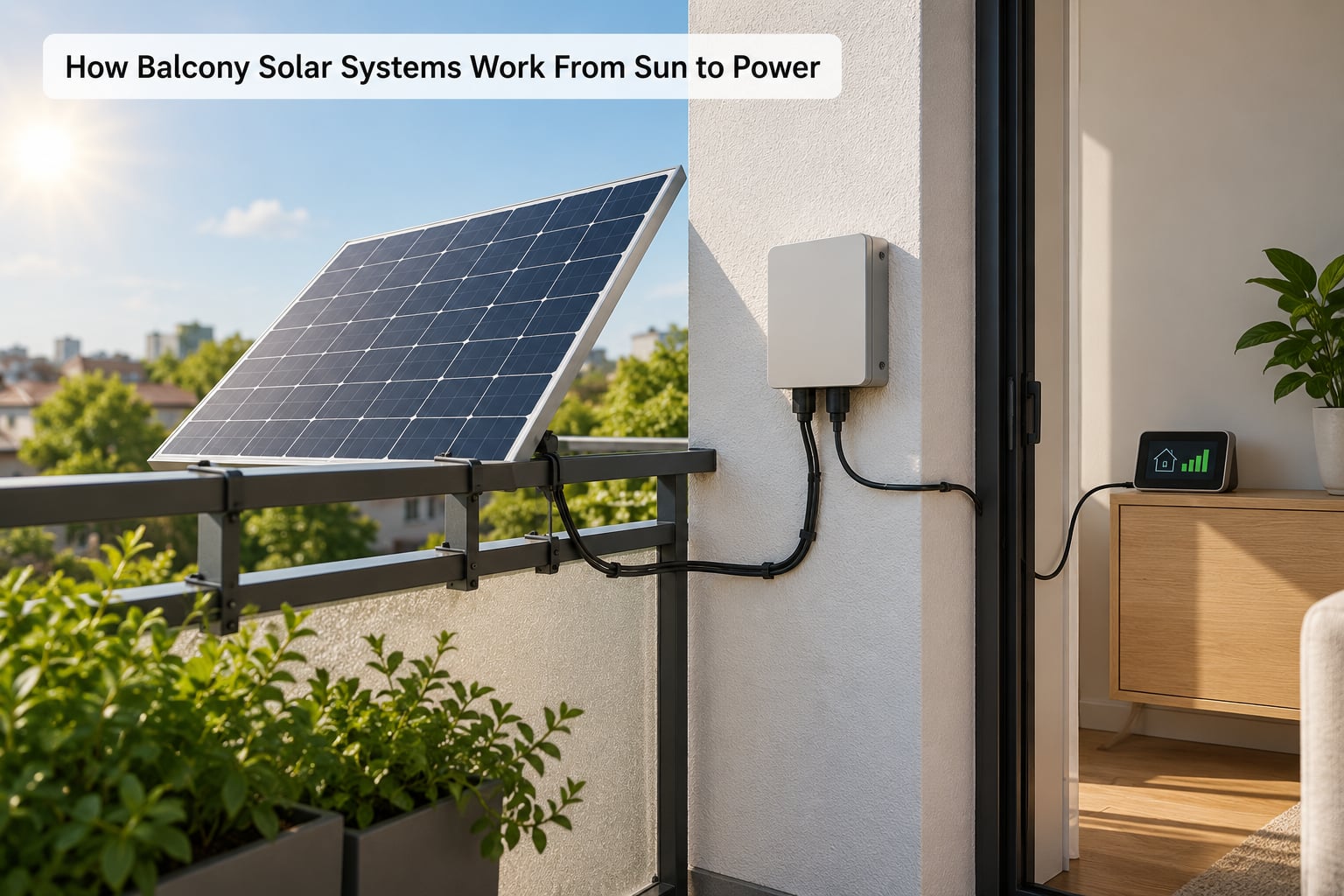
The energy path has five stages. Understanding them tells you where your output goes and why a shaded balcony behaves so differently from a marketing photo.
1. Photons hit the panel and knock electrons loose
Balcony panels are built from photovoltaic cells, which are semiconductors, usually silicon. When photons from sunlight strike the surface with enough energy, electrons break free of their atoms and begin moving in one direction. That movement is electricity, and because it flows one way, it is called direct current.
2. The panel outputs direct current through its leads
The wired edge of each cell strings together in series and parallel so the module produces a usable voltage, usually 30 to 40 volts DC. Two cables exit the back of the frame through weatherproof MC4 connectors, which lock so water and grit cannot reach the contacts.
3. The microinverter converts DC to alternating current
A standard wall outlet carries alternating current, and your appliances expect AC at a precise voltage and frequency. The microinverter sits between panel and plug and does that conversion one panel at a time, then shapes the output so it matches the grid frequency your utility supplies.
4. The plug feeds power into the receptacle
The inverter’s plug inserts into a grounded outlet, and the generated current travels upstream into the branch circuit serving that receptacle. Your electrical panel sees a small current arriving rather than leaving.
5. Your running loads absorb it, and the grid covers the rest
This is the piece most descriptions get wrong. A grid-tie inverter supplies the first N watts of your current load, and the utility provides everything above that. If your house is drawing 300 watts and the inverter is making 400, the surplus is curtailed rather than pushed anywhere.
That single sentence explains the whole economic model. You only save on what your home is using at the moment the sun is up.
How Much Power Can a Balcony Solar System Produce?
Real output depends on three things: the rated wattage of the kit, how many peak sun hours your balcony actually gets, and how much of that light reaches the panel instead of hitting a railing, a neighbouring wall, or an overhang.
A peak sun hour is one hour of full sun at solar noon. Three peak sun hours a day is a reasonable expectation for a north-facing balcony in a temperate climate; five is closer to a south-facing balcony in a sunny region. Multiply rated watts by peak sun hours, then apply a system efficiency factor of roughly three quarters for heat, wiring, and conversion losses.
| System size | 3 peak sun hours | 4 peak sun hours | 5 peak sun hours |
|---|---|---|---|
| 400 W kit | About 0.9 kWh/day | About 1.2 kWh/day | About 1.5 kWh/day |
| 800 W kit | About 1.8 kWh/day | About 2.4 kWh/day | About 3.0 kWh/day |
| 1200 W kit | About 2.7 kWh/day | About 3.6 kWh/day | About 4.5 kWh/day |
Multiply the daily figure by 365 for a rough annual number, and expect it to vary through the year. Winter output in a shaded or north-facing spot can be a fraction of a summer day.
You will also see a rule of thumb claiming a panel converts about a third of the sunlight striking it into electricity. It is a rough mental model derived from early commercial silicon cells, not a rating and not a promise. Modern panels do better in bright sun and much worse in heat or haze, which is why it does not translate neatly into a kWh figure for your balcony.
| Load | Typical running draw | Can a small kit offset it? |
|---|---|---|
| Router and modem | 8 to 15 W | Yes, continuously |
| LED bulbs | 8 to 12 W each | Yes |
| Phone and laptop charging | 5 to 65 W | Yes |
| Refrigerator | 100 to 200 W, high startup surge | Partly, only while the sun is up |
| Television | 70 to 150 W | Yes, in daylight |
| Dehumidifier | 200 to 400 W | Only with a larger kit |
| Washing machine | 400 to 800 W when heating water | Rarely |
| Level 2 EV charger | 1400 W and up | No |
Most households draw several hundred watts of background load during daylight hours, which is why a modest kit can cover a surprising share of the always-on stuff and almost none of the heating or charging.
What Components Does a Balcony Solar System Need?
Every kit sold for this purpose covers the same six jobs, and it helps to know which part does what before you read a spec sheet.
- Panels. Usually one or two 400 W modules with tempered glass and an anodized frame. Weather ratings such as IP65 matter on a balcony where rain comes sideways.
- Mounting hardware. Railing clamps, a wall bracket, or a stand, sized for wind loading rather than just panel weight. A railing bracket that bites a balcony where drilling is not permitted is the common case.
- A microinverter. Converts each panel’s DC to grid-matched AC. It is the most expensive part, the part that carries the meaningful warranty, and the part forum buyers check first when buying used.
- Cabling and connectors. Outdoor-rated DC cable between panel and inverter, MC4 connectors at both ends, and an AC plug for the receptacle.
- Protection equipment. Ground fault and interruption protection, a rapid disconnect switch, and earthing. In the United States, look for UL 3700 certification, the standard written for these movable plug-in devices.
- Monitoring. Many kits ship with a small plug-in meter or an app on a Wi-Fi connection so you can see daily generation instead of guessing.
A lithium-ion battery and a charge controller are optional additions for a grid-connected kit. They let you bank midday surplus for the evening, and they are what turns the system into something closer to a small backup supply. They also add cost, weight, and a second charging stage to maintain.
Can You Install Solar on a Balcony or Rent an Apartment?
Often yes, with permission. Three separate approvals matter and they are not the same thing.
The building or lease
Your lease or condo association rules usually govern anything fixed to a railing or drilled into a wall. A renter needs written permission from a landlord, and the landlord may need sign-off from the building. A free-standing setup that touches nothing structural is an easier conversation, though many leases still treat it as a fixture.
Local permission
In the United States, plug-in solar legality varies by state. As of 2026, nine states have enacted laws specific to these devices, most pairing a power cap around 1,200 watts of AC output with a UL 3700 certification requirement and a notification duty to the utility. Elsewhere it falls under general interconnection and electrical codes. Check your state’s position before you buy.
The outlet itself
The receptacle needs grounding and a ground fault circuit interrupter. Many guidance pages call for a dedicated circuit so the inverter is not sharing capacity with other loads, and a properly oriented grounded outlet rather than an adapter. Do not assume an outdoor balcony outlet is suitable just because it is near the panel.
The physical questions
A railing has to take the panel’s weight and the wind force that comes with a panel acting as a sail at height. Check the railing’s rated load, and expect an installer or your landlord to ask for wind loading figures. Shading is the quieter killer: a railing, an overhang, a neighbouring building, or a bare tree will cut output far more than the panel’s wattage suggests.
What Are the Main Benefits and Limitations?
Balcony solar’s appeal is access rather than capacity. It opens some share of generation to people who cannot install a rooftop array: renters, apartment residents, condo owners with shared roofs, and anyone whose roof faces the wrong direction. The system moves with you when you move, and it needs no roof access at all.
The limitation is that it produces less than you might hope and only when the sun is up. Expect single-digit kilowatt-hours on a small kit, drop to near zero on an overcast day, and no output after dark. Overcast conditions flatten generation so severely that most owners describe solar as something to plan around rather than rely on.
There are export limits too. Where a state law caps the device, the inverter is simply built to that cap. And most plug-in solar is not credited through net metering, so surplus you cannot use is not bought back. That makes daytime self-consumption the entire case, which is why orientation matters so much.
Maintenance is light but not zero. Dust and bird droppings on glass, connectors to check for corrosion, and firmware that occasionally needs attention.
What Safety Rules Should You Follow?
Pushing current back into a circuit that was built to draw from it deserves care. The rules below are not optional.
- Use a certified device. In the US, UL 3700 is the standard for these movable plug-in PV devices. Certification, compliance, and being merely ready are three different claims.
- Follow the manufacturer’s installation instructions. They specify mounting torque, connector pairing, circuit requirements, and orientation. Deviating from them voids the warranty and the certification.
- Use a grounded, GFCI-protected outlet. Ground fault protection is what protects people from a fault in equipment that is outdoors on a wet surface.
- Never run an extension cord. It is called out in nearly every guide and it is the rule people break most often. An extension cord is not part of the certified installation.
- Do not work on live wiring. Plugging in a complete unit is a different act from opening a panel, splicing cable, or fitting a breaker. Anything beyond the plug belongs to a licensed electrician working to local code.
- Respect the anti-islanding shutdown. The inverter detects a grid failure and stops producing within seconds. That protection exists so line workers are not exposed to live equipment on a de-energized line. Never bridge or defeat it.
- Keep it clear and ventilated. Mount where nothing drapes over the inverter and where no one can lean on or tamper with the connection.
How Do You Choose the Right Balcony Solar Setup?
Work through these in order. Most mismatches come from picking the panel size first and the balcony second.
Start with the load you actually want covered
List what runs in your home between 9am and 4pm on a clear day. If that adds up to under 200 watts, a small kit covers it completely and anything larger is curtailed. If your goal is heating water or charging a car, balcony solar is the wrong tool and no size change will fix that.
Measure the sun, not the marketing
Watch the balcony across a full day at a few points in the year. Count how many hours it is unshaded. A railing that clips the lower third of the panel for two hours a day costs you more than any orientation upgrade recovers.
Check the balcony
Railing load rating, wind exposure, mounting options that do not require drilling, and a safe route for the cable to the receptacle.
Check the rules before the money
Your state’s position, your utility’s requirements, your lease, and your building’s rules. A device you have to remove because of a clause is not portable in any sense that matters.
Decide portable, grid-connected, or battery-backed
Grid-connected alone suits most people: it is the simplest path and the cheapest per watt. A battery makes sense if you want power after sunset or some resilience during outages, and you should accept the added weight, cost, and maintenance. A portable power station is a different product entirely: it stores energy rather than generating it, and it works anywhere without a permit.
Buy the inverter’s warranty, not the panel’s
The panel is the visible part and the inverter is the component that fails. Check warranty length on the microinverter specifically, and if you buy used, confirm it transfers. Forum buyers regularly learn this the hard way.
Frequently Asked Questions
Can a balcony solar system power a whole apartment?
No. A typical kit outputs 400 to 1,200 watts of AC, while a normal apartment draws several kilowatts whenever anything more than a few lights is running. It offsets daylight loads such as a router, monitor, or refrigerator, and the grid supplies everything else. It cannot run electric heating, water heating, or a level 2 EV charger.
Do balcony solar panels work in winter or on cloudy days?
Yes, but at a much lower level. Panels still generate under cloud, though owners report output flattening to a small fraction of a sunny day. Winter brings lower sun angles and shorter days, so a north-facing or shaded balcony can lose most of its summer figure. Treat it as a daytime supplement, never a dependable supply.
Can I connect a balcony solar system directly to my home?
That is exactly what it does, through a standard grounded outlet rather than through your panel. The plug feeds current into the branch circuit, and your running loads absorb it while the grid covers the rest. Connecting to a breaker or wiring a new circuit is a different job, and one for a licensed electrician.
Is a battery required for a balcony solar system?
No. Most kits are grid-connected only, and surplus generation is curtailed once your household load is met. Adding a lithium-ion battery with a charge controller stores midday output for evening use, but it adds weight, cost, and maintenance. It also changes outage behaviour only for circuits the battery is designed to carry.
How much maintenance does a balcony solar setup need?
Very little. Wipe dust and bird droppings off the glass a couple of times a year, check connectors for corrosion after storms, and keep the inverter unobstructed. Occasionally the monitoring app or inverter firmware needs an update. If it is certified and installed to the manual, the system should run for years without a technician.
Conclusion
How balcony solar systems work comes down to one short chain: sunlight moves electrons in a silicon cell, a microinverter converts that direct current into grid-compatible alternating current, and a plug pushes it into a receptacle where your running appliances absorb it. Surplus is curtailed, night-time output is zero, and an outage shuts the whole thing down.
Start by watching your balcony for a day and counting unshaded hours. Then add up what your home draws in the afternoon, check your state’s rules and your lease, and confirm you have a grounded GFCI outlet within reach of the panel. If any of those four steps come up short, a different kind of solar setup will serve you better.