NiMH is the better battery for solar lights in almost every case, because it stores more usable energy, has no memory effect, and handles a partial nightly charge better. NiCd still wins in one place that matters: deep cold. If your lights sit outdoors through sub-zero weather, or the fixture shipped with a tiny low-capacity cell, nickel-cadmium may outlast nickel-metal hydride. Here is the honest comparison, including the swap question most people actually want answered.
I have replaced batteries in more garden lights than I care to admit, and the same failure keeps showing up: someone drops a 2000mAh cell into a fixture whose panel can barely refill a 600mAh cell, then wonders why the light now dies by 9pm instead of midnight. The chemistry debate matters less than the sizing rule, which is why both get their own section below.
Table of Contents
- nicd vs nimh batteries for solar lights at a Glance
- What Is the Difference Between NiCd and NiMH Batteries?
- Which Battery Holds More Charge for Solar Lights?
- How Do NiCd and NiMH Batteries Handle Solar Charging?
- Why a Small Panel Changes Everything
- Which Type Lasts Longer and Has Fewer Problems?
- Are NiCd or NiMH Batteries Better for the Environment?
- Can You Replace One Battery Type with the Other?
- Which Should You Choose?
- Frequently Asked Questions
- Can I use a NiMH battery instead of NiCd in a solar light?
- Are NiMH batteries always better than NiCd batteries?
- What voltage battery does a solar garden light use?
- Why does my NiCd solar light stop working after being fully charged?
- How should I dispose of old NiCd and NiMH batteries?
- Do solar lights charge NiMH batteries properly in winter?
- The Short Answer
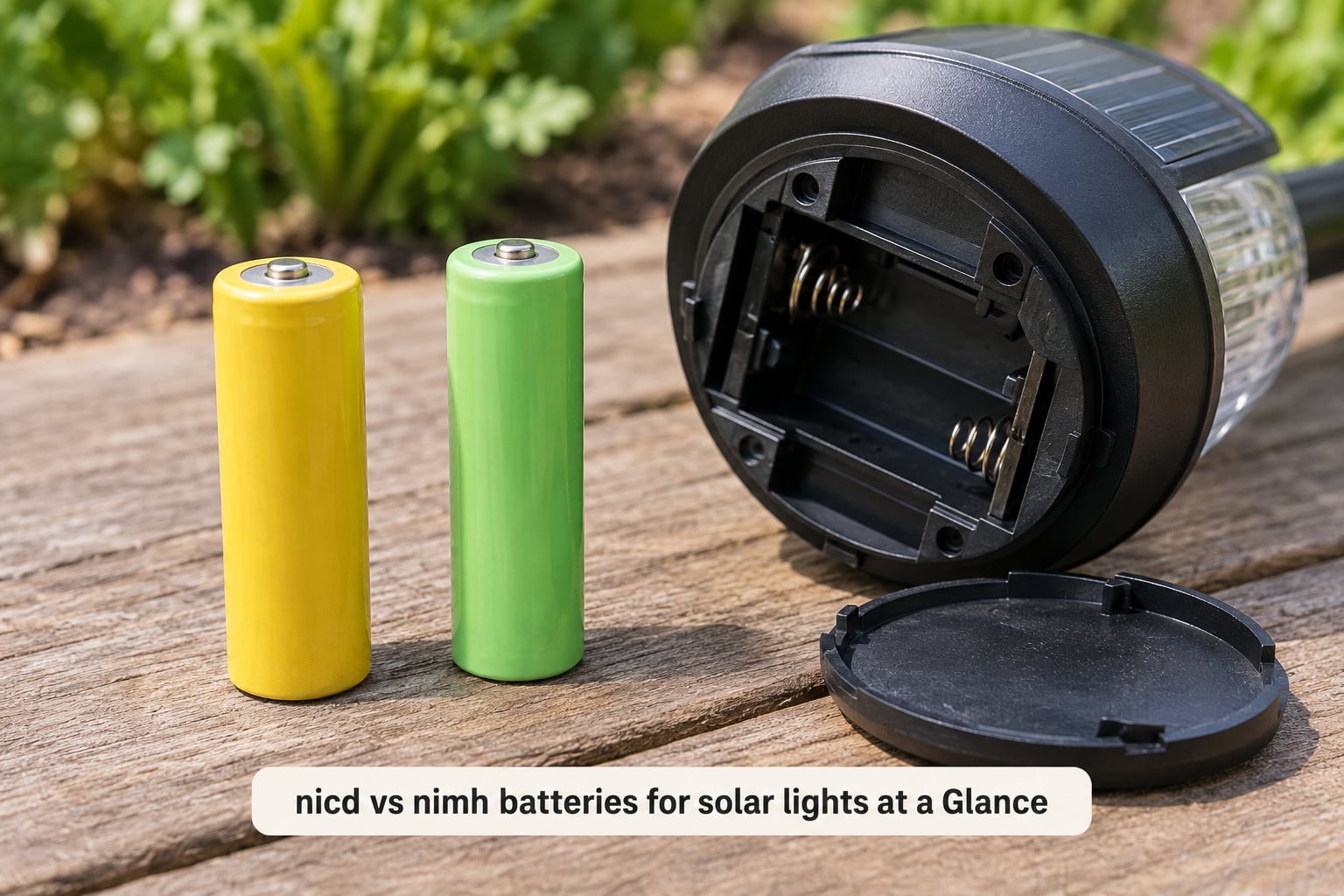
nicd vs nimh batteries for solar lights at a Glance
| Factor | NiCd (nickel-cadmium) | NiMH (nickel-metal hydride) |
|---|---|---|
| Nominal cell voltage | 1.2V | 1.2V |
| Typical capacity in solar fixtures | 300mAh to 1200mAh AA | 600mAh to 1200mAh AA; general-purpose cells run 2000mAh and up |
| Energy per cell | Lower | Up to roughly 40 percent higher |
| Charging from a solar panel | Very tolerant, accepts a long trickle charge | Efficient, but more sensitive to overcharge on cheap all-day circuits |
| Operating temperature range | About -40 to 60C | About -20 to 60C |
| Cold weather runtime | Holds up well below freezing | Runtime drops noticeably in deep cold |
| Cycle life | Roughly 1000 cycles | Roughly 1000 cycles, varies by cell and charge method |
| Memory effect | Yes, a real problem with shallow daily discharge | None to speak of |
| Self-discharge | Higher, around 5 to 7 percent per month | Lower, roughly 2 to 3 percent per month for typical cells |
| Environmental profile | Contains toxic cadmium | No cadmium, recyclable materials |
| Best for | Cold climates, budget fixtures, low-charge-current panels | Most modern path, garden, deck and sign lights |
Both chemistries put out the same 1.2V per cell, which is why they physically fit the same slot. Everything else on this list is where the choice actually bites.
What Is the Difference Between NiCd and NiMH Batteries?
Nickel-cadmium, usually printed NiCd, stores charge using nickel oxide hydroxide and a cadmium electrode. Cadmium is what gives the cell its toughness: it tolerates deep discharge, rough handling, heat, and a slow trickle charge without complaint.
Nickel-metal hydride, or NiMH, replaces the cadmium with a hydrogen-absorbing alloy. That swap removes the toxic metal and lets the cell hold considerably more energy in the same AA or AAA shell, which is the whole reason it became the default rechargeable.
Why do solar lights use one or the other? Cheaper fixtures built in the 1990s and early 2000s shipped NiCd because it was cheap and nearly impossible to ruin. Modern lights use NiMH because buyers wanted longer runtimes, and the charge circuits got better at the same time.
Three terms show up constantly, so it is worth pinning them down. Memory effect means a NiCd cell gradually forgets how to hold its full charge after repeated shallow discharges, which is exactly what a solar light does every night. Self-discharge is the percentage of charge lost while the cell just sits there. Trickle charge is the small continuous current a solar panel pushes through the fixture’s charge circuit during the day.
Which Battery Holds More Charge for Solar Lights?
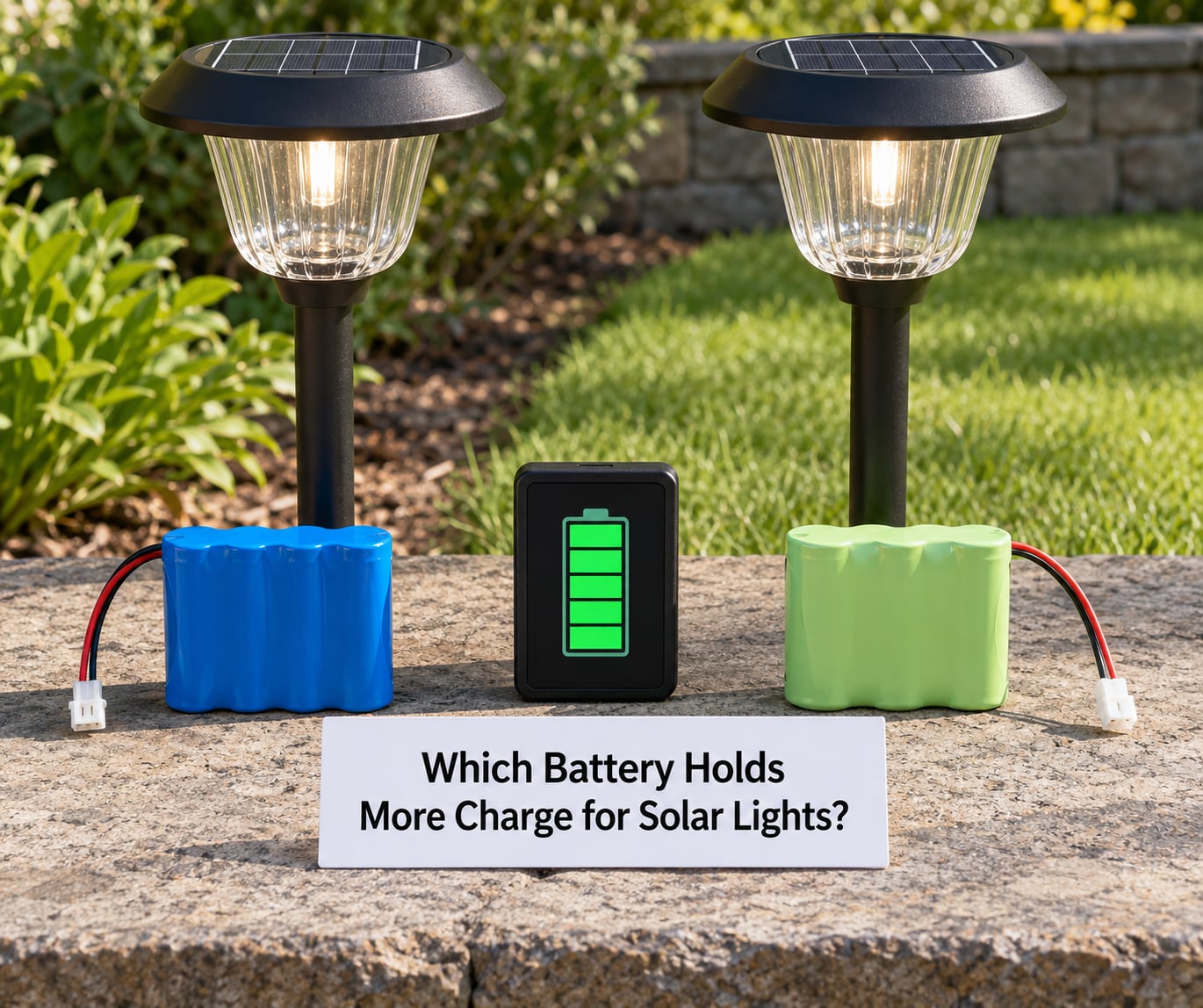
On paper NiMH wins, carrying up to around 40 percent more energy than NiCd at the same size. On a real path light, the gap shrinks a lot, because the panel decides how much energy ever gets in.
The part most buyers get wrong is size, not chemistry. A stake light panel is small and delivers a low charge current, so a 2000mAh+ general-purpose cell may never reach full charge, no matter how many sunny days you give it. A half-full 2000mAh cell gives you less usable light than a properly charged 900mAh cell.
For most garden and path lights, the practical sweet spot sits between 600mAh and 1200mAh. Someone on r/diyelectronics described a 6V NiCd pack of AA cells printed at only 400mAh straight from the factory, and called it exactly what it was. On r/batteries, buyers of dedicated solar NiMH cells such as the Varta 800 Solar AA note how modest that capacity is by design.
Hobbyists on CandlePowerForums push the same logic harder, recommending low-capacity 600mAh to 1000mAh NiCd cells for yard lights because higher capacity simply does not fit the application. If you are matching capacity, 600mAh instead of 300mAh is fine. Doubling past what the panel can deliver is what causes problems.
How Do NiCd and NiMH Batteries Handle Solar Charging?
A solar light charges with a low, continuous current during daylight and stops feeding the cell once the circuit’s cutoff voltage is reached. Both chemistries handle that, but not identically.
NiCd accepts a slow, long trickle without complaint. It also tolerates being left on the panel for days with no damage, which is why cheap fixtures with all-day charge circuits never had a problem with it.
NiMH charges more efficiently and soaks up a weak panel faster, but it is more sensitive to overcharge. On a circuit designed for NiCd and left running all day, the extra voltage can shorten cell life. The consensus on AllAboutCircuits and the eevblog forum is that a charger built for NiMH will usually charge NiCd safely, while a NiCd charger pushing an NiMH pack in is less accurate on charge termination.
Why a Small Panel Changes Everything
Partial charging is normal for solar lights. Cloudy weeks, shade from a fence, and winter sun all mean the cell never sees a full charge, and NiCd responds to that pattern by shrinking its usable capacity through memory effect. NiMH just runs on what it has.
Cold weather works the other way round. NiCd keeps performing down to around -40C; NiMH is rated nearer -20C and gives up visible runtime below freezing. If your lights face a north-facing yard that freezes solid for weeks, that gap is real.
You cannot fix any of this by changing chemistry alone if the panel is undersized or shaded. In that case, cleaning the panel, clearing the growth around it, or moving the fixture does more than a new battery will.
Which Type Lasts Longer and Has Fewer Problems?
Both chemistries land near 1000 charge cycles in good conditions, so cycle life alone rarely decides it. What differs is how gracefully each one ages in a specific environment.
Self-discharge favors NiMH. Typical cells lose roughly 2 to 3 percent a month, against around 5 to 7 percent for NiCd, so a NiMH light holds more of its afternoon charge through to the end of a long winter night.
Memory effect favors NiMH just as clearly. A NiCd light drained only partway every night for a season can lose a chunk of its capacity and stay there until you fully discharge it, if the fixture even allows that.
Deep discharge tolerance favors NiCd, and so does heat. Cells in a sealed stake light can cook in summer, and NiCd shrugs that off better than NiMH does.
The most common real-world complaint from NiMH upgraders is short runtime after a swap. That is nearly always a panel-matching problem, not a chemistry problem.
Are NiCd or NiMH Batteries Better for the Environment?
NiMH is the better environmental choice, and not by a small margin. Cadmium is a toxic heavy metal that the EU restricts in batteries for exactly this reason, and NiCd cells need proper take-back routes rather than household trash.
NiMH cells contain no cadmium and use materials that recyclers handle easily. Disposal is still regulated in most places, just for different reasons, and recycling rate for NiMH remains far below what it should be.
Lower impact does not automatically make NiMH the right swap for your fixture. A cold-climate location with a well-made NiCd pack may be better served by keeping the cells it already has and recycling them properly at end of life.
Can You Replace One Battery Type with the Other?
Usually yes, with caveats. Both are 1.2V cells and both come in AA and AAA, so the mechanical swap is easy. The electronics decide the rest.
Before you buy anything, read the printed rating on the cell already in your light and look at its label. NiCd cells nearly always say NiCd or show a cadmium recycling mark; NiMH cells say NiMH, Rechargeable, or nothing at all. A multimeter set to DC voltage helps too: a fully charged cell of either type reads close to 1.2V, and an exhausted one sits below 1.0V.
Do not mix chemistries in one pack. A fixture with two AA slots in series driven by a weak panel can push the stronger cell past its limit while the weaker one lags, and NiMH is the cell that suffers first.
Keep the replacement capacity close to the original printed rating. A big jump in mAh on an old fixture is the change most likely to disappoint you, because the charge circuit was sized for whatever shipped with it.
Follow the manufacturer’s instructions where they exist. If your light is cheap enough that they do not exist, stay close to the original cell specification and stop there.
Which Should You Choose?
| Your situation | Choose | Capacity to target |
|---|---|---|
| Replacing cells in an existing compatible fixture | Match the printed rating first | Whatever the original cell shows |
| New path or garden lights you are buying today | NiMH | 600mAh to 1200mAh AA |
| Frequent nightly use, long summer evenings | NiMH, larger cell | 1000mAh to 2000mAh if the panel is generous |
| Cold, shaded, or north-facing spot | NiCd, or move the fixture | 600mAh to 1000mAh |
| Low-budget repair of an old NiCd light | NiCd if you can find a legitimate cell | Match the original printed mAh |
| Any replacement where you care about disposal | NiMH | 600mAh to 1200mAh |
If you can only pick one answer for a typical backyard, go NiMH at a moderate capacity and stop optimizing. The gains past that point are small, and the failures are frustrating to diagnose.
Two years is a reasonable replacement interval for either chemistry in an outdoor fixture, regardless of how good the cell claims to be. Heat, moisture, and trickle charging wear cells out faster than their cycle rating suggests.
Frequently Asked Questions
Can I use a NiMH battery instead of NiCd in a solar light?
Usually yes, since both are 1.2V cells in AA or AAA sizes. Keep total voltage identical to the original pack, match all cells to the same chemistry, and stay near the printed mAh of the cell you are replacing. On an old fixture, a large capacity jump can overwork a charge circuit sized for NiCd.
Are NiMH batteries always better than NiCd batteries?
No. NiMH stores more energy, has no memory effect, and self-discharges more slowly, which makes it the better default. NiCd still wins below about -20C, tolerates deep discharge and heat better, and is more forgiving on a cheap all-day trickle charger. Cold climate and an undersized panel are the two cases where the older chemistry holds its ground.
What voltage battery does a solar garden light use?
Most solar garden lights use one or more AA or AAA rechargeable cells at 1.2V nominal, giving 1.2V, 2.4V, 3.6V, 4.8V or 6V packs depending on how many cells are wired in. Both NiCd and NiMH cells are 1.2V, so voltage alone never tells you which chemistry is inside. Read the cell label instead.
Why does my NiCd solar light stop working after being fully charged?
A cell reading full but producing no light usually points at the fixture, not the battery. Test the pack with a multimeter, then cover the photocell to force the light on. If it stays dark, check the on/off tab, the contacts for corrosion, and the sensor cover. Leaving a NiCd light switched off also lets its higher self-discharge drain the pack.
How should I dispose of old NiCd and NiMH batteries?
Never put either chemistry in household trash. NiCd contains cadmium and is subject to strict collection and take-back rules in many jurisdictions, and NiMH is regulated as well despite being cadmium-free. Use household hazardous waste, a manufacturer take-back program, or a certified recycling drop-off point near you.
Do solar lights charge NiMH batteries properly in winter?
They charge, just slowly. Winter sun delivers far less energy, so a small panel may never fully refill the cell no matter how clear the day is. NiMH handles repeated partial charging better than NiCd because it has no memory effect, but runtime still drops. Clean the panel, keep snow off it, and expect shorter nights on the same cell.
The Short Answer
NiCd vs NiMH batteries for solar lights comes down to one decision: buy NiMH at 600mAh to 1200mAh unless your light sits in real freezing weather or an old fixture expects NiCd. Read the printed rating on the cell you are replacing, match that chemistry, and skip the temptation to fit the biggest battery you can find.
When the light still will not light up after a swap, the panel is usually the culprit. Clean it, give the fixture two full days of direct sun, and make sure the on/off tab is actually turned on.