Here is how LED chips work in solar lights, stripped to the useful parts. The chip is a small semiconductor device that turns the direct current from the rechargeable battery into light: electrons and holes meet at a junction inside the chip, release energy as photons, and a phosphor coating turns the blue glow into white. That whole process needs so little power that a small panel and a small battery can run it all night.
Understanding the chip explains most of what confuses people about solar lights. Why two fixtures with the same wattage look completely different. Why a light dims in January but is fine in July. And why a lamp that stopped glowing after a year almost always has a corroded driver or a dead battery, not a dead chip. Updated for 2026, with the details homeowners can actually test at home.
Table of Contents
- What Is an LED Chip in a Solar Light?
- How LED Chips Work in Solar Lights
- How LED Chips Turn Current Into Light
- How Solar Power Reaches the LED Chip
- Why LED Chips Are Used in Solar Garden Lights
- What Determines LED Chip Brightness and Runtime?
- Why LED Chips Can Fail in Solar Lights
- How to Choose a Solar Light Based on Its LED Chip
- Frequently Asked Questions
- Do LED chips charge in a solar light?
- Are brighter LED chips always better for solar lights?
- Why does a solar light work during the day but not at night?
- Can a solar light run without a solar panel?
- What does IP65 mean for an LED solar light?
- What to Do First
What Is an LED Chip in a Solar Light?
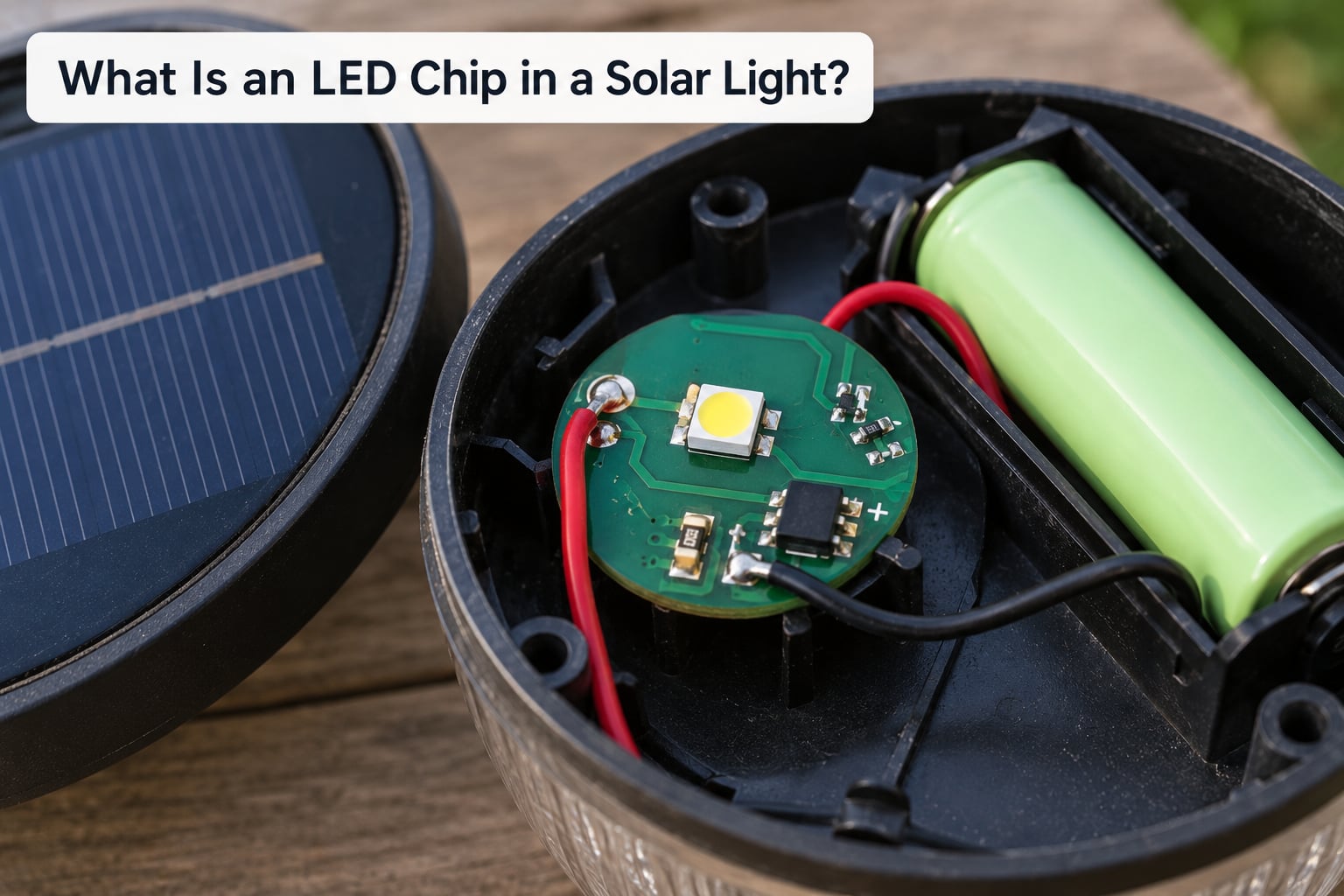
An LED chip is a piece of semiconductor, usually silicon-based gallium nitride or gallium arsenide, cut into a die only a few millimetres across. Put a forward voltage across it and it emits light. That is the whole trick, and it is worth separating three words that get used interchangeably on listings.
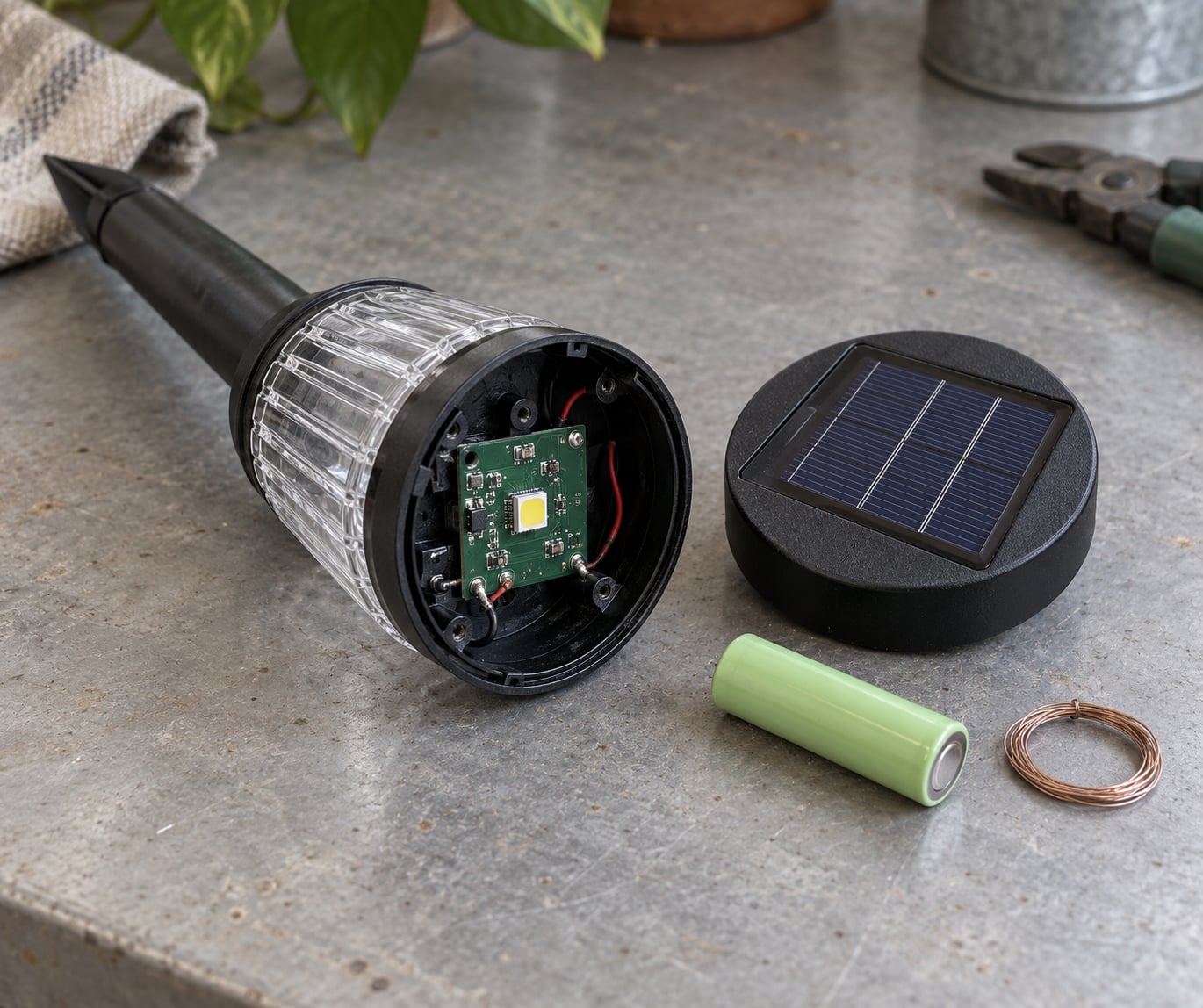
The die is the bare chip. The package is the die bonded to a metal frame and filled with clear or diffused epoxy, usually sold as an SMD LED with a size number like 2830 or 5050, which refers to the package dimensions in millimetres. The lamp is the whole finished emitter assembly. A solar light might carry one LED, eight SMD packages on a little board, or a single COB array of dozens of dies bonded directly to a substrate.
Two more things are mounted on that board with the chip. A phosphor coating, usually a ceramic phosphor blended into the epoxy, absorbs part of the chip’s blue emission and re-emits it at a longer wavelength. That is why a single blue-emitting die can produce warm white, cool white or anything in between. And a current-limiting resistor or driver IC, which holds the current steady as the battery voltage falls through the night. Without it, the chip would draw more and more current and cook itself.
How LED Chips Work in Solar Lights
The energy path has five stages, and every one of them loses a little something. Sunlight arrives, the panel turns part of it into electricity, the controller meters that into a battery, a light sensor closes the circuit at dusk, and the chip converts the stored current into photons.
- Sunlight reaches the panel. Photons strike the photovoltaic surface and knock electrons loose.
- The panel makes DC electricity. The photovoltaic effect converts that light energy into direct current, typically 15 to 22 percent of what landed on it.
- The charge controller meters it into the battery. It limits current so the cells do not overcharge, and cuts outgoing current when the battery is empty.
- The dusk sensor closes the circuit. A photocell senses the light level dropping, and the driver switches current to the LED board.
- The LED chip emits light. Forward current crosses the semiconductor junction, electrons and holes recombine, and photons come out.
How LED Chips Turn Current Into Light
The die is built from alternating semiconductor layers doped in two different ways. One region is doped to create an excess of electrons, the other an excess of positively charged vacancies called holes. Where the two meet sits the pn-junction, and the whole arrangement is repeated as a stack of layers.
Apply forward voltage and the barrier at the junction collapses. Electrons from the n-type side fall into holes on the p-type side. An electron dropping into a hole gives up energy, and that energy leaves as a photon. The colour of the photon is set by the band gap of the material, which is why different chemistries give blue, green, amber or ultraviolet emitters. In a white chip, the blue photons hit the phosphor on the package, and the phosphor gives back a longer-wavelength photon in yellow or red. Blue plus yellow adds up to something the eye reads as white.
What makes this efficient is that almost nothing leaves as heat. An incandescent lamp dumps roughly 90 percent of its input into the filament as heat and only the rest becomes light. A quality LED chip converts roughly 80 to 150 lumens per watt, so for the same light output it pulls a small fraction of the current. That single fact is what made solar garden lighting practical at all.
How Solar Power Reaches the LED Chip
Each stage in the chain does one job, and the useful thing about the chain is that you can test it stage by stage when a light quits.
| Stage | What it does | Where energy is lost |
|---|---|---|
| Photovoltaic panel | Converts sunlight to direct current | About 78 to 85 percent of incoming light never becomes electricity |
| Charge controller | Regulates charge current and blocks drain at empty | Small controllers are inefficient; cheap PWM types can shed 10 to 30 percent of what the panel collects |
| Rechargeable battery | Stores energy as chemical energy | Heat, self-discharge, and age; capacity drops every season |
| Dusk sensor and driver | Switches on at dusk, holds LED current steady | Sensor sensitivity can trigger early or late; marginal drivers flicker |
| LED chip | Converts current to photons | Heat at the junction and phosphor conversion loss, usually the smallest loss in the system |
Panels and batteries are direct current, which suits LEDs because LEDs run on DC. There is no inverter and no transformer anywhere in the chain. The dusk sensor, usually a small photocell that sits under the panel, compares ambient light against a threshold and flips a transistor when it goes dark.
Once the circuit closes, current runs from the battery, through the driver, across the forward voltage of the chip (typically a couple of volts per die), and back. Hold the current constant and the light holds steady. Let voltage sag as the battery empties and the light fades and flickers, which is a good clue when you are diagnosing a fault.
Why LED Chips Are Used in Solar Garden Lights
Low current draw is the reason, and the other benefits follow from it. A solar light gets maybe two to five peak sun hours a day, and a path light has a tiny panel to collect them with. Whatever the chip wastes is gone forever.
LEDs draw a fraction of what a comparable incandescent or halogen source would. Longevity matters just as much on solar equipment: quality chips are rated for 25,000 to 50,000 hours, which at five hours of nightly use is well over a decade of service, while the battery underneath them usually fails first. Switching speed keeps the current draw steady instead of spiking, which matters for battery life. Directional output means the light goes where the fixture aims instead of radiating into the neighbouring hedge.
Heat is the underrated one. The chip still produces heat at the junction, but far less heat per lumen, so the board runs cool enough to sit inside a sealed plastic or metal housing that a glass bulb could never tolerate.
What Determines LED Chip Brightness and Runtime?
Brightness and runtime pull against each other, and the chip is where that trade happens. Five things matter most.
- Lumens per watt (efficacy). The real quality number. Two chips rated at 0.5W can deliver 40 lumens or 90 lumens.
- LED wattage and forward current. More current means more light and a shorter night.
- Colour temperature. Warm white around 2700 to 3000K looks softer and spreads light differently than cool white at 5000 to 6500K. Perceived brightness varies, so compare on lumen output, not colour.
- Battery capacity in mAh. This is your runtime budget.
- Panel size and sunlight. The panel decides how much energy goes in; the battery decides how long it lasts.
Here is the sizing rule of thumb. Runtime in hours is roughly battery mAh multiplied by usable voltage, divided by the LED current draw in mA. A 2000 mAh battery feeding a light that draws 60 mA gives you about 30 hours of theoretical light, which in practice is one full night with plenty left over.
Wattage on its own tells you very little. A fixture listing 2000 lumens on a postage-stamp panel is usually quoting a number measured at full battery charge, before dusk dimming, not what you see at midnight in March. Anyone selling realistic runtime beats anyone selling a headline lumen figure.
Why LED Chips Can Fail in Solar Lights
The chip is often the last component to fail, not the first. A teardown posted on r/hardwaregore found three of four legs of the driver IC corroded away on a failed outdoor lamp while the LED itself was completely undamaged. Users on solar and electrical forums repeat the same story: the light is dead, the panel and battery look fine, and the real fault is somewhere in the tiny board between them.
Common failure points, roughly in the order they show up:
- Moisture ingress. Water gets past the seal, sits on the board, and corrodes solder joints and pins.
- Corroded contacts. Battery terminals and exposed traces go green and stop conducting.
- Driver or charge controller failure. The controller can die while panel, battery and chip all stay physically intact.
- Voltage mismatch. Fitting the wrong battery chemistry, alkaline instead of NiMH or lithium-ion, will stress or kill the driver.
- Heat stress. Poorly sealed fixtures in direct sun can cook the driver.
- Cold weather. Battery capacity drops sharply in winter, so the light draws the same current from a weaker source and the driver runs harder.
Before anything else, the community test that works more than any other: remove the rechargeable battery and fit a standard alkaline cell. If the light comes on, the chip and driver are fine and the rechargeable cell was the problem. Note that many cheap fixtures will not accept a standard cell, so on those the test is to clean the contacts first and then measure battery voltage after a full day of sun. Anything under about 1.2V per cell on a NiMH pack points at the battery, not the chip. Mains work is a different story entirely: leave anything involving wiring modifications to a qualified electrician.
How to Choose a Solar Light Based on Its LED Chip
Read the efficacy number, not the wattage. If a listing gives lumens per watt, that tells you almost everything. If it only gives lumens, look for the LED wattage and work it out yourself, then compare the answer to similar fixtures.
Check the battery and panel pair rather than the light on its own. A bigger LED on a small panel gives you a bright first half-hour and a dark rest of the night. Many fixtures include three brightness modes, and the lowest mode can stretch runtime several times over, so it is worth checking whether one exists before you blame the chip.
Look at the IP rating. IP65 means dust-tight and protected against water jets from any direction, which is the sensible minimum for anything left outdoors. IP67 survives temporary submersion. Below that, expect trouble in a wet climate.
Prefer fixtures where the battery is replaceable and the LED board is a separate module rather than potted in. Cheap garden lights arrive with sealed cells and glued boards, which is why so many end up in landfill after one winter. Match the replacement battery to the chemistry the charge controller expects, and never substitute alkaline.
Frequently Asked Questions
Do LED chips charge in a solar light?
No. LED chips are outputs, not inputs. The solar panel does all the charging, using the photovoltaic effect to turn sunlight into direct current that a charge controller meters into the rechargeable battery. The chip only draws power. Putting a chip under sunlight does nothing, because it generates electricity in reverse, and only a tiny amount of it.
Are brighter LED chips always better for solar lights?
No, brighter usually means a shorter night. A higher-wattage chip produces more lumens but pulls more current from the same battery, so the light runs out sooner. What you actually want is a high efficacy chip, measured in lumens per watt, so you get more light per milliamp-hour. A dimmer but efficient chip on a well-sized panel beats a bright one on a tiny panel.
Why does a solar light work during the day but not at night?
That usually means the battery never charged. Common causes are a panel sitting in shade, dirt or leaves on the surface, the panel being too small for the LED, or a battery old enough to have lost most of its capacity. Less often it is the dusk sensor stuck off. Cover the photocell with black tape and darken the rest of the fixture to check whether the sensor is the problem.
Can a solar light run without a solar panel?
Yes, but not as a solar light. It needs power from somewhere, and the chip only cares about the volts and amps arriving at the board, not where they came from. Many fixtures will run happily from a suitable external DC supply or a charged battery pack. Grid-connected panel setups are a separate matter entirely and are covered by local electrical codes.
What does IP65 mean for an LED solar light?
IP is the ingress protection rating. The first digit rates dust tightness, so 6 means completely dust-tight. The second rates water, so 5 means protection against low-pressure water jets from any direction. In practice IP65 is the sensible minimum for a garden light left out all year. IP67 adds protection against temporary immersion, and anything lower than IP54 will struggle through a wet winter.
What to Do First
Start with the panel and the battery, not the chip. Clean the panel, give it a full day of direct sun, and check for corrosion at the battery contacts. If it still will not light, the alkaline-cell test tells you in under a minute whether the chip and driver are alive. When you do shop for a replacement, compare lumens per watt and check the IP rating first, and pick a light with a replaceable battery so the next failure is a two-minute fix instead of a trip to the bin.