If you have ever wondered how to calculate solar payback period for your own roof, it comes down to one division: your net system cost divided by your annual electricity savings. Once you have those two figures, the whole thing takes about ten minutes with a stack of bills and one installation quote.
Most people get a wrong answer for one of three reasons. They use a lead-generation calculator that flatters the result, they apply a federal tax credit that no longer exists, or they quote a cash-basis payback for a system they are financing with a loan. Fix those three things and your number will hold up.
I will walk through the calculation in six steps and use a real worked example so you can see where each figure comes from. The same structure works whether you are quoting a 6 kW array or a 20 kW system with batteries.
Table of Contents
- What You Need
- Step-by-Step: How to Calculate Solar Payback Period
- 1. Estimate the system’s upfront cost
- 2. Find your current annual electricity cost
- 3. Estimate the solar energy the system will produce
- 4. Calculate annual electricity savings
- 5. Subtract incentives and recurring costs
- 6. Divide net investment by annual net savings
- Common Mistakes
- Frequently Asked Questions
- What is a reasonable solar payback period?
- Is there still a 30% federal solar tax credit?
- How do net metering rules change the math?
- Do solar panels last long enough to pay back?
- Is it better to pay cash or finance the system?
- Is calculating a solar payback period complicated?
- The bottom line on your payback number
What You Need
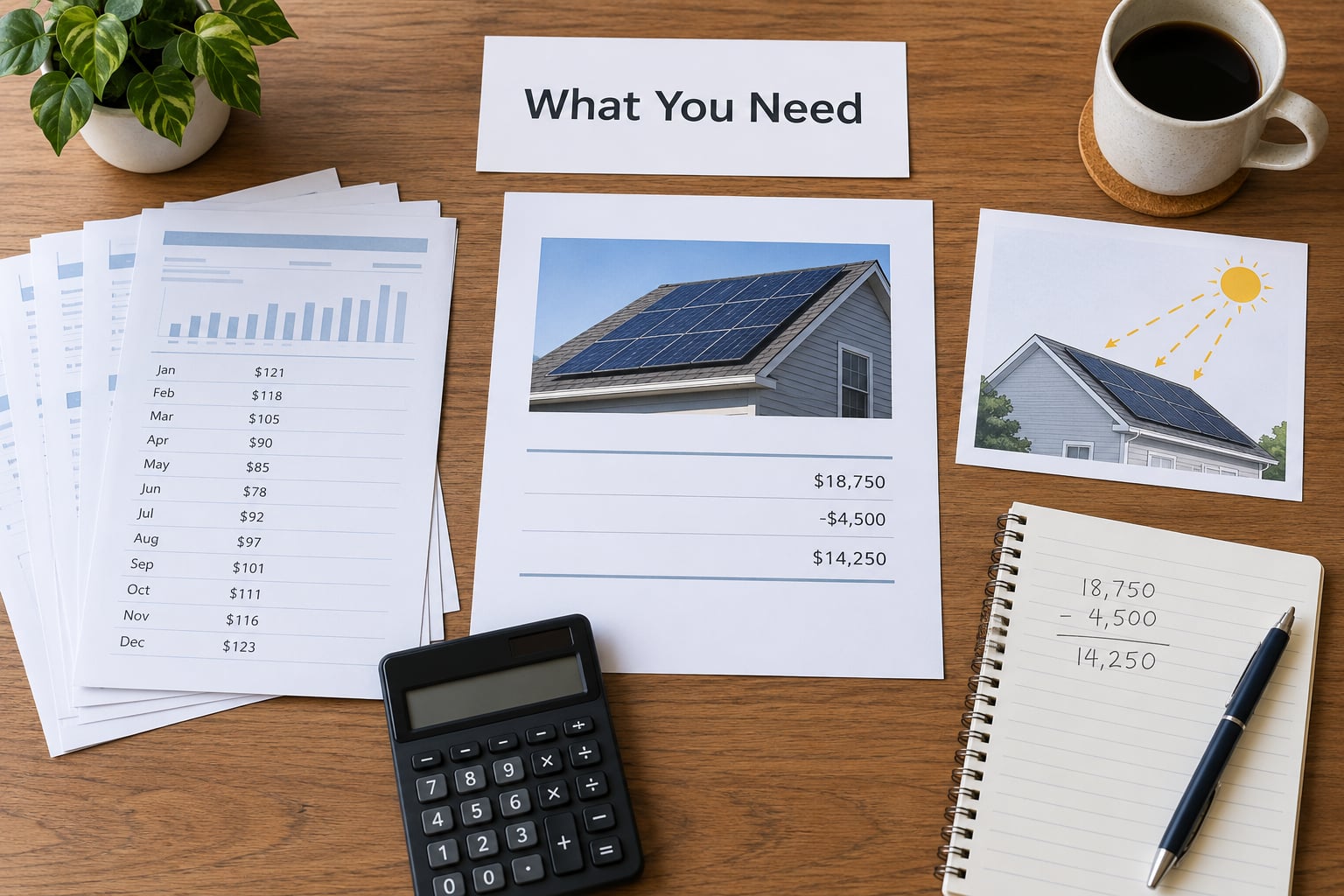
Six inputs. That is the whole list, and if you gather them before you start, the arithmetic takes minutes rather than an afternoon.
- Twelve months of electricity bills. Twelve gives you a real annual total instead of a guess from a single month. A summer or winter bill alone will throw the result off badly.
- An itemized installation quote. You want the line items, not a single headline price: panels, inverter, racking, labor, permitting, monitoring, and any electrical upgrade.
- The system’s expected annual production. Most quotes include this in kilowatt-hours per year. It is the single most important number in the calculation.
- Your incentive list. State rebates, utility rebates, sales tax exemptions, property tax treatment, and any certificate income. Be precise about what is confirmed versus what is pending.
- Financing terms. If there is a loan, you need the amount, the rate, and the term. If you are paying cash, note that and skip the interest work entirely.
- A calculator or spreadsheet. A phone calculator handles the simple version. A spreadsheet is worth it once you add rate escalation and degradation.
If you cannot get an itemized quote, ask the installer for cost per watt and the annual production figure. Those two numbers let you build a defensible estimate on your own.
Step-by-Step: How to Calculate Solar Payback Period
Here is the order that works: total the cost, subtract incentives, work out your annual bill, convert the system’s production into dollars saved, then divide. Do the steps in a different order and you tend to double-count something.
1. Estimate the system’s upfront cost
Start with the gross installed price, then check it against cost per watt. Divide the total by the system size in watts. An 8,000 watt residential system quoted in the low-to-mid 3 dollar per watt range is normal for a straightforward roof with no structural work; anything far above that deserves an explanation of what is included.
Line items that homeowners forget: permit and inspection fees, the utility interconnection application, a service panel or meter base upgrade if the existing one is full, monitoring subscription, and scaffolding when roof access is awkward. Add a battery and the number changes character entirely, which is why battery payback is better calculated on its own rather than blended into the panel math.
Then separate cash from financed. If you borrow, the number that matters at this step is the loan principal plus origination fees, not the sticker price. Keep the interest out of this step and handle it in step 6, where it belongs.
For the worked example: an 8 kW system, 8,000 watts, quoted at 3.90 dollars per watt, comes to 31,200 dollars gross. That is the starting line, not the answer.
2. Find your current annual electricity cost
Add up the kilowatt-hours on your last twelve bills, then add up the total amount you paid, including supply and delivery charges. Divide one by the other and you have your average retail rate in dollars per kilowatt-hour. That average is the number that belongs in a payback calculation, not your summer peak rate.
The standard formula quietly assumes a flat rate that most real tariffs do not offer. If your plan has a demand charge, a fuel adjustment, or time-of-use windows, separate them before you average, because they are not offset by solar the same way an energy charge is.
Two more things to nail down. First, fixed customer charges do not disappear when you go solar, so leave them out of the savings figure. Second, decide what you believe about rate growth and hold that number steady, because a quote that quietly assumes 8 percent annual growth is a sales pitch, not a projection.
Worked example: 10,000 kWh a year at an average of 24 cents per kWh, a 2,400 dollar annual bill before fixed charges, with a blended utility rate that rises about 2 percent a year.
3. Estimate the solar energy the system will produce
Use the production estimate from the quote, then sanity check it. The quick method is system size in kilowatts multiplied by peak sun hours for your area, multiplied by 365, multiplied by a derate factor of roughly 0.78 to 0.85 to cover inverter conversion, wiring, soiling, and hot-weather losses.
That derate factor is the number most calculators bury, and it is not small: leaving it out inflates output by roughly a fifth and shortens payback by years. If an installer will not show you the math behind their production number, ask until they will.
Then check the site. A south-facing array in a high-sun state and a north-facing or heavily shaded roof do not belong in the same calculation. Ask for the specific assumptions behind the production number, including shading from that chimney or that tree your neighbor keeps promising will not grow.
Do not forget degradation. Panels lose roughly half a percent of output a year, which is small in year one and worth mentioning in a 25-year view. A calculator that assumes flat output for 25 years is optimistic by design.
Worked example: 8 kW multiplied by 4.7 peak sun hours multiplied by 365 multiplied by 0.80 gives 10,977 kWh in year one. Round it to 11,000 kWh.
4. Calculate annual electricity savings
This is the step most glossed over, and it is where the real answer lives. Solar you use yourself displaces a full retail rate. Solar you export is usually paid at a lower avoided cost, and in some states much lower. Those two streams are not worth the same amount, and mixing them into one blended rate is how a 14-year payback gets marketed as 9.
So split the production into two piles. Self-consumed solar is worth the full retail rate, roughly 24 cents in the example. Exported solar is worth whatever your utility actually pays, which can range from a few cents on a legacy grandfathered plan to something close to retail in a state with a strong retail net metering program. Check your utility’s current tariff rather than the marketing summary of it.
Self-consumption rate is the variable that decides this split, and it depends on when your household uses power. The value of your solar changes a lot depending on which appliances run during generation hours. Shift usage to midday with a battery, a water heater timer, or a smart thermostat and your savings rise without adding a single panel.
Worked example: 11,000 kWh produced against 10,000 kWh of usage, with an 80 percent self-consumption rate. That gives 8,000 kWh at retail, worth 1,920 dollars, plus 3,000 kWh exported at an 11 cent avoided cost, worth 330 dollars. Total year-one savings: 2,250 dollars.
5. Subtract incentives and recurring costs
Start with the awkward one. The 30 percent federal residential clean energy credit ended after 2025, so a quote dated 2026 that still applies it is either stale or being worked on a different property type. Commercial and some rental arrangements continue under separate investment credit treatment, which is a common source of the confusion you will see in seller quotes and buyer forum threads alike.
What usually remains: state rebates, utility incentives, sales tax exemptions on equipment, property tax assessment treatment, and in a handful of states, renewable energy certificate or virtual power plant income. Check the terms, because several are means-tested, capped, or paid years after installation rather than deducted upfront.
Then add the costs nobody mentions. Monitoring subscriptions, insurance, inverter replacement somewhere in year 12 to 15, and small repair items. A modest recurring figure keeps the estimate honest, and on a 13-year payback these are worth real money in present terms even though they look small on paper.
Worked example: no federal credit applied. A state rebate of 1,500 dollars, no sales tax exemption in this state, plus 150 dollars a year for monitoring and an inverter reserve of roughly 100 dollars a year. Net cost is 29,700 dollars, and recurring costs total 250 dollars a year.
6. Divide net investment by annual net savings
The formula is the whole article: payback period equals net system cost divided by annual net savings. In the example, 29,700 divided by 2,000 gives 14.9 years, call it about 15 years on a cash basis in year one.
| Line | Year-one figure |
|---|---|
| Gross installed cost (8 kW at 3.90 per watt) | 31,200 |
| Less state rebate | 1,500 |
| Net system cost | 29,700 |
| Self-consumed solar (8,000 kWh at retail) | 1,920 |
| Exported solar (3,000 kWh at avoided cost) | 330 |
| Less monitoring and inverter reserve | 250 |
| Annual net savings | 2,000 |
| Payback period | About 15 years |
Now adjust for the two variables you held constant. At 2 percent annual rate escalation, savings grow about 2 percent a year, which pulls the effective break-even in to roughly 14 years. At flat rates with half a percent of panel degradation each year, it stays near 15.
If you financed instead, do not divide the same way. A 29,700 dollar loan at 7.5 percent over 25 years runs about 2,630 dollars a year in payments against 2,000 dollars of first-year savings, so you are paying out of pocket every year. The gap closes only if savings grow faster than interest compounds, and break-even lands somewhere in the back half of the term rather than at year 15.
| How you pay | Effect on payback | Who takes the incentives |
|---|---|---|
| Cash purchase | Shortest, closest to the raw math | You |
| Solar loan | Stretched by interest; break-even moves toward the back of the term | You |
| Lease | No payback at all, since you do not own the asset | Lessee claims them |
| Power purchase agreement | No payback, and a bill that does not drop to zero | Provider claims them |
For comparing solar against other uses of money, payback is too blunt on its own. A 15-year payback with savings that escalate is a different proposition from a 15-year payback on a flat bill, and internal rate of return captures that difference. Ask for both, and read the assumptions printed next to each one.
Common Mistakes
These are the errors that show up again and again, and each one has a straight correction.
Using your whole bill as the savings baseline. Fixed customer charges, demand fees and fuel adjustments keep appearing after solar is installed. Subtract them, or your savings figure is fiction. This is the single most common way a solar quote gets inflated.
Trusting a calculator that wants your email first. Solar calculators that gate their results behind a contact form exist to sell systems, and the numbers are tuned to close deals. Use one that shows the math, or run it yourself in a spreadsheet.
Applying a federal credit that ended. The residential 30 percent credit stopped after 2025. If a proposal adds it back for a 2026 installation, ask which property classification it is claiming. Do not carry that number into your own model without an answer.
Quoting cash payback for a loan-financed system. This is the single most misleading number in the industry. If you are borrowing, the honest measure is cumulative cash flow, and the break-even year moves a long way out.
Leaving out the derate factor and degradation. Peak sun hours times system size is a ceiling, not an estimate. Apply 0.78 to 0.85 for real-world losses and about half a percent a year for degradation, and state which values you used.
Blending battery payback into panel payback. Panels and storage have different lives, different economics, and different failure modes. Calculate them separately, then add them together. Blending the two is a fast way to end up with a payback number that means nothing.
Overstating incentives and export value. State rebates get capped and change, and grandfathered net metering terms get revised. Take the confirmed amount, and treat anything pending as zero until it lands in your account.
One habit fixes most of these: write your assumptions on the same page as the number. Rate growth, degradation, self-consumption rate, derate factor, financing terms. When a quote arrives with different assumptions, you can see exactly where the gap is instead of arguing about whose number is right.
Frequently Asked Questions
What is a reasonable solar payback period?
With strong incentives, 7 to 10 years has historically been a good result, and anything under 7 years usually comes with assumptions you have not been shown. After the residential federal credit ended, 12 to 16 years is a realistic range in many states, and 9 to 12 years is achievable where retail electricity rates and export compensation are both strong. The number matters less than the assumptions printed beside it.
Is there still a 30% federal solar tax credit?
Not for most homeowners. The 30 percent residential clean energy credit ended after 2025, so residential systems installed in 2026 are calculated without it. Commercial and certain rental or tax-exempt arrangements continue under separate investment credit rules. Some states and utilities replaced part of it with rebates and sales tax exemptions, so a local incentive check is worth an hour of your time.
How do net metering rules change the math?
Net metering is what you are paid for solar you send to the grid, and the value swings the whole calculation. Retail credit pays you close to your full rate, so every exported kilowatt-hour is worth nearly as much as one you use yourself. Avoided cost compensation pays a fraction of that, which can add years to payback. Check your utility’s current tariff, since rates and rules change and vary widely by state.
Do solar panels last long enough to pay back?
Panels usually carry performance warranties of 25 to 30 years, and most last longer than that, so a 15-year payback leaves a decade of free generation. The inverter is the shorter-lived part and often needs replacing once around year 12 to 15, which is worth budgeting for. Roof condition, shingle age, and inverter replacement are the three things most likely to interrupt a projected timeline.
Is it better to pay cash or finance the system?
Cash gives you the shortest payback and the cleanest math, because the only thing competing with your savings is whatever else you could have done with the cash. A loan stretches break-even because interest runs alongside rising savings, often pushing it toward the back of the term. Leases and power purchase agreements avoid that entirely, but you never own the system, so there is no payback to calculate.
Is calculating a solar payback period complicated?
The arithmetic is not. Learning how to calculate solar payback period takes one afternoon once you have twelve months of bills and an itemized quote. The hard part is judgment: deciding which rate to use, what production to believe, and whether an incentive is confirmed. Write your assumptions down as you go, and anyone can check the result.
The bottom line on your payback number
Start with the two figures nobody argues about: your average cost per kilowatt-hour and the system’s annual production estimate. Everything else is an adjustment layered on top, and adjustments are exactly where quotes get spun.
Run the numbers yourself before you run anyone else’s. It takes an afternoon, and it is the fastest way to tell a real offer from a sales pitch.