Low voltage wins for any permanent installation that has to stay bright through winter, cloud and shade. Solar wins when you want accent lighting with no wiring, no transformer and no trench.
When people weigh low voltage vs solar landscape lighting, they are usually comparing a wired 12V system fed by a transformer against self-contained fixtures that charge a battery from their own panel. The two answer the question differently: one is a small electrical circuit you design, the other is a collection of independent lights you place one at a time.
- Brightness: a wired path or spotlight fixture commonly puts out 100 to 200+ lumens; entry solar path lights often land somewhere between a handful of lumens and roughly 40.
- Consistency: wired output holds steady night after night. Solar output depends entirely on what that day’s panel captured.
- Installation: solar is a stake and a switch. Low voltage is a transformer, a cable route, protected connections and usually a weekend.
- Running cost: a 12V LED fixture typically pulls 3 to 12 watts; a solar fixture pulls nothing from the grid at all.
- Longevity: LED fixtures on a wired circuit often last a decade or more. Solar fixtures usually need a battery change every one to two years.
- Best fit: low voltage for driveways, entry points, large trees and layered designs; solar for isolated accents, rentals, sheds and properties far from a power source.
Table of Contents
- Low Voltage vs Solar Landscape Lighting at a Glance
- How Low Voltage Landscape Lighting Works
- How Solar Landscape Lighting Works
- Installation and Wiring: Which Is Easier?
- Light Quality and Design Flexibility
- How bright is low voltage vs solar landscape lighting in practice?
- Cost: Upfront Spend vs Long-Term Expenses
- Maintenance, Weather Resistance, and Reliability
- Which Should You Choose?
- Frequently Asked Questions
- Are 12 volt landscape lights AC or DC?
- Can I install low voltage landscape lighting myself?
- Do solar landscape lights need direct sunlight?
- Which is cheaper to install, solar or low voltage lighting?
- Which type is better for lighting a long driveway?
- Conclusion
Low Voltage vs Solar Landscape Lighting at a Glance
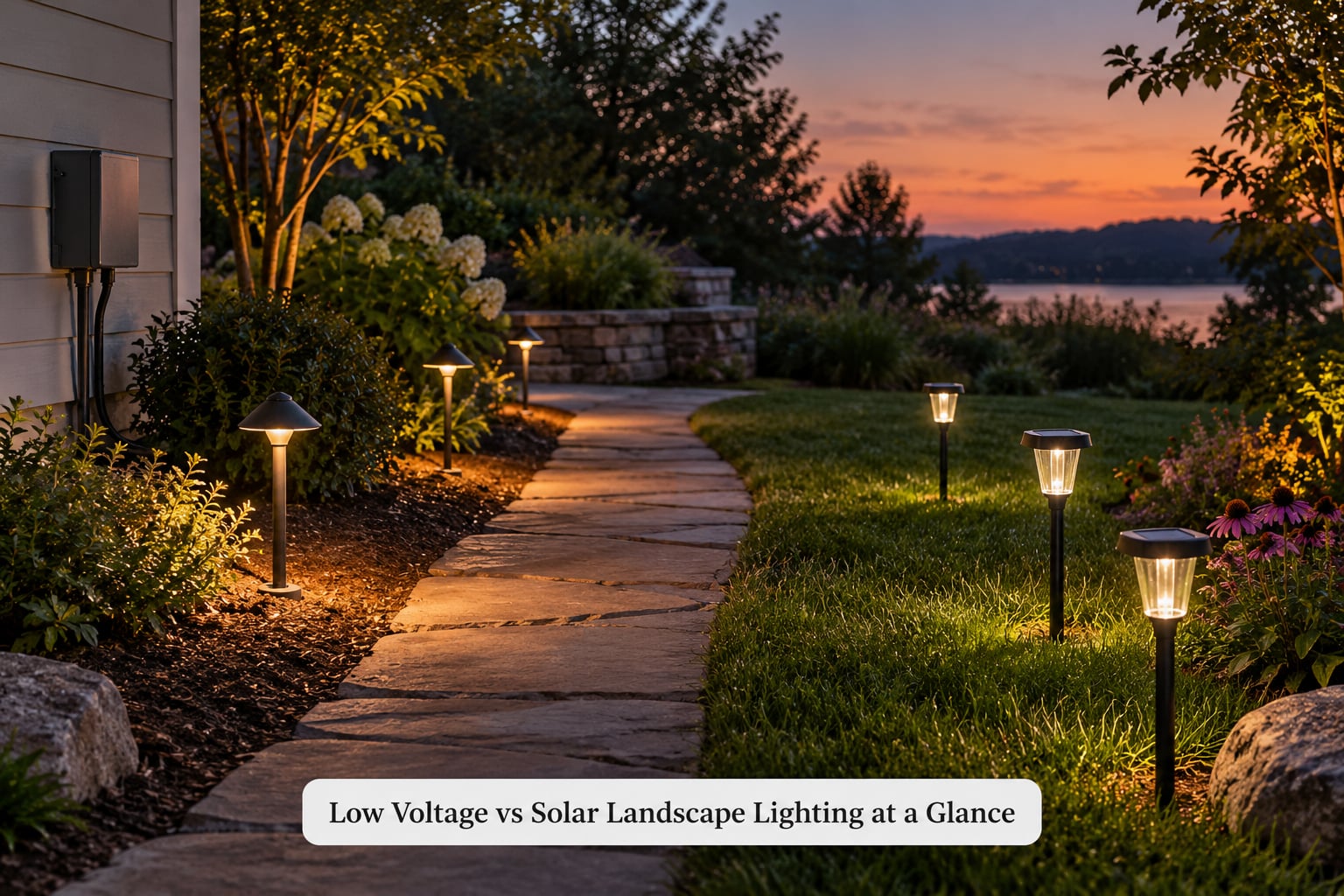
Here is the same comparison in one place, arranged by the decisions people actually make in the aisle or on the drawing board.
| Criterion | Low voltage (12V wired) | Solar |
|---|---|---|
| Power source | Transformer steps household 120V down to 12V, feeding a buried cable network | Photovoltaic panel on each fixture charges its own rechargeable battery |
| Typical brightness | Path and spot fixtures roughly 100 to 200+ lumens | Entry path lights single digits to around 40 lumens; larger solar spots vary widely |
| Brightness in shade, cloud or snow | Unaffected by weather once installed | Dims or switches off; snow-covered panels can mean days of dark |
| Installation | Trenching, cable routing, protected connections, transformer placement | Stake it, switch it on, remove the tab |
| Upfront spend | Higher: transformer, cable, fixtures, and often labour | Low: you are buying fixtures only |
| Ongoing cost | Small electricity draw, occasional bulb or driver swap | Battery replacement every one to two years, whole fixtures often retired in a few seasons |
| Typical service life | LED fixtures commonly 10 years or more | Often 2 to 5 years per fixture, dependent on battery quality |
| Scalability | High, within transformer capacity; run lengths cost wattage | Unlimited fixtures, but each one is standalone and individually placed |
| Where it belongs | Front walkways, driveways, steps, trees, entry points | Garden beds, paths far from an outlet, rentals, seasonal displays, sheds and docks |
How Low Voltage Landscape Lighting Works
A low voltage landscape lighting system has four moving parts: a transformer, a run of low voltage cable, the fixtures themselves, and a switching device. The transformer sits on a waterproof-rated outlet, usually on an exterior wall or near the panel, and steps household power down to a safe 12 volts for most residential work. Twenty-four volt systems exist for longer runs.
The cable is typically buried six to eight inches deep, which keeps it below mower and spade depth while avoiding the deeper trench that buried line-voltage cable requires. Each fixture taps that run through a sealed connection, and a photocell or timer switches the whole circuit at dusk. From the home’s point of view this is a very small electrical job, which is why it feels safe to work with.
Two technical points trip people up. The first is voltage drop: the further a fixture sits from the transformer, the lower the voltage reaching it, which reads as uneven brightness along a path. Thicker cable, a shorter run, or a multi-tap transformer with 12V and 15V taps fixes most of it, and this is the single most common DIY complaint on the forums. The second is AC versus DC, which I cover in the FAQ below because it comes up constantly.
How Solar Landscape Lighting Works
A solar landscape light is a sealed box containing four things: a small photovoltaic panel, a rechargeable battery, an LED fixture, and a light sensor that switches it on at dusk. The panel absorbs daylight and converts it to current, the battery stores it, and the sensor fires the LED when light levels drop. That is the whole chain, and it explains both the appeal and the ceiling.
The key word is independent. Solar lights are not fixtures on a circuit. There is no transformer, no shared cable, and no way to dim a group or switch a whole path from one wall switch. Each light decides for itself when to run, based on the energy it happened to capture, and two fixtures ten feet apart can behave like two different systems if one sits under a maple and the other sits in the open.
Panels face whichever direction gets the most sky, and in the Northern Hemisphere that is generally a south-facing, unobstructed position. Quality also varies widely across the price range, mostly in battery capacity and panel area. A small panel feeding a large battery often spends most of its life doing very little.
Installation and Wiring: Which Is Easier?
Solar wins this comparison so decisively that the other answer feels unfair. A solar stake light goes into the ground, a tab is removed from the battery, and the light is working that evening. There is nothing to trench, nothing to connect and nothing to bury.
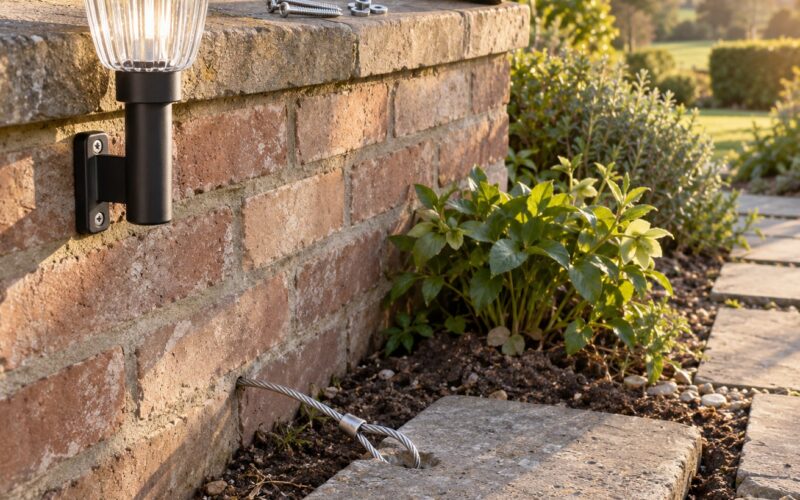
Low voltage is a real project. You map the fixture layout, decide where the transformer goes, route the cable between fixtures so runs stay short, dig a shallow trench, and seal every connection with watertight connectors or heat-shrink. The digging is the least enjoyable part; a narrow trenching shovel or an edger for shallow runs keeps it manageable.
Local rules matter here. Low voltage does not need a permit or a licensed electrician in most jurisdictions, but the outlet it plugs into must be a GFCI-protected exterior receptacle in a wet location, and cable runs must clear buried utility lines before any digging. Call 811 or your local equivalent first. If you are unsure about the receptacle, that is the point to hire someone.
Before buying solar, run a sunlight audit. Pick the spot at midday on a bright day, note whether it is under a roof edge, a dense canopy or a fence, and ask whether that shade is worse in December than in June. A recent r/landscaping thread asked almost exactly this question about a yard full of pines, oaks and hollies, and the practical answer was that partial shade works for some fixtures and fails for others.
Light Quality and Design Flexibility
Brightness is where the two systems part company fastest. A typical wired path or spotlight fixture is built to put out somewhere in the range of 100 to 200 lumens or more, focused by a lens or reflector into a beam aimed at a path, a shrub or the trunk of a tree. Entry-level solar path lights often manage single digits to about 40 lumens, which is enough to see the edge of a stepping stone on a dark night and little more.
How bright is low voltage vs solar landscape lighting in practice?
On a lit street, both can look adequate. Off a lit street, only the wired system reliably illuminates a walkway, a driveway or the face of a house. If your goal is seeing where you are walking, or lighting a large tree from the base, the output gap decides it before any other factor.
Low voltage also gives you control that solar cannot match. You can aim a spotlight, aim it differently next year, group fixtures on a dimmer, put them on a timer or tie them into a smart controller, and add a fixture later by extending the run. Beam control and color temperature both become design decisions. Solar fixtures are fixed by their moulded housing and panel position.
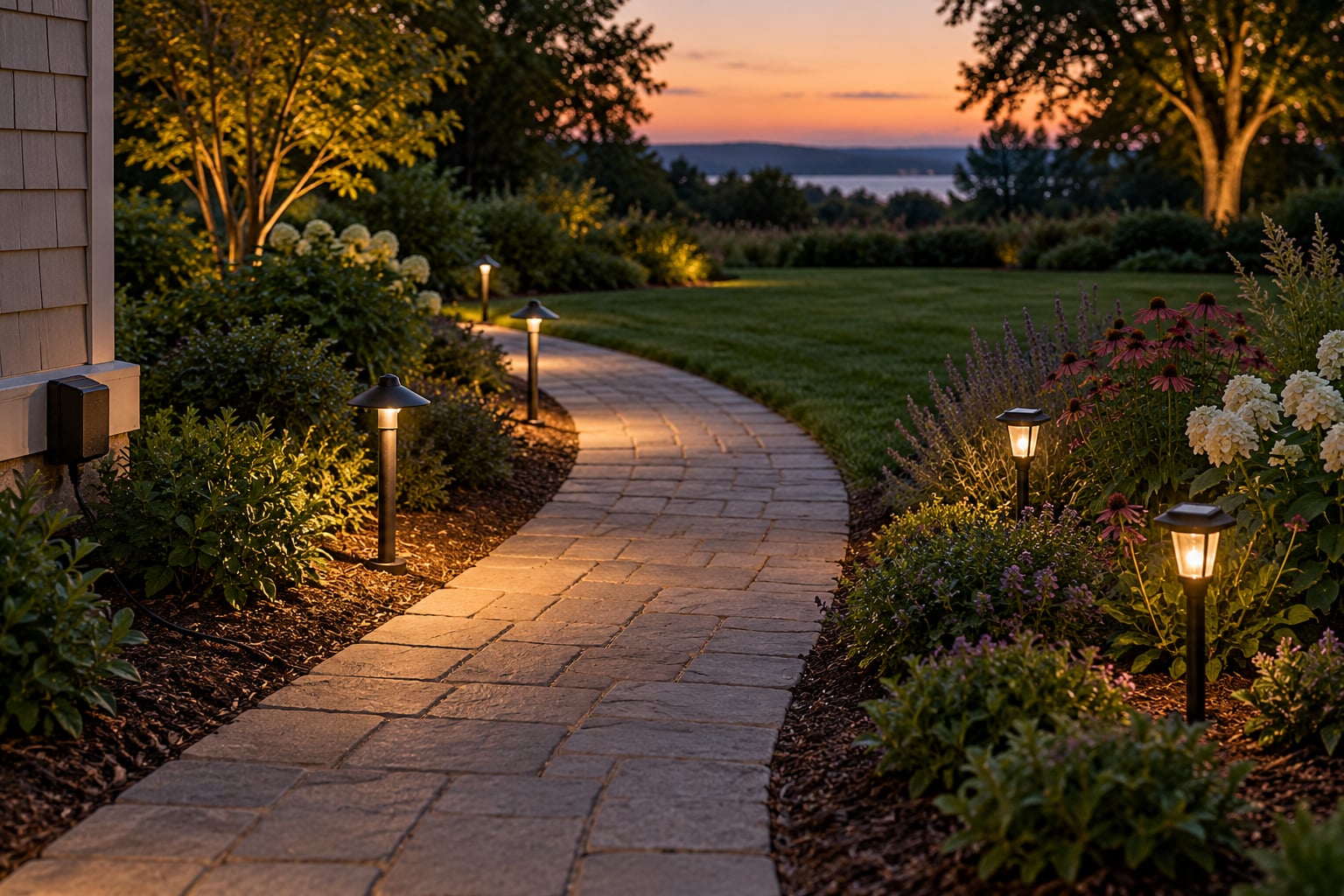
Layered design is where low voltage earns its keep, and it is a real advantage rather than a marketing line. Professional plans stack three or four layers: low path lights for navigation, shielded wall washes for architecture, uplights aimed into tree canopies, and brighter floods at entry points. Each layer needs aiming and even spacing, which is a wired-design problem. Solar can nod at this with a handful of well-placed accents, but it cannot produce even spacing along a long run.
Cost: Upfront Spend vs Long-Term Expenses
Upfront, solar is cheaper by a wide margin. You are buying fixtures and you are done. The expensive parts of a low voltage system are the parts you never see once it is finished: the transformer, several hundred feet of cable, the connectors, and the labour to dig and connect it.
Long-term, the gap narrows and can reverse. Low voltage LED fixtures draw so little power that the electricity is close to irrelevant, and the transformer is rated for years of service. The realistic recurring cost on the solar side is the battery. Replaceable NiMH cells are expected to need changing every one to two years, and plenty of budget fixtures have a sealed battery you cannot change at all, which quietly turns a five-year light into a five-year replacement cycle.
Over a decade, that arithmetic is why so many owners who start with solar end up rebuilding in low voltage. Every few seasons you are replacing cells or whole fixtures, and each replacement is another small landfill item with a battery inside it. It is also worth being honest in the other direction: a well-made solar fixture with a replaceable battery in full sun can run a long time with very little attention, and one r/HomeImprovement user running solar spotlights in a backyard reported no real issues and good performance, valuing them mainly for the installation time they saved.
For a big property with many fixtures, low voltage usually wins on total cost. For a handful of accent lights, solar usually wins on everything that matters.
Maintenance, Weather Resistance, and Reliability
The maintenance lists look different because the systems have different failure modes. Low voltage maintenance is inspection: wipe lenses, check that connections are still sealed, confirm the transformer output is holding up, and replace any buried section that a shovel found. There is nothing to consume on a schedule. Voltage drop that develops over years shows up as one dim end of a run and is fixed with a heavier gauge cable or a run from a second tap.
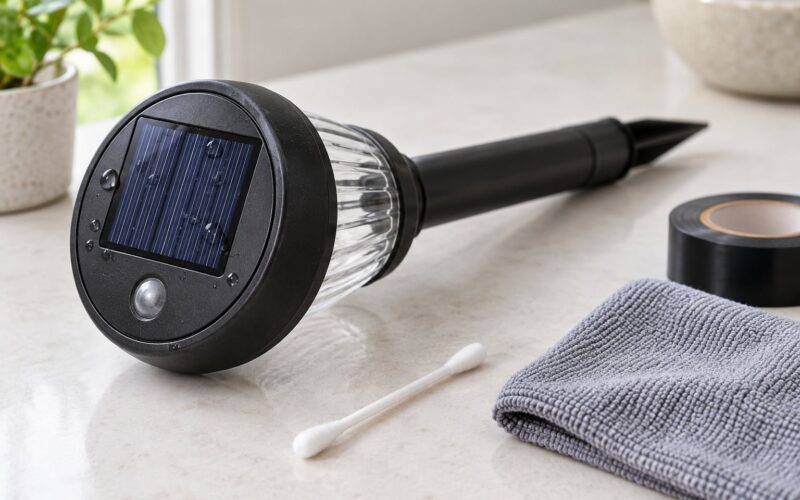
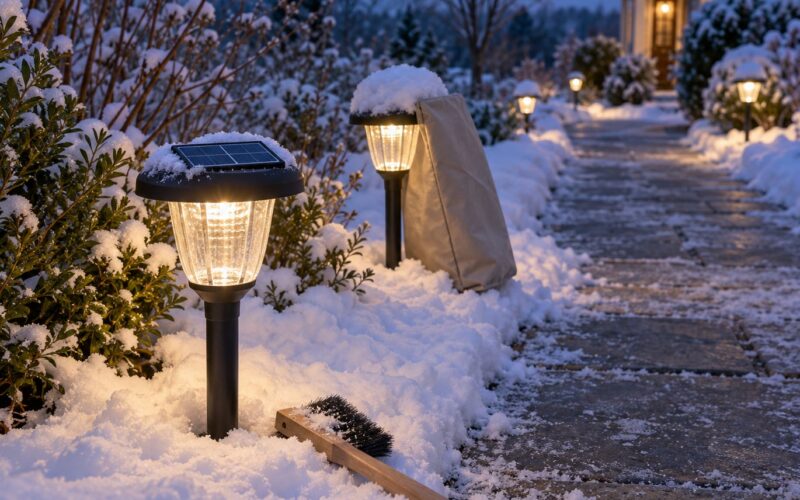
Solar maintenance is intervention. You clean the panel when leaves and winter grime cover it, you wipe fogged lenses, and you replace batteries on a schedule rather than on failure. The panel is the weak point in wet northern climates, because a covered panel collects no energy whether or not the fixture itself survived the season. A low voltage system comes back at full output the day the snow recedes; a solar system may sit dark while the battery slowly recharges.
Both types need a weather rating, and IP65 is the usual baseline for outdoor fixtures: sealed against dust and protected against water jets. IP67 adds temporary immersion protection. Ratings describe the fixture body, not the installation, so a rated fixture with an unsealed connection still fails, and that is the most common cause of early low voltage deaths in the field. Read the rating, then make sure the connections match it.
On reliability over a long horizon, the community consensus is fairly lopsided. A recurring sentiment on r/HomeImprovement is that low voltage is the way to go, with solar framed partly as a waste concern. That view is reasonable for primary lighting and unfair for a decorative accent in full sun.
Which Should You Choose?
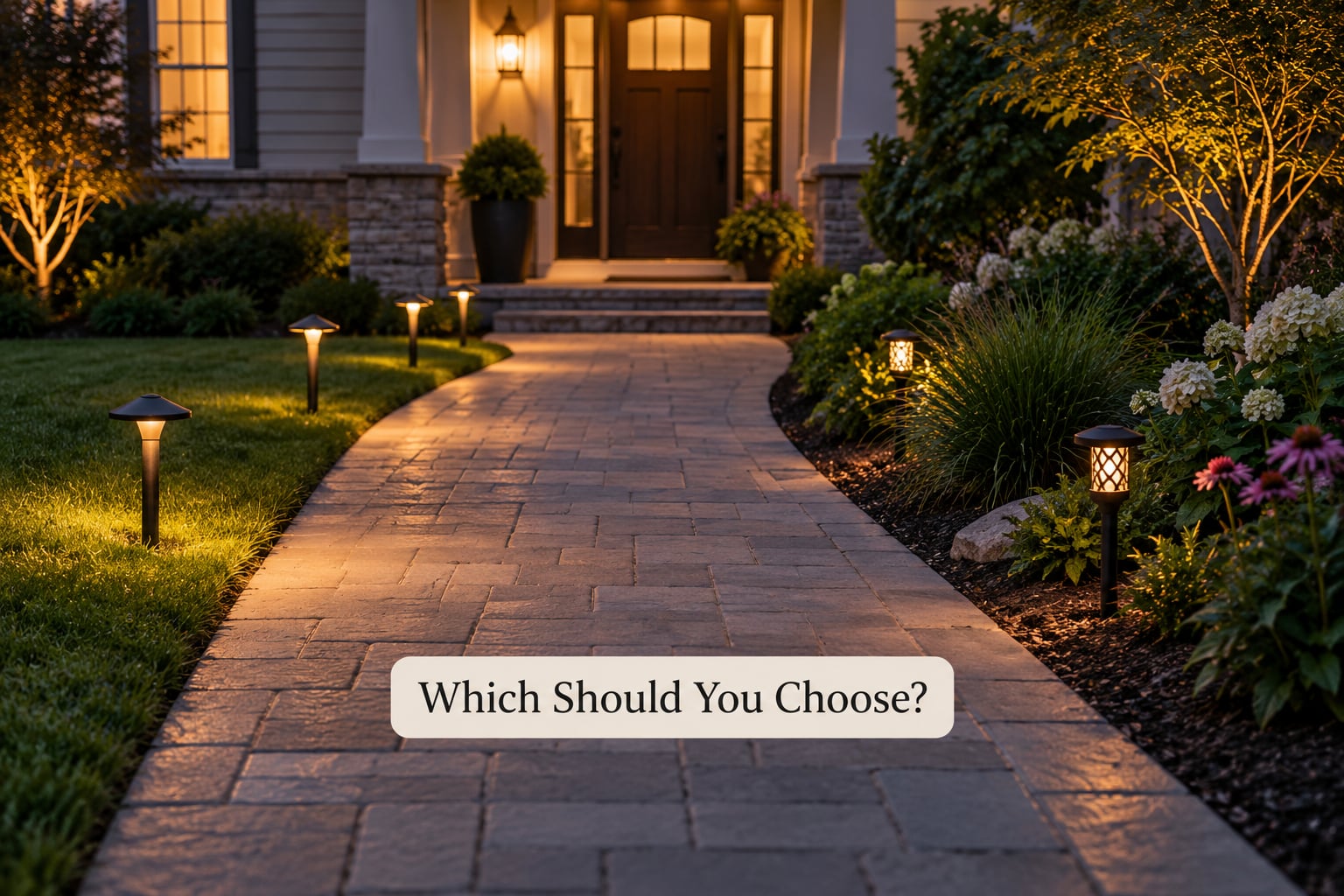
Choose low voltage when the lighting has to work every night. That means a main walkway to the front door, steps, a long driveway, a large tree you want to highlight, entry points for security, or any design where even spacing and aiming matter. It also wins if you plan to expand the system in a few years, or if you want it on a timer, a dimmer or a smart controller.
Choose solar when the lighting is decorative and the site is awkward. A rental where you cannot dig, a shed or dock with no power run, a garden bed far from the house, seasonal displays that come out in October, or a spot with solid full sun and no realistic path for cable. Solar is also the right answer for anyone renting equipment or moving within a few years.
Mixing them is entirely reasonable, and most mature yards end up doing it. A low voltage core handles the structural lighting, and a handful of solar accents fills gaps or dresses a bed without another trench. The forum caution is fair, though: mixing on the same path produces visibly uneven quality, so keep the two systems in separate roles rather than alternating them fixture by fixture.
A short checklist to score yourself against:
- Does this light need to work on a cloudy, snowy or shaded night? If yes, low voltage.
- Do you need even spacing or aiming, or brightness over a wide area? Low voltage.
- Is there a realistic route for buried cable from an existing outdoor receptacle? If yes, low voltage is realistic.
- Is the spot in full sun most of the day, and is the role decorative or temporary? Solar.
- Do you rent, or expect to move within a few years? Solar.
Frequently Asked Questions
Are 12 volt landscape lights AC or DC?
Most 12V landscape fixtures run on 12V AC coming from a toroidal transformer, and they are designed for it. LED fixtures increasingly include a small driver that rectifies the output to DC for the diode itself, but from your side the transformer still delivers AC. Check the fixture spec sheet or the port on the fixture before connecting anything, and never run one fixture type off a system designed for the other.
Can I install low voltage landscape lighting myself?
Most homeowners can. The work is planning cable routes, calling 811 before you dig, keeping runs short to limit voltage drop, sealing every connection against moisture, and plugging the transformer into a GFCI-protected exterior receptacle in a wet location. No permit or electrician is required in most places for a low voltage circuit. If you are unsure about the receptacle or the outlet is an indoor one, hire someone for that part.
Do solar landscape lights need direct sunlight?
They need meaningful daylight, but they do not need unbroken sun all day. Partial shade works when the panel still gets several hours of open sky, and panels can be positioned slightly away from the fixture if the base sits under a shrub. What kills performance is a panel that spends the day under a canopy, a roof edge or a fence. Panels generally face south in the Northern Hemisphere. Test the spot at midday before you buy a run of them.
Which is cheaper to install, solar or low voltage lighting?
Solar is much cheaper to install. You are buying fixtures only, and there is no transformer, no cable, no trenching and often no labour. Low voltage costs more up front because of the transformer, several hundred feet of cable, protected connections and the digging. Over ten years the gap usually narrows, because solar batteries are typically replaced every one to two years while a wired LED circuit mostly needs attention rather than parts.
Which type is better for lighting a long driveway?
Low voltage is the better fit for a long driveway. A transformer and cable network can carry consistent light the full length and support evenly spaced fixtures, which is what makes a driveway safe to walk and read as intentional design. Solar can handle occasional markers or a few isolated posts, but each fixture is standalone, so spacing gets uneven and brightness drops wherever a light sits in shade.
Conclusion
Start by checking five things in this order: your budget for installation, how much sun the spot really gets, how complex the layout is, how much light the area actually needs, and how much maintenance you are willing to do. If the light has to work every night, spend the money on a low voltage system and plan the cable run and transformer capacity carefully. If it is decorative, in full sun, and there is no sensible path for wiring, solar is the sensible answer and there is no reason to feel bad about it.