For solar garden lights, lithium beats NiMH almost everywhere it matters: more energy per gram, far less self-discharge, no memory effect, and it keeps lighting up when the temperature drops. NiMH still makes sense when the light was built for it, replacements are easy to find, and you don’t mind swapping cells every season or two.
The catch is compatibility. A NiMH cell puts out 1.2 volts and a lithium-ion cell puts out roughly 3.6, so they are not interchangeable in the same housing unless the light was designed for whichever one is already inside it.
One more thing worth saying up front: a solar light that dies in its second autumn is usually a charging problem, not a battery problem. Shade, a dirty panel, or a charge controller that quit are all more common culprits than dead cells. Check those before you buy anything.
Table of Contents
- Lithium vs NiMH Solar Light Batteries at a Glance
- What Is the Difference Between Lithium and NiMH Solar Light Batteries?
- Which Battery Lasts Longer in Solar Lights?
- How Do Lithium and NiMH Batteries Perform in Cold Weather?
- Which Battery Charges Better with a Small Solar Panel?
- Lithium vs NiMH: Maintenance, Safety, and Environmental Impact
- Lithium vs NiMH Solar Light Batteries: Cost and Value
- How to Match Battery Chemistry to Your Solar Light
- Which Should You Choose?
- Frequently Asked Questions
- Can I replace a NiMH battery in a solar light with a lithium battery?
- Are lithium solar light batteries better than NiMH for winter use?
- Why does my solar light work with new batteries but stop working after a few nights?
- Do NiMH batteries lose their capacity when they are only partly charged by a solar panel?
- Can I use lithium and NiMH batteries together in the same solar light?
- How should I dispose of and recycle old rechargeable solar-light batteries?
- Conclusion: Start With the Manufacturer’s Battery Recommendation
Lithium vs NiMH Solar Light Batteries at a Glance
This table covers the criteria that decide the outcome for an outdoor stake light, path light, or lantern. Read across the two columns and the winner is usually obvious, unless voltage compatibility says otherwise.
| Criterion | Lithium (Li-ion) | NiMH |
|---|---|---|
| Nominal cell voltage | 3.6 to 3.7V per cell | 1.2V per cell |
| Energy density | 100 to 300 Wh/kg | 55 to 110 Wh/kg |
| Cycle life | 500 to 1500 cycles | 300 to 500 cycles |
| Self-discharge per month | About 2 to 5 percent | 20 to 30 percent standard, 5 to 10 percent low self-discharge |
| Output in freezing weather | Holds up well | Drops noticeably, and charging below 0C/32F is poor |
| Accepts a tiny panel’s charge current | Good, if the cell is the right size for the panel | Very good at low capacities such as 200 to 300mAh |
| Memory effect | None | Present, but mild in this application |
| Maintenance | Almost none for years | Swap cells every one to three seasons |
| Leakage and corrosion risk | Low with protected cells | Low; alkaline cells in the same slot are the real leak risk |
| Weight per unit of energy | Light | Heavier |
| Upfront battery cost | Higher per cell | Lower per cell |
| Swappable in the other light | Only if the housing was built for it | Only if the housing was built for it |
| Best for | Cold climates, high-use lights, lights you want to forget about | Budget lights, warm climates, easy-to-find replacements |
The short version: lithium wins on every physical property, and NiMH wins only on price and availability. Which of those matters more depends entirely on the light and where it lives.
What Is the Difference Between Lithium and NiMH Solar Light Batteries?
NiMH stands for nickel-metal hydride, and it has been the default battery in consumer solar lights for roughly twenty years. Each cell runs at 1.2 volts, so a light with three cells holds a 3.6V pack, which is a common and tidy number for a small charge controller.
Lithium-ion cells run at about 3.6 to 3.7 volts each. In solar lights they usually appear as a protected cylindrical cell, a small lithium pack with a protection circuit, or a lithium iron phosphate cell at 3.2V used in larger builds. Newer and higher-output solar lights are increasingly built around them because the same weight of battery does much more work.
Historically there was a third chemistry in these lights. NiCd, or nickel-cadmium, was the original rechargeable cell at 1.2V, and you will still meet people swapping NiCd for NiMH. That swap is fine because both are 1.2V. Going from either of those to lithium is not.
The charging path is the same for both. During daylight the small solar panel turns sunlight into current, and a charge controller on the light’s circuit board decides when to route that current into the battery. At dusk the same board switches the LED on and the battery carries the lamp through the night. Only cells that can soak up a panel’s weak current and hold enough charge survive a long winter night.
Which Battery Lasts Longer in Solar Lights?
Lithium lasts longer because it stores two to three times the energy per unit of mass and gives most of it back over the night. NiMH sits in the 55 to 110 Wh/kg range against roughly 100 to 300 Wh/kg for lithium-ion, and that gap shows up as hours of runtime rather than a line on a spec sheet.
Cycle counts favour lithium too, typically 500 to 1500 full cycles against about 300 to 500 for NiMH. In a solar light a cycle is a day of charge followed by a night of use, so a well-made lithium cell can outlast several NiMH cells over the life of one panel.
Self-discharge decides what happens between sunny days. A standard NiMH cell can lose 20 to 30 percent of its charge in a month sitting still, which is why low self-discharge NiMH exists at 5 to 10 percent. Lithium loses closer to 2 to 5 percent over the same period, which matters for lights in cloudy climates that go two or three nights on a single charge.
Brightness on the packaging tells you nothing about battery life. Two lights that both claim 30 lumens can differ by a factor of three in how long they run, because runtime depends on the LED’s actual draw, the panel’s wattage, how many hours of sunlight the spot gets, and the cell’s real capacity rather than its printed rating.
Panel size and lamp wattage usually matter more than chemistry. A brighter LED on the same small panel drains faster than the panel can refill, so the light is dim by midnight and then barely charges at all before sunset. That is a hardware mismatch no battery chemistry can fix.
How Do Lithium and NiMH Batteries Perform in Cold Weather?
Lithium is the better choice for winter, and not by a small margin. Lithium-ion holds its output better at low temperatures, so a lithium light in an unheated yard or a snowed-in gate post keeps lighting the path when an NiMH light in the same yard goes dim by nine o’clock.
The weak point for both chemistries is charging in the cold. Below roughly 0C/32F, charge acceptance falls off and charging a lithium cell in that condition can stress it. NiMH manages it slightly better in the short term but still comes up short, and both chemistries lose capacity in heat above about 45C/113F, which is a summer problem rather than a winter one.
Winter also removes the hours you were counting on. Shorter days mean less charge time, a leafless tree still blocks light that a summer canopy would have let through, and snow or dirt on the panel cuts output further. Users on gardening forums describe lights that run two or three hours a night in November and then appear to fail entirely, and in most of those cases the cells were fine.
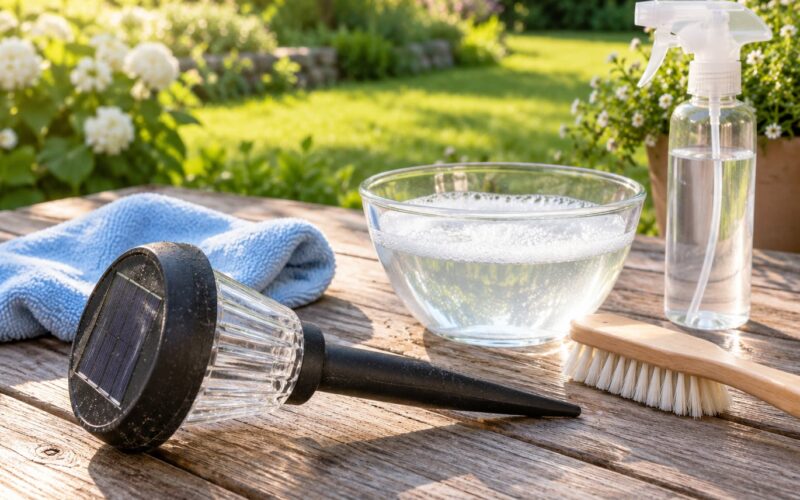
Clean the panel and check for shade before you blame the chemistry. If a light has genuinely never worked well through a cold season and you have tested it in summer with a fresh alkaline cell, then chemistry is the likely culprit.
Which Battery Charges Better with a Small Solar Panel?
Both charge, but the match between cell and panel matters more than the chemistry. A stake light might have a panel that delivers only a few milliampes. A cell rated at 2000mAh asked to soak that up never reaches full charge, stays warm under load, and delivers disappointing output night after night.
This is the part most guides get backwards. Higher mAh is not better in a solar light. If you are replacing cells, match the original rating or step slightly down, keeping the same chemistry, the same voltage, and the same physical size. A lower-capacity cell that actually fills up will beat a bigger one that never reaches charge.
Partial charging is the normal condition, not a fault. Both chemistries top up during the day and run down at night, and that is exactly the shallow cycling NiMH is happiest with.
Check the panel before you check the battery. On some budget lights only a small strip of the panel face is real photovoltaic material and the rest is painted, which caps runtime at a few hours no matter what battery you fit. Cover the panel with your hand and see whether the output indicator drops, then compare the panel to the cell’s charge requirement.
Lithium vs NiMH: Maintenance, Safety, and Environmental Impact
The memory effect on NiMH is real but overstated for this use case. NiMH can lose usable capacity after repeated shallow discharges, and solar lights are exactly that pattern, yet reported problems are usually caused by heat, age, or poor charging rather than memory. Lithium has no such effect at all.
Maintenance is the practical difference. An NiMH light in a busy yard may need new cells every one to three seasons. A lithium light in the same position can go years, and it stores fine through winter without being topped up, which is exactly what makes it better for seasonal outdoor lighting.
On safety, the leaks people worry about are usually alkaline, not NiMH. Regular alkaline cells pushed into a solar light run for a few days on the old battery, then corrode the contacts and the housing from the inside. Stick to rechargeable cells and use the voltage the manufacturer specifies.
Lithium needs a little more respect. A cell without a protection circuit can swell or enter thermal runaway if it is shorted, crushed, or overcharged, which is why solar light cells are sold with protection built in. Never mix chemistries in one light, never charge a lithium cell with an NiMH charger, and follow the battery and charging specifications in the light’s manual. If you are building your own lighting rather than swapping cells, that guidance is not optional.
Recycling is easier for NiMH than for lithium. NiMH goes back into the nickel-cadmium recycling stream, while lithium cells belong in battery and e-waste collection, and damaged or swollen cells need a dedicated drop-off point rather than the household bin.
Lithium vs NiMH Solar Light Batteries: Cost and Value
NiMH costs less per cell and lithium costs more, and that is the whole upfront story. The better question is what each one costs per light per year, because a cheap cell you replace every autumn stops being cheap by the third year.
The number of replacements over three to five years depends on the light, not the chemistry alone. A good panel and a low-draw LED stretch both cell types considerably. A dim, fractional panel burns through any battery faster than you would expect, and swapping cells there buys you a season at best.
What US shoppers should verify before buying: the chemistry printed on the original cell, the voltage and cell count of the pack, the physical size, and whether the light’s manual names a specific battery type. If the manual is gone, the print on the old cell is the next best guide. Battery selection, panel quality and lamp draw are all worth comparing before you settle on the cheapest cells in the aisle.
How to Match Battery Chemistry to Your Solar Light
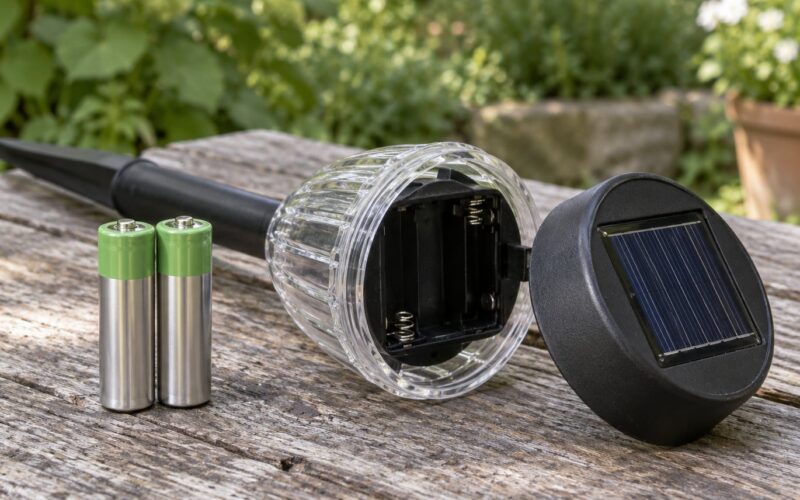
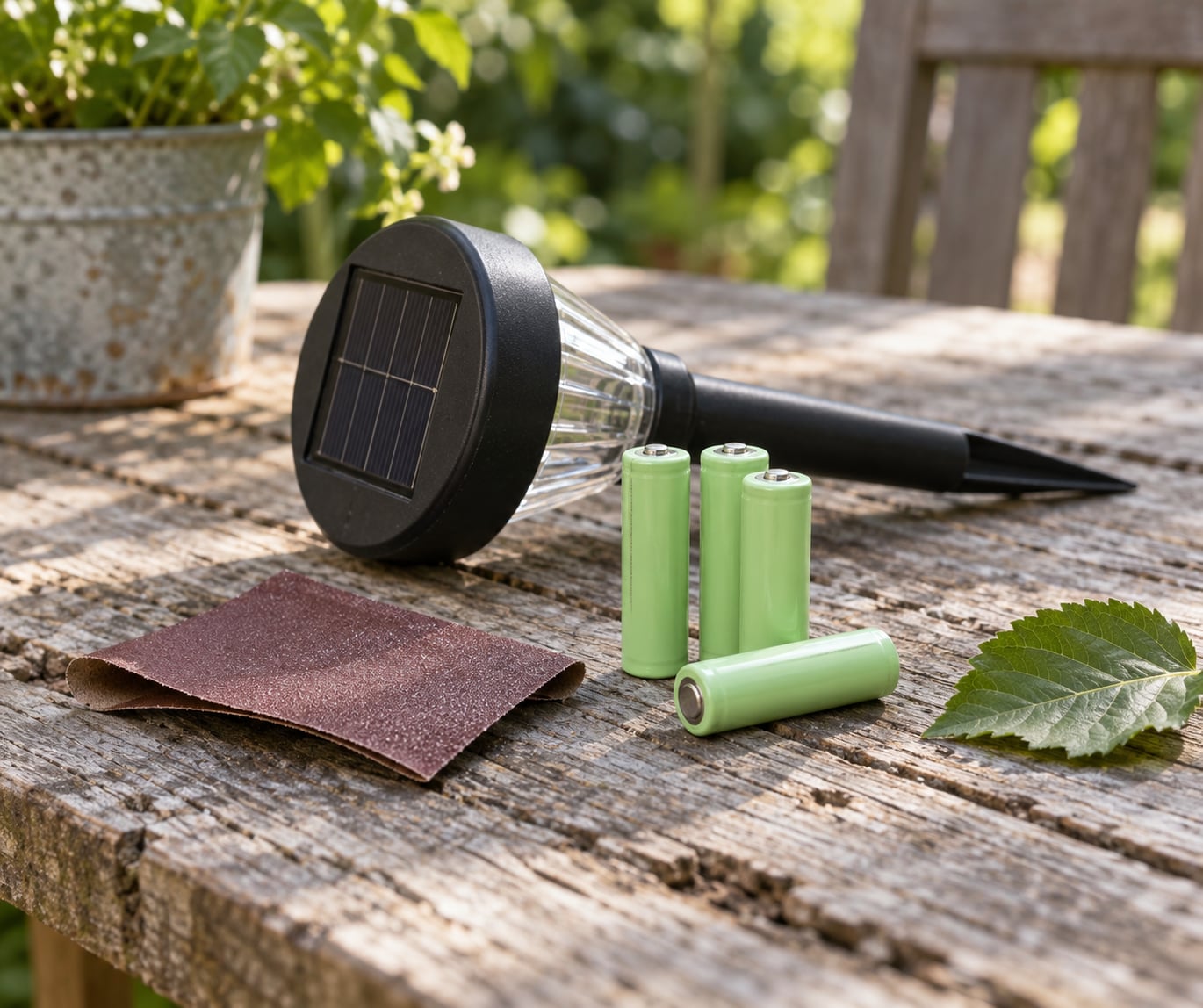
Start with the cell you are replacing. Look for the chemistry and the mAh number printed on the barrel, then count how many cells the light takes. Three 1.2V cells in series is a 3.6V pack, and that is why a 1.5V alkaline cell in each slot can make a light run brighter and burn out sooner.
Then check size. Solar lights use a mix of full and shortened cells, and the shortened ones are easy to confuse with the next size up.
| Cell size | Approximate dimensions | Typical solar-light use |
|---|---|---|
| AA | 50.5 by 14.5mm | Stake lights, path lights, larger lanterns |
| 2/3AA | 44.5 by 10.5mm | Compact stake lights, wall lights, sensor lights |
| AAA | 44.5 by 10.5mm | Small decorative lights, string lights |
| 2/3AAA | Shorter than AAA | Small decorative lanterns, mini stakes |
Confirm polarity from the contacts in the holder, not from the label, since the same cell can sit in either direction across different models. Check that the light is marked for rechargeable cells only, and never mix a lithium cell with an NiMH cell in the same pack.
By use case, the pattern is consistent. Everyday path lights in a mild climate are fine with NiMH. Decorative lanterns you replace as part of seasonal decorating work well with lithium, since they may sit uncharged for months. Motion-sensor lights and driveway lights see repeated deep discharge and benefit from lithium. Anything exposed to real winter cold is a lithium job. And a light whose panel came with no panel at all will disappoint either way.
Which Should You Choose?
Choose lithium when the light was built for it, or when you are buying a new light for a cold climate, a high-traffic area, or anywhere you would rather not climb a ladder every autumn. The higher upfront cost is usually recovered within a few seasons, and you get steadier output through winter and better resistance to a cloudy run of days.
Choose NiMH when the light shipped with 1.2V NiMH or NiCd cells, when replacements are sold everywhere in the size you need, and when you are comfortable with a seasonal swap. Low self-discharge NiMH from a recognised brand works especially well in small lights with tiny panels, because the cell charges fully in a short window.
One exception runs through both verdicts. If the light only gives you three hours a night in summer with a fresh cell, the problem is upstream, and no chemistry fixes it. Clean the panel, look for shade across the day, and confirm the panel is doing its job before ordering batteries.
Frequently Asked Questions
Can I replace a NiMH battery in a solar light with a lithium battery?
Usually not. A NiMH cell outputs 1.2V and a lithium-ion cell outputs about 3.6V, so a lithium cell in a pack built for NiMH can push the controller and the LED past their limits, and a lithium pack in a light not designed for one leaves the charge controller unable to read the voltage. Buy the chemistry the light was designed for unless the manual explicitly allows a swap.
Are lithium solar light batteries better than NiMH for winter use?
Yes. Lithium-ion holds its output better at low temperatures, so a lithium light keeps a usable brightness on a freezing night when an NiMH light in the same spot goes dim by mid-evening. The caveat is charging in the cold, which is poor for both chemistries below about 0C/32F, so keep the panel clear of snow and give the light as much daylight as the site allows.
Why does my solar light work with new batteries but stop working after a few nights?
Because a fresh alkaline cell holds far more charge than the panel can put back, so it hides a charging shortfall for a day or two and then dies. Once a rechargeable cell is fitted, the real limit shows: a dirty panel, partial shade, a lamp that draws more than the panel can refill, or a fractional panel with only a small strip of real cells. Clean the panel and check for shade before ordering more batteries.
Do NiMH batteries lose their capacity when they are only partly charged by a solar panel?
Over many repeated cycles, shallow charging can cost a NiMH cell some usable capacity, which is the memory effect, but in daily solar-light use it is rarely the main failure cause. Heat, age, and long stretches in cold storage hurt NiMH more. Low self-discharge NiMH cells are the better pick for small lights because they charge fully within a short window and hold that charge between sunny days.
Can I use lithium and NiMH batteries together in the same solar light?
No. Mixing 3.6V lithium cells with 1.2V NiMH cells in one pack gives cells at wildly different states of charge, and the weakest or fullest cell decides what the pack does. The result is overcharging, deep discharge, swelling in the lithium cells, or a light that never reaches brightness. Keep one chemistry per light, match cells from the same batch, and replace the whole set rather than mixing old and new.
How should I dispose of and recycle old rechargeable solar-light batteries?
Take them to a household battery or e-waste collection point rather than the bin, and tape the terminals of loose cells before transport so nothing shorts in the container. NiMH cells go into the rechargeable battery stream that most US retailers and civic depots accept. Lithium cells, and any cell that is swollen, dented, hot or leaking, need a dedicated battery drop-off site and should be handled with gloves.
Conclusion: Start With the Manufacturer’s Battery Recommendation
Lithium wins the physics in a solar light: more energy per gram, thousands of usable charges instead of hundreds, minimal self-discharge, and better output when it is cold. NiMH wins on price and on being the cell your particular light was built to charge safely.
So the first thing to check is the battery the manufacturer specifies, then the voltage and cell count printed on the old cell. After that comes the panel, because no chemistry compensates for a small or partly shaded panel, then the cold exposure the light actually sees through winter, how often it runs, and how easy replacements are to find.
This guide reflects what we see in the field as of 2026, and the honest answer stays the same: match the chemistry to the light, keep the panel clean, and expect most of the runtime difference to come from the hardware rather than the cells.