Monocrystalline panels squeeze more power out of each square metre of roof because every cell is cut from a single crystal of silicon, while polycrystalline panels are cast from many melted crystals together and cost less per watt but need more space. That single difference drives everything else you will see on a quote: how many panels go up, how much racking you need, and how the system behaves in summer heat.
This is the version of the comparison I wish I had before my own array was quoted. Almost everything marketed as a big difference between the two comes down to area and price per watt, and the gap between real-world output of a good array and a cheap one is far smaller than the efficiency numbers on the spec sheet suggest.
Below, monocrystalline vs polycrystalline panels explained in plain language, including what actually drives your bill savings and what is just marketing.
Table of Contents
- Monocrystalline vs Polycrystalline Panels at a Glance
- What Is a Monocrystalline Solar Panel?
- How Monocrystalline Cells Are Made
- Where Monocrystalline Panels Work Best
- What Is a Polycrystalline Solar Panel?
- How Polycrystalline Cells Are Made
- Where Polycrystalline Panels Work Best
- How Do Monocrystalline and Polycrystalline Panels Compare?
- Efficiency and Power Output
- Cost and Payback
- Durability and Lifespan
- Temperature, Shading and Low-Light Performance
- Appearance, Area and Installation
- Which Should You Choose?
- Frequently Asked Questions
- Can I mix monocrystalline and polycrystalline panels in the same solar array?
- Do solar panels work better in cold or hot weather?
- Is a more efficient solar panel always the better investment?
- How can I tell whether installed panels are monocrystalline or polycrystalline?
- What information should I compare in quotes for monocrystalline vs polycrystalline panels explained?
- Conclusion
Monocrystalline vs Polycrystalline Panels at a Glance
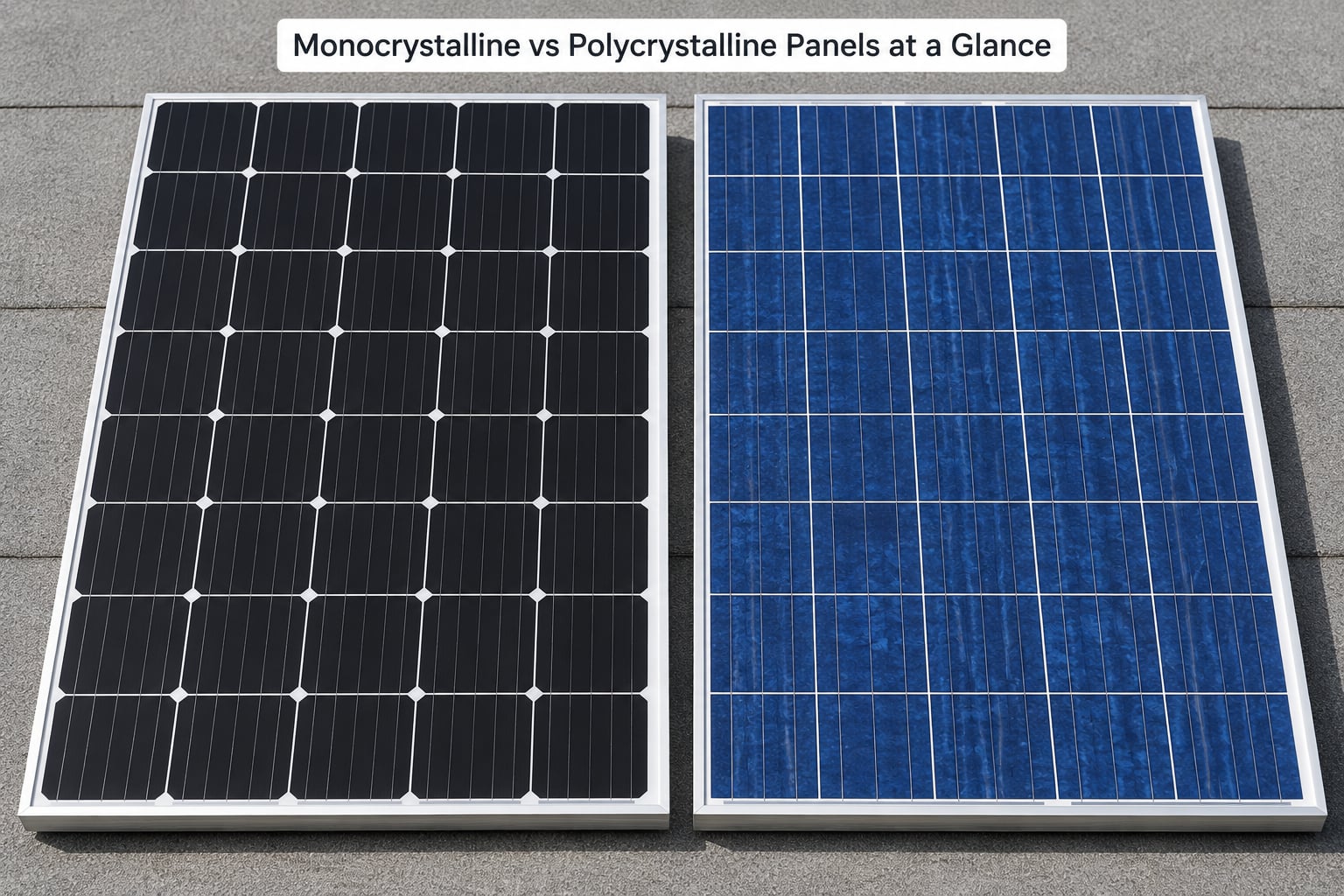
| Factor | Monocrystalline | Polycrystalline |
|---|---|---|
| Crystal structure | One continuous crystal per wafer | Many crystals meeting at grain boundaries |
| Typical efficiency | About 15-23% | About 13-17% |
| Power per panel | Around 400-450W on current residential models | Around 250-300W on older models |
| Power per square metre | Roughly 160-200W | Roughly 125-150W |
| Cost per watt | Higher | Lower |
| Temperature coefficient (per 1C above 25C) | About -0.3% to -0.4% | About -0.37% to -0.5% |
| Typical annual degradation | Roughly 0.3-0.5% in year one, then under 0.5% | Roughly 0.5-1% in year one, then higher |
| Appearance | Uniform black | Blue with a speckled grain pattern |
| Best suited to | Small or awkward roofs, high household usage | Large unshaded roofs, budget-first projects, small 12V kits |
One caveat before the details: panel quality, system design, climate and installation can matter as much as the label. A well-designed polycrystalline array on a clean unshaded roof can beat a badly mounted monocrystalline one every year, and the gap between a good poly array and a good mono array per kilowatt installed is much narrower than the headline efficiency spread suggests.
What Is a Monocrystalline Solar Panel?
A monocrystalline solar panel is built from wafers cut out of a single, uniformly oriented crystal of very pure silicon. Because the crystal structure is continuous, there are no grain boundaries for electrons to cross, and that is why the cells convert a larger share of incoming sunlight into usable electricity.
Two practical things follow from that structure. The panel produces more watts per square metre, so you need fewer of them for the same system size, and each cell looks evenly black because light is absorbed across a uniform surface instead of being scattered by internal crystal edges.
How Monocrystalline Cells Are Made
Manufacturers start with silicon purified to an extremely high grade, melt it, and touch a small seed crystal to the surface. A slowly rotating crystal-puller draws a single cylindrical ingot upward from the melt under tightly controlled temperature and speed, so the crystal grows in one continuous orientation rather than forming many competing grains.
The ingot is then sliced into thin wafers, doped to form the electrical junction, printed with conductive fingers and busbars, and assembled into a cell. That slow, careful, energy-intensive growth is the main reason mono cells cost more to make: you are buying controlled crystal growth, not just silicon.
Where Monocrystalline Panels Work Best
Monocrystalline panels suit roofs where area is the binding constraint, such as a small south-facing slope, a garage, a narrow extension, or an array that has to share space with vents and chimneys. They also suit households with heavy daytime usage, because fewer panels can cover a larger share of the load.
Partly angled or split-orientation arrays benefit too, since a higher-efficiency panel reaches the target kilowattage with fewer modules and less cable. Orientation and shading still set your output, though, so no panel type rescues a roof that faces the wrong way or sits under a tree all afternoon.
What Is a Polycrystalline Solar Panel?
A polycrystalline solar panel, often called multi-crystalline, is made from many silicon crystals that meet inside the same wafer. Electrons crossing from one grain to the next lose a little energy as heat, which is why the cells convert a smaller share of sunlight into power.
The visual signature is the blue, speckled or marbled surface, and the commercial signature is a lower cost per watt. Poly panels were the budget option for years and remain useful when the roof is large, unshaded and the upfront equipment budget is the deciding factor.
How Polycrystalline Cells Are Made
Molten silicon is poured into square moulds and simply allowed to cool. Many crystals nucleate at once and grow together, filling the mould with a block that is sawed into wafers. That is a simpler, faster, higher-yield process than growing a single ingot, so less silicon is wasted and the cells cost less per watt.
The trade is physical: where a monocrystalline wafer has one continuous lattice, a poly wafer is a patchwork. The grain boundaries act as small obstacles to current flow, and the loss shows up as lower conversion efficiency.
Where Polycrystalline Panels Work Best
Polycrystalline panels make sense when you have plenty of usable roof or ground area, a south-ish orientation with no shading, and a firm cap on what you want to spend on equipment. The extra area needed is easy to find on a big roof and impossible to find on a small one.
They also still appear in small and low-voltage builds such as off-grid 12V kits, camper and boat installs, and budget garden lighting arrays, where the deciding number is cost per panel and watts are measured in tens rather than hundreds. If you are sizing a system like that, work out the charge controller and battery capacity first, because the panel choice matters far less than getting the storage side right.
How Do Monocrystalline and Polycrystalline Panels Compare?
Here is the honest split: the differences in material structure, efficiency ceiling and temperature coefficient are real and measurable. The differences in payback, resale value and lifetime output depend far more on the array you actually buy than on the word printed on the datasheet.
Efficiency and Power Output
Modern monocrystalline residential cells run roughly 15-23% efficiency, against about 13-17% for polycrystalline. In watts, that is roughly 160-200W per square metre for mono and 125-150W per square metre for poly, which is why a current 400W+ module needs noticeably less roof than a 250-300W module of a few years ago.
That efficiency gap does not mean the mono roof generates more electricity from the same sunlight. It means you need fewer panels, less racking and less wiring for the same kilowattage. Once two arrays are sized to the same kW on the same roof, the real-world production difference is usually much narrower than the efficiency numbers imply.
Both types use bypass diodes and string inverters in similar ways, so neither gains an advantage from partial shade on its own. Low-light and cloudy-sky behaviour is close to identical; the difference in diffuse light is small enough that it should never drive your decision.
Cost and Payback
Monocrystalline equipment carries a higher cost per watt, and that gap has narrowed a great deal over the past decade. The reasons are manufacturing complexity and scale: single-crystal growth is slower and yields less usable silicon per batch, so cells cost more to make, and the modern market has concentrated almost entirely on mono, which pushes its price down.
What actually drives your budget is bigger than the panel. Inverters, racking, mounting hardware, conduit, the charge controller on smaller systems, and installation labour are largely identical for both types. Panel choice only shifts the balance if roof area is genuinely tight, where fewer modules can cut racking and labour on a constrained array.
Payback then depends on your electricity prices, any incentives you qualify for, the size of the array and how long you plan to keep it. Compare installed cost per watt and projected annual production, not the price of a single panel, which is where most misleading comparisons come from.
Durability and Lifespan
Both types can last for decades when they are properly installed. A monocrystalline panel is not automatically longer-lived than a polycrystalline one; glass, encapsulant, frame quality, junction box design and the quality of the install do more for longevity than the crystal structure.
The real difference is degradation. Mono panels typically lose around 0.3-0.5% of output in year one and then under 0.5% a year, while older poly panels often start closer to 0.5-1% in year one. A 25-year performance warranty promising around 87-92% of nameplate output reflects that slow fade, and a panel rarely dies at exactly year 25.
Temperature, Shading and Low-Light Performance
The temperature coefficient tells you how much output a panel loses for every degree Celsius above 25C on the cell. Monocrystalline typically loses 0.3-0.4% per degree, polycrystalline 0.37-0.5%, so on a hot sunny roof the more efficient type loses slightly less of its peak.
Worked example: a 400W mono panel and a 275W poly panel on the same roof hit a cell temperature of 60C, which is 35C above standard test conditions. The mono panel loses about 12% of its rating, the poly panel closer to 15%.
Shading is a design problem, not a material problem. One panel in a shaded string can drag the output of the rest down unless bypass diodes and a sensible string layout are used, and no choice of crystal changes that. Ask for a production estimate that models your actual shade, not a generic figure from a product page.
Appearance, Area and Installation
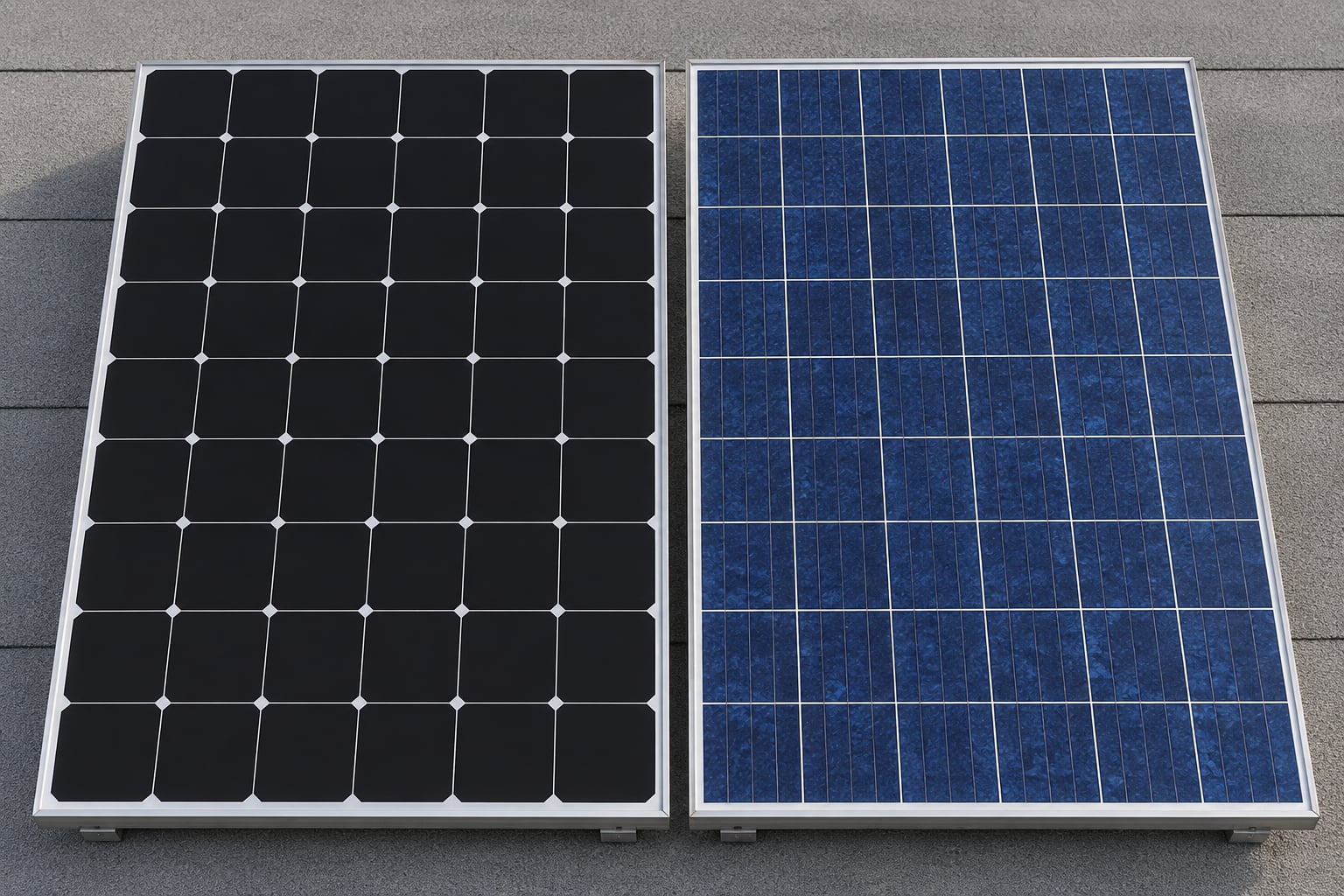
Monocrystalline cells are black with clipped or rounded corners and a uniform texture, while polycrystalline cells are blue with square corners and a visible grainy, speckled pattern. Appearance matters more than most buyers expect once a planner or a homeowners association reviews the roof.
Panel weight per watt is comparable, so mounting and structural loads are decided by total array size and racking rather than by panel type. Follow the manufacturer mounting instructions, keep to the electrical code for string sizing and grounding, and have the electrical and structural work done by a qualified, licensed installer.
Which Should You Choose?
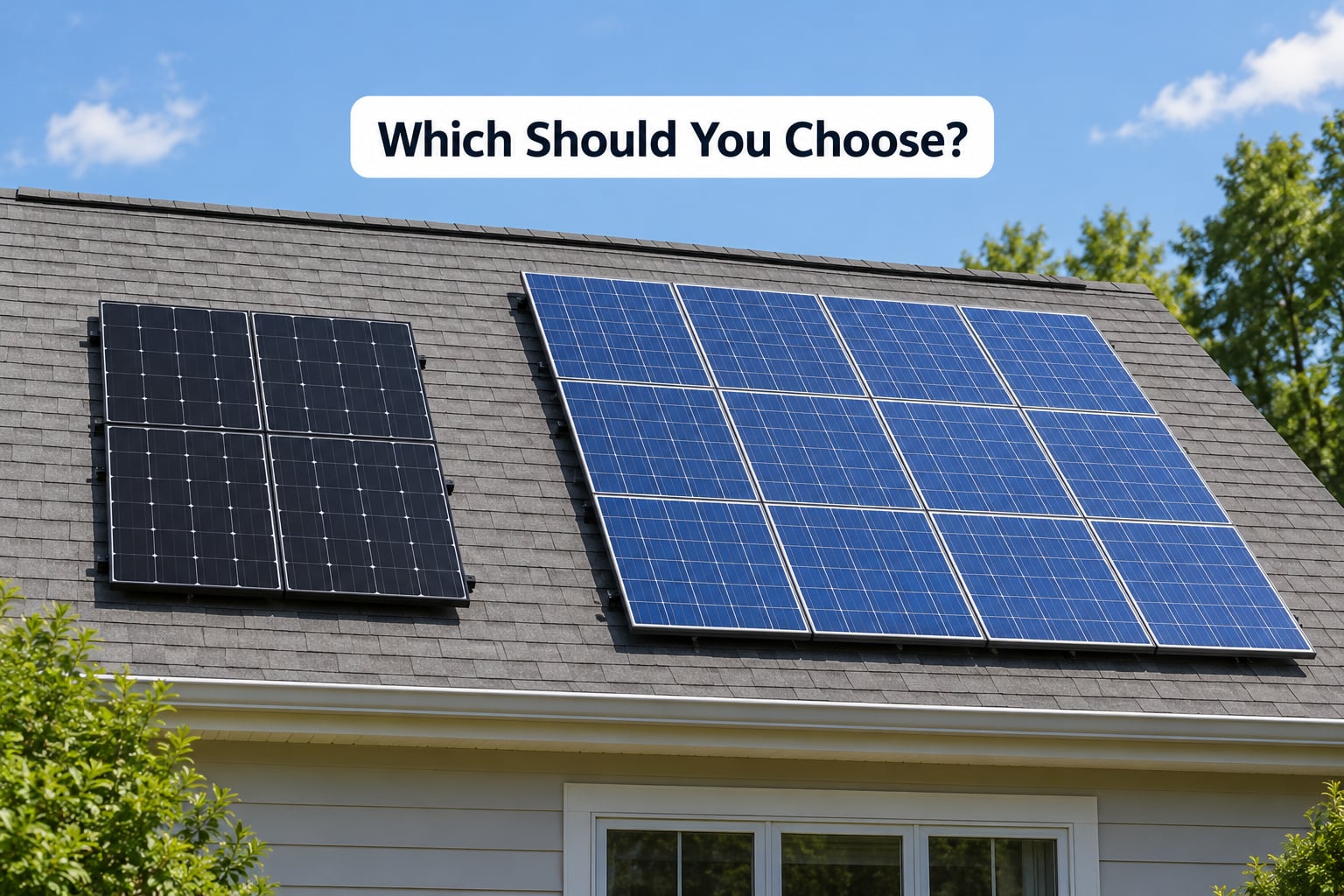
| Your situation | Lean toward | Why |
|---|---|---|
| Small or awkward roof | Monocrystalline | Reaches the target kW in less area and less racking |
| Large unshaded roof, tight equipment budget | Polycrystalline | Lower cost per watt, and the extra area is available |
| Hot, sunny climate | Monocrystalline | Smaller temperature loss on a hot cell |
| High daytime household usage | Monocrystalline | More of the array output usable during peak hours |
| Small 12V cabin, van or garden lighting array | Either | Low wattage means cost per panel matters more than watts per square metre |
| Design-led or HOA-reviewed roof | Monocrystalline | All-black arrays are usually the easier approval |
| Budget dominated by non-panel costs | Either | Inverter, racking and labour costs are the same for both |
My honest recommendation for a new residential array is monocrystalline, because the price gap has shrunk while the space saving has not. Choose polycrystalline only when you have the roof area to spare and the equipment budget genuinely cannot stretch.
When you compare quotes, ask every installer for four things in the same units: total system size in watts, installed cost per watt, the performance warranty terms and degradation rate, and projected annual production in kWh for your specific roof. If two quotes cannot be compared that way, they are not really being compared at all.
Frequently Asked Questions
Can I mix monocrystalline and polycrystalline panels in the same solar array?
Technically yes, but most installers advise against it. Panels with different current, voltage and temperature coefficients respond to irradiance and heat differently, so the weakest string pulls the whole array down and you lose efficiency you paid for. It occasionally makes sense when you are adding panels to an existing roof, which is where monocrystalline vs polycrystalline panels explained decisions get practical rather than theoretical.
Do solar panels work better in cold or hot weather?
Panels produce more power in cold conditions because they work more efficiently when the cells are below their standard 25C test temperature, which is why output peaks in winter and falls on a hot summer afternoon. Hot weather cuts output by roughly 0.3-0.5% per degree above 25C, with monocrystalline panels usually losing slightly less than polycrystalline ones.
Is a more efficient solar panel always the better investment?
Not automatically. Efficiency decides how much roof area you need, not how much electricity your roof can harvest, so the higher cost per watt only pays off when space is tight or the non-panel costs of a bigger array are significant. On a large unshaded roof with cheap labour, the extra spend per watt can take longer to recover than you expect.
How can I tell whether installed panels are monocrystalline or polycrystalline?
Look at the cell surface. Monocrystalline panels are uniform black, often with clipped or rounded cell corners, while polycrystalline panels are blue with a speckled or marbled grain pattern and square corners. If the surface is hard to judge at a distance, check the spec sheet or the label on the back for the cell type, wattage and efficiency rating.
What information should I compare in quotes for monocrystalline vs polycrystalline panels explained?
Compare quotes on installed cost per watt, total system size in watts, projected annual production in kWh for your actual roof, and the performance warranty terms including the degradation rate. Ask for the module model number, the inverter, the racking and the installer qualification separately, so you can see which part of the price difference actually comes from the panel.
Conclusion
Monocrystalline vs polycrystalline panels explained comes down to space against cost: mono gives you more watts per square metre, better hot-weather behaviour and slower degradation, while poly gives you a cheaper watt when you have the roof to put it on. For most new residential systems in 2026, mono is the sensible default.
Start by asking each installer for a site-specific production and cost comparison based on panel model, usable roof area, orientation, shading, warranty and total installed cost. That single document answers the real question better than any spec sheet on its own.