To calculate the cost of running a light, you multiply the bulb’s wattage by the hours it runs, divide by 1,000 to turn watts into kilowatt-hours, then multiply by your electricity rate. That gives you the running cost per hour, per day, per month and per year.
The formula is: Cost = (Watts ÷ 1,000) × Hours of use × Your rate per kWh. The catch is that almost every online calculator buries the method and hands you one number, which is useless when your rate or your hours differ. This guide shows the arithmetic so you can reproduce it yourself.
Everything below works in cents, so the numbers stay clean and you can check them against a bill.
Table of Contents
- What You Need
- Step-by-Step: How to Calculate the Cost of Running a Light
- 1. Find the Light’s Wattage
- 2. Estimate How Long the Light Runs
- 3. Convert Watts to Kilowatt-Hours
- 4. Multiply Energy Use by the Electricity Rate
- 5. Compare Daily, Monthly, and Annual Costs
- Common Mistakes
- Frequently Asked Questions
- How do I find the running cost of a light if I do not know its wattage?
- How much does it cost to run one LED light bulb per month?
- Do solar lights have zero running costs after installation?
- Should I use the wattage printed on the lamp or measure actual energy use?
- How do motion sensors and timers change a light’s running cost?
- Do outdoor lights use more electricity than indoor lights?
- Conclusion
What You Need
Four inputs produce the answer. Three of them you can get in under two minutes.
- The wattage of the bulb or lamp. Printed on the bulb, on the specification plate inside the fixture, or in the manual. For an LED, look for the actual watt draw, not just the “60W equivalent” number on the box.
- How many hours a day it runs. A porch lamp on a dusk-to-dawn sensor is a different number from a lamp on a timer, and different again from a lamp someone flips on for ten minutes.
- Your electricity rate in cents per kilowatt-hour. It sits on your bill, usually as a line item near the energy charge. The US Energy Information Administration publishes the average US residential rate each month, and as of 2026 it sits in the mid-teens in cents, but your own bill is the number that matters.
- The power source. Mains-powered lights draw from the grid and cost you money per hour. Solar lights cost you nothing per hour but carry battery and panel replacement costs that belong in the same spreadsheet.
If a light runs off a 120V circuit and you want to know whether that circuit can handle it, divide the watts by 120 to get amps. A 40W bulb is about 0.33 amps. For anything involving new wiring, new circuits or a breaker that keeps tripping, have a licensed electrician do the work rather than guessing.
Step-by-Step: How to Calculate the Cost of Running a Light
Five steps, in this order. Work through them once and the second light takes thirty seconds.
1. Find the Light’s Wattage
Wattage is a unit of power, meaning how fast electricity flows, not how much you pay. Turn the fixture off before you read the label inside it, and read it with a dry hand.
The number you want is on the bulb itself, on the sticker in the fixture, or in the manual. For a fixture with several lamps, multiply the per-bulb wattage by the bulb count. A three-bulb fixture at 60W per bulb is 180W, not 60W.
One trap worth knowing: on LED packaging the front of the box usually says something like “60W equivalent,” which describes the brightness of the incandescent bulb it replaces. The real watt draw is printed small on the side or back. Using the equivalent number overstates an LED’s consumption by roughly seven times.
2. Estimate How Long the Light Runs
Hours per day is where most estimates quietly go wrong, so pick a number you could defend.
- Dusk-to-dawn porch light: roughly 10 to 12 hours in summer, closer to 7 to 8 in winter. Use 10 if you want one number for the year.
- Pathway and garden lights on a timer: whatever the timer is set to, commonly 4 to 6 hours.
- Motion-activated security light: far less than people guess, often 15 to 45 minutes a day across a week of triggering.
- Seasonal string lights: 5 to 6 hours a day for 30 days, not 365.
- An empty room someone forgets about: this is the one that quietly costs more than the rest of the house combined.
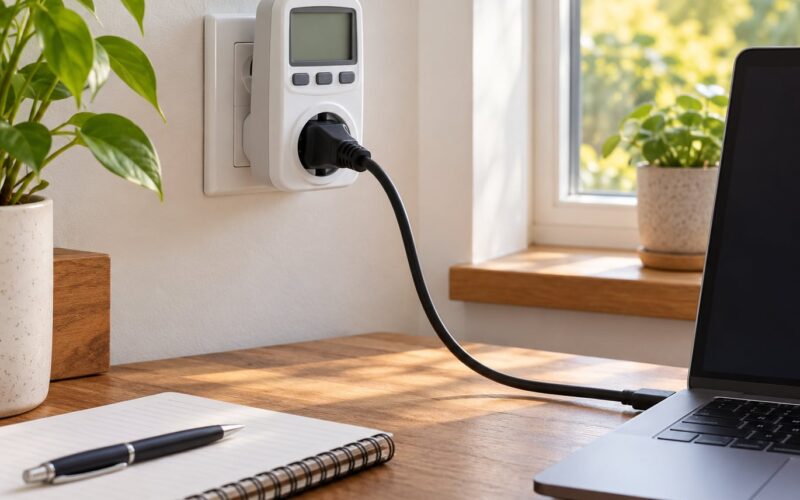
If you want a real number rather than a guess, a plug-in energy monitor between the bulb and the socket will give you a kilowatt-hour reading you can check against your estimate after a week.
3. Convert Watts to Kilowatt-Hours
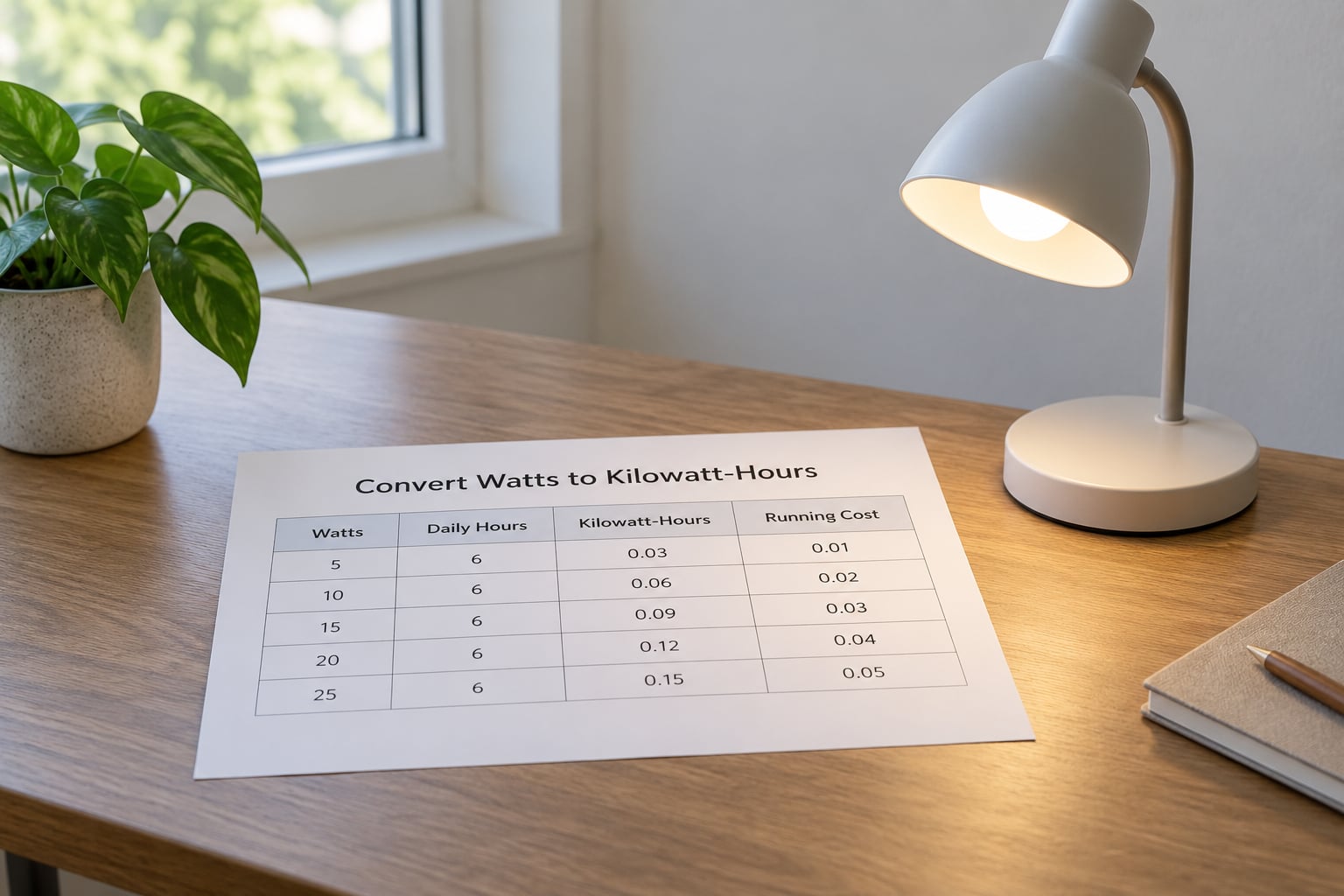
Watts are power. Kilowatt-hours are energy, and the kilowatt-hour is the only unit you are ever billed for. The conversion is straightforward: divide watts by 1,000 to get kilowatts, then multiply by hours to get kilowatt-hours.
Worked example. A 60W incandescent lamp running 6 hours a day uses 60 ÷ 1,000 = 0.06 kW, and 0.06 kW × 6 hours = 0.36 kWh per day. Over a 30-day month that is 10.8 kWh. Check it against a bill and the number lands in a believable place, which is exactly how you know the method is sound.
| Bulb | Watts | Hours per day | kWh per day | Cost per day at 15 cents/kWh |
|---|---|---|---|---|
| LED | 5 | 6 | 0.03 | 0.45 cents |
| LED | 9 | 6 | 0.054 | 0.81 cents |
| LED | 14 | 6 | 0.084 | 1.26 cents |
| CFL | 25 | 6 | 0.15 | 2.25 cents |
| Incandescent | 40 | 6 | 0.24 | 3.60 cents |
| Incandescent | 60 | 6 | 0.36 | 5.40 cents |
| Incandescent | 100 | 6 | 0.60 | 9.00 cents |
Small numbers, big cumulative effect. A single 100W incandescent on that schedule burns about 219 kWh a year, which is a meaningful slice of a household budget for one lamp.
4. Multiply Energy Use by the Electricity Rate
Final step: kWh × your rate in cents per kWh equals your running cost in cents. Using the 60W incandescent above, 0.36 kWh per day × 15 cents = 5.40 cents a day. Across 30 days that is 162 cents a month, and across a year roughly 1,970 cents.
Your rate comes from your bill, not from a website. Find the energy or electricity charge, find the kilowatt-hours used for that period, and divide. If a bill shows 720 kWh and the energy charge is 108, your rate is 15 cents per kWh. Round numbers like 15 or 17 cents are common because tariffs are usually built that way.
Two reasons not to borrow someone else’s rate. Some households sit well below the national average and some sit well above, and the gap is real money over a year. Some utilities also price by time of use, where an on-peak rate can run several times the off-peak rate. Energy forum readers report on-peak rates near six times their off-peak rate in some regions, and outdoor lighting that runs in the evening sits squarely in the expensive window.
5. Compare Daily, Monthly, and Annual Costs
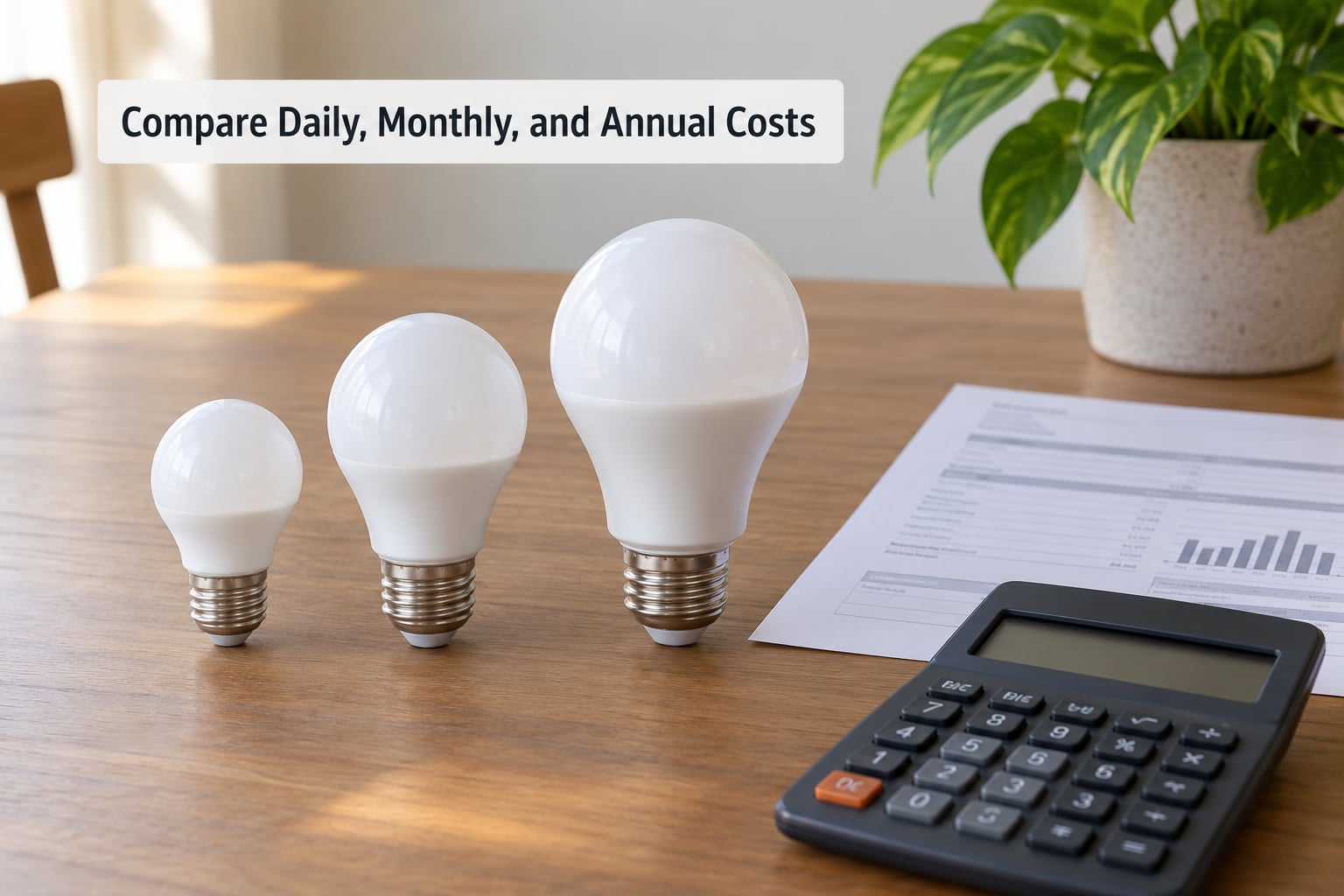
One bulb is rarely the question. Comparing across time horizons at the same hours-per-day assumption makes the trade-offs obvious, and the same table scales to a whole house at the end.
| Bulb | Watts | Per hour | Per day (6 hrs) | Per month (180 hrs) | Per year (2,190 hrs) |
|---|---|---|---|---|---|
| LED | 5 | 0.08 cents | 0.45 cents | 14 cents | 164 cents |
| LED | 9 | 0.14 cents | 0.81 cents | 24 cents | 296 cents |
| LED | 14 | 0.21 cents | 1.26 cents | 38 cents | 460 cents |
| CFL | 25 | 0.38 cents | 2.25 cents | 68 cents | 821 cents |
| Incandescent | 40 | 0.60 cents | 3.60 cents | 108 cents | 1,314 cents |
| Incandescent | 60 | 0.90 cents | 5.40 cents | 162 cents | 1,971 cents |
| Incandescent | 100 | 1.50 cents | 9.00 cents | 270 cents | 3,285 cents |
Scale that to a household and the calculation stops being a curiosity. Take 20 fixtures running 6 hours a day. With 9W LEDs that is 20 × 9 × 6 = 1,080 Wh per day, or about 394 kWh a year, which comes to roughly 5,910 cents. With 60W incandescents the same 20 fixtures pull 7.2 kWh a day, about 2,628 kWh a year, or close to 39,400 cents. The difference, around 33,500 cents a year, arrives without changing a single habit.
The same method gives you per fixture, per bulb and per hour-of-light cost. Dividing annual cost by total lumens produced tells you which setup genuinely delivers light more cheaply, which is a fairer comparison than wattage alone.
Common Mistakes
Treating watts as brightness. The higher the wattage, the more energy consumed, not the more light produced. Compare on lumens, and check lumens per watt before you swap anything.
| Technology | Typical wattage | Typical lumens | Lumens per watt |
|---|---|---|---|
| Incandescent | 60 W | 800 | 13 |
| Halogen | 43 W | 800 | 19 |
| CFL | 14 W | 800 | 57 |
| LED | 9 W | 800 | 89 |
Using the lamp’s rated wattage for an LED. Fix: use the actual watt draw printed on the bulb, which is the small number, not the equivalent on the front of the box.
Counting one bulb in a multi-lamp fixture. Fix: count the sockets, multiply, and treat the fixture as a single load.
Confusing watts with kilowatt-hours. Fix: watts tell you how fast energy moves, kilowatt-hours tell you how much you used. Only the second one appears on your bill.
Ignoring standby draw. Some fixtures with motion sensors, timers or smart bulbs idle at a small continuous draw. It is usually a small fraction of a watt, but add it if you are working with several dozen fixtures.
Treating a solar light as free. A solar light costs no electricity per hour, but its battery and panel eventually need replacing. Spread that replacement cost across the years you expect to use it and you get a fair annual figure to compare against a mains lamp.
A few habits cut the number without buying anything: motion sensors on driveways and back doors, timers on holiday displays, dimming unused rooms rather than switching them off entirely, and matching each bulb’s output to the room instead of using one wattage everywhere.
Frequently Asked Questions
How do I find the running cost of a light if I do not know its wattage?
Turn the fixture off and read the label on the bulb or the specification sticker inside the fixture, or check the manual. If the label is gone, the bulb shape and fitting give you a strong hint about its era, and an LED of that size almost always draws under 15W. To be certain, put a plug-in energy monitor between the bulb and the socket and read the kilowatt-hours after a known number of hours.
How much does it cost to run one LED light bulb per month?
It depends on wattage, hours and your rate. A 9W LED running 6 hours a day uses about 1.62 kWh a month, which at 15 cents per kWh is roughly 24 cents. A 14W LED on the same schedule comes to about 38 cents a month, and a 5W LED to about 14 cents. Left on 24 hours a day, a 14W LED costs roughly 151 cents a month at that rate.
Do solar lights have zero running costs after installation?
No, though the electricity cost is zero. Solar lights still need battery replacement, usually every one to three seasons depending on climate and usage, and panels degrade over time. Divide the replacement cost by the years you expect the light to work and you get an annual figure. Compare that against a mains lamp’s yearly electricity cost and solar usually wins outdoors, especially where wiring would be expensive.
Should I use the wattage printed on the lamp or measure actual energy use?
Use the printed wattage for estimating and measure when you want certainty. Printed wattage is accurate enough for a comparison, and it is instant. Measuring with a plug-in energy monitor catches the things a label cannot: standby draw in sensors, dimming behaviour, and an aged ballast or driver pulling more than it should. Measure once per room type rather than per bulb.
How do motion sensors and timers change a light’s running cost?
They cut it directly, and the amount depends on real trigger frequency. A security light rated 4 hours a day but only triggered for 45 minutes actually runs about 5 hours a week, so its effective hours per day are closer to 0.7, not 4. Recalculate with measured runtime rather than the label assumption. On high-traffic paths a timer often costs more than a motion sensor.
Do outdoor lights use more electricity than indoor lights?
Outdoor fixtures tend to draw more, often because they are floodlights or string lights rather than single bulbs, and they often run longer into the evening. They also usually fall in peak pricing windows on time-of-use tariffs, so each kilowatt-hour costs more. Path lights on a timer are the exception that flips this, since many draw only a couple of watts each.
Conclusion
Three numbers give you any answer: the wattage, the hours per day, and your rate in cents per kWh. Multiply them in that order and the result is reproducible on paper in under a minute, which no black-box calculator has ever done for me.
Start tonight with one outdoor light you actually keep on. Get its wattage, note how long it runs, then work out the monthly figure and compare it against a lower-power replacement or a solar light. Multiply by however many similar fixtures you have and you have your own answer.