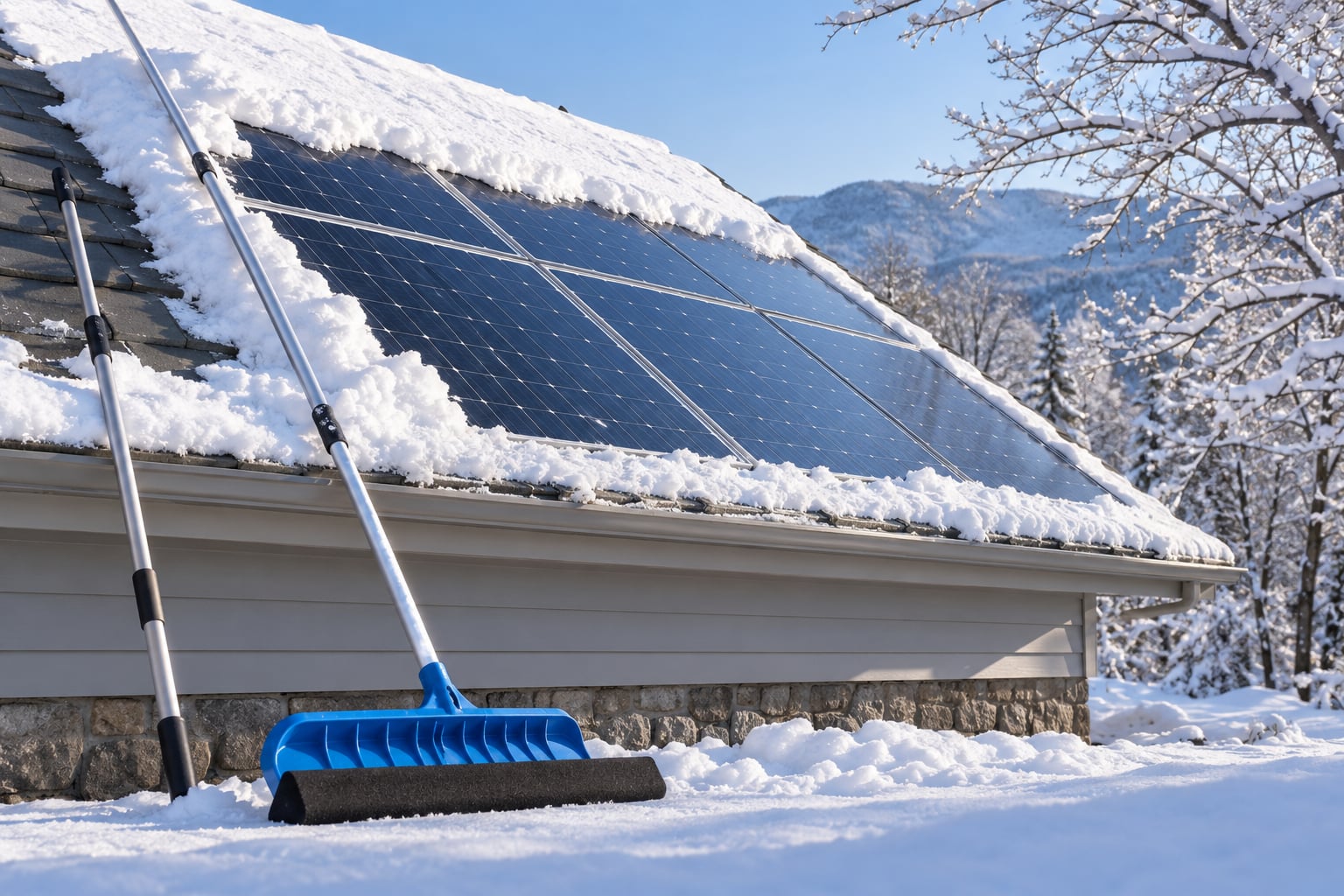
Leave a light dusting alone and clear anything more than about an inch of settled snow, or any ice at all. Work from the ground with a plastic or foam-edged rake on an extended pole, never from the roof. On a ground-mount array the job takes ten minutes with a leaf blower; on a steep roof you need reach and a soft head.
Snow does real damage to a winter’s production. A covered panel makes almost nothing, and an off-grid household with batteries feels that immediately. There is also weight and water to think about, since meltwater trapped against the frame is a corrosion risk.
Most of the advice online gets the method right and the risk wrong, so let’s put the safety rules first and the technique after them.
Table of Contents
- What You Need
- Step-by-Step
- How to Clear Snow from Panels Without Climbing
- How to Remove Heavy Snow and Ice Safely
- How to Know When the Panels Are Working Again
- Common Mistakes
- Safety and Timing Tips
- Frequently Asked Questions
- Should you remove snow from solar panels?
- What is the best tool for cleaning snow off solar panels?
- Will snow melt off solar panels on its own?
- How much power do solar panels lose under snow?
- Can I use hot water, salt or a pressure washer on solar panels?
- When should I call a solar installer instead of clearing snow myself?
What You Need
The only thing that matters more than the tool itself is the head material. Plastic, polyethylene, rubber and foam are what owners trust across the solar forums, because none of them will scratch tempered glass. Bare metal is the material everyone warns against, for good reason: a steel rake edge dragged over glass crazes the surface and wears through the anti-reflective coating.
- A polyethylene roof rake or a plastic snow rake with a foam or rubber strip on the edge. This is the default choice for both ground and roof mounts.
- A telescoping pole with a wide soft brush head when the array is high or set back. Some owners reach 28 feet with a pole plus a soft brush and describe it as the single best tool in the house.
- A leaf blower on cold air only for powder snow on a ground-mount array. Low output, aimed down the panel face, never at the frame or rails.
- A soft pool brush as a free substitute. A pool supply closet will usually have one.
- A towel or cloth strip to wrap around a rake edge if that is the rake you own. It is a compromise, not a first choice.
- Your panel manufacturer’s installation manual. It states the approved cleaning tools, and warranty terms follow it.
- Gloves, a headlamp and a charged phone if you are working early or late in the season.
| Tool | Material | Reach | Safe on glass | Best snow type |
|---|---|---|---|---|
| Polyethylene roof rake | Plastic head, optional foam strip | 4 to 16 ft | Yes | Settled and wet snow |
| Foam snow rake | Foam head over plastic | 4 to 14 ft | Yes | Light to settled snow |
| Telescoping pole plus soft brush | Aluminium pole, bristle or cloth head | Up to 28 ft | Yes with a soft head | Powder and light snow |
| Leaf blower, cold air | Plastic housing | Arm’s length plus hose | Yes at low force | Dry powder only |
| Pool brush | Soft nylon or rubber | Handled or pole-fed | Yes | Light dustings |
| DIY bull-float pole rig | Threaded poles plus soft concrete broom | About 30 ft | Yes | Garage and high roof arrays |
| Metal shovel or snow pusher | Steel or aluminium | Arm’s length | No | Not for panels |
| Squeegee | Rubber blade | Arm’s length | Usually | Thin films, rarely snow |
| Roof de-icer salt or hot water | Chemical or thermal | Requires access | No | Never on a panel |
The table’s last two rows are there as warnings, not options. The things to avoid are metal blades of any kind, abrasive or stiff-bristle brushes, ice-melting salt, hot water, pressure washers and anything that needs you to stand on the roof.
Step-by-Step
Run the sequence in this order and it takes less time than the weather forecast did. Every step below is designed so you can tell it worked from the ground.
- Measure before you act. Look at the array from the street and compare it with a door handle, a fence picket or the depth of your boot sole. Under an inch is usually fine to leave. More than that, or any ice shell, means you have a job.
- Check the weather and the ground. Wait for dry, settled snow. Wet heavy snow sticks to glass, and clearing it half-frozen is how panels and people get hurt. Skip the work entirely during a storm, at dusk or on a whiteout day.
- Read the manual and check the system. Note what your manufacturer permits for tool contact, and glance at the inverter or monitoring app to record the current reading before you start. You need a before number to compare against later.
- Clear loose snow first. Blow or brush off the dry top layer with the blower on cold or a soft brush, working along the panel face. If a panel already shows daylight, that layer came off cleanly and you move to the next one.
- Work the heavy layer with controlled pulls. Start at the upper edge of the array and draw the rake down in one smooth pass, then again from slightly higher. Short, repeated strokes dig the head into the glass and can snap it off. Long single strokes do not.
- Stop at the frame. Never rake across a mounting rail, clamp or connector, and never lean the head into the panel’s short edge to gain leverage. Stop the moment the rake head skids on glass.
- Look for ice and damage. From the ground, check for a slab sitting at the lower edge, a cable that has been pushed out of its run, or a panel that looks cracked or has a dark patch. Any of those mean you stop and call an installer.
- Confirm the reading changed. The generation display should climb as the glass clears, even on a cloudy day. If the number sits at zero with clean glass in front of you, the problem is not snow.
How to Clear Snow from Panels Without Climbing
Work from the perimeter of the array and let gravity do the moving. Stand where you can see the whole face of a panel, then push or pull the tool down the slope in one pass from the upper edge toward the lower edge. Light to moderate snow comes off on the first contact, and a dry powder layer usually needs nothing more than air.
A ground mount is the easy case. Ground-mount owners in snowy states describe clearing panels with a leaf blower and a towel-wrapped roof rake, because the array sits low enough to reach comfortably. That is the setup to aim for if you are planning an install and expect real winters.
| Factor | Ground mount | Roof mount |
|---|---|---|
| Typical reach | Hand height to 6 ft | 10 to 30 ft |
| Falling snow risk | Low, panels sit below head height | Real, slabs release from the lower edge |
| Best tool | Leaf blower, plastic rake, pool brush | Polyethylene rake on a telescoping pole |
| Time for a 10-panel array | About 10 minutes | About 30 minutes |
| Getting the job done | Routine seasonal work | Plan the pole length before winter |
| Call a professional when | Ice or a bent mount | Over 20 ft reach, steep pitch or visible damage |
If your reach stops short, build a rig instead of climbing. One far-northern homeowner with 10 ft garage walls on a 6:12 pitch needed about 30 ft of reach and assembled it from three 10 ft threaded concrete bull-float poles plus a 4 ft soft concrete broom, reporting that it works perfectly. Buy or borrow pool extension poles to get there with a soft head.
Watch what you are standing under. Snow slides off an array in slabs, not drips, and a slab coming off a steep array can land on a person, a car or a gutter. Keep children and pets inside until you have cleared the full lower edge.
How to Remove Heavy Snow and Ice Safely
A rake earns its keep once the snow is settled and heavy enough to stay put, and even then only with controlled pulling. Ice is a different problem entirely, and the honest answer is that no hand tool clears an ice shell without risk to the glass.
| Snow depth or condition | What happens to output | Action | Tool | Time |
|---|---|---|---|---|
| Under 1 inch, dry | Barely affected | Leave it, or blow it off when convenient | Leaf blower on cold | 5 minutes |
| 1 to 3 inches, dry | Most of the day lost | Clear once a week in a normal winter | Polyethylene rake or soft brush | 15 minutes |
| 3 to 6 inches, wet | Effectively zero | Clear on the next dry day | Rake, long single pulls | 30 minutes |
| Over 6 inches, wet | Zero, plus load on the rails | Clear in stages, one panel row at a time | Rake or extended brush | Two sessions |
| Ice or freezing rain shell | Zero | Wait for a thaw, then clear; skip if you cannot reach safely | None by hand | Days |
Water is the tempting answer and it is the wrong one. Owners on solar forums agree almost unanimously that spraying or hosing a panel makes things worse: the water runs off and refreezes, builds ice dams along the lower frame and the eave, and the garden hose itself turns brittle in cold weather and cracks.
Hot water is worse. Tempered glass has a thermal shock limit, and a sudden temperature jump across a frozen panel is exactly the kind of stress that cracks it. The same goes for any de-icing salt or chemical sprayed on the surface. Those products are not designed for photovoltaic glass, and their residue sits on the panel for the rest of its life.
So when the table says clear it and you cannot reach, the answer is to wait. On a sunny thaw the panels warm, meltwater runs off and the slab drops by itself, usually within a few days. Forum owners who stopped worrying about snow say the same thing: most of it leaves on its own once the sun returns.
How to Know When the Panels Are Working Again
Compare the number you wrote down in step three with the number you see now. On a grid-tied system, the inverter display or the monitoring app is the source; on many systems the production figure climbs within minutes of the glass clearing, even under cloud. Watch for the change across two panels rather than one.
A dip that lasts an hour after clearing is normal, because the array needs direct sun before it produces. A reading that sits at zero while the panels are visibly clean is not normal, and neither is a fault code that appears right after you worked on the roof.
The signs that point to damage rather than snow are specific: a dark patch or spiderweb crack in the glass, a corner of the laminate lifting, a connector sitting proud of its mount where the cable should be clipped, or an output figure that drops sharply when you compare two clean rows against each other. Continuous shading from a soiled strip along one edge can do the same thing, because cells are wired in series and a shaded cell drags down the string it belongs to. Stop there and call the installer.
Common Mistakes
Every one of these has a straightforward fix, and most of them happen in a hurry.
- Climbing onto an icy roof. Fix: everything on this page works from the ground. A fall onto ice or a wet slope is the serious injury in this whole topic, and no amount of cleared snow makes it safer to be up there.
- Using a steel shovel or metal rake. Fix: plastic, polyethylene, rubber or foam. If the rake you own is metal, wrap the edge in a towel or duct tape and replace it when the season ends.
- Pouring hot water or spreading salt. Fix: neither. Cold meltwater refreezes into ice dams, and hot water can crack the glass outright.
- Hitting panels with full blower force. Fix: use cold air, low output and a downward angle along the panel face. Blowing at the frame or a connector hard enough to move snow can also move a cable.
- Clearing in the wrong weather. Fix: dry, settled snow in daylight. Half-frozen slush turns into a slide hazard on the roof and on the tool.
- Treating every snowfall as urgent. Fix: measure first. Under an inch on a sunny-tilted array is not worth the risk, and the panel will shed it on its own.
- Raking with short, choppy strokes. Fix: one long pull per pass. Chopping drives the head into the glass and can snap the handle at the joint.
Safety and Timing Tips
Wait for dry, stable snow and do the work in daylight, so you can see the roof edge, the condition of the glass and any cable you might have disturbed. Keep people and pets out from under the array while the lower edge still holds snow, because that is where the slab comes down.
Check your manufacturer’s instructions before the first storm of the season and again if anything on the roof has been replaced. Warranty terms follow the manual, and the manual is where the approved tool materials are listed.
Stay clear of electrical equipment while you work. Keep the inverter, combiner and any disconnect in sight rather than reaching past them, and if you see a damaged connector, an exposed conductor or water inside the junction box, leave it alone and call the installer.
Hire a solar installer or a roofer when the array is above about 20 ft of reach, the roof pitch is steeper than a typical residential slope, the mounting hardware looks strained, or you find damage during the walk-around. That is not a failure. It is the point where the risk of doing it yourself outweighs the cost of the callout.
Two things you can do before winter arrives pay off all season. Steeper tilt lets snow slide off on its own, which is why installers in snowy regions push the angle up rather than letting panels sit nearly flat. Snow guards, installed at the lower edge, break a releasing slab into smaller pieces so it lands where a car or a walkway is not waiting, and they cost nothing at retrofit.
On an off-grid system with batteries, plan the storm before it arrives. Keep the pole and brush dry and ready, because the week you need the array is the week you will not want to dig a rake out of the garage in a whiteout.
Frequently Asked Questions
Should you remove snow from solar panels?
A light dusting under roughly an inch on a tilted array is fine to leave, because the sun usually sheds it within days. Clear anything thicker, and clear any ice at all, since a covered panel produces almost nothing. If your system is off-grid with battery backup, treat it as urgent earlier than a grid-tied system.
What is the best tool for cleaning snow off solar panels?
A polyethylene or plastic roof rake with a foam or rubber edge, mounted on a pole long enough that you never need the ladder. For high arrays, a telescoping pole with a wide soft brush head gives roughly 28 ft of reach. Skip steel entirely, since metal edges scratch tempered glass and wear through the anti-reflective coating.
Will snow melt off solar panels on its own?
Often yes. A dark panel in sun warms quickly, and meltwater runs down the glass and drops off the lower edge, usually within a few days of a storm. Steeper tilt helps the slab release instead of sitting. What does not clear itself is wet heavy snow packed into a frame or an ice shell from freezing rain.
How much power do solar panels lose under snow?
A fully covered panel makes essentially nothing, and a thin even dusting costs little because some light still reaches the cells. Cell strings are wired in series, so a shaded or covered section can pull down more of the panel than the covered area alone would suggest. Expect production to climb within minutes of the glass clearing.
Can I use hot water, salt or a pressure washer on solar panels?
No to all three. Hot water on frozen glass can crack it through thermal shock. Salt and de-icing chemicals are not made for photovoltaic surfaces and leave a residue that stays for the life of the panel. A pressure washer can damage seals and drive water into the frame, where trapped meltwater causes corrosion.
When should I call a solar installer instead of clearing snow myself?
Call when the array sits above about 20 ft of reach, the pitch is steeper than a typical residential roof, or you spot cracked glass, a lifted laminate corner or a connector pushed out of its run. Also call if snow load has visibly strained the mounting hardware, or if the inverter still reads zero after the panels are visibly clean.
Start with a tape measure or your boot sole. If it is under an inch and the array is tilted, let the sun handle it this 2026 winter and spend your effort on the roof instead.
If it is thicker, wait for dry settled snow, then use a plastic or foam-edged rake on a pole from the ground, long pulls from the upper edge down. If you cannot reach it without climbing, leave it until the next thaw or call an installer, and neither option will cost you much.