Yes, outdoor lights harm insects, and the damage goes well past the pile of moths on your porch. Bright night lighting pulls nocturnal insects off their normal routes, wears down the energy they need to mate and lay eggs, feeds predators at an unnatural density, and keeps bats out of yards where they would otherwise clear mosquitoes. A warm, dim, shielded, short-lived fixture harms far less than an all-night floodlight.
Two questions get tangled together here, and separating them is most of the answer. One is nuisance: are bugs swarming my door? The other is ecological: are insect populations in my yard and beyond getting worse because of my lighting? The second one is the harder question, and it is the one you asked.
The honest answer is that nobody can put a single number on it, and that is a real problem. A recent review of the evidence for insect-friendly lighting, published in a peer-reviewed environmental journal, concluded that the benefits of spectral tuning and dimming are ambiguous and often overstated. What is not ambiguous is the direction of the effect at the fixture itself: insects do gather, burn energy, and die there.
How much harm any given light causes comes down to five things: how bright it is, which wavelengths it puts out, how high it throws light, how long it stays on, and how much habitat sits nearby. A cottage beside a nature reserve with two warm path lights is a different situation from a townhouse with a floodlight aimed at the street.
Table of Contents
- Do Outdoor Lights Harm Insects?
- How Does Artificial Light Affect Insects?
- Do Lights Attract All Types of Insects?
- Which Outdoor Lights Are Least Disruptive?
- Does UV Light Make Outdoor Lights More Harmful?
- Are Solar Outdoor Lights Better for Insects?
- Do outdoor lights harm insects differently when they run on solar?
- How Can You Reduce the Impact of Outdoor Lighting?
- What About Light Pollution Beyond Your Garden?
- Frequently Asked Questions
- Do low-wattage outdoor bulbs stop harming insects?
- Is a yellow outdoor light better for insects than white light?
- Do motion-activated solar lights reduce insect disruption?
- Do outdoor light traps work without harming beneficial insects?
- How can I light a path safely without attracting insects?
- How to Choose More Insect-Friendly Outdoor Lighting
Do Outdoor Lights Harm Insects?
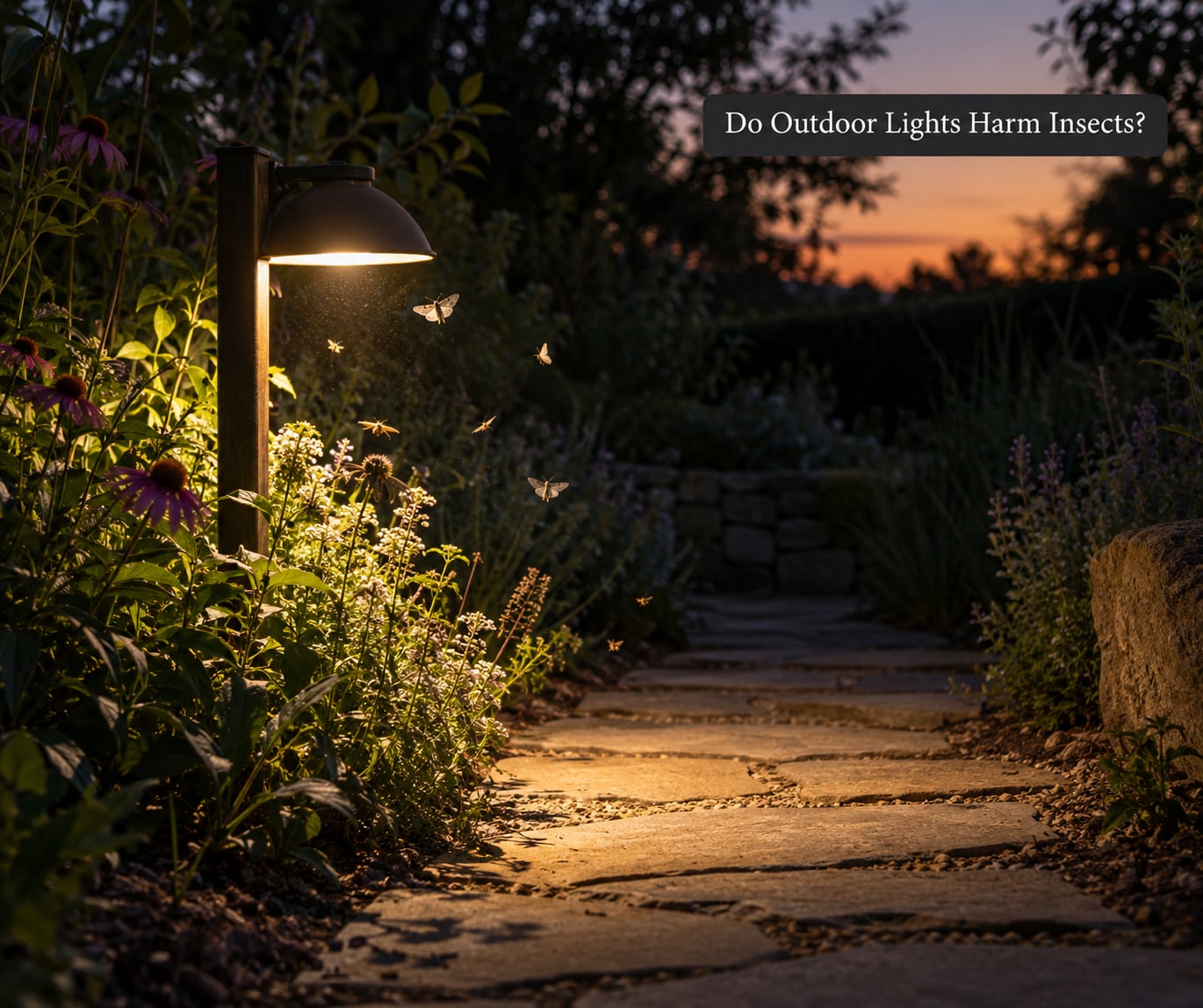
So, plainly: yes, and the effect is measurable in insect fitness, not just in how you feel about your patio. The four documented harms are burned energy reserves and failed mate-finding, insects killed at or near the fixture, predator congregation that spikes and then crashes local numbers, and pollination and food-web losses that ripple outward.
The nuisance version of the harm is real but almost beside the point. A homeowner with a porch light next to a state park will see insects every single time the door opens; the same light in a dense city block barely registers. Forum threads on r/DIY and r/NativePlantGardening show gardeners arriving at the same conclusion through pure frustration, with a hundred comments of people saying, in effect, that they wish they had switched the lights off years ago.
Here is what actually determines the damage.
- Brightness. Lumen output, not wattage, is what an insect responds to. A dim fixture at half output is roughly half the invitation.
- Spectrum. Ultraviolet and blue pull hardest. Amber and red pull least.
- Height and aim. Light thrown upward and outward reaches flight paths and sky. Light aimed straight down mostly does not.
- Duration. A light that burns from dusk to dawn removes the night window entirely.
- Surroundings. The closer the habitat, the more insects pass through your light’s reach.
Not every one of those is a knob you can turn. But four of the five are, and that is the whole basis of the mitigation advice later in this article.
How Does Artificial Light Affect Insects?
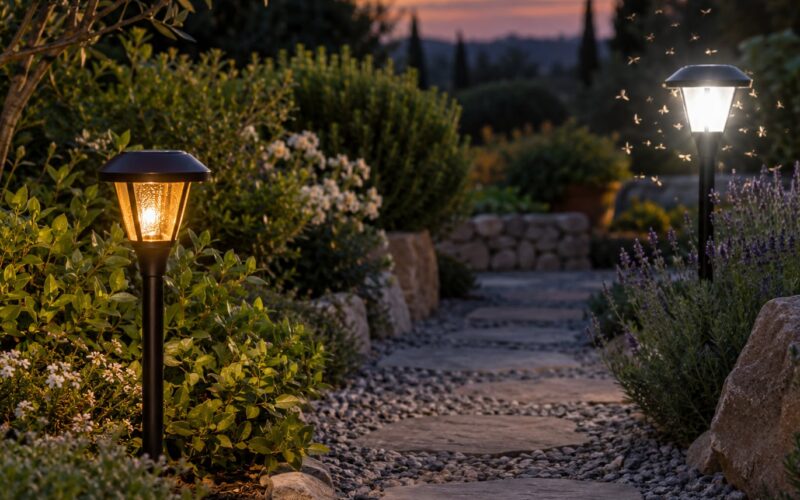
Many nocturnal insects orient themselves at a fixed angle to the moon, using it as a compass while they fly. A porch light sits a few metres away instead of hundreds of thousands of kilometres, so the geometry they depend on collapses. They correct, overshoot, and correct again, and that is why moths appear to orbit a bulb rather than land on it.
The result is a slow drain. A night insect circling a light is spending fat and protein reserves it needed for a mate and for eggs. Many never make it to either. Researchers in the UK have found that a substantial share of large moths taken at lit sites are damaged or dead, and the moths that do leave often carry broken wing scales from repeated collisions with the fixture, the wall, or the glass.
Then the effects cascade in ways that are easy to miss.
Predator congregation. Spiders, birds, bats, wasps and predatory beetles all learn that a lit window is a buffet. The first few nights produce a feeding frenzy, and local insect numbers around the light drop. What usually follows is worse: predators shift their range to sit on the lamp, so nearby habitat no longer gets the pressure it once did, and the community reorganises around the light rather than around the vegetation.
Predator avoidance. Some animals leave lit ground entirely. Bats in particular will route around bright, continuously lit areas and forage in the darker gaps, which means a well-lit garden can quietly lose its best mosquito control. A big brown bat working an unlit yard will eat something close to a thousand mosquito-sized insects in an hour. Take that bat out of the picture and the mosquitoes it was eating are still there while the things eating them are not.
Moth-eating birds. Several songbird species that switch to nocturnal moths in summer do most of their feeding on moths. Where light pulls moths away from native vegetation and into an open lawn where birds will not follow, both the moths and the birds lose.
Pollination. Moths move pollen across gardens that bees never reach at night. Insects that fail to fly, fail to mate, or die at a lamp do not pollinate. With insect abundance already declining, a recurring nightly drain on the population is worth taking seriously even if you cannot see it in your own backyard.
One more mechanism deserves a mention because it operates even with a shielded, warm, motion-activated light: a fixture changes when insects are active. Pollinators in a dark garden fly in the late hours; with constant lighting they shift, and so do the plants they visit. Predator-prey relationships in the food web depend on timing as much as on totals.
And keep the caveat in view. The evidence review was blunt: we do not know whether so-called sustainable lighting practices actually reduce harm to insects, because the field has more measurements of attraction than of population outcomes. Community wildlife groups such as Gainesville Nature Watch still give the same four-part formula, low lumens, low Kelvin, down-shielded, motion-activated, because the direction of each change is well supported even if the total effect size is not.
Do Lights Attract All Types of Insects?
No, and the differences are worth knowing because the usual advice collapses them into one group.
Moths are the most visibly affected, and the most studied. Their compound eyes are built for low light, which makes them poorly equipped to deal with a bright source at close range, and many species navigate by moonlight as described above.
Flying flies respond strongly to ultraviolet and blue. This is why fly-paper traps and UV zappers work at all, and why flies usually thin out fastest when you kill the light source rather than when you add another gadget.
Beetles, particularly June beetles and other scarabs, are drawn to light in enormous numbers and pile up beneath fixtures where they can be trodden on or eaten by everything.
Mosquitoes are a different problem. They respond more to carbon dioxide, body heat and scent than to visible light, so a lit porch is not a mosquito trap. What a light does is make you an easier target for the mosquitoes that were already following the other cues, and it removes the bats that would have thinned them out.
Bees, butterflies and hoverflies mostly stay put, but they can be drawn out at dusk and later than they should be active, which shifts their pollination window away from what the plants expect.
Mayflies swarm and mate on short summer nights, which is exactly when a bright garden light sits at its most disruptive. Fireflies are the fragile case: their flashes are a mating signal, and ambient light drowns them out. A dark yard is not merely kinder to fireflies, it is the only condition under which the species can reproduce there at all.
The wider point is that visible attraction is only the part you can count. Light also changes behaviour in insects you never notice visiting the fixture at all.
Which Outdoor Lights Are Least Disruptive?
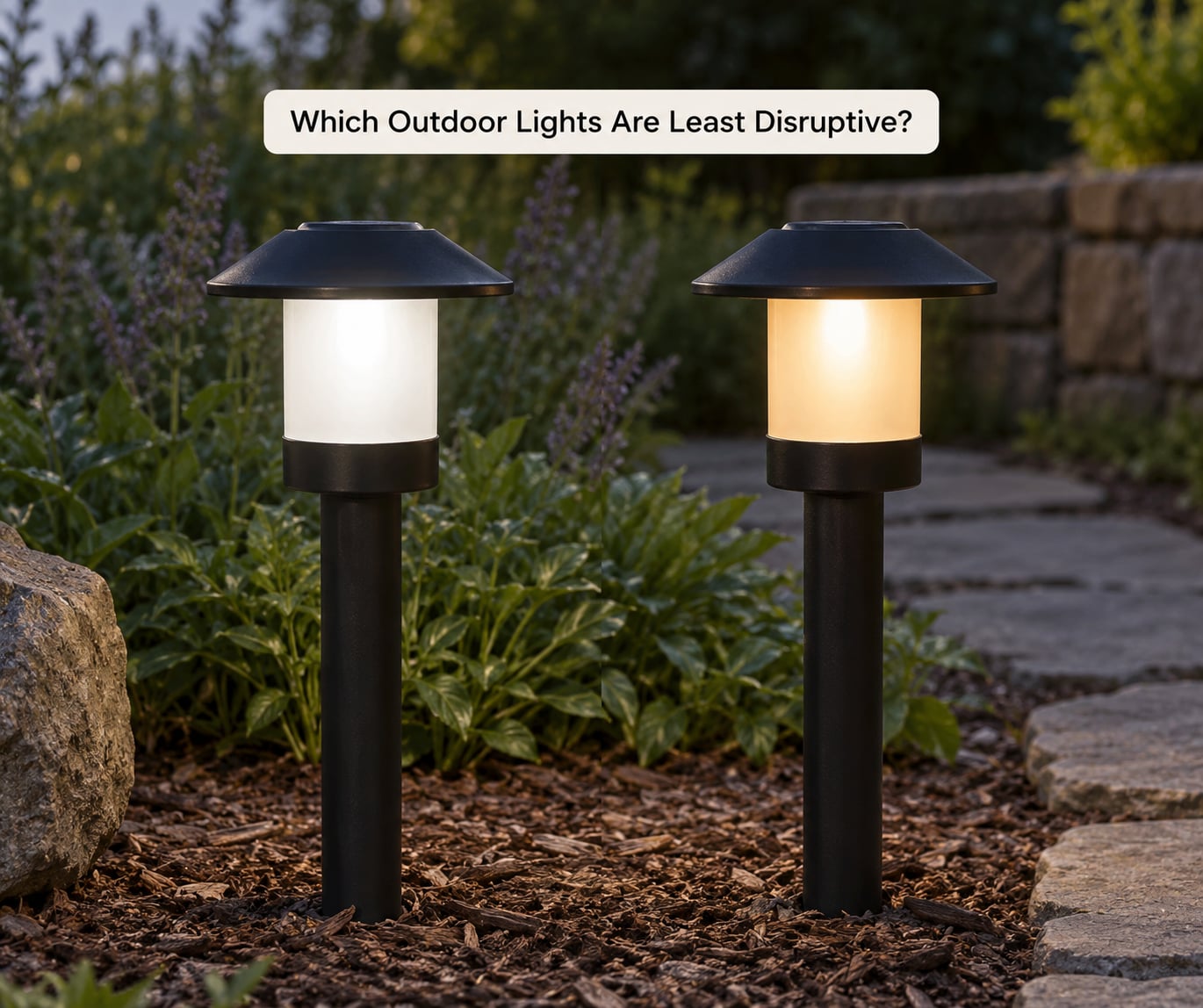
No fixture attracts zero insects, but the ranking runs from least disruptive to most, and the table below covers the options most households actually have access to.
| Light type | Spectrum | Brightness control | Shielding | Typical schedule | Likely effect on insects |
|---|---|---|---|---|---|
| Red, below 2200K | Little to no UV or blue | Usually fixed | Varies | Often continuous | Least disruptive of all common options |
| Amber LED, 2200-2700K | Very little blue | Often dimmable | Easy to shield | Timer or sensor | Low attraction, good for paths and doorways |
| Warm white LED, 2700-3000K | Small blue component | Widely dimmable | Easy to shield | Timer or sensor | Low to moderate, the sensible default |
| Neutral white, 3500-4000K | Clear blue component | Sometimes | Usually possible | Often continuous | Moderate to high attraction |
| Cool white or daylight, 5000-6500K | Strong blue and UV | Sometimes | Usually possible | Often continuous | Highest attraction, worst choice outdoors |
| Incandescent or halogen | Broad, strong UV | Dimmable | Easy to shield | Varies | High attraction, poor efficiency, short bulb life |
| Mercury vapour | Heavy blue and UV | Not dimmable | Often unshielded | Continuous | High attraction and skyglow |
| Motion-activated fixture | Depends on the lamp inside | As above | As above | Brief bursts only | Large reduction through duration alone |
Read the table by column and you get the formula community groups arrive at: low lumens, low Kelvin, shielded, and switched only when needed. Any fixture that fails one of those can usually be improved on at least one of the others.
One honest wrinkle, and it trips up a lot of people. LEDs are more efficient and long-lasting than the bulbs they replaced, but a standard cool-white LED dumps a higher share of its energy into blue and ultraviolet than an incandescent did. Switching to a bright cool LED is an efficiency win and an insect loss at the same time. The fix is not to go back to incandescent, which that same evidence review suggests also happens to attract more insects overall. The fix is a warm or amber LED at low output, shielded and timed.
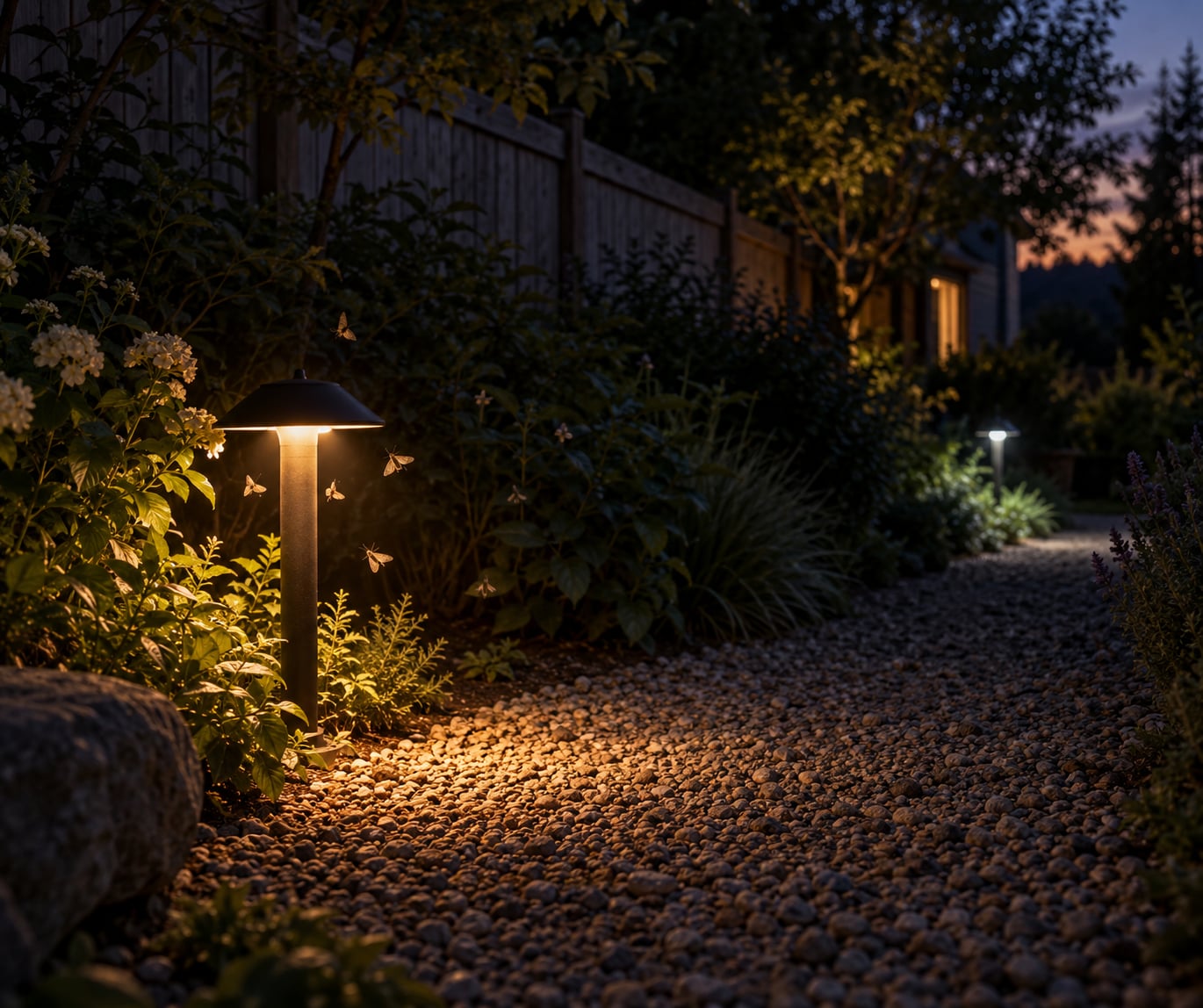
For a walkable path, several small fixtures sitting low along the rail or at step level beat one bright fixture overhead. Nocturnal insects mostly fly above low vegetation, and light that never rises into their flight path never gets their attention. Fixture selection, aiming, and any new circuit are electrical work, so follow the manufacturer’s instructions or hire a licensed electrician rather than guessing at wiring.
Does UV Light Make Outdoor Lights More Harmful?
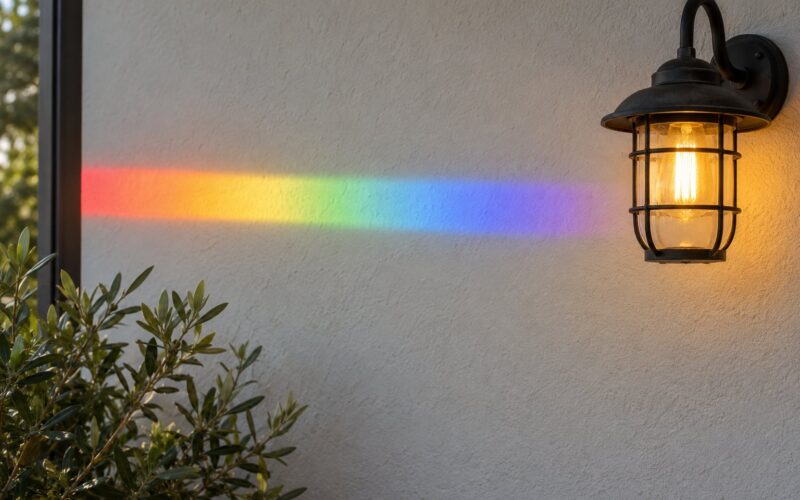
Ultraviolet matters, but treating it as the single issue gets the answer wrong. Attraction across the useful insect range is concentrated roughly between 300 and 650 nanometres, which breaks into ultraviolet at about 300-420nm, blue at 421-495nm, and visible light above roughly 496nm.
Most insects have photoreceptors tuned to ultraviolet and blue, and a good share of flying insects are drawn to it. That is the honest UV case. Older lamp types are where it bites: incandescent and halogen throw a broad spectrum with a meaningful UV component, mercury vapour is heavily weighted toward UV and blue, and compact fluorescents sit in between.
What UV is not is the whole story. Three other factors often outweigh it. The first is total intensity, because a brighter source attracts more insects regardless of wavelength. The second is exposure time, because a 10-lumen lamp on a 30-second sensor is a smaller ecological event than a 2,000-lumen floodlight on a dusk-to-dawn photocell. The third is the direction the light travels; a shielded fixture throws almost no UV skyward because the light never leaves the lens.
Practical conclusion: judge a fixture on brightness, hours, shielding and spectrum together. A high-UV bulb in a fully shielded, motion-activated fixture is a minor issue. A low-UV bulb blasting sideways off a wall all night is still a problem, because of the light itself rather than its ultraviolet content.
Are Solar Outdoor Lights Better for Insects?
Solar power fixes the electricity bill and nothing else about the insect problem. The same physics apply to a panel on a stake as to a fixture on a wire.
Do outdoor lights harm insects differently when they run on solar?
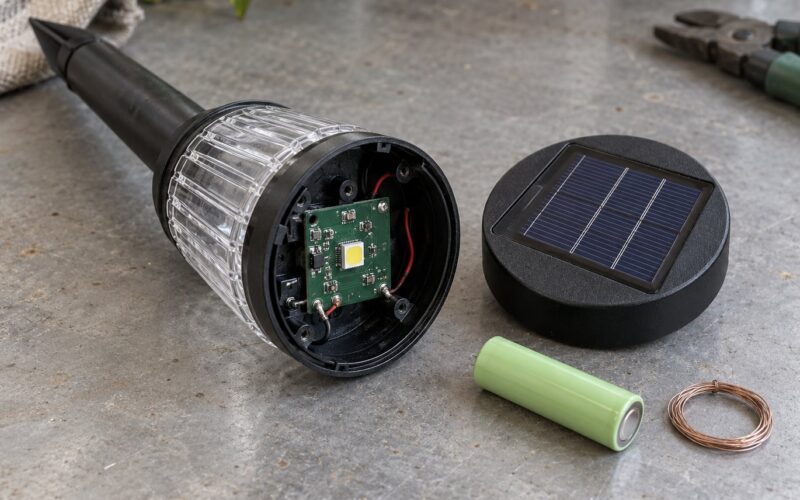
No. The panel supplies the energy; it does not change the spectrum, the brightness, the hours or the aim. A cheap cool-white solar stake light buried in a flower border is a perfectly good bug lamp with a small battery attached. What solar genuinely does is make lower-output, motion-activated, scattered lighting affordable, and those two properties are where the ecological gains are.
That is the useful angle. Cord-free solar fixtures are easy to mount low along a path edge, easy to space apart, and easy to buy with a motion sensor and a dim warm-amber output. Those are three of the mitigations on the list below, and solar is the reason many households can actually afford all three.
Two cautions. A dusk-to-dawn photocell that never turns anything off is a fixture that runs every night until the panel fails, so check whether the light has a manual switch and whether you will use it. And cheap solar lights tend to be bright for their size, because the panel is small and the manufacturer wants the lumens to look impressive in a photograph. A dimmer, warmer, better-shielded fixture at 40 lumens beats a 200-lumen one for everything except visibility in a snowstorm.
How Can You Reduce the Impact of Outdoor Lighting?
Here is the ordered list, ranked by how much difference each step makes. The top three do most of the work, and none of them require buying a new fixture.
- Turn lights off when nobody is using the area. This is the single biggest lever and it costs nothing. Many people switch off at night and forget to switch off again in the morning, so set a repeating timer on your phone instead of relying on memory.
- Add a motion sensor or photocell. Duration control cuts exposure without cutting safety, which is what makes it acceptable to people who need a lit door for security.
- Add a timer switch. Lights off at midnight automatically, even if nobody is home to do it.
- Dim the output. If a path is over-lit, the most economical fix is turning the brightness down rather than buying a dimmer bulb. Use the light only as bright as the task requires.
- Go warm or amber. Target 2200-3000K on anything that throws light outward. This is necessary but not sufficient, which is why it sits fifth rather than first.
- Shield and aim downward. Full-cutoff fixtures send light to the ground instead of the sky. This cuts glare for people, skyglow for the neighbourhood, and the flight-path distraction for insects.
- Lower the mounting height. A surface-mounted step or rail light at knee height is effectively invisible to insects flying several metres up.
- Use several small fixtures instead of one bright one. Lower total output, lower mounting, and no concentrated point for insects to orbit.
Then the two moves that help even more than most people expect. Mount a fixture as far from a flower border, pond or hedge as the task allows, and use vegetation itself as a light shield. A sea turtle lighting study in Barbados recommended turning balcony lights off when unoccupied and blocking stray light with ornamental planting, and the same trick works in a garden.
Now the things that do not work, so you can skip them.
Bug zappers are counterproductive. They attract insects in order to kill them, they kill beneficial species along with pests, and they need emptying regularly or they become a bug buffet. Electrified fences for biting flies are a narrower technology with a narrower claim, but do not read that as a recommendation.
Citronella candles and sprays do not address the cause. They mask food odours for people without changing what insects do when light hits them. They also add smoke, expire, and near foliage a candle is a fire risk.
Swapping to a warm LED and nothing else usually disappoints. People report doing exactly this and still seeing the same pile of bugs, and the reason is that brightness and hours of operation were the dominant factors all along.
One more you can run tonight, and it takes twenty minutes. Pick a single fixture, count the insects around it for ten minutes, then swap in a warm low-output lamp and count again in the same conditions. That gives you a number for your own property instead of a general claim from the internet, and it usually surprises people in a good way.
What About Light Pollution Beyond Your Garden?
A fixture does not respect a property line. Light that spills sideways is light trespass, and light that escapes upward is skyglow, which brightens the night sky for every backyard in the neighbourhood and interferes with the low-intensity celestial cues that migrating birds, insects and even some human rhythms depend on.
The sources you cannot control are often the biggest ones: street lighting, a neighbour’s security floodlight, a car park behind you. That frustration comes up constantly in forums, and the honest answer is that you can only control your own fixtures. You can, however, reduce your own contribution, and cumulative reduction only works if more than one property does it.
Lighting professionals rate fixtures on a BUG scale, and the terms are worth knowing when you read a spec sheet.
- Backlight is light thrown behind the fixture where it can distract drivers and neighbours.
- Uplight is light escaping upward, the main driver of skyglow.
- Glare is light at angles that reduce visibility for anyone looking at or near the fixture.
Here are the rest of the short definitions. Kelvin (K) is the unit of correlated colour temperature, describing how warm or cool a source looks, with lower numbers warmer. A lumen is total visible light output. Phototaxis is movement toward a light source, and light trespass is light reaching ground beyond the area you meant to light. Skyglow is the scattered glow left above a lit area.
And here is the ten-minute site check. After dark, walk your property and note where you can see the source itself, where the beam lands, and where neighbouring yards or the street get lit by your fixtures. Any spot where you can see the lamp from a distance is badly aimed. Anything landing on a neighbour’s hedge or a neighbouring path is light trespass you can usually fix by adding a shield or lowering the aim.
Bats and artificial lighting are taken seriously enough to appear in UK planning guidance as a formal environmental assessment item, which tells you how far this has moved out of the fringe. If your garden borders woodland, water or a nature reserve, assume more than most.
Frequently Asked Questions
Do low-wattage outdoor bulbs stop harming insects?
They reduce it, but they do not remove it. What insects respond to is light output, not wattage, so the real question is lumen count and how long the light runs. A dim 40-lumen path light on a motion sensor is a very small event compared with a 1,600-lumen floodlight running from dusk to dawn. Judge fixtures on lumens, Kelvin, shielding and hours together, not on the number printed on the bulb box.
Is a yellow outdoor light better for insects than white light?
Yes. Yellow and amber sit in a longer, warmer part of the spectrum with very little ultraviolet or blue, which are the wavelengths most insects are drawn to. Target 2200-3000K. Warm colour alone is not enough, though. If the yellow fixture is bright, unshielded and on all night, it will still gather insects, so pair the colour with lower output, a downward aim and a timer or motion sensor.
Do motion-activated solar lights reduce insect disruption?
They usually do, and the reason is duration rather than the solar panel. A light that stays dark until someone walks up is exposed for seconds rather than for eleven hours, and fewer exposure hours means fewer insects drawn off their route and far less concentrated predator activity. The panel itself changes nothing about spectrum or brightness, so check that the fixture is warm-toned, dim and shielded rather than assuming solar makes it wildlife-friendly.
Do outdoor light traps work without harming beneficial insects?
No, not selectively. Outdoor light traps work by attracting insects to a killing surface, and the insects that arrive include moths, beetles, hoverflies and other beneficial species, not just mosquitoes. They also need regular emptying to stay effective, and a full trap becomes a light source that is doing nothing but feeding predators. Changing the fixture and how long it runs fixes more of the problem than adding a trap does.
How can I light a path safely without attracting insects?
Use a small shielded fixture mounted low, aimed at the ground, in warm amber light, and switched by a motion sensor or timer. Several low fixtures spaced along the edge work better than one bright overhead light, because insects mostly fly above path height and never enter the lit volume. Keep brightness to the minimum that lets you see the path clearly, and aim nothing above horizontal or off onto neighbouring property.
How to Choose More Insect-Friendly Outdoor Lighting
Start by picking the dimmest shielded warm or amber fixture that still lets you see your path, and mount it low enough that its light never rises into insect flight height.
Everything after that is a smaller adjustment: add a motion sensor or a timer so the light is only on when it is needed, drop the colour temperature toward 2200-3000K, aim every beam downward, and cut the number of fixtures rather than their brightness. Then walk the property after dark and confirm no lamp is visible from the street and no beam lands on a neighbour’s plants.
Do the first step this week. Switching off or motion-controlling the light that runs longest on your property will do more good than every bulb swap combined.