Shade is the single biggest factor in whether a solar light works, and it works through a plain chain: less light reaching the panel means less current, less current means a smaller top-up for the battery overnight. Understanding how shade affects solar light charging tells you whether a shady corner is worth a light at all, or whether you need a panel on a cable.
Most solar fixtures do charge in shade, just slowly. The useful question is never “does it charge” but “how much charge, and is that enough for the hours you need light.”
Table of Contents
- How Shade Affects Solar Light Charging
- Why Direct Sunlight Matters for Solar Lights
- How Much Does Partial Shade Reduce Charging?
- How Long Should a Solar Light Take to Charge?
- What Happens When a Solar Light Stays in the Shade?
- How to Improve Charging in Shaded Areas
- How to Choose a Solar Light for a Shady Location
- Frequently Asked Questions
- Can a solar light charge in shade?
- How many hours of direct sun does a solar light need?
- Does a solar light work on a cloudy day?
- Should I remove the solar panel from my solar light?
- Why does my solar light work in summer but not winter?
- How can I tell whether a shaded location receives enough sunlight?
- Conclusion
How Shade Affects Solar Light Charging
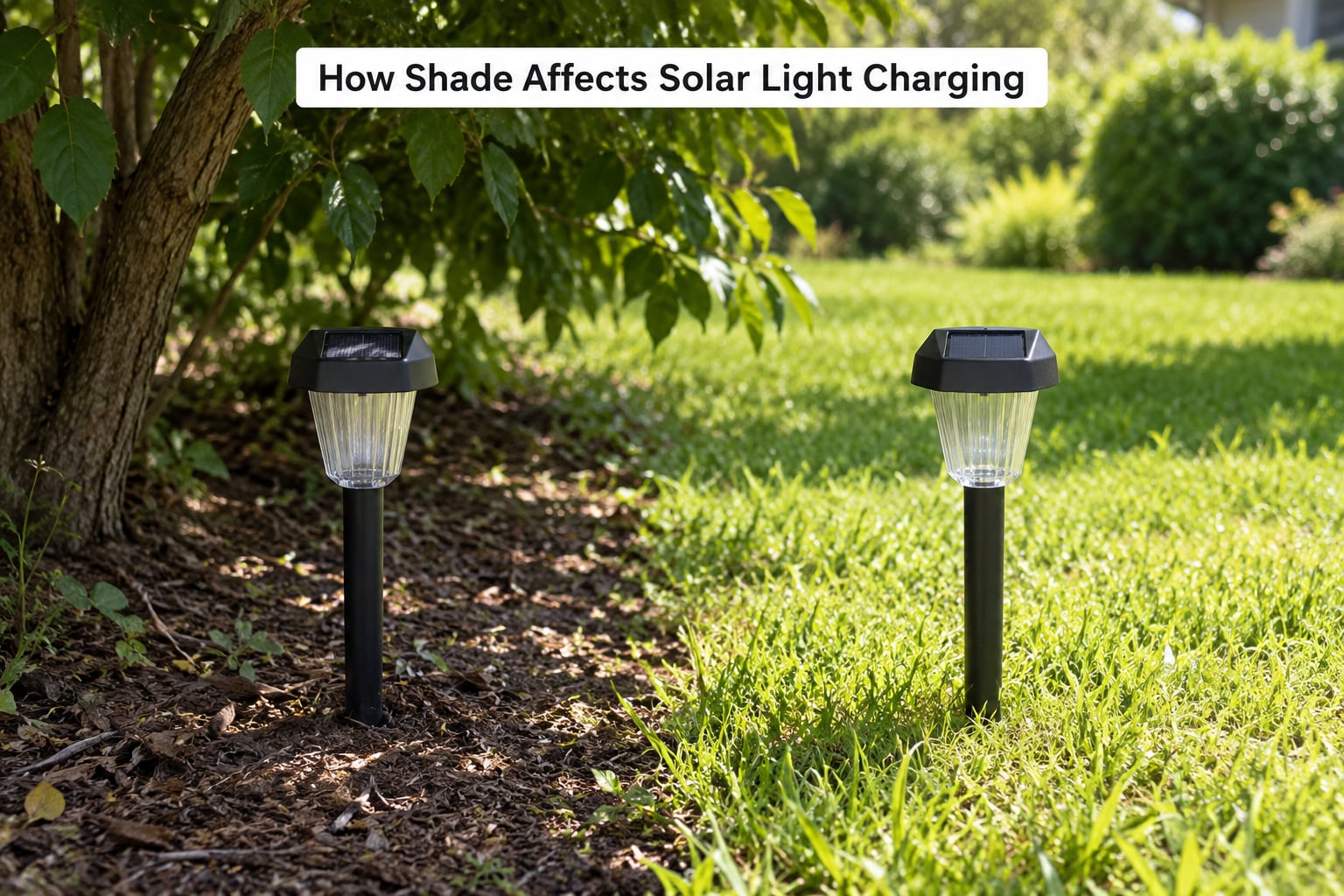
A solar light stores daylight as electricity in a small rechargeable battery, then spends that charge on LEDs after dark. The panel is a photovoltaic cell: it absorbs light, separates charge, and pushes current through a charge controller into the battery.
Shade changes only the first step. The conversion hardware still works, the battery still accepts charge, the sensor still switches on at dusk. What drops is the volume of light arriving at the panel, and the panel’s output falls with it.
That leads to the point most guides miss. It is the panel’s position that governs charging, not the light’s. A path light sitting in deep shade with its panel on a two-metre cable in full sun will charge fine and glow all night. The same light with the panel tucked under the same eave will not.
Here is roughly what each shade level tends to deliver. Treat these as indicative planning figures rather than manufacturer specifications, since panel quality, season and sky conditions move every one of them.
| Shade level | Indicative charge retained | What you get in practice |
|---|---|---|
| Full sun, 6+ hours direct | Near 100% | Full brightness through the night |
| Light shade, dappled | About 50 to 70% | Good run time, may fade near dawn |
| Partial shade, half the day shaded | About 20 to 40% | Roughly half a night of moderate light |
| Deep or permanent shade | Under 10% | Faint glow for an hour or two, or nothing |
Why Direct Sunlight Matters for Solar Lights
Direct sunlight carries far more usable energy per square metre than the light you feel on your skin. On a clear day, direct beam light supplies most of a solar light’s daily energy, while the softer diffuse light from a bright sky makes up a smaller remainder.
Shade is worse than it looks because of how cells are wired. The photovoltaic cells in a panel sit in series, and each one has a bypass diode that routes current around it when it goes into shadow. Put one cell in shade and the rest of the panel keeps working, but the whole panel’s output settles at whatever the weakest working cell can carry.
So the loss is not proportional. Half a panel in shade rarely means half the charge, and a small shadow across one corner can pull down more than the shaded fraction deserves. Users on r/OffGridCabins describe it plainly: partial shade drops output far below what the visible shaded area would suggest.
How Much Does Partial Shade Reduce Charging?
Aim for these rules of thumb while you are measuring a spot. In full sun, charge accumulates quickly and the light is fine. Under light shade, such as a canopy edge that moves with the sun, charging slows but usually keeps pace overnight.
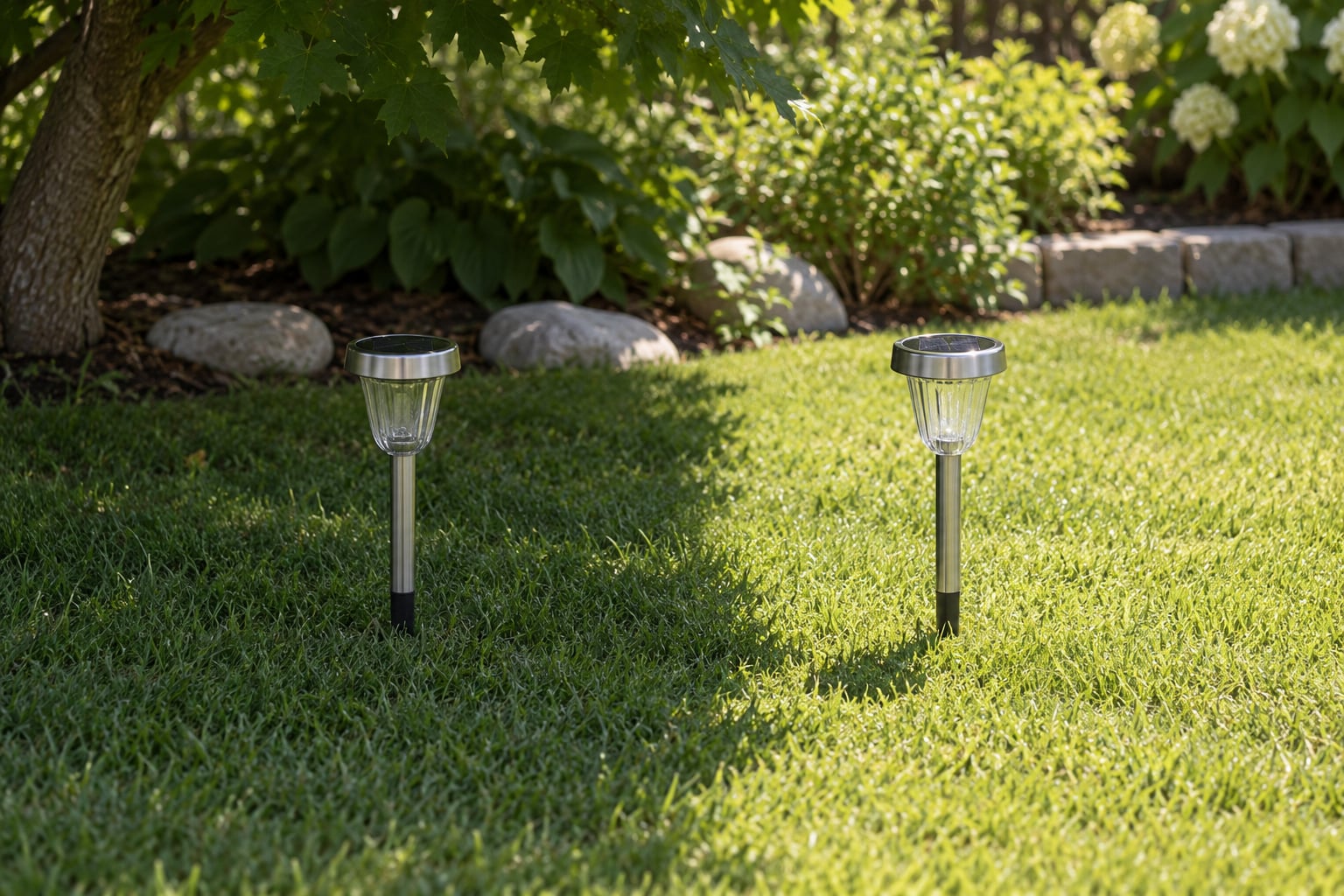
Partial shade, where a wall, fence or tree blocks the panel for half the day, leaves you with a fraction of a full charge and a shorter night. Deep shade, such as under dense evergreens or a fully covered patio, produces so little that the light is effectively decorative.
A wall or fence that stands to the south of a panel in the northern hemisphere is the trap most homeowners fall into. A north-facing wall is often better, because it gets no direct sun at all and therefore casts no moving shadow.
How Long Should a Solar Light Take to Charge?
There is no universal charging time, and any site claiming one figure for all solar lights is oversimplifying. A full charge usually needs 6 to 8 hours of strong direct sun, but the time to get there depends on panel area, battery capacity in mAh, conversion efficiency, weather, season, and how much the light spends each night.
Two switches change the demand side of that equation. A dusk-to-dawn sensor that runs the LED all night drains the battery fastest. A motion sensor or a low mode that only lights when triggered stretches the same charge over a much longer night, which is why shaded spots work better with motion-activated fixtures than with steady-on ones.
Season matters as much as shade. Winter sun sits lower, so shadows from fences, trees and houses stretch much further across the ground, and the available light is weaker. A path light with a full summer charge can leave you in the dark by midnight in January.
| Shade level | Summer charge time | Winter charge time | Nightly brightness |
|---|---|---|---|
| Full sun | 6 to 8 hours | 8 to 12 hours | Full |
| Light shade | 10 to 14 hours | Often not achievable | Reduced, fades before dawn |
| Partial shade | 18 to 30 hours | Rarely achieved | Dim, short run |
| Deep shade | Not realistic | Not realistic | Faint or none |
Winter figures assume the panel still sees a few hours of direct sun. When even that is missing, no amount of waiting produces a useful charge.
What Happens When a Solar Light Stays in the Shade?
A chronically undercharged light does not simply run a bit shorter. It runs shorter, dimmer and less predictably, and the effect compounds.
First, brightness drops. The LED runs at lower output for part of the night, which is the part of the night most people notice. Run time shrinks next, often to a few hours rather than the advertised figure, because the battery never reaches full and spends the night deeper in its discharge range.
Motion detection becomes unreliable too. Many sensors are set to trigger only when the light level falls below a threshold, and a light that starts the night already dim can miss the threshold entirely, so the fixture appears dead. Repeated deep discharge is the worst part, since it ages the battery faster, and a battery aged through one bad summer will perform worse in the next.
One honest limitation worth stating plainly: shaded solar is rarely adequate for all-night security lighting. It is well suited to path markers, step lights, deck edges and decorative accents where a few hours of glow is the goal.
How to Improve Charging in Shaded Areas
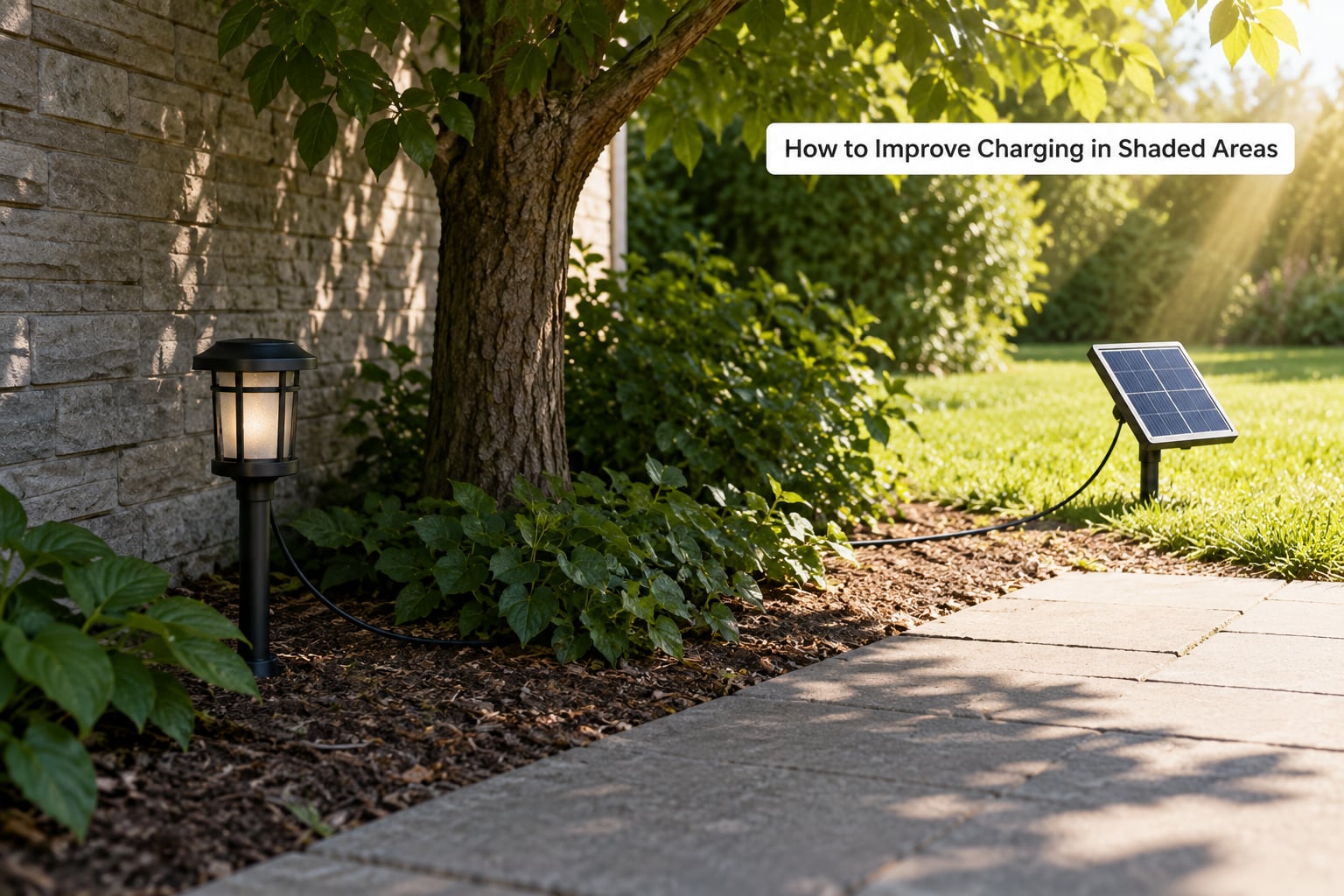
Start with the panel, not the fixture. Almost every improvement below is a way of giving the panel more usable light.
- Move the panel out of the shadow. A panel can often slide several feet along a spike, along a wall bracket or along a cable while the light stays where you want it. Check the shadow at 9am, noon and 4pm before you commit.
- Buy a light with a separate panel. Fixtures with a remote panel on a cable are the standard fix for covered porches, deep eaves and tree-lined walks, because panel and lamp no longer have to share one spot.
- Pick a larger panel or higher-capacity battery. More panel area means more current on a weak day, and a larger battery gives you somewhere to store what little you do collect. Both help, but neither creates sunlight that is not there.
- Clear obstruction growth. Prune branches back from the panel, and clear leaf litter, moss, mud and grass that sit against the surface. A dirty panel loses a surprising share of its output.
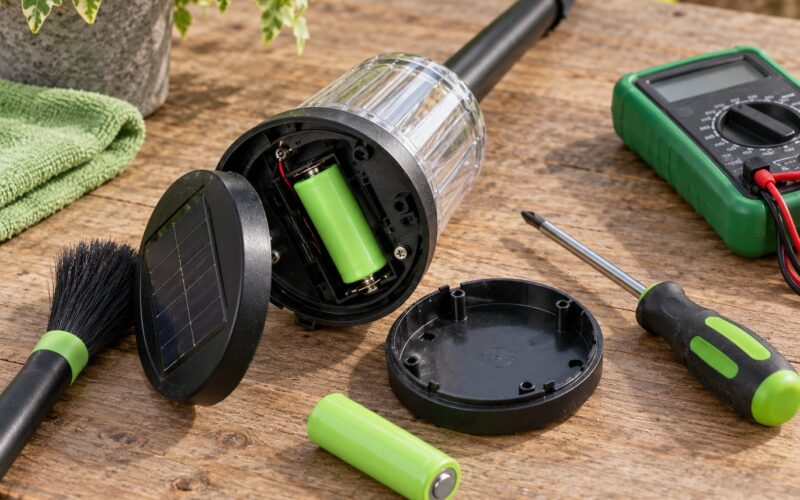
- Clean the surface a few times a year. A soft cloth and water are enough. Do it in spring and again in autumn, before leaf-on and after leaf-fall change the light.
- Re-aim the panel each season. A tilt that suits an August sun often points at nothing in January. Adjustable heads exist for exactly this reason.
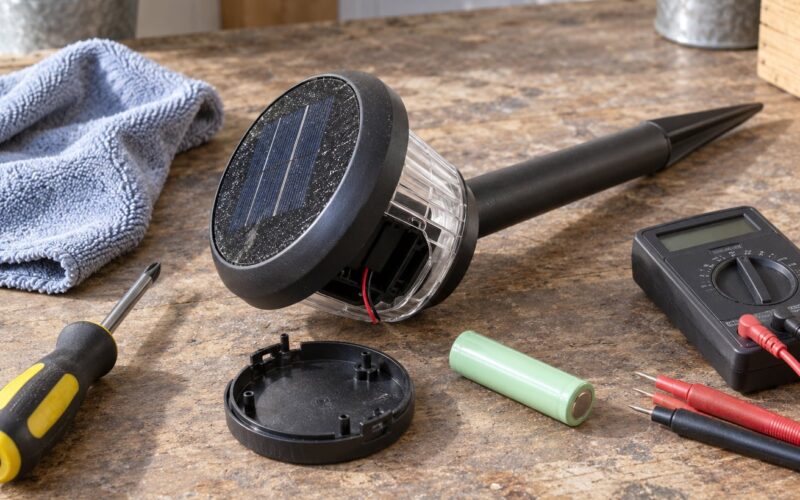
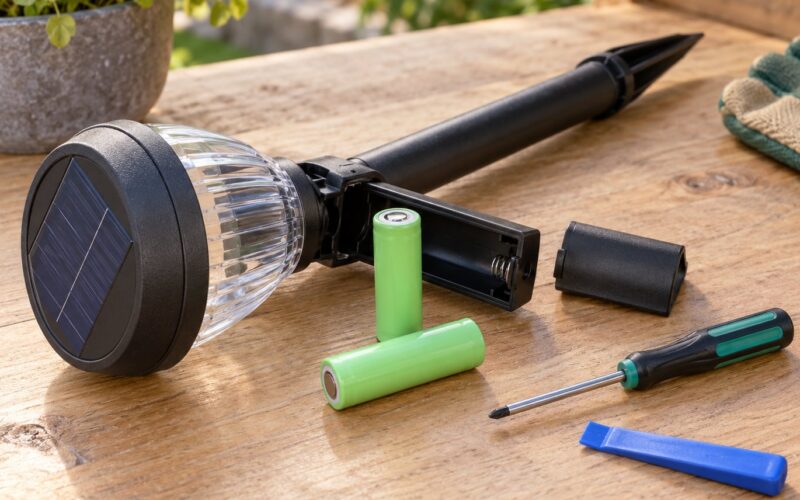
- Check the switch and the battery tab. Many fixtures ship with the switch in OFF or with a plastic pull-tab insulating the battery. A light that is off all day never charges, which looks identical to shade damage.
Lighting the space with a pale reflective surface nearby, such as light-coloured gravel or a rendered wall, adds a small amount of bounced light. It helps at the margin and will not rescue a deep-shade spot on its own.
How to Choose a Solar Light for a Shady Location
Spend an afternoon at the spot before you buy anything. Note where the shadows fall, how long they sit there, and whether they move. A spot with four hours of clean morning sun is workable. A spot that sees one hour through a gap is not.
Then read the specifications rather than the lumen number on the front of the box. Look for a stated charge time, the battery capacity in mAh, the rated run time and any mention of a remote or detachable panel. A listing that claims all-night brightness from a shaded position is describing a fixture that will disappoint you.
| Feature to look for | Problem it solves |
|---|---|
| Separate or remote panel | The light must sit in shade while the panel sits in sun |
| Larger mAh battery | Stores more of the limited charge available |
| Motion sensor or low mode | Stretches a small charge over a longer night |
| Adjustable panel tilt | Follows the sun as seasons change |
| Warm white LED | Uses less power for a usable glow |
| USB charging port | A way to top up on bad weeks |
Match the answer to your climate, too. In areas with long winters and low sun angles, a motion-activated decorative light beats a brighter fixture you will only ever see as a dim glow.
Frequently Asked Questions
Can a solar light charge in shade?
Yes, but slowly. A solar panel keeps producing current in indirect and diffused light, so a shaded light will gain charge rather than none at all. The problem is how little: deep shade can deliver under a tenth of what full sun would, which usually means a dim glow for an hour or two instead of a full night.
How many hours of direct sun does a solar light need?
Most solar lights need 6 to 8 hours of strong direct sun for a full charge, and up to 10 to 12 in winter when the sun sits lower. Under light shade that target may not be reachable at all. Judge the spot by its best and worst week, not by a single sunny afternoon.
Does a solar light work on a cloudy day?
Cloud cover reduces output but does not stop it, because diffuse light still carries usable energy. A bright overcast day might deliver a quarter to a third of a clear day’s charge. Run several cloudy days together and the battery never recovers, which is why lights seem to die in a rainy week and return after a sunny one.
Should I remove the solar panel from my solar light?
Only if the fixture is designed for it. Lights with a remote or detachable panel are built with a cable and a connector that you extend toward the sun, which is the standard fix for a shaded porch or a tree-lined path. Panels on fixed fixtures are sealed in place, and forcing one off usually breaks the wiring seal.
Why does my solar light work in summer but not winter?
Winter cuts charging twice. The sun sits lower, so shadows from fences, trees and houses stretch much further across your garden, and the light itself is weaker. A light that was fully charged in July arrives at a partial charge in January, and it runs out well before dawn. Check for a new shadow before blaming the battery.
How can I tell whether a shaded location receives enough sunlight?
Stand at the spot and note where shadows fall at roughly 9am, noon and 4pm on a clear day, then repeat in winter. If the panel area is clear for four hours or more, a light will generally work. You can also check what other panels nearby do: if a neighbouring fixture charges poorly in the same spot, expect the same result.
Conclusion
Shade does not switch a solar light off, it starves it, and the loss runs steeper than the shaded area suggests. The panel’s position is what decides the outcome.
Before you buy anything, spend one afternoon at the spot and watch where the shadows fall, in summer and again in winter. If the panel cannot get four or more hours of direct sun, move the panel toward the sun, choose a fixture with a remote panel, or light that corner another way. Check the switch and the battery tab too, since those two solve more dead lights than any amount of shade does.