Beam angle is the width of the cone of light a fixture throws, measured in degrees from the centre of the beam out to the point where intensity drops to 50% of peak brightness. That 50% rule is called full width at half maximum, or FWHM. A 15 degree beam is a tight spotlight; a 120 degree beam is a broad flood.
It sounds like a small spec buried on a spec sheet. In practice it decides how far light reaches, how much area gets covered, whether you end up with hotspots or dark patches, and how many fixtures the job takes. This guide has been updated for 2026 and covers how to read the number, how to convert it into a coverage footprint, and where the common ranges actually work outdoors.
Table of Contents
- What Does Beam Angle Mean in Outdoor Lighting?
- Beam Angle vs. Field Angle: What Is the Difference?
- How Does Beam Angle Affect Outdoor Light Coverage?
- How to Measure or Check the Beam Angle of a Light
- Reading a Beam Angle Specification in Outdoor Lighting
- Common Beam Angles and Where They Work Best
- How to Choose the Right Beam Angle for Your Outdoor Space
- Common Beam Angle Mistakes to Avoid
- Frequently Asked Questions
- Is a wider beam angle always better for outdoor lighting?
- What is the best beam angle for lighting a garden path?
- How do I convert beam angle into a coverage area?
- Does a 30-degree beam angle light a larger area than a 60-degree beam?
- Can I change the beam angle of an existing outdoor light?
- Does beam angle matter as much as lumens for solar garden lights?
- Conclusion
What Does Beam Angle Mean in Outdoor Lighting?
Light leaving an LED fixture starts as a wide glow and is shaped into a cone by a lens or a reflector. Beam angle is the full width of that cone, and the industry measures it at the 50% intensity point.
Here is the part that catches people out. The light does not stop at the beam angle. It falls off gradually beyond it, all the way out to the field angle. The number on the box tells you where the useful core of the beam ends, not where the light stops.
Two angles describe the same fixture, and both matter outdoors:
- Beam angle measures to the 50% intensity point. This is the useful, bright core you aim at the thing you want to highlight.
- Field angle measures to the 10% intensity point. This is the dim outer fringe, and outdoors it is the edge that causes light spillage into a neighbour’s yard.
A narrow beam concentrates the same lumens into a smaller, brighter pool. A wide beam spreads those lumens thin. That is why a 120 degree flood can feel disappointingly dim beside a 30 degree spot with the identical lumen rating, even though the numbers match on paper.
Beam Angle vs. Field Angle: What Is the Difference?
The two measurements use the same cone and different intensity thresholds, so the numbers are not interchangeable. Comparing a 25 degree beam to a 25 degree field is like comparing a diameter to a circumference.
| Term | Measured at | What it tells you |
|---|---|---|
| Beam angle (FWHM) | 50% of peak intensity | The bright core, where most of the useful light lands |
| Field angle (FWHM x 1.2 to 1.5) | 10% of peak intensity | The full spread including the dim fringe, and where spill starts |
| Cut-off angle | Where light stops hitting the ground | How much skyglow a fixture produces when tilted |
| Shading angle | Angle from the fixture to the lamp | How well the hood hides the lamp from direct view |
A full cutoff fixture is one where no light escapes above the horizontal, which is the usual local code target for residential path and flood lighting. Cut-off angle is a separate number from beam angle, and it is the one your neighbours will notice.
Some manufacturers quote the field angle in their spec sheets without saying so, particularly on cheaper landscape and solar fixtures. If a listing gives one number and no measurement method, treat it as approximate.
How Does Beam Angle Affect Outdoor Light Coverage?
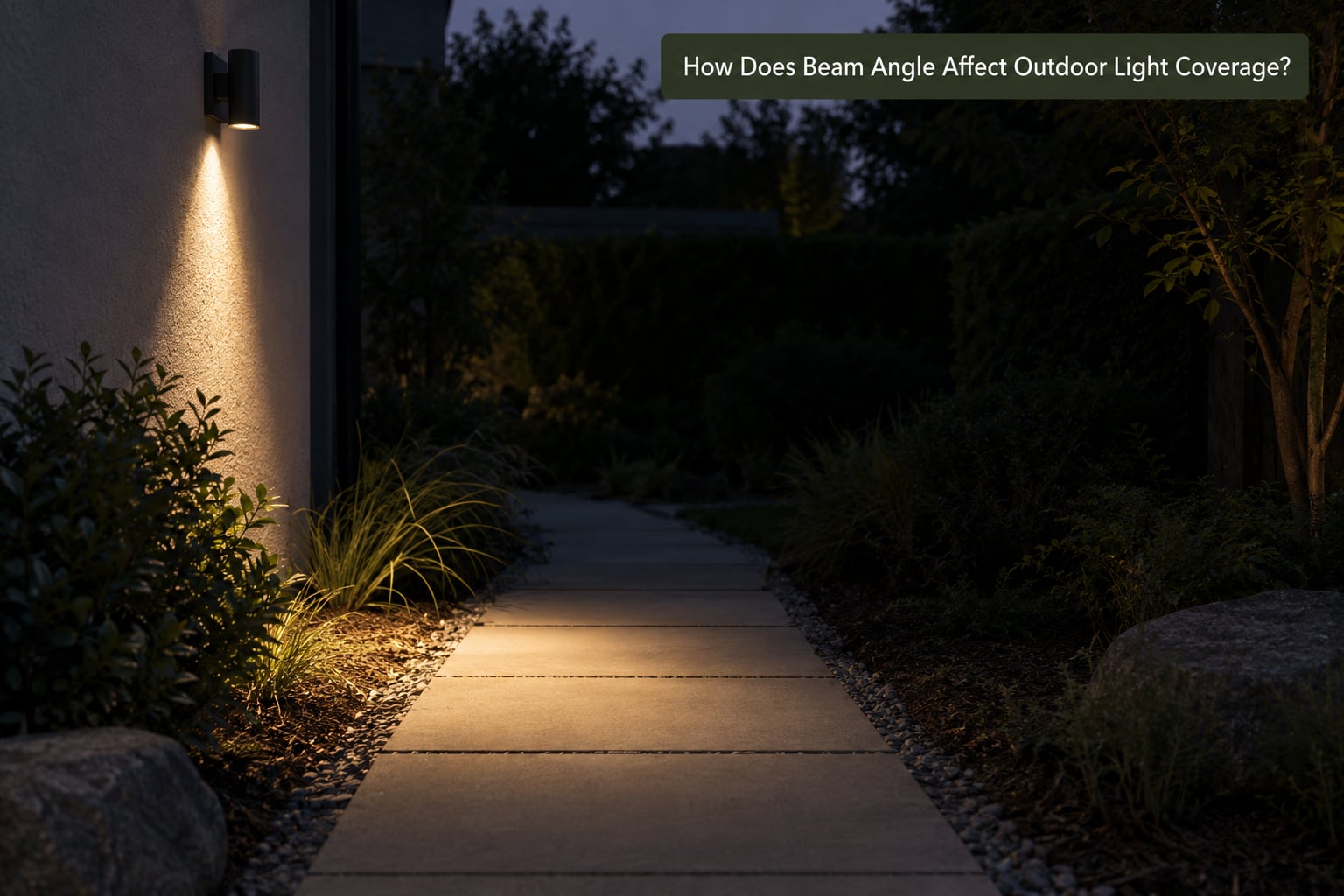
Coverage comes from geometry, not from the angle alone. A beam pointed straight down makes a circular footprint. Tilt the same fixture toward a wall or a tree and the shape stretches out, which is exactly why uplighting a trunk produces a tall oval rather than a circle.
The standard approximation for a downward-facing fixture is simple: footprint diameter equals 2 multiplied by the mounting height, multiplied by the tangent of half the beam angle. For a light hung 10 feet up with a 36 degree beam, that gives about 6.5 feet across at the half-brightness line, and the dim fringe extends considerably beyond that.
| Beam angle | Mounted 3 ft | Mounted 6 ft | Mounted 10 ft | Mounted 15 ft |
|---|---|---|---|---|
| 15 degrees | 0.8 ft | 1.6 ft | 2.6 ft | 4.0 ft |
| 30 degrees | 1.6 ft | 3.2 ft | 5.4 ft | 8.0 ft |
| 36 degrees | 1.9 ft | 3.9 ft | 6.5 ft | 9.7 ft |
| 60 degrees | 3.5 ft | 6.9 ft | 11.5 ft | 17.3 ft |
| 120 degrees | 10.4 ft | 20.8 ft | 34.6 ft | 52.0 ft |
Read those numbers as the diameter of the bright core, not the whole lit area. The full field angle typically runs about 20 to 50% wider depending on the optics, which is why a wall lit with a wide flood often shows scalloped edges or a hotspot in the middle.
Two more factors sit on top of the geometry. Throw distance follows the inverse square law, so doubling the distance cuts illumination to roughly a quarter. And the same lumens spread across four times the area means each square foot gets a quarter of the light, which is why wide-angle fixtures need noticeably more output to look equally bright.
How to Measure or Check the Beam Angle of a Light
The reliable method is the spec sheet, not guesswork. Look for the angle in degrees, then check which of the two measurements it uses before you plan the layout around it.
Reading a Beam Angle Specification in Outdoor Lighting
Four checks will tell you most of what you need:
- Does it say beam angle or field angle? Beam angle at 50% is the number you want for planning coverage. Field angle at 10% overstates the useful pool.
- Is it a full angle or a half angle? Manufacturers sometimes quote half the cone from the centre line, especially in older literature. A 30 degree half angle is a 60 degree beam.
- Does it name a measurement method? Anything citing FWHM or CIE standards can be trusted. A bare number with no method is a marketing figure.
- Is there an IES photometric file? A published photometric report gives you candela and foot-candle readings at real distances, which is the only reliable way to predict brightness on your property.
A lumen rating alone cannot tell you coverage. Two fixtures with identical lumens and different beam angles produce completely different results on the ground.
To check a fixture you already own, set it up in a dark area at a known height, mark where the bright core falls off, and measure the width. Do not open the housing or modify wiring to test it. If a fixture needs opening, replacing a driver, or changing voltage, hand that to a licensed electrician and follow the manufacturer’s instructions.
Common Beam Angles and Where They Work Best
A flood light beam typically falls somewhere between 60 and 120 degrees, and most residential outdoor fixtures land in the 15 to 60 degree range. Here is how the main bands map to real jobs.
| Beam angle | Common name | Retail descriptor | Typical outdoor use |
|---|---|---|---|
| 10 to 20 degrees | Very narrow | Very narrow spot | Tall trees, distant architectural details, flagpoles |
| 21 to 35 degrees | Narrow | Narrow spot | Medium trees, front doors, statues, column accents |
| 36 to 50 degrees | Medium | Spot or narrow flood | Shrubs, garden beds, path lights, small facades |
| 51 to 90 degrees | Wide | Flood | Decks, patios, driveways, walls, security lighting |
| 91 to 120 degrees and above | Very wide | Wide flood | Large lawns, backyards, parking areas, near-field fill light |
Retail labels are not standardised. One brand’s 50 degree flood is another brand’s spot, so always compare the number rather than the word on the box.
How to Choose the Right Beam Angle for Your Outdoor Space
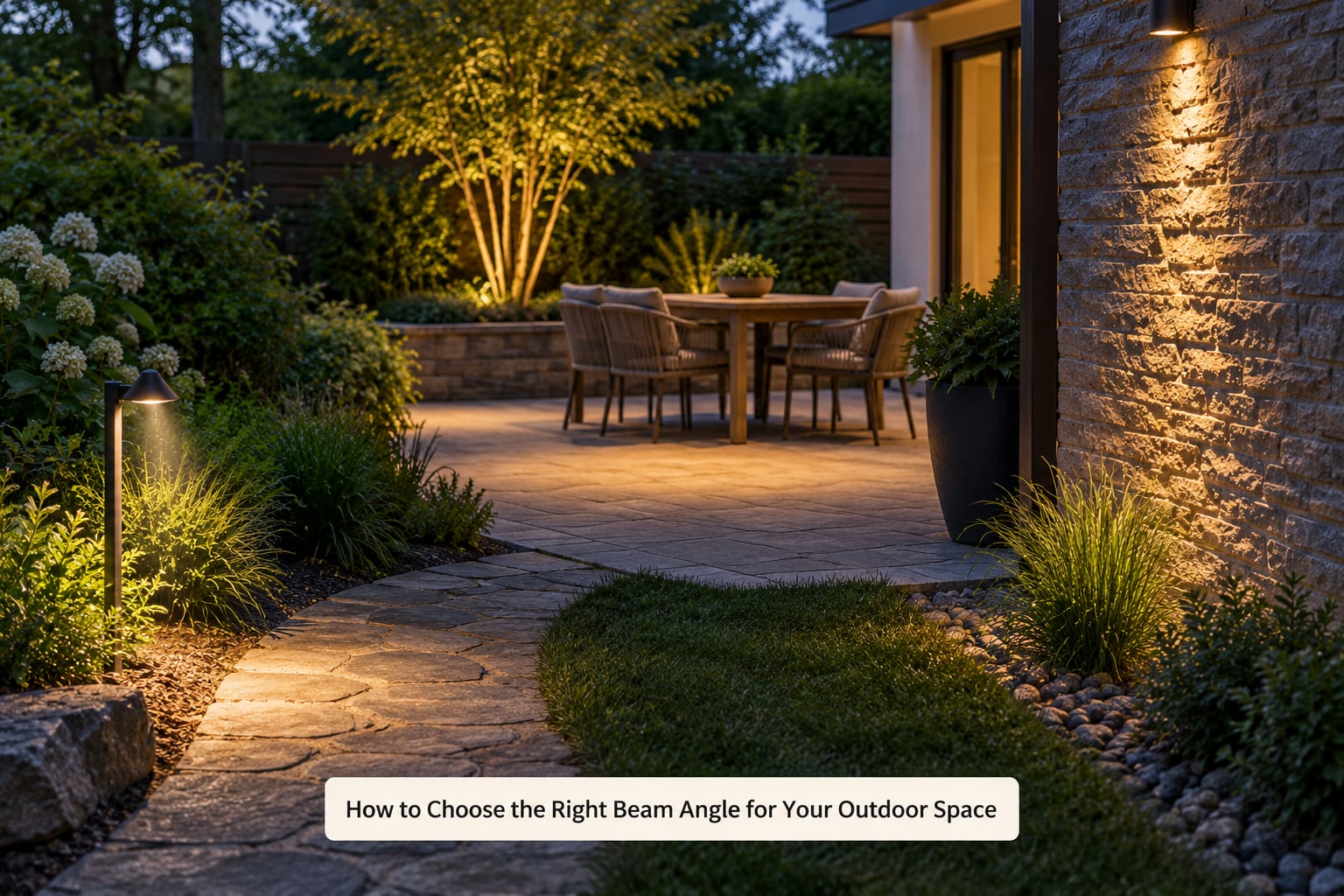
Work from the target backwards. Decide what the light is for, measure how far away that target is and how tall it is, then pick the narrowest beam that still covers it.
| Application | Useful beam angle | Mounting note |
|---|---|---|
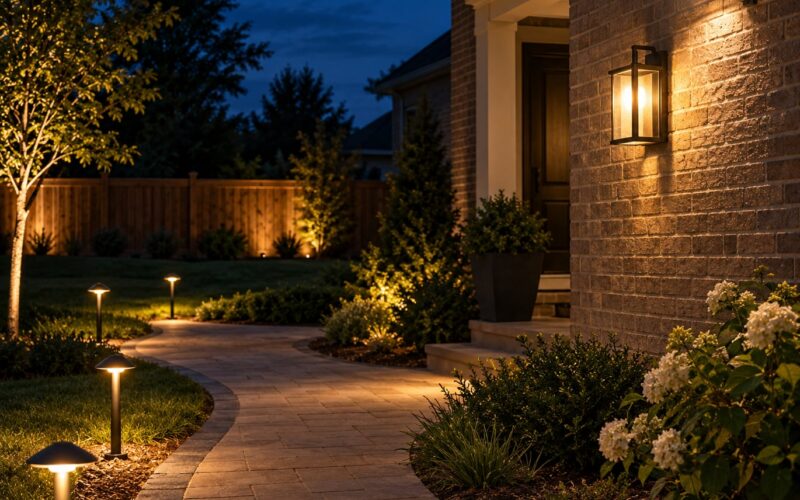
| Path and walkway lights | 36 to 60 degrees | Set in the ground, tilted back, spaced about 6 to 10 ft apart |
| Tree and shrub uplighting | 15 to 36 degrees | Two to four feet back from the trunk, aimed at the canopy |
| Facade and accent spots | 10 to 30 degrees | Wall-mounted, aimed along the surface rather than straight out |
| Wall washing | 60 to 120 degrees | Mounted 18 to 24 inches off the wall to soften scalloping |
| Decks and patios | 60 to 90 degrees | Mounted 8 to 10 ft high for even coverage |
| Security and motion lighting | 60 to 120 degrees | Higher mounting, shielded, aimed below the horizontal |
Glare and neighbours deserve their own check. Aiming a wide flood more than 45 degrees off vertical throws light into the night sky and off cloud cover, which brightens the sky for everyone. Shielded, full cutoff fixtures solve most of this by keeping light below the horizontal.
For solar fixtures, the angle is constrained by physics rather than taste. The panel has to collect enough daylight to charge the battery, and the battery has a limited depth of discharge, so output is capped. A wide-angle solar flood spreads a limited budget over a big area and ends up dim, while a narrow-angle solar spot concentrates the same budget and reads as brighter at night. Check the IP65 or IP67 rating too, since an outdoor fixture lives in the rain.
Professional specification goes one step further with NEMA distribution types, where Type I is a narrow symmetrical distribution and Type V is a very wide symmetrical one, with the others in between. If you are specifying commercial or municipal fixtures rather than garden lights, the NEMA type is the number that matters, and the BUG rating, which grades backlight, uplight and glare, tells you how much of a nuisance the fixture will be.
Common Beam Angle Mistakes to Avoid
Going too narrow is the most common error. A 15 degree spot on a wide path creates two bright pools and everything between them stays black, and you end up adding fixtures that you would not have needed with a 45 degree beam.
Going too wide is just as common. A 120 degree flood on a single tree flattens it, washes out its shape, and lights up the neighbouring fence. Wide beams look dim even when the lumen count is high, which is the complaint we hear most often from people who expected more brightness.
Ignoring mounting height causes the rest. A fixture moved from 3 feet to 10 feet needs a wider beam to cover the same ground, and the inverse square law means you also lose brightness. Height changes both the angle and the intensity you need.
Treating lumens as a coverage spec is the fourth one. Lumens describe total light output, not how it lands. Two fixtures can have the same lumens and cover completely different areas.
Finally, assuming every solar fixture performs the same. Real output swings widely depending on panel size, placement, tree shade and season, so a fixture that demos brilliantly in August can disappoint in December. Angle matters, but so does the panel.
Frequently Asked Questions
Is a wider beam angle always better for outdoor lighting?
No. A wider beam covers more area but spreads the same lumens thinner, so it reads dimmer and creates more spill. Wide beams suit patios, driveways and near-field fill light. Narrow beams suit trees, doorways and architectural details where you want intensity in one place. Choose the narrowest angle that reliably covers the target.
What is the best beam angle for lighting a garden path?
Between 36 and 60 degrees works well for most path lights, especially when the fixture sits in the ground and is tilted back. It gives you a pool wide enough to walk through without lighting the whole lawn. Space fixtures about 6 to 10 feet apart, and stagger them on opposite sides if the path is wide.
How do I convert beam angle into a coverage area?
Measure the mounting height, then double it and multiply by the tangent of half the beam angle. That gives the diameter of the bright core where intensity drops to 50 percent. A light 10 feet up at 36 degrees produces a core about 6.5 feet across. Add roughly 20 to 50 percent more for the dim outer field.
Does a 30-degree beam angle light a larger area than a 60-degree beam?
No, it lights a much smaller area. At a 10 foot mounting height a 30 degree beam covers about 5.4 feet across while a 60 degree beam covers about 11.5 feet. The trade runs the other way for brightness: the narrower cone concentrates the same lumens, so it looks far brighter at its centre.
Can I change the beam angle of an existing outdoor light?
Sometimes. Interchangeable lenses or lens kits can convert a wide flood to a narrower spot on fixtures designed for them, and swapping the lamp or LED module sometimes works too. Check the manufacturer’s instructions first, and never open a fixture or change wiring that is live. Mains and low-voltage work belongs with a qualified electrician.
Does beam angle matter as much as lumens for solar garden lights?
Both matter, but differently. Lumens decide how much light exists, which on solar units is capped by panel size, battery capacity and how much shade the panel gets. Beam angle decides how that limited output is distributed, so a narrow beam makes the same lumens look considerably brighter. On solar lights the angle is often the cheaper lever.
Conclusion
Start by naming the area you want lit and measuring it. Work out the throw distance from where the fixture will sit, convert the target width into a beam angle, and choose the narrowest angle that still covers the whole thing. That single habit avoids wasted fixtures, glare and light spilling where you did not want it, and it is the difference between what is beam angle in outdoor lighting as a spec and what it means on your actual property.