A solar light’s mAh rating tells you the size of its battery, and a bigger battery usually means a longer night. But mAh only translates into extra hours when the light’s LED draws the same power, the panel can refill the cell each day, and the chemistry matches. Here is how mAh ratings affect solar light runtime in practice, with the numbers attached.
| Light type | Typical cell | Typical mAh | Stored energy | Hours after a full summer day |
|---|---|---|---|---|
| Decorative lantern or string light | 1.2 V NiMH | 300 to 600 mAh | 0.4 to 0.7 Wh | 3 to 5 hours, dim |
| Decorative path marker | 1.2 V NiMH | 600 to 800 mAh | 0.7 to 1.0 Wh | 4 to 6 hours |
| Standard path or step light | 1.2 V NiMH | 1,000 to 1,200 mAh | 1.2 to 1.4 Wh | 6 to 8 hours |
| Garden accent or spot light | 3.7 V Li-ion | 1,200 to 2,000 mAh | 4.4 to 7.4 Wh | 8 to 10 hours |
| Yard sign or address light | 3.7 V Li-ion | 2,000 to 3,000 mAh | 7.4 to 11.1 Wh | 10 to 14 hours |
| Security, driveway, or street light | 3.2 V or 3.7 V Li-ion, sometimes LiFePO4 | 3,000 to 6,000 mAh | 9.6 to 22 Wh | 12 hours or constant-on with a larger panel |
Those hour figures are ideal estimates for a full, sunny day with a new battery and the light running in its lowest or sensor-triggered mode. Real results land lower, and the rest of this guide explains exactly where the missing hours go.
Table of Contents
- How mAh Ratings Affect Solar Light Runtime
- What Does mAh Mean for a Solar Light?
- How mAh ratings affect solar light runtime once everything else is equal
- How to Estimate Runtime from Battery Capacity
- mAh, Watts, Volts, and Lumens: Quick Guide
- Why Two Solar Lights with the Same mAh Can Run for Different Times
- LED power draw and lumen output
- Motion sensing versus constant on
- Brightness steps and programmable timers
- Battery age
- Low-voltage cutoff and the discharge curve
- How Sunlight, Seasons, and Weather Change Runtime
- Peak sun hours
- Cold temperatures
- Shade and panel placement
- What a poor charging day looks like
- How to Choose a Runtime That Fits Your Needs
- Decide the duration first
- Then set the brightness target
- Check the panel-to-battery ratio
- Weigh the trade-offs
- How to Test Actual Runtime Before You Buy
- Check the stated LED wattage or current
- Read the test conditions behind the claim
- Estimate the energy use yourself
- Test for a full night outdoors when you can
- Match the replacement chemistry and voltage exactly
- Frequently Asked Questions
- Is a higher mAh rating always better for a solar light?
- How many mAh do I need for all-night solar lighting?
- Does a 3000 mAh solar light last longer than a 2000 mAh one?
- Why does my solar light stop working before dawn?
- Can I replace the battery in a solar light with a higher-mAh unit?
- Conclusion: Start with Energy Needs, Not mAh Alone
How mAh Ratings Affect Solar Light Runtime
A higher mAh rating increases runtime only in proportion to what the solar panel can refill each day. Two lights both labelled 2,000 mAh can differ by ten times in stored energy depending on cell voltage, and a light with a small panel will run the same three hours whether its battery holds 1,000 mAh or 10,000 mAh.
So the honest version of the answer has three conditions attached. The LED has to draw the same power, because a brighter light empties the same battery faster. The panel has to be big enough to put back what you take out over a night. And the battery has to be healthy, since capacity falls every year it sits in the cold and the heat.
When those three line up, extra mAh is real extra hours. Take a path light running a 0.05 W LED for eight hours a night. That is 0.4 Wh a night. A 1,200 mAh NiMH cell at 1.2 V holds about 1.44 Wh, so it has roughly three nights of charge in reserve. Double the cell to 2,400 mAh and you get six nights of buffer — useful in February, invisible in July.
That reserve is the actual value of mAh. It is not brighter light and it is not more lumens. It is margin for cloudy stretches and cold mornings.
What Does mAh Mean for a Solar Light?
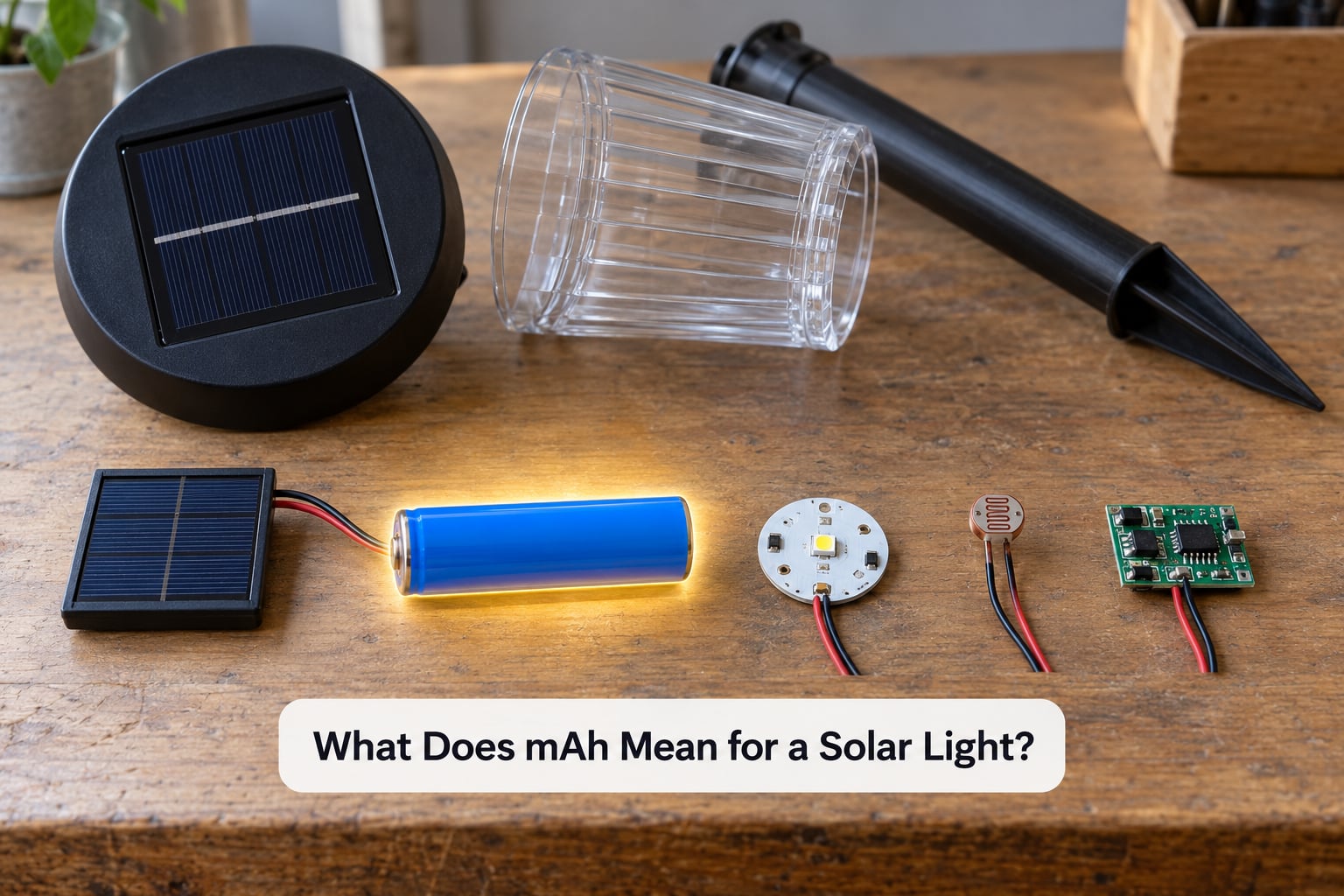
Milliampere-hours measure how much charge a battery can move. If a cell can deliver 1,000 mA for two hours, it is rated at 2,000 mAh. That is current multiplied by time, and it says nothing about the voltage the cell works at.
Here is the part that trips people up. A 2,000 mAh NiMH cell at 1.2 V stores about 2.4 Wh. A 2,000 mAh lithium-ion cell at 3.7 V stores about 7.4 Wh — three times the energy behind an identical number on the box. Comparing two lights by mAh alone is like comparing two tanks by volume without knowing whether one holds petrol or water.
It also says nothing about how fast energy leaves. A 2,000 mAh battery driving a 0.2 W LED and one driving a 2 W LED have the same capacity and very different evenings. Capacity is the size of the reserve, not the tap size.
How mAh ratings affect solar light runtime once everything else is equal
Hold the LED wattage, the panel size, the chemistry, and the operating mode fixed, and runtime scales fairly close to line with capacity. That is the only situation where a bigger mAh number on a listing tells you something straightforward.
Most comparisons are not made under those conditions. Two lights at the same mAh with different panel sizes is a different product in every way that matters at 2 AM.
How to Estimate Runtime from Battery Capacity
Two steps, and the second one needs the LED’s wattage, which most listings hide.
- Convert mAh to watt-hours. Watt-hours = mAh × cell voltage ÷ 1000. A 2,000 mAh cell at 3.7 V gives 7.4 Wh.
- Divide by the LED’s power draw. Runtime hours = usable watt-hours ÷ LED watts.
- Discount for what the circuit wastes. The charge controller, the dusk sensor, and the LEDs themselves draw a little. Treat 80 to 90 percent of rated capacity as usable.
- Check the ceiling. Compare your result with what the panel can collect. If the panel cannot refill the battery in a day, the number on step two is fiction.
A worked example, because the formula is meaningless without one. Take a common 3.7 V garden light with a 2,000 mAh cell. That is 7.4 Wh stored. At 90 percent usable, about 6.7 Wh reaches the circuit. If the LED board draws 0.5 W, the ideal is 13 hours — more than any night needs.
Real-world behaviour looks different. The same light on a bright June day charges fully and runs about 8 to 10 hours before the low-voltage cutoff kicks in. In December, with five peak sun hours instead of seven, it manages three or four. Neither number is wrong; they describe different sun.
Treat everything from this formula as an ideal ceiling, not a promise. The datasheet figure on a retail box assumes 20 to 25 °C, full charge, and a fresh cell.
mAh, Watts, Volts, and Lumens: Quick Guide
These four numbers get thrown around as if they measure the same thing. They do not, and mixing them up is the source of most disappointed solar light buyers.
| Specification | What it measures | Why it matters | Why comparing it to mAh misleads |
|---|---|---|---|
| mAh | Charge the cell can move at its own voltage | Sets the total energy reserve for the night | Meaningless without the cell voltage it was measured at |
| Watt-hours (Wh) | Total energy stored | The only capacity figure that compares fairly across chemistries | Not printed on most solar light boxes, so shoppers use mAh instead |
| Watts (W) | Energy consumed per hour by the LED | The denominator in any runtime calculation | Higher watts drain the same battery faster; more watts is not more mAh |
| Volts (V) | The cell’s nominal working voltage | Turns mAh into Wh and must match the charge circuit | A 3.7 V cell in a 1.2 V light can destroy the electronics |
| Lumens | Light output at the lens | Tells you how bright it looks from the path | More lumens usually means more watts, so runtime shortens |
Read across any solar light listing and ask one question: how many lumens, at how many watts? Lumens alone will not tell you whether it reaches dawn, and mAh alone will not tell you whether you can see the path.
Why Two Solar Lights with the Same mAh Can Run for Different Times
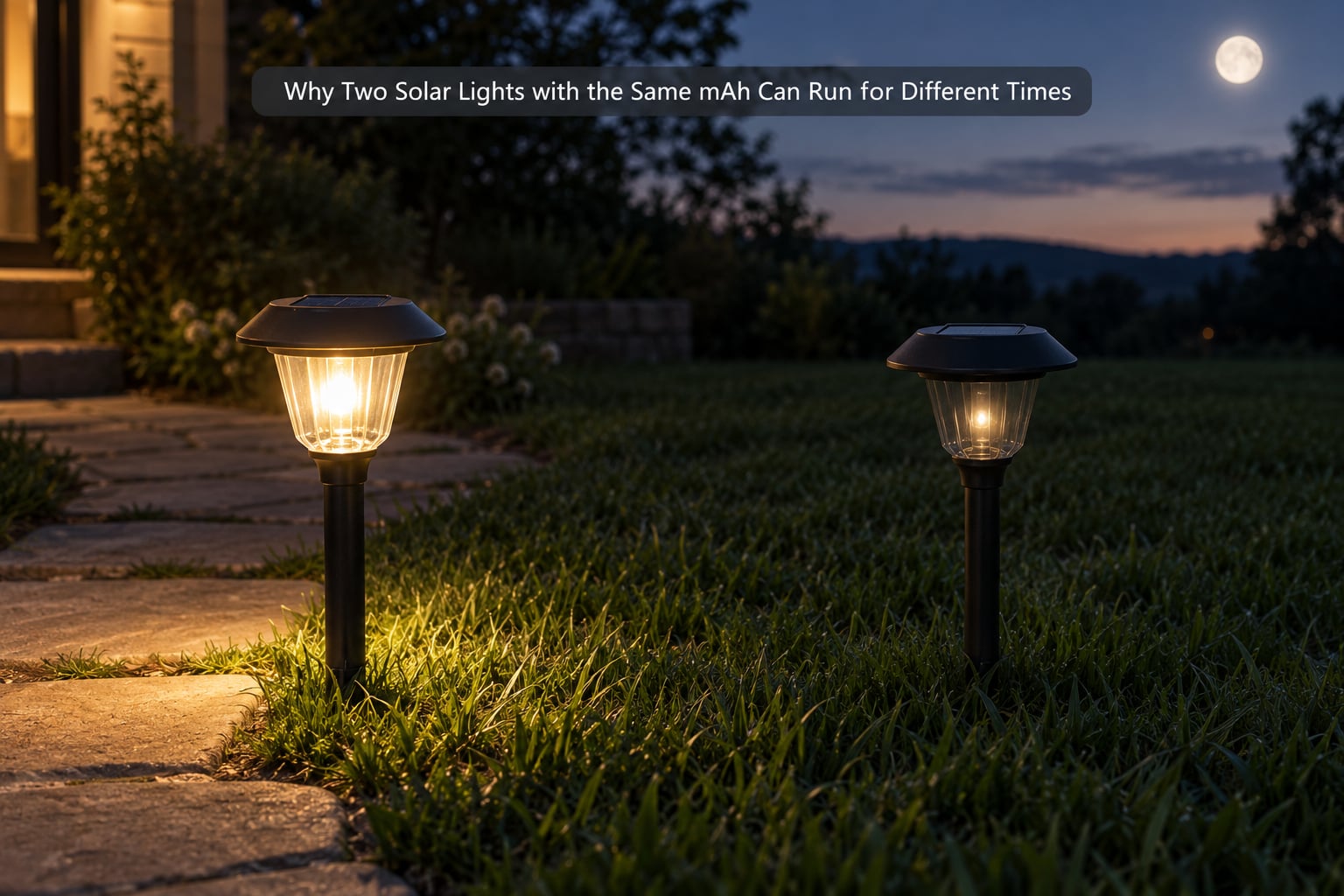
Same battery label, wildly different nights. Five things account for nearly all of the gap.
LED power draw and lumen output
Higher lumen output consumes more power, and runtime falls in direct proportion. A 300-lumen accent spot and a 60-lumen path light can share the same 1,200 mAh cell, and the accent light will empty it two to three times sooner. If you want all-night runtime and 400 lumens from one small panel, you are asking for a bigger panel, not just a bigger battery.
Motion sensing versus constant on
Motion-activated lights run their LED only when something passes, which on a quiet path can mean a few minutes of actual illumination across eight hours of darkness. That turns the same battery into three to five times the effective runtime. Users regularly report that switching a light from constant-on to motion mode is the single biggest improvement they make, and it costs nothing.
Brightness steps and programmable timers
A light set to its lowest step can stretch a charge across a whole night. Turn it to high and expect roughly the proportional loss. Timer modes are worth checking too: some fixtures dim for the first few hours rather than shutting off, which some people notice more than a sudden cutoff.
Battery age
Capacity fades. After a few hundred charge cycles a NiMH cell may hold 70 to 80 percent of its original rating, and lithium-ion loses ground on a similar schedule. A three-year-old light with a 2,000 mAh label might be delivering closer to 1,500 mAh, so it fails early in the night long before anyone suspects the label is stale.
Low-voltage cutoff and the discharge curve
The circuit cuts off when cell voltage drops below a set floor, so some stored energy is always left on the table. How much depends on the chemistry and where the cutoff sits. This is where experienced buyers put the panel ceiling most bluntly: if your location only gives you enough sun for three hours of runtime, a 1,000 mAh cell and a 10,000 mAh cell both give you three hours. It is the single most repeated warning about oversized cells, and it is correct.
How Sunlight, Seasons, and Weather Change Runtime
How mAh ratings affect solar light runtime in practice is mostly a question of how much energy went in that day. A battery can only spend what the panel put back, so weather is not a side note, it is the main variable.
Peak sun hours
Peak sun hours is the standard measure of usable daily sunlight. Most of the southern United States gets four to six in midsummer and two to three in midwinter. Areas further north see less in winter, and cloud cover can halve a good day. That swing, not the battery, is why lights die at 2 AM in February and look fine in July.
Cold temperatures
Standard lithium-ion chemistry loses roughly 30 to 40 percent of its rated capacity below 32 °F while the light is running. NiMH tolerates cold better than most people expect. LiFePO4 handles it best of the three, which is part of why it shows up in colder climates and in barn and driveway lighting.
Shade and panel placement
A panel under a shrub, beside a fence, or facing north loses a startling share of its output. Moving a light six feet to clear an obstruction often does more for runtime than doubling its mAh. Cleaning a dirty panel twice a year matters just as much, and it costs nothing.
What a poor charging day looks like
When the cell is undercharged, the light usually glows for an hour or two, runs dim, and quits. That dim output is not the LED degrading, it is the cell sitting near its cutoff voltage from the moment the switch closes. If you see that pattern on a bright day, the panel is undersized for the battery, and the mAh label is a red herring.
How to Choose a Runtime That Fits Your Needs
Start from the night, not the number. Work backwards from how many hours of light you actually need and where.
Decide the duration first
Most gardens need four to six hours of usable light for paths, steps, and accents. Decorative lanterns that only need to glow until midnight can run a small cell all year. Security and driveway lighting is different: if you want output at 4 AM in January, you are sizing for the worst night of the year, not the average one.
Then set the brightness target
Decide how bright you need the spot to be before you pick capacity. Runtime and output compete for the same stored energy. A dimmer LED on the same panel is often the cheapest route to more hours, and it costs no extra battery.
Check the panel-to-battery ratio
A light with a small integrated lid panel and a very large battery is a bad buy at any mAh. You want the panel’s daily harvest in watt-hours to comfortably exceed the night’s consumption. Separate-panel designs with a lead to a sunnier spot exist precisely for this reason, and they are the right answer for shaded locations.
Weigh the trade-offs
A high-mAh battery adds weight and bulk, which matters for stake lights in soft soil and for anything mounted high. A higher-power lamp produces more light and consumes energy faster. Most buyers are better served by a moderate battery and a smaller LED than by a large battery feeding an output the panel cannot sustain.
How to Test Actual Runtime Before You Buy
Runtime claims are testable, but only when you control for the conditions. The advertised figure is usually a summer, full-sun, best-case number with the light in its lowest mode.
Check the stated LED wattage or current
Look for watts, or milliamps at the cell’s voltage, on the spec sheet or the chip documentation. Without it you cannot run the runtime formula at all, and a listing that omits it is telling you something.
Read the test conditions behind the claim
Questions worth asking: how many peak sun hours, what month, which mode, and new or aged battery. A claim of 10 hours that assumes 6 peak sun hours is a June claim. The sensible default is to treat every runtime number as best case until you have seen your own.
Estimate the energy use yourself
Multiply LED watts by the hours you need, compare that against the battery’s watt-hours, then check the panel can refill it. If the numbers do not balance, one of the three parts is undersized.
Test for a full night outdoors when you can
If you are buying locally, charge the light through a full sunny day per the manufacturer’s instructions, then time how long it actually runs. Do the same test before and after any battery change and you will see exactly what the swap did — or did not do.
Match the replacement chemistry and voltage exactly
Never fit a 3.7 V lithium-ion cell into a light built for 1.2 V NiMH; the charge circuit is not designed for it and can be destroyed. Never put alkaline batteries in a solar light — they cannot be recharged and can leak. Replace swollen, leaking, or damaged cells with the type and voltage the manufacturer specifies, and follow the stated charging instructions.
Frequently Asked Questions
Is a higher mAh rating always better for a solar light?
No. A higher mAh rating only buys longer runtime when the LED power draw, panel size, and battery chemistry stay the same. If the panel cannot refill the extra capacity in a day, the light quits at the same hour either way. Bigger cells also add weight and cost. Check the cell voltage first, because two lights with the same mAh label can hold very different energy.
How many mAh do I need for all-night solar lighting?
For a path or accent light running a small LED, 1,000 to 2,000 mAh usually covers a full night in summer and most of a cloudy one. Security and driveway lights need 3,000 mAh or more, ideally with a larger panel. In winter, add roughly 30 percent more capacity than your summer estimate, since usable sun drops sharply.
Does a 3000 mAh solar light last longer than a 2000 mAh one?
Only sometimes. If both lights use the same cell voltage, the same LED wattage, and a panel scaled to their battery, then yes — about 50 percent more stored energy means roughly 50 percent more runtime. Change any one of those three and the comparison breaks down, which is why matching mAh labels are so often misleading.
Why does my solar light stop working before dawn?
The usual causes run in a fixed order. Check shade or a dirty panel first, then whether the panel is simply too small for the battery, then battery age, and only then capacity. A light that glows dim for an hour and quits on a bright day points at an undersized panel. A light that dims steadily from full brightness usually points at a tired cell.
Can I replace the battery in a solar light with a higher-mAh unit?
You can, but only with the same chemistry and the same nominal voltage as the original, and only if the panel can recharge the larger cell in a day. Going from 600 mAh to 2,300 mAh in a small light often changes nothing, because the panel was never the limiting factor size-wise. Never fit a 3.7 V lithium-ion cell into a 1.2 V NiMH light, and never use alkaline cells.
Conclusion: Start with Energy Needs, Not mAh Alone
Work out how many hours of light you need, convert any mAh figure to watt-hours using the cell’s voltage, and divide by the LED’s wattage. Then check that the panel can refill that energy in a day of your local sunlight — winter, not July. That single check separates every useful capacity upgrade from the ones that change nothing.
Everything else follows from it: mode settings, placement, battery age, and chemistry. The mAh number is one input in a system, which is why how mAh ratings affect solar light runtime is a conditional answer rather than a ranking. It is also the figure most often quoted without the context that makes it mean anything.