Flickering LED fixtures are almost always one of four things: a bulb that is loose or failing, a dimmer that is not built for LEDs, a connection that has loosened, or a driver inside the fixture going bad. Most cases are sorted in under ten minutes with a screwdriver, and most homeowners can do them safely at home.
Before anything else, switch the circuit off at the breaker panel and confirm the fitting is dead. If the flicker comes with a burning smell, buzzing, scorch marks or a warm switch plate, stop there and call a licensed electrician. This guide covers diagnosis only, never live wiring.
The four causes, in the order worth ruling out:
- A loose bulb, a worn socket contact, or an LED bulb at end of life.
- A dimmer that chops the waveform below the load it needs, especially a leading-edge model on modern LEDs.
- A loose terminal, a loose neutral or a worn wall switch creating an intermittent arc.
- A failing LED driver, the small circuit that converts mains power into the steady current the LEDs need.
Table of Contents
- What You Need
- Step-by-Step: How to Troubleshoot a Flickering LED Fixture
- 1. Identify When the Flicker Happens
- 2. Check the LED Bulb and Fixture Compatibility
- 3. Test the Switch or Dimmer
- 4. Inspect the Fixture Connections
- 5. Determine Whether the LED Driver Is Faulty
- Common Mistakes That Worsen the Problem
- Fitting a non-dimmable bulb on a dimmer
- Using a dimmer outside its load range
- Rushing a terminal connection
- Touching or leaving exposed copper
- Replacing a driver without matching voltage and polarity
- Adding a capacitor to smooth flicker
- Frequently Asked Questions
- Why do LED bulbs flicker when turned off?
- Why does only one fixture flicker when others on the same circuit are fine?
- Can a dimmer be causing my LED to flicker?
- Is a faint glow or a flicker a fire hazard?
- What are the symptoms of a faulty LED driver?
- Why are my LED recessed lights flickering?
- Conclusion
What You Need
The job is mostly observation and one or two hand tools. Gather everything before you isolate the power, because working with the breaker off and no torch is how people drop screws into a backbox.
- The fixture manual or the bulb packaging. It tells you the wattage ceiling, the base type and whether the fixture is dimmable at all.
- A replacement LED bulb. Match the base first: BC and B22 are bayonet caps, ES and E27 are the large Edison screw, SES and E14 are the small screw. A bulb of the wrong base will not go in, which is a cheap way to fail.
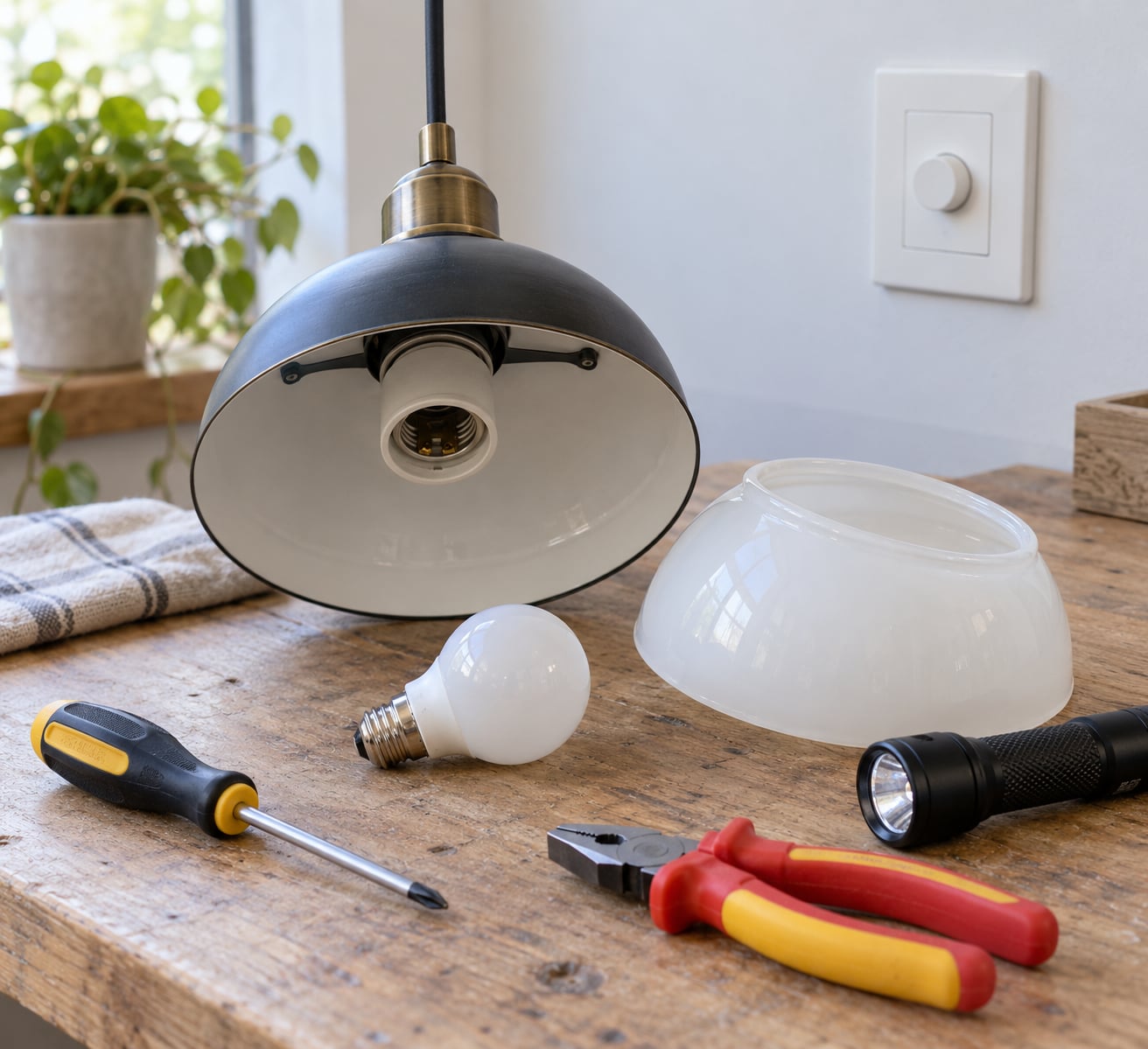
- Insulated hand tools. A slim screwdriver or a pair of insulated pliers is usually enough for a diffuser, shade or lamp holder.
- Work gloves and eye protection. Glass diffusers chip easily and go into your eye at exactly the wrong moment.
- A stable step ladder. A chair and a swivel are how falls happen.
- A torch. Mains lighting circuits are dead with the breaker off, which is the point.
- A two-pole voltage tester, if you are qualified. A non-contact tester only proves a conductor is live; it does not prove a conductor is dead. Do not open a consumer unit or distribution board to do this check.
If you are not confident working inside a luminaire or a backbox, the test is simple: could you describe every conductor you are about to touch and what it connects to? If not, that work belongs to a licensed electrician.
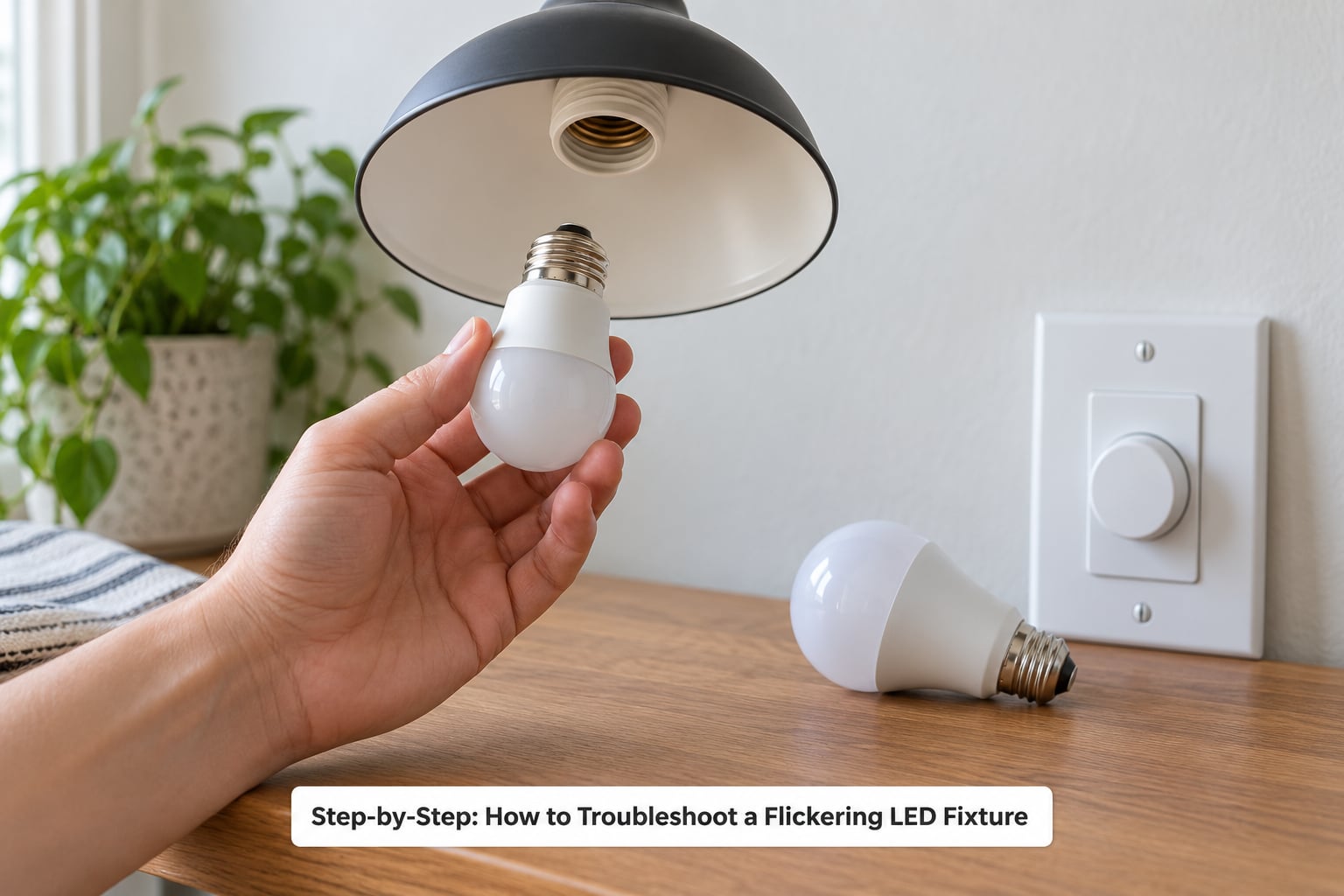
Step-by-Step: How to Troubleshoot a Flickering LED Fixture
1. Identify When the Flicker Happens
The pattern of the flicker tells you where to look, so record it before you touch anything. Note whether the LED flickers constantly, only for the first few seconds after switching on, only when the dimmer is turned down, only while the switch is being moved, or only when a large appliance starts up in the house.
Constant flicker points at the bulb, the socket or the driver. A flicker that appears in the first two seconds and then settles is usually a cold driver or a bulb that is close to end of life. Flicker that only happens at low dimmer settings almost always means the dimmer and the LED do not match. Flicker that starts the moment you flick the switch, and stops when you hold it still, is a switch contact or a loose terminal. Flicker that lines up with the washing machine or the air conditioning kicking in is a supply or load issue on the circuit.
Success signal: you can now name one or two candidate causes instead of five. Everything after this step is confirmation.
2. Check the LED Bulb and Fixture Compatibility
Turn the breaker off, remove the diffuser or shade, and check the bulb is seated properly. A bayonet cap or Edison screw that has backed off a quarter turn loses contact on one side, and the fixture will flicker every time it is nudged or when the fixture moves with the ceiling. Push it home and quarter-turn it firm, but not hard enough to strip the threads.
Then compare the bulb against the fixture. The wattage matters in both directions: an LED drawing more than the fixture rating runs the driver hot, and a much lower wattage can leave older drivers unable to start at all. Confirm the base type matches, the bulb is rated for the fixture’s voltage, and if the fixture is on a dimmer, the bulb says dimmable on the box or in the base marking.
Test the simplest fix first: swap in a known-good bulb of the same base and wattage from another room. If the flicker follows the bulb, you are done. If it stays with the fitting, the bulb was never the problem. Replace every lamp in a multi-lamp fixture together rather than one at a time, because mixed drivers and mixed driver quality in the same fitting behave differently from each other.
Success signal: steady light with the new bulb fitted. If the new bulb flickers too, move on rather than buying a third bulb.
3. Test the Switch or Dimmer
Turn the dimmer to full on. If the LED is steady at full brightness and only flickers as you bring it down, the dimmer is the problem. Dimmers work by chopping up the AC waveform. A leading-edge dimmer, the older and cheaper type fitted to most houses built before the 2010s, chops the front of each cycle and leaves LEDs with an uneven supply. A trailing-edge dimmer chops the back of the cycle and suits LEDs far better.
Two more dimmer issues are worth knowing. Dimmers have a minimum load, often stated in watts, and a modern 6W to 10W LED lamp can sit below that figure, leaving the dimmer hunting for a load it does not have. Some dimmers also need a neutral wire at the switch to work properly; the cheapest models work without one and flicker as a side effect.
To isolate it, run the dimmer to full and listen as you bring it up slowly. Audible buzz or crackle that matches the flicker is the dimmer talking to you. A second test is to put the same bulb on a switch that has no dimmer fitted. Steady there means the bulb is fine and the dimmer is not.
Success signal: steady output from a plain switch, and flicker that stops at full brightness on the dimmer.
4. Inspect the Fixture Connections
With the breaker off, remove the diffuser and look inside the fitting. Check the lamp holder sits square in its socket, and that the socket contacts grip the bulb base firmly. Open a B22 bayonet holder and you can often see the contact tab sitting away from the cap; a socket with a blackened or flattened tab is worn out and needs replacing with the fixture, not by the bulb.
Look at every terminal and wire connection. Terminal blocks with screws should have conductors fully seated with no stray strands. Connector blocks and wire caps that have come loose, or copper showing outside a connector, are the cause of most intermittent kitchen flicker. Look for scorch marks, browned insulation or plastic that has warped, all of which mean heat built up at that joint. In a pendant, check the ceiling rose or junction box as well, because a fitting that hangs from a loose box will flicker every time someone walks past.
Restore every connection exactly as the manufacturer specifies, with the correct terminal type and the correct torque. Do not twist bare wires together and wrap them in tape; that is not an approved permanent connection anywhere.
Call an electrician now if you see exposed live copper, scorch marks, a burning smell, buzzing that continues with the light off, or if the breaker trips again after you restore everything. Arcing connections are a recognised cause of residential electrical fires and they do not get better on their own.
5. Determine Whether the LED Driver Is Faulty
The LED driver is the small circuit inside the fixture or bulb that takes mains alternating current and turns it into the steady direct current an LED needs. LEDs are extremely sensitive to supply, so when a driver degrades the output drops out repeatedly and you see flicker.
Symptoms of a failing driver are worth naming. The light may flicker constantly, flash briefly and settle, run dim or at an odd colour, light only part of the fitting, cycle on and off every few seconds, or leave a faint glow after the switch is off. A driver also runs warm, so a fixture that is hot to touch in a way it was not last month deserves attention.
You cannot repair a driver, only replace it. If the LED is integrated into the fitting, as with most recessed downlights, shop lights and outdoor soffit fittings, the whole lamp assembly is the replaceable part. If the driver is separate and housed in a compartment the manufacturer says is serviceable, replacement drivers are sold by input voltage, output current and wattage, and polarity must match. Check the warranty first: drivers inside integrated fittings are commonly covered for five years or more, and a replacement fixture is often the route rather than a repair.
Success signal: steady light through every stage above means you never needed to reach this step. If flicker survives a known-good bulb, a plain switch and clean terminals, the driver is the remaining suspect.
Common Mistakes That Worsen the Problem
Most wasted evenings come from the same handful of wrong turns. Electricians posting on DIY forums repeat the same order every time: change the bulb, confirm the bulb is dimmable, confirm the dimmer is LED-rated, then look at connections.
Fitting a non-dimmable bulb on a dimmer
A standard LED on a dimmer flickers at low settings, buzzes, and burns out early. The dimmer is chopping a supply the bulb was never designed to take, which also shortens the life of the driver. Replace it with a bulb labelled dimmable.
Using a dimmer outside its load range
A 5W LED on a dimmer rated for 20W minimum will hunt. Either add more lamps on that circuit or fit an LED-compatible dimmer with a lower minimum load.
Rushing a terminal connection
Over-tightening cuts the conductor and strands it; under-tightening leaves it arcing. Follow the manufacturer’s torque and check the conductor is fully seated before you tighten anything.
Touching or leaving exposed copper
No conductor should be visible outside a connector. If you strip back a cable, re-terminate it properly. If you are not sure how, stop.
Replacing a driver without matching voltage and polarity
Connecting a driver backwards can destroy the lamp and, in poor-quality fittings, create a hazard. Match input voltage, output current and polarity, and only service a driver compartment the manufacturer permits you to open.
Adding a capacitor to smooth flicker
Capacitor and rectifier add-ons appear in forums as a workaround for strip lighting. They hide the symptom, waste energy, and they are not an approved permanent connection in fixed wiring.
A few habits prevent flicker coming back. Match every bulb on a dimmed circuit to the same dimmable type. Balance lighting circuits so no single circuit carries a lighting load plus a washing machine, dishwasher and HVAC on one line. Use surge protection at the distribution board if your area has frequent supply surges. For outdoor and garage fittings, check the seals and gaskets, because moisture corrodes terminals faster than any other cause.
Frequently Asked Questions
Why do LED bulbs flicker when turned off?
A faint glow for a second or two after switching off is normal on many LED bulbs and drivers. Mains power leaks through a small capacitor inside the driver, which is by design and harmless. Persistent glow that lasts as long as the switch is off, glow bright enough to read by, or glow from a dimmer is different: that points to a switch with a poor neutral connection or a low-quality driver. Leave a momentary glow alone; investigate anything that stays lit.
Why does only one fixture flicker when others on the same circuit are fine?
One flickering fixture among several usually means the fault is local, not in the supply. Check that the bulb is seated, that it is the correct base and wattage for the fitting, and that the terminals inside are tight. A driver in that one fitting may simply be failing while the others work. If the flicker follows the fitting to a different room, or spreads to other fittings, treat it as a circuit problem and get an electrician.
Can a dimmer be causing my LED to flicker?
Very often, yes. If the LED is steady at full brightness and flickers as you dim it down, the dimmer is the culprit. Older leading-edge dimmers were built for incandescent loads and leave LEDs with an uneven supply, and a dimmer with a high minimum load will flicker with a low-wattage bulb. A trailing-edge or LED-rated dimmer with a suitable load range normally resolves it without touching any wiring.
Is a faint glow or a flicker a fire hazard?
Ordinary flicker is not itself a fire risk, but it is a warning sign worth taking seriously. Loose connections that flicker are arcing, and arcing is a recognised cause of residential electrical fires. Isolate the circuit at the breaker if you notice a burning smell, buzzing that continues with the light off, scorch marks, a warm switch plate, sparks or a breaker that trips repeatedly. Any of those means stop and call a licensed electrician.
What are the symptoms of a faulty LED driver?
A failing driver shows up as constant flicker, a few seconds of flashing before the light settles, cycling on and off every few seconds, part of the fitting lighting up, dim or oddly coloured output, or a faint glow after switching off. The fitting may also run hotter than it used to. You cannot repair a driver. Integrated LED fittings are replaced as a whole lamp assembly, while a separate serviceable driver is matched on input voltage, output current and polarity.
Why are my LED recessed lights flickering?
Recessed downlights fail in two ways, and the distinction tells you where to look. If the lamp has a separate bulb and a bulb change fixes it, the lamp was at end of life. If the fitting has an integrated LED panel and a driver, the whole assembly is one replaceable unit and the panel itself rarely fails alone. Also check for a loose lamp holder, a dimmer on the same circuit that is not LED-rated, and shared neutrals in a box holding several fittings, which is a job for an electrician.
Conclusion
Start with the breaker, record the flicker pattern, fit a known-good compatible bulb, and test the fitting on a plain switch before you assume the fixture is faulty. In that order, most flickering LED fixtures resolve without a tool beyond a screwdriver, and you avoid replacing three bulbs that were never the problem.
Stop and contact a licensed electrician for flicker that persists after those steps, for a burning smell, buzzing, heat, sparks, scorch marks, damaged wiring, or a breaker that keeps tripping. Those symptoms point to an arcing connection or a supply fault, and both get worse with time rather than better.