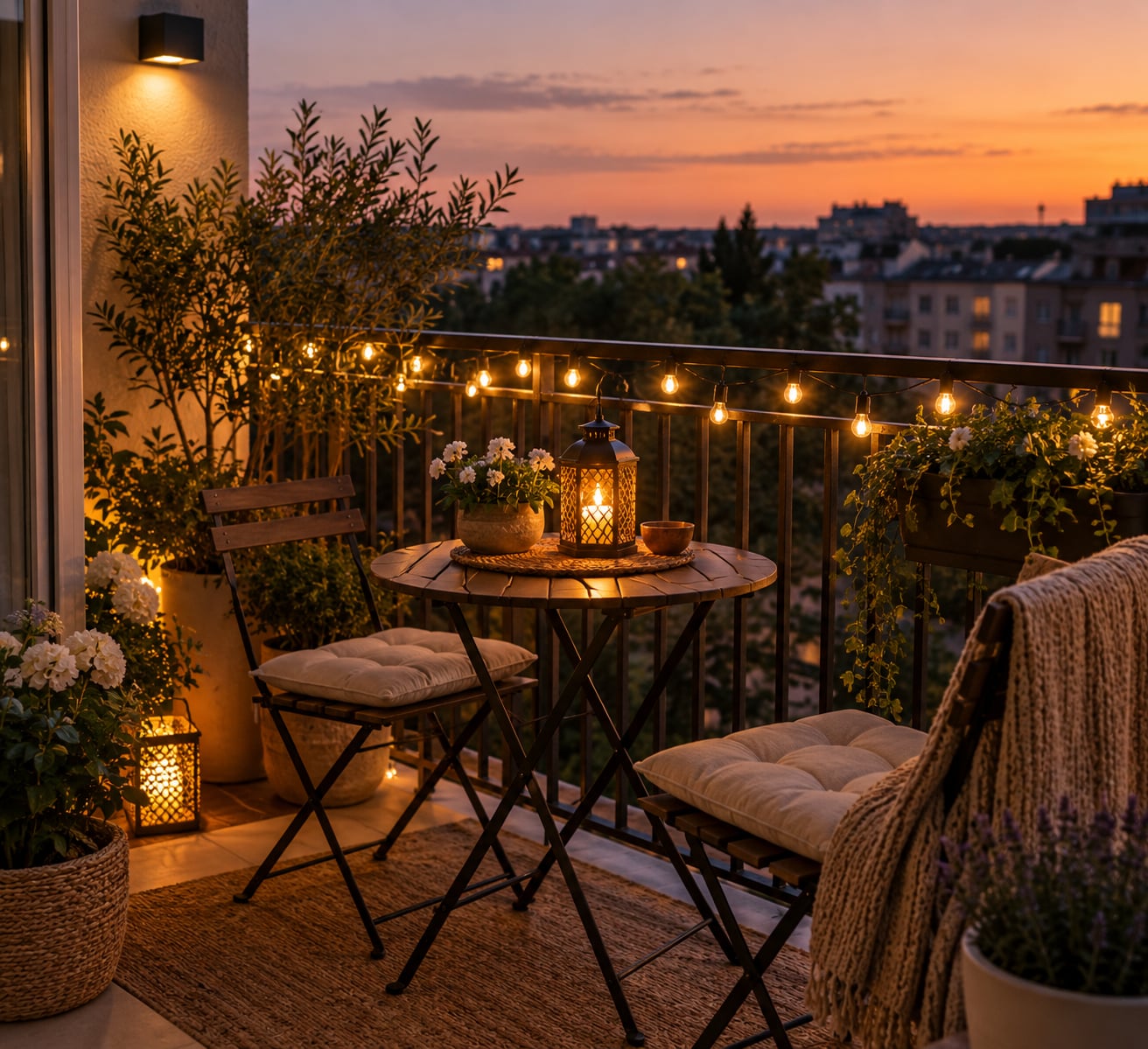
How to light an apartment balcony comes down to two things most people get wrong: picking a light that needs no drilling, and picking a power source the balcony actually has. Start with one warm ambient layer (string lights along the rail, or a solar lantern), add a low task light where you sit, and you have a balcony you use after dark in about an hour. Most of the work is measuring and choosing a mount.
I’ve rented balconies with no outdoor outlet and a textured render wall that swallowed every adhesive hook I tried it on. The setups that survived were the boring ones: a clip on the railing, a lantern on the table, a rechargeable floor lamp by the chair. That is the whole game.
Last checked October 2026. If you are renting, read the “Common Mistakes” section before you buy anything — half of it is lease and building rules.
Table of Contents
- What You Need
- Step-by-Step
- How to Light an Apartment Balcony with Layered Lighting
- Choose the Right Location and Light Temperature
- Install Solar or Battery-Powered Lights Without Wiring
- Test the Lighting and Improve the Atmosphere
- Common Mistakes During the Install
- Common Mistakes
- Frequently Asked Questions
- Can I install lights on an apartment balcony?
- Are solar lights bright enough for a balcony?
- What type of light is best for a small balcony?
- Can I use outdoor string lights on a renter balcony?
- How do I choose a light for a shaded balcony?
- Do apartment balcony lights need to be waterproof?
- Conclusion
What You Need
Nothing technical. You need a tape measure, a phone flashlight to test brightness at night, and a clear idea of what your balcony will be used for. Drinks for two and cooking a grill need different light, and buying for the wrong one is how people end up with a bright lamp pointed at a wall.
Before you shop, work out five things:
- Power. Look for an outdoor-rated receptacle on the balcony wall. Most apartment balconies do not have one, which rules out plug-in string lights entirely and pushes you to solar, battery or USB.
- Permission. Does your lease or building management allow anything attached to the railing or the wall? The railing is often common property, and a manager who does not answer the question is telling you something.
- Sun. A north-facing or fully shaded balcony gets very little usable solar charging. Note where the sun lands and for how long.
- Weather rating. Anything outdoors should be rated for damp or wet locations. IP44 suits a covered balcony; IP65 suits one that gets wind-driven rain.
- Anchor points. Measure the distance anchor to anchor, not around the balcony. That single number decides your strand length.
One more: check the surface. Smooth painted concrete holds removable adhesive. Textured render, stucco and brick dust do not, and a hook that falls off in month two takes paint with it.
Step-by-Step
How to Light an Apartment Balcony with Layered Lighting
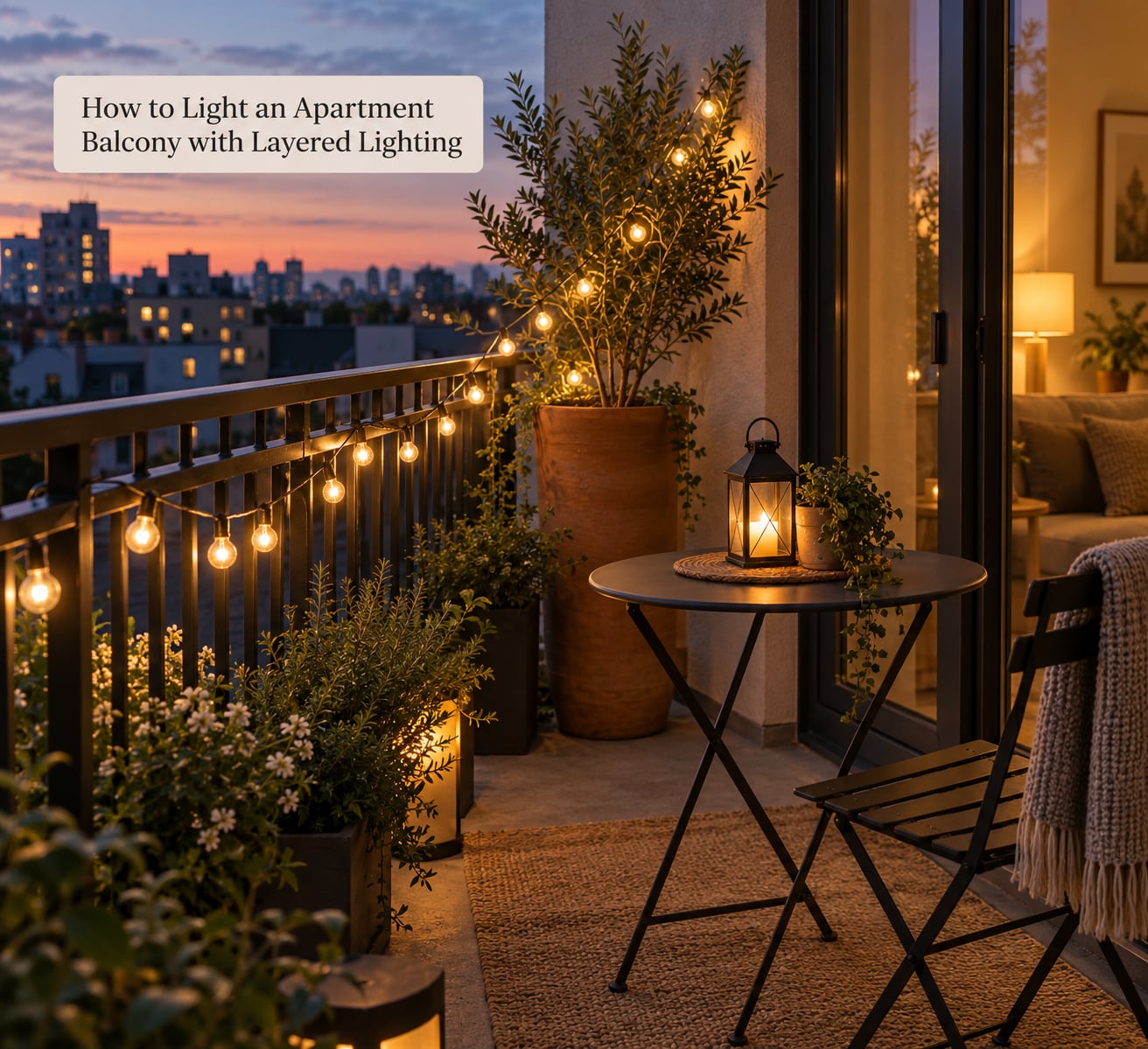
Layered lighting is the fastest route to a balcony that feels intentional: one ambient layer for the overall mood, one task layer where you sit or eat, and one accent layer to catch a wall or a planter.
Ambient is the layer you notice before you switch anything else on. String lights draped along the railing do this best, and they work at eye level, which keeps them off the ceiling of a top-floor unit. A solar lantern in a corner is the second-best option, and the only one that works on a balcony with no sun and no outlet.
Task is the layer people forget until someone tries to eat outside at 9pm. A rechargeable table lamp or a small lantern on the bistro table lights the actual surface. Without it, a beautiful string of bulbs still leaves you squinting at a plate.
Accent is optional and cheap. A solar spotlight aimed at a planter, or an LED strip clipped under the top rail, throws a pattern onto the wall or the floor and makes a 7-foot balcony read as deeper.
Two layers is enough for a small space. Three if you have a wall worth lighting. Four on a big terrace is where the bill for electricity and the complaints from the unit below start.
Choose the Right Location and Light Temperature
Put the light low and to the side, not overhead. Overhead light on a balcony reads like a car park, and it drops harsh shadows across a table. A strand hung at rail height, or a lamp at 30cm above the tabletop, gives you light that reaches your face.
Colour temperature matters more than people expect. Warm bulbs feel like an evening out; cool bulbs make the same balcony look like a corridor. Check the Kelvin number on the bulb or the product listing.
| Colour temperature | What it looks like | Where it works |
|---|---|---|
| 2200K to 2700K | Warm, candle-like amber | Small balconies, dinners, plants. My default for a renter balcony. |
| 3000K to 3500K | Neutral white | Workspaces, cooking, drying laundry outdoors. |
| 4000K and above | Cool, bluish | Security and path lighting only. Harsh on a balcony. |
Avoid any bulb that is not marked shatterproof if the balcony is above ground level or gets wind. Polycarbonate bulbs cost less than replacing glass into a courtyard.
Install Solar or Battery-Powered Lights Without Wiring
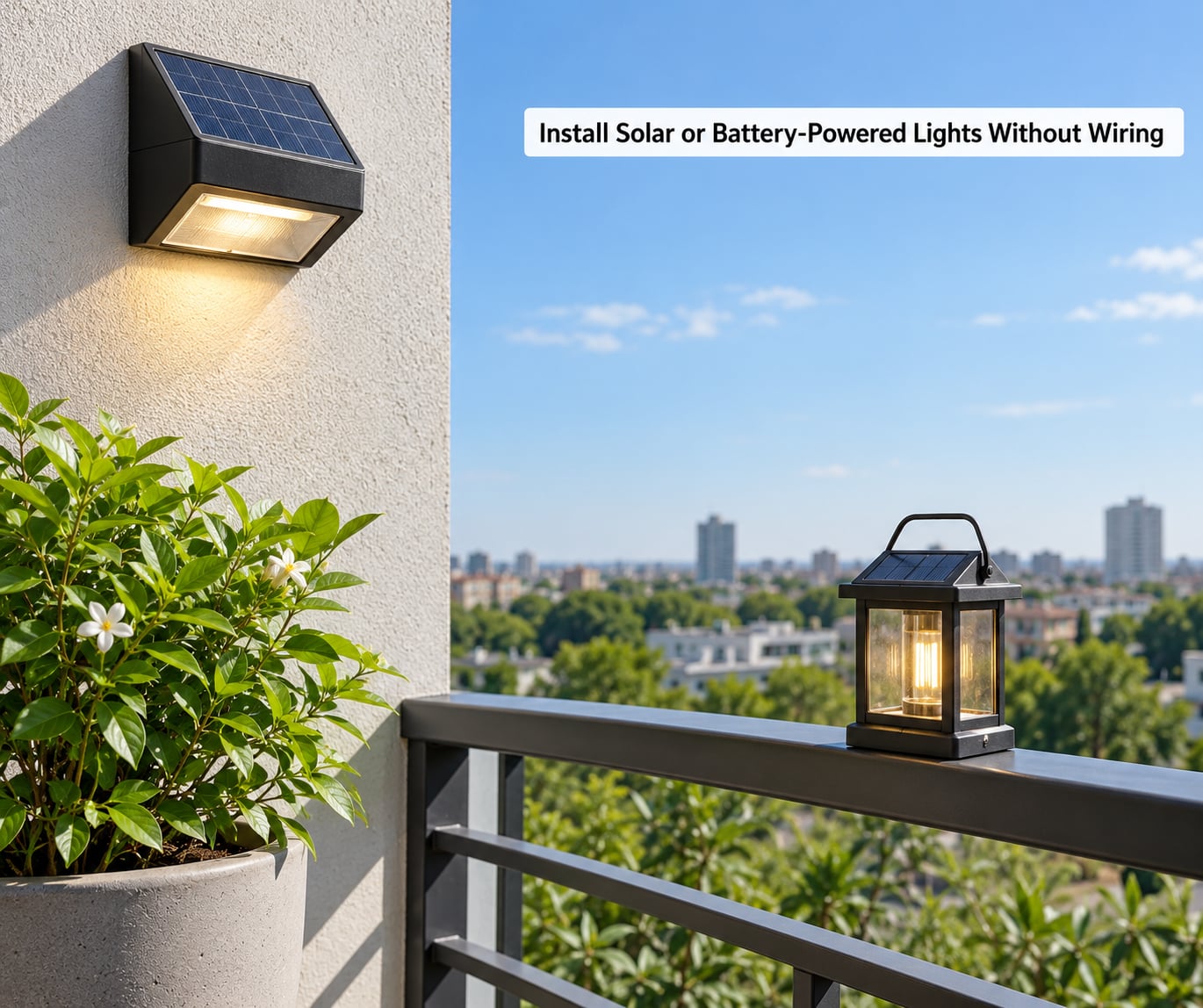
When there is no outlet, the power choice comes down to how much sun the balcony gets and how long you need light for.
Solar is the maintenance-free option and the one that gets unfairly judged. A panel needs direct sun on it, not ambient brightness — a solar light tucked under an overhang or beside a tall planter wall simply will not charge. Panel facing open sky, nothing casting a shadow across it after 2pm.
Be honest about what solar gives you: a soft ambient glow, typically enough to sit and talk and find your way to the door, not enough to chop vegetables. Most solar balcony lights also lose real runtime in winter, when sun hours drop and cold reduces battery performance. Dual-charging models with a USB port solve this — plug them in on a grey December weekend and you have a full night.
Rechargeable battery fixtures — table lanterns and floor lamps — give you the brightest, steadiest light for the least fuss, and they are the answer people reach for after deciding solar is too dim. Check the stated runtime per charge and whether a USB-C port is included, because a proprietary cable is a lifetime annoyance. Keep a physical on/off switch if you can; it is the single feature renters ask for most, because everything not plugged in otherwise drains slowly in the background.
USB string lights are the cheapest way to get a proper strand running, and they plug into any power bank or indoor USB port. Run the cable through a sliding door gap or a window gasket — never across the walkway. Make sure the strand itself is rated for outdoor use; many cheap ones are indoor-only with a fabric-wrapped cord that soaks through in a week.
And if you do have an outdoor receptacle, use it. Plug into a GFCI-protected outlet only, keep the connection off the floor where water collects, and run any extension lead along the wall or through an outdoor-rated channel rather than across the tiles.
| Power source | Choose it if | Skip it if |
|---|---|---|
| Solar | The panel gets several hours of direct sun and you want zero cable management | The balcony is shaded or north-facing, or you need real task light |
| Rechargeable battery | You want the brightest light and can charge it indoors every few days | You want lights that run all night with no charging ritual |
| USB string lights | A power bank or an indoor socket is within a few metres | The cable would have to cross the walkway to reach power |
| Plug-in, GFCI | There is a weather-rated outdoor receptacle on the balcony wall | The only socket is indoors and the cord would be exposed |
| Power from a window or door | You have a sliding door and can feed a cable along the frame | The door opens onto the balcony and the cable would be pinched |
Test the Lighting and Improve the Atmosphere
Turn everything on at full darkness, not at dusk. Stand where you normally sit and check three things: can you read a menu, can you find the door handle, and is anyone flashing you in the eyes.
Solar and dusk-to-dawn sensors are worth testing properly. Cover the photocell with your hand and confirm the light switches on, then cover it again and confirm it switches off — a sensor that latches on all night drains a battery by morning. Where a fixture has a timer, run it once through so you know what time it actually cuts out rather than finding out at 1am.
Check for shadows next. If you have one strand only and it runs along one rail, the other half of the balcony stays dark. A second short run, or a lantern opposite, fixes that faster than a brighter single strand.
Cable safety deserves a walk-around. Nothing crosses the doorway, nothing runs where someone puts a chair leg, and no connector is sitting in a saucer of rainwater. Then look up and outward: on an exposed balcony, light spill goes straight into the flat below and straight into the unit across the way. Aim a spot at the floor or a planter, not out over the rail.
Last, work out your removal plan before you install. Rental-safe means: no drilling, no residue, no new fixtures on the rail at move-out. Railing clips, drape hooks and weighted planters all come off in five minutes and leave nothing behind.
Common Mistakes During the Install
Running only one overhead strand. Fix: add a low lantern near the table, then judge again. Eyes read low light as cosy and high light as clinical.
Buying the brightest fixture on the page. Fix: aim for roughly 200 to 400 lumens for a small balcony sitting area. Anything much higher turns a 7-foot space into a car park and reaches the neighbours.
Putting the solar panel in shade. Fix: trace the sun across the balcony at midday. If the panel is shadowed for most of the day, drop solar and use rechargeable or USB instead.
Trusting adhesive hooks on textured render. Fix: test one on an inconspicuous corner for 24 hours. If it lifts, move to rail clips or weighted planters rather than piling on tape.
Running the cord across the floor. Fix: route along the wall, under a rail, or through the door frame. A cord across tiles is the most common thing that gets a balcony lighting plan dismantled.
Common Mistakes
Most balcony lighting mistakes come from buying before checking, so here is the full list with the fix next to each one.
- Drilling or clamping permanently to the building. Fix: check the lease and ask building management in writing first. Use no-drill mounts.
- Attaching to the railing without permission. Fix: railings are frequently common property. Ask, or hang from your own planters and door frame.
- Using indoor-rated strands outdoors. Fix: look for an IP44 or IP65 rating and outdoor-rated connectors, not just weather-resistant packaging.
- Plugging into an indoor socket with a long exposed lead. Fix: use GFCI protection, keep the connection dry and off the ground, and never run a lead across the walkway.
- Skimping on cord slack. Fix: measure the anchor-to-anchor run, add the length from the power point, then add about 20% for sag. A taut strand looks like a security wire.
- Skipping a shade or diffuser. Fix: on a task lamp, a frosted bulb or a fabric shade removes glare without changing the bulb.
- Forgetting shade from neighbouring buildings. Fix: check what blocks the sun at 3pm, not at noon. Solar panels facing a brick wall all day produce very little.
- Aiming light out over the rail. Fix: point down and inward. It keeps the balcony lit and the complaints off your doorstep.
- Leaving the balcony untested through real weather. Fix: run one wet evening, then check every connector and any rust or water ingress the next morning.
- Never cleaning or storing anything. Fix: wipe solar panels every few months, and bring rechargeable lanterns indoors for winter storage so the cells do not sit half-drained in a cold shed.
Safety first: anything electrical on a balcony should be outdoor-rated, connected through GFCI protection, and clear of standing water. If you need to run new cable or fit a fixed fixture, that is a job for a licensed electrician and it usually needs your landlord’s permission anyway.
Frequently Asked Questions
Can I install lights on an apartment balcony?
Usually yes, as long as you do not drill or hard-wire. Most leases forbid attaching anything to the building fabric or the railing, which is often common property, so check first and ask building management in writing. Safe options for renters are railing clips, over-the-rail drape hooks, weighted planters and freestanding poles, all of which come off in minutes at move-out.
Are solar lights bright enough for a balcony?
Bright enough for atmosphere, not for tasks. A good solar string or lantern lights a small sitting area so you can talk and find your way to the door, but it will not light a prep surface for cooking. If you need real task light, use a rechargeable battery lantern or USB lights, or pick a dual-charging model with a USB port so you can top it up on a cloudy week.
What type of light is best for a small balcony?
One warm-white string light at rail height, plus a single lantern or rechargeable table lamp near your chair. That two-layer setup reads as considered rather than bright, works on a 6 to 10 foot balcony, and costs far less than a fixture designed for a patio. Keep bulbs between 2200K and 3000K and add an accent spot only if you have a wall worth showing off.
Can I use outdoor string lights on a renter balcony?
Yes, provided you mount them without touching the building. Drape them over the railing, clip them to a rail, or run them between weighted planters. Avoid adhesive hooks on textured render, since they rarely hold and can lift paint. Confirm the strand is rated for outdoor use with outdoor-rated connectors, because indoor strands with fabric cords soak through within a week or two.
How do I choose a light for a shaded balcony?
Skip solar. A balcony in permanent shade, or one facing north, will not charge a panel enough to run a light all evening. Go for rechargeable battery lanterns or USB string lights powered from an indoor socket or a power bank, and use a small mirror or a light-coloured wall surface to spread what light you have. A solar spot is still fine for a decorative accent with no expectation of brightness.
Do apartment balcony lights need to be waterproof?
They need to be rated for damp or wet locations, which is what the IP code tells you. IP44 suits a covered balcony with occasional damp; IP65 suits an exposed balcony with wind-driven rain. Full submersion ratings are not needed. Anything plugged in should also sit behind GFCI protection, and connectors should never rest in standing water.
Conclusion
Choose one reliable ambient light first — a warm-white string light clipped or draped along the railing, or a solar lantern if the balcony gets real sun. Add a low task light where you sit, because that is what makes the space usable rather than merely decorated. When wiring is not allowed and there is no outdoor outlet, solar handles the mood and rechargeable or USB lights handle the brightness.
Then check the sun, check the lease, and test everything at full dark before you call it done. That is an hour of work and one that survives the season.