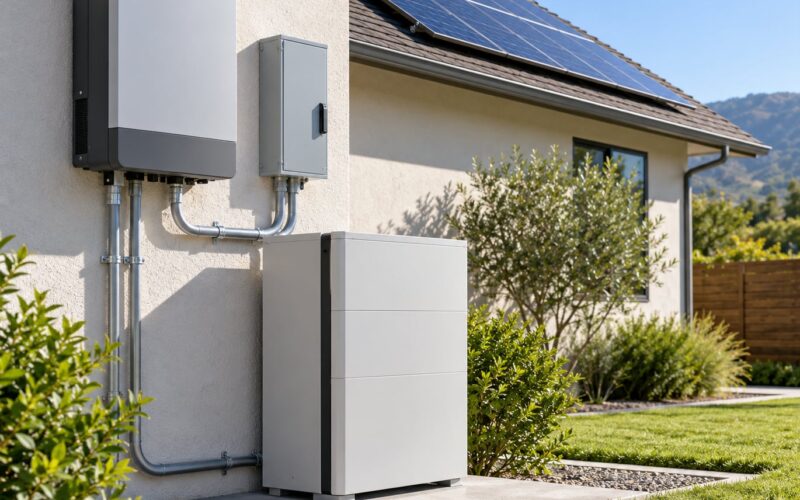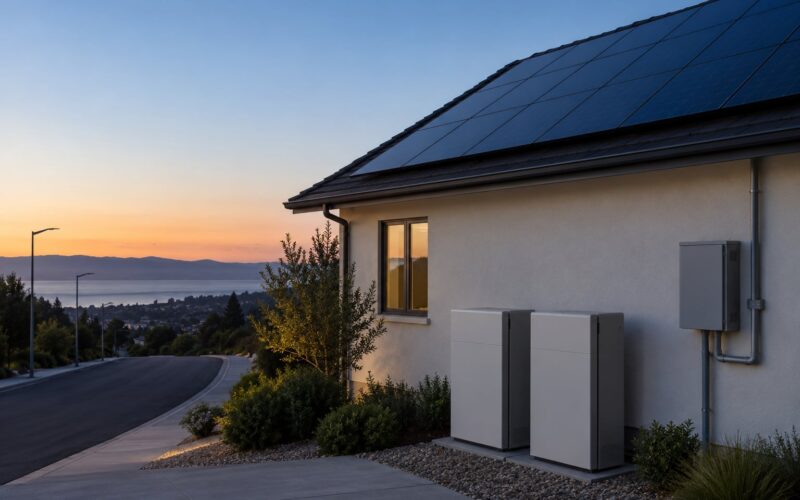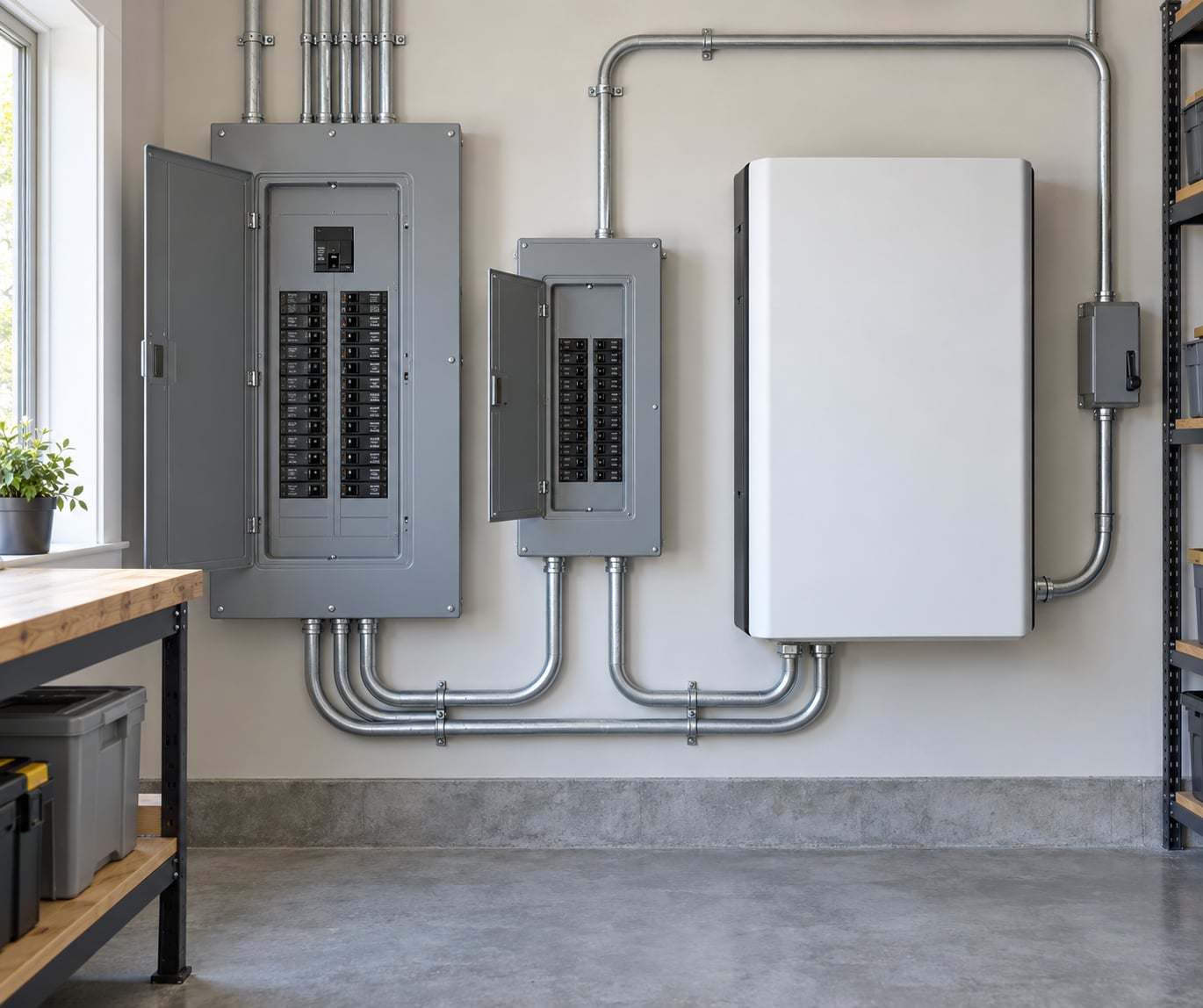
A critical load panel is a small secondary breaker panel, often called a critical load subpanel or an essential load panel, that collects the specific household circuits you want to keep powered during a grid outage. A battery and its inverter feed only that panel through a transfer device, so the fridge, internet and a few lights stay on while everything else in the house goes dark.
That is the whole idea. A critical load panel does not create power and it does not store any. It is an organizational box that tells a battery system which circuits matter, which is the difference between a battery that empties in ninety minutes and one that carries you through a two-day outage.
Below is what the panel is, how the wiring actually works, which loads belong on it, and the questions worth asking before spending money on one.
Table of Contents
- What Is a Critical Load Panel?
- What Is a Critical Load Panel, Technically Speaking?
- How Does a Critical Load Panel Work?
- What Is a Critical Load Panel Used For?
- Loads Most Homeowners Put on the Panel
- Loads That Should Stay Off
- How Is It Different From a Regular Electrical Subpanel?
- Does a Critical Load Panel Work With Solar Power?
- How Many Watts Should a Critical Load Panel Support?
- How Is a Critical Load Panel Installed?
- What Safety and Code Questions Should Homeowners Ask?
- Frequently Asked Questions
- Do I need a critical load panel if I already have solar?
- Can a critical load panel be added after the battery is installed?
- How long can a critical load panel run on one home battery?
- Do I need a licensed electrician to install a critical load panel?
- What is the difference between a critical load panel and a generator interlock?
- Is a critical load panel better than a generator for backup power?
- Conclusion
What Is a Critical Load Panel?
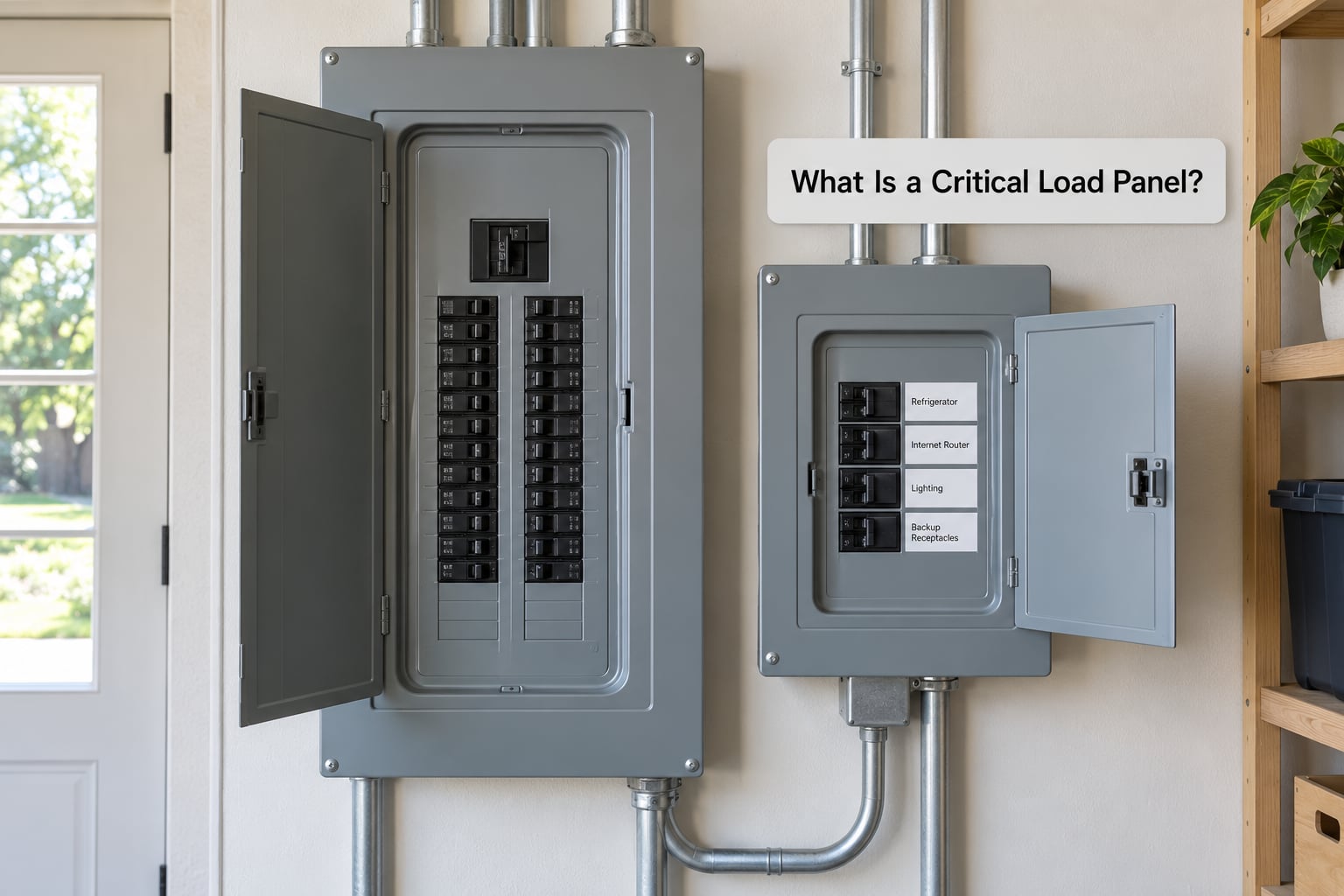
A critical load panel is a separate breaker box, fed from your main electrical panel, that holds the circuits you have chosen as essential. When a grid-tied battery loses grid power, it forms its own small electrical island around that panel and nothing else.
The terms all describe the same object. If a proposal says critical loads panel, essential load panel, backup load panel or partial backup panel, read them as synonyms rather than different products.
What Is a Critical Load Panel, Technically Speaking?
Technically it is a standard branch-circuit subpanel with one important job attached: its feed is controlled by a transfer device, so it can be energized from a source other than the utility. It has its own bus bars, its own breakers, and its own grounding and bonding arrangement. The difference from an ordinary subpanel is not the box. It is what energizes it when the grid is gone.
Most critical load panels are installed next to the main panel so the feeder between the two is short, and they are usually sized smaller than the main service, often in the 100 to 200 amp range depending on how many loads you put on them.
How Does a Critical Load Panel Work?
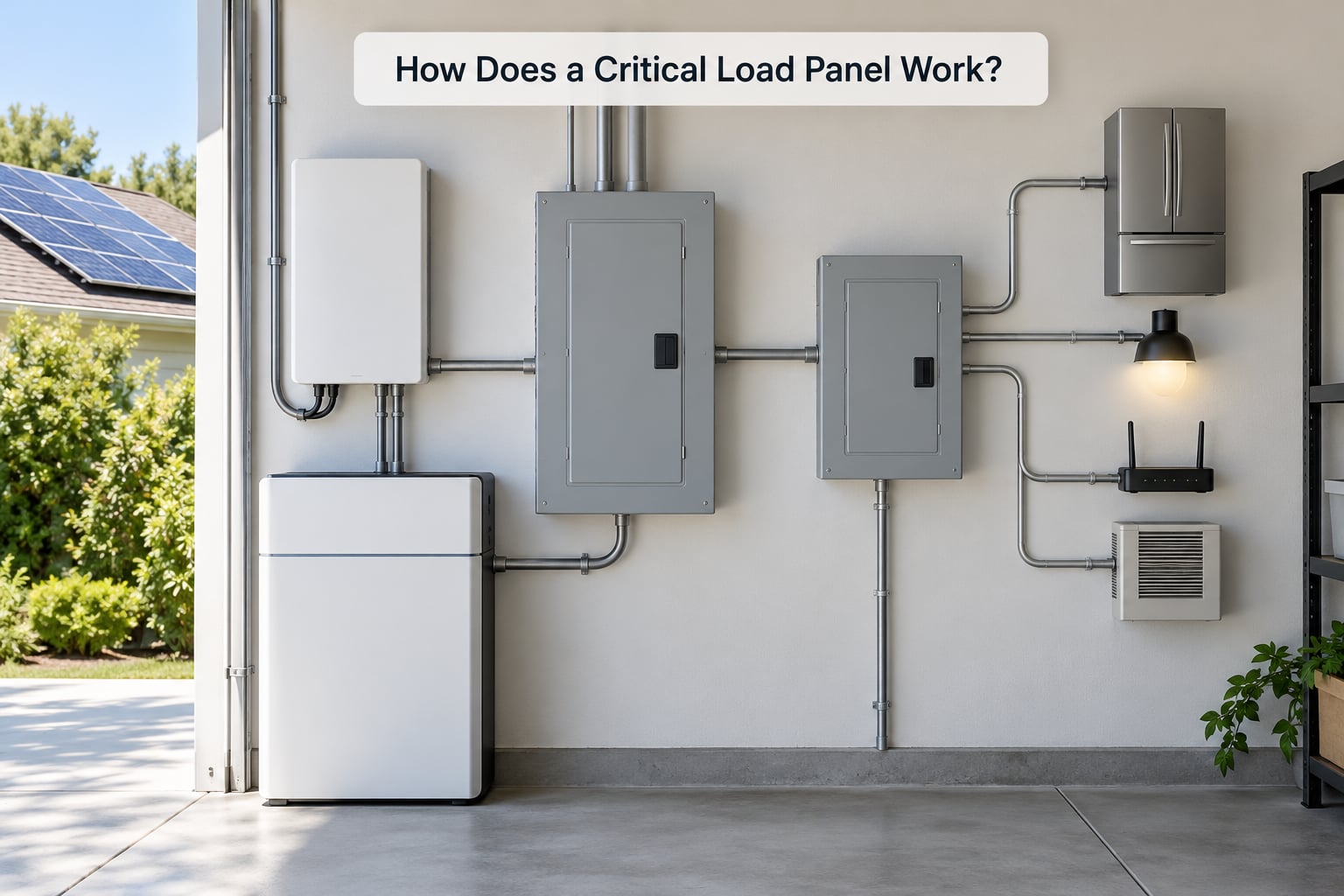
The power path is short and worth memorizing, because most confusion about these systems comes from not knowing where the cutoff sits.
Grid / utility meter
        |
        v
[ Main panel ]  <-- everything NOT in the subpanel lives here
        |
        |  (transfer device / inverter opens here)
        v
[ Critical load subpanel ]
        |
        +-- fridge
        +-- freezer
        +-- internet router + modem
        +-- essential lighting
        +-- sump pump
        +-- selected receptacles
During normal operation, the utility feeds everything. The inverter’s transfer device sits closed and passes grid power through to the main panel.
When the grid fails, here is the sequence most systems follow.
- The utility feed goes dead, and the inverter detects the loss of grid voltage within a second or two.
- The transfer device opens the connection between the battery and the main panel. This is the anti-islanding step that protects utility workers and keeps two power sources from ever fighting on the same wire.
- The inverter forms a closed loop around itself and the critical load subpanel only.
- The subpanel’s circuits come back on, typically in well under a second, so a computer or router rarely notices.
- The battery discharges to serve those loads, and any connected solar begins topping the battery back up during daylight.
- When the grid returns, the transfer device waits for stable utility power, then closes and hands control back.
Everything wired outside that subpanel stays off for the duration. Homeowners regularly describe this on solar forums as the surprise of the whole experience, and they are usually surprised in the same way.
What Is a Critical Load Panel Used For?
It is used to run a short, deliberate list of loads through a long outage without draining a battery meant for a few hours. The test is simple: would you be genuinely stuck without it, or would you merely be annoyed?
Loads Most Homeowners Put on the Panel
- Refrigerator and freezer, which is the reason most people build one at all
- Internet modem, router, and the network gear that keeps a home office running
- One or two lighting circuits, rather than every fixture in the house
- Sump pump in basements that flood, and well pump if your water comes from a well
- Furnace or gas furnace blower, so heat ignition and venting work on a cold night
- Medical equipment such as an oxygen concentrator, or a powered wheelchair charger
- Security system, alarm panel, and internet-connected cameras
- Chargers for phones, laptops, and a baby monitor
Loads That Should Stay Off
| Load | Typical running draw | Why it usually stays off |
|---|---|---|
| Central air conditioner | 2,000 to 5,000 W | Enormous surge; a small battery cannot start or sustain it |
| EV charger | 2,400 to 11,000 W | Acts like a small heater and empties a battery in hours |
| Electric water heater | 3,000 to 5,000 W | Long recovery time makes it a poor use of stored energy |
| Electric range and oven | 2,000 to 4,000 W | Not a survival load, and it needs the most energy |
| Dryer and resistance heat | 1,500 to 5,000 W | Comfort loads, and a heat pump often covers heating instead |
| Pool and spa pumps | 1,500 to 3,000 W | Long-running motors that drain capacity for little benefit |
| Power tools and welders | Varies widely | High surge; run them from a generator instead |
Solar forum users run into the same trap repeatedly. In the abstract, central air sounds essential, and then a heat wave arrives and the choice becomes obvious. People on prepper forums land in a similar place, keeping the well pump in mind and explicitly dismissing the television.
How Is It Different From a Regular Electrical Subpanel?
A regular subpanel simply extends the building’s wiring to a second group of breakers. It carries grid power forever and has no idea an outage exists. A critical load subpanel is wired and controlled so that a battery can become its only source, which changes what it can do and what it must be built to handle.
| Feature | Critical load panel | Whole-home backup | Portable generator with transfer switch |
|---|---|---|---|
| What stays powered | A chosen list of circuits | Most or all circuits | Whatever you plug in, or the whole house with a larger switch |
| Typical runtime on one home battery | Often 1 to 3 days of essential use | Roughly 1 to 3 hours of full-house use | 8 to 20 hours per tank depending on load |
| Switchover speed | Instantaneous, well under a second | Instantaneous | A few seconds, or longer with a manual start |
| Refuel or recharge | Solar or utility power once the grid returns | Same | Gasoline or propane, stored on site |
| Outdoor carbon monoxide risk | None; equipment is indoors | None | Real, and the reason fuel storage and placement matter |
| Install complexity | Moderate; needs permits and utility coordination | Higher; may need a service upgrade | Simple, but a licensed electrician is still required |
| Ongoing upkeep | Monitoring app and firmware updates | Same, at larger scale | Oil changes, fuel treatment, seasonal tests |
One sentence captures the difference that matters most when a salesperson uses the phrase whole-home backup: whole-home backup means every circuit has access to power, not that it will receive power.
Panel size is not the limiting factor here, and this trips people up. Opening a few empty spaces in your main panel does not create spare service capacity, and a main panel upgrade is a separate and much larger job than adding a critical load panel.
Does a Critical Load Panel Work With Solar Power?
Yes, and the pairing is where the real value sits. Solar is what turns a fixed runtime countdown into something that can last as long as the weather holds.
With grid power on, the array charges the battery and the house runs on a mix of both. During an outage, the battery serves the critical load panel alone until it reaches its reserve threshold, and then any generation the panels produce in the morning flows straight into the loads instead of into an empty battery. Users describe that combination, rather than the battery size alone, as the reason their setups lasted for days.
Two limits are worth stating plainly. First, solar alone will not operate the panel during an outage. Panels make DC power, the grid outage tells the equipment to shut down for safety, and most installations need a battery between them. Second, the inverter has to be one that is listed for this kind of islanded backup operation. A grid-tie inverter that cannot form an island simply will not do the job, no matter how much sun hits the roof.
A few systems also let you define the critical load group in software inside the inverter rather than only in a physical panel, and some smart panels switch individual circuits on and off to stay inside a power limit. Both are legitimate approaches, and both are worth asking about.
How Many Watts Should a Critical Load Panel Support?
There is no universal panel size, and any quote that arrives without a load list is a guess. The honest method starts with your own circuits, not with a battery model.
First, the distinction that decides everything: kW is power, the rate of electricity flowing right now, while kWh is energy, the total a battery can hand out over time. A load that needs 3 kW to run can be fine for ten hours on a 10 kWh battery and useless on a 2 kWh one. Plenty of people buy capacity and then discover their loads never start.
Second, separate continuous loads from surge loads. A refrigerator compressor, a sump pump, and a router all draw steady power once running. A pump motor, a compressor, or anything with a compressor needs a much higher momentary output to start. Inverter output is usually rated for continuous power, and surge capability is a separate number that matters more than people expect.
Third, build the list. Walk your panel with a flashlight and a notebook, turn each breaker off one at a time, and write down what goes dark. Label everything as you go. This one afternoon of work produces a better list than any generic article, and it is the answer to the most common question homeowners ask, which is how do I know which circuits are already on the critical load panel.
Then add it up and compare the total against the inverter’s continuous rating, the battery’s usable output, and the amperage of the subpanel feed. Leave a margin rather than sizing to the exact last watt, because motors age and startups vary.
Rough illustration of why the same battery behaves so differently:
| Scenario | Approximate running load | Realistic runtime on a 13.5 kWh battery |
|---|---|---|
| Critical loads only: fridge, freezer, router, lights, sump pump | 200 to 400 W | 24 hours or more |
| Critical loads plus a heat pump or well pump running steadily | 1,000 to 1,500 W | 8 to 12 hours |
| Whole-home usage during an evening | 4,000 to 7,000 W | Under 2 hours |
Reserve percentage and storm mode are two levers worth knowing about. Setting a reserve floor means the battery holds energy back rather than draining to empty, and storm mode temporarily raises that floor when severe weather is forecast.
How Is a Critical Load Panel Installed?
This is a licensed electrician’s job in every jurisdiction that matters, and the sequence below describes the architecture rather than a set of instructions. Do not attempt these connections yourself.
- Load inventory. Decide the circuit list before anything else, using the walk-the-panel method above.
- Service inspection. The electrician checks the main panel rating, available breaker spaces, the feeder route, working space, and whether a service upgrade is needed. Many discoveries happen here.
- Panel selection. Size the subpanel to the load list and the feed, and confirm clearances and working space at the chosen location.
- Permit. The local authority having jurisdiction reviews the plan. Residential electrical permits are routine, and skipping one is a resale and insurance problem later.
- Utility coordination. Grid-interactive systems usually need interconnection approval and possibly a utility upgrade before the equipment is energized.
- Installation. Shutoff, lockout and verification of a dead system come first. Then the subpanel feeder, the branch circuits moved or added, the inverter and transfer device connections, grounding and bonding, and permanent circuit labels.
- Commissioning. The electrician tests the transfer behavior, verifies the island forms correctly, confirms no unintended backfeed path exists, and walks you through the monitoring app.
One question on forums comes up more than any other, so here is the plain answer: you can add a circuit later. A critical load panel installed today is not a one-time decision, because the subpanel can be expanded with additional circuits up to its rating as long as the inverter and battery can carry them. The capacity to grow is worth confirming before the first install, since some feeders are sized with no room to increase.
Single point of failure is the other common worry. If the inverter or transfer device fails, the whole critical load panel goes dark, even though the rest of the house was fine before. That is true of every islanded system, and it is the argument for keeping a modest generator or a well-planned manual option in the back pocket for long multi-day events.
What Safety and Code Questions Should Homeowners Ask?
Ask these before signing anything.
- Who pulls the permit, and does the local authority having jurisdiction require a plan review?
- Is the interconnection application filed with the utility, and is approval required before commissioning?
- Are the inverter, transfer device, and panel all listed equipment for this service?
- How is the subpanel feed grounded and bonded, and how is the neutral handled between main and subpanel? This is the single detail that DIY forums argue about most, and it is not a place to improvise.
- Is any breaker backfed, and how is the bus handled to prevent parallel power paths?
- What is the working clearance around the panel, and will anything need to be relocated?
- Who commissions the system and demonstrates an actual outage test?
Two errors cause most failed inspections. Backfeeding a breaker without understanding the bus configuration, and treating the neutral and ground bonds as if they belong together in both panels. Both are genuine hazards and both get caught.
Get an itemized quote that lists the subpanel as its own line. Homeowners report installers burying that line item and leaving the partial versus whole-home conversation until after the signature, which is the single biggest source of buyer’s remorse in this category.
Frequently Asked Questions
Do I need a critical load panel if I already have solar?
Only if you want battery backup. Solar alone sends power to the grid and stops during an outage. A battery with an inverter that is listed for islanded operation is what keeps circuits alive, and a critical load panel is how you tell that battery which circuits to serve. Without a panel, the alternative is a smart relay panel or a load-managed setup.
Can a critical load panel be added after the battery is installed?
Yes, in most cases, as long as the inverter can form an island and the planned location and feeder route were thought about ahead of time. It needs its own permit and utility coordination where the system is grid-interactive, and the added circuits must stay within the inverter’s continuous output. Adding it later is a normal retrofit, not a rebuild.
How long can a critical load panel run on one home battery?
On essential loads such as refrigeration, internet, a few lights, and a sump pump, a typical home battery often runs well over a day, and much longer when solar is replenishing it. Run the same battery against whole-house usage and you get roughly one to three hours. The difference comes from keeping high-draw loads off the panel, not from the battery itself.
Do I need a licensed electrician to install a critical load panel?
Yes. The subpanel feeder, grounding and bonding, transfer device, and inverter connections are all live work on energized service equipment, and they require a permit and inspection in nearly every jurisdiction. Homeowners can do the planning work, including the load inventory and the circuit list, and then hand the electrical scope to a licensed professional.
What is the difference between a critical load panel and a generator interlock?
They solve related but different problems. A critical load panel groups the circuits a battery should serve. A generator interlock prevents a portable generator from feeding the main panel at the same time as the utility, which is a safety mechanism. You can use either alone, and many households end up with both, since a generator covers what a battery cannot reach.
Is a critical load panel better than a generator for backup power?
For short and medium outages, a battery with a critical load panel is quieter, needs no fuel handling, starts instantly, and keeps running as long as the sun does. A generator lasts as long as its fuel, can run far heavier loads, and still works in a week of cloudy weather. Many homeowners end up pairing the two, using the battery first and starting the generator when the outage runs long.
Conclusion
A critical load panel is a modest box with an outsized job: it decides which parts of your house survive an outage, and it does so without adding any power of its own. Get the circuit list right, size it to the inverter and battery you actually have, and it turns a small battery into something usable for days instead of hours.
Start with three steps. Walk your panel and write down what you would genuinely miss, then keep central air, water heating, EV charging, and laundry off that list. Confirm the inverter and panel are listed for islanded backup before you buy anything. Then bring the finished list to a licensed electrician, along with questions about permitting, utility interconnection, and how much room the subpanel has to grow later.