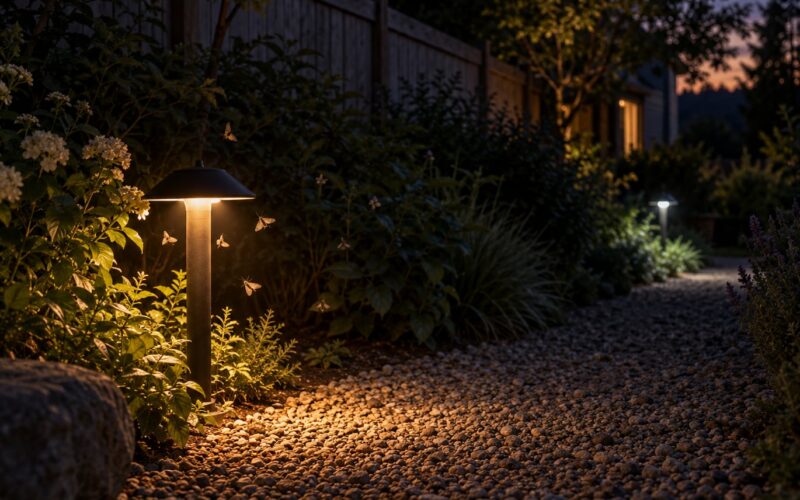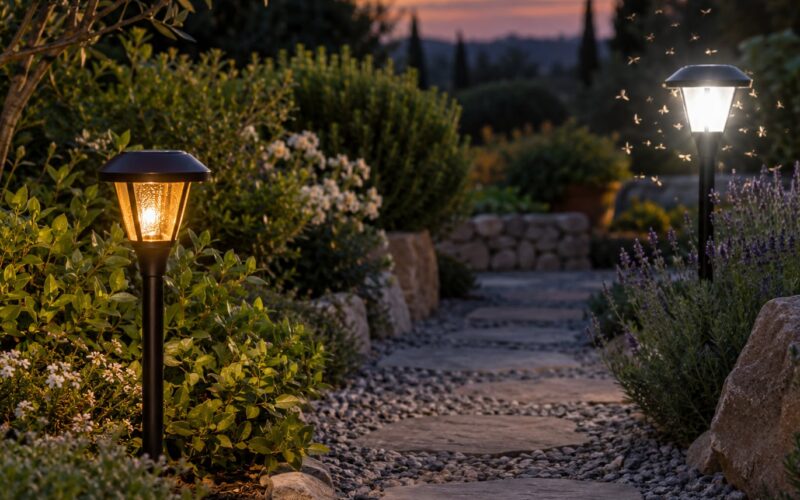
A photocell in outdoor lighting is a small light-sensitive sensor that measures the ambient light around a fixture and switches the lamp on at dusk and off at dawn. It is the part that lets a garden, pathway or parking lot light run itself without a timer or a switch.
Most of the time it is a cadmium sulfide photoresistor behind a small lens, often called a photocontrol, dusk to dawn sensor or light sensor. It does not make electricity and it is not a solar cell. It simply changes its resistance as the light level changes, and a small circuit reads that change.
If a light is stuck burning through the afternoon, the photocell is the first thing to check. If it never comes on at night, the same. Below is what the sensor actually does, what the different types look like, and how to test one in a couple of minutes with nothing but a piece of tape.
Table of Contents
- What Is a Photocell in Outdoor Lighting?
- How Does a Photocell Detect Darkness?
- What Is the Difference Between a Photocell and a Motion Sensor?
- What Are the Common Types of Photocells?
- By sensing element: cadmium sulfide and silicon
- By connection: wire-in, twist-lock and Zhaga
- By how the switching is configured
- How Do You Choose a Photocell for Outdoor Lighting?
- Why Might a Photocell Not Work?
- Frequently Asked Questions
- How do you know if a photocell is bad?
- How do I replace a photocell sensor?
- What is the lifespan of a dusk to dawn sensor?
- Why does my outdoor light stay on during the day?
- Do solar garden lights need a photocell?
- Conclusion: Start With the Sensor and the Location
What Is a Photocell in Outdoor Lighting?
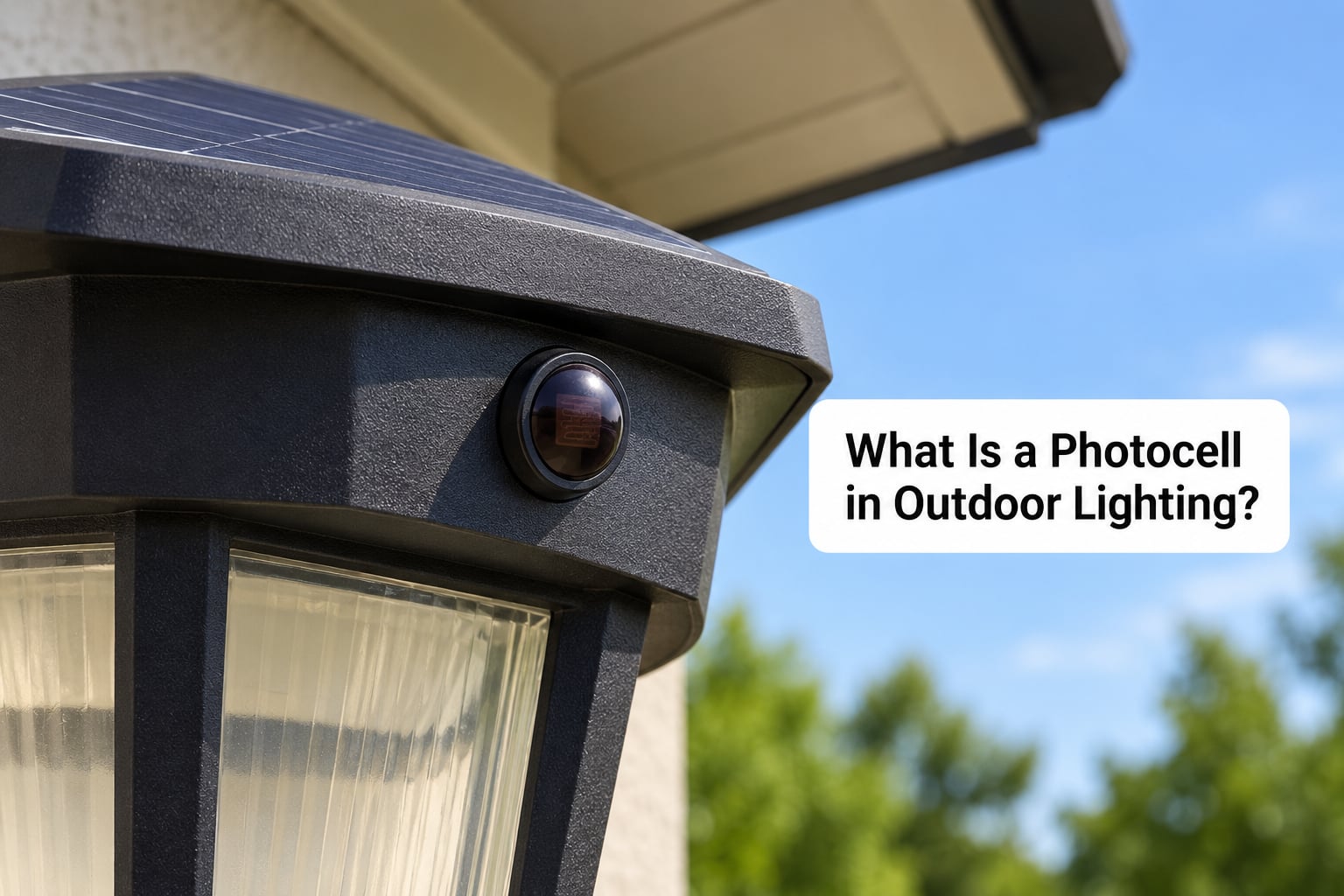
Put simply, a photocell is an automatic light switch for an outdoor fixture. It senses the light level, compares it to a set threshold, and opens or closes the circuit that feeds the lamp.
It is different from the lamp itself. The lamp is the light source; the photocell is the decision-maker. That distinction matters when something goes wrong, because a dead bulb and a dead photocell look identical from the sidewalk at night.
It is also different from the three other things people confuse it with. A motion sensor reacts to movement, not to darkness. A timer runs on a clock you set, so it drifts out of step with the seasons. A dusk to dawn control is usually a photocell, so the two terms often describe the same thing from different directions.
The confusion starts with the word cell. A photocell is not the photovoltaic cell in a solar panel. A photovoltaic cell generates electricity from light. A photocell senses light and resists or passes current differently depending on how much light hits it. Sensors and generators are different jobs, and swapping one for the other is a common source of confusion in popular writing.
How Does a Photocell Detect Darkness?
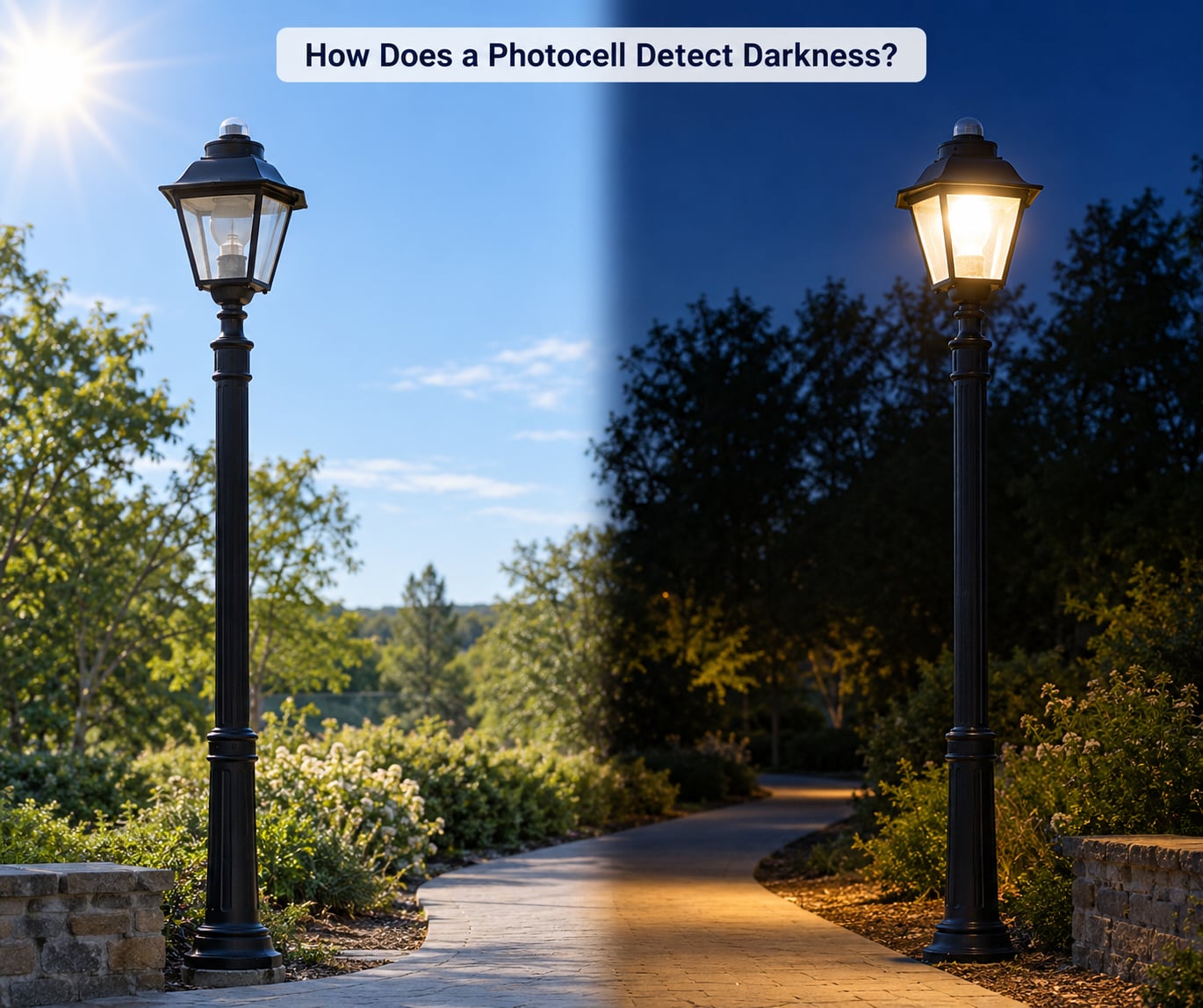
A photocell detects darkness by measuring resistance, not brightness. The active element is a light-dependent resistor, and its job is simple: less light means more resistance, more light means less resistance.
That change happens continuously, in the same way a squinting eye notices a darkening sky. A control circuit inside the sensor watches that resistance and compares it to a threshold. Cross the threshold and the circuit changes state. That is the entire decision.
Here is the sequence in practice:
- Daylight hits the sensor. The photoresistor’s resistance falls, and the control circuit holds the lamp in its open state, meaning off.
- Light fades through dusk. The resistance climbs past the switch point.
- The circuit energises a relay, an electromechanical or solid-state switch, and the relay closes the line to the fixture. The lamp comes on.
- Dawn arrives, the resistance falls again, and the relay releases. The lamp goes off.
So the sensor switches the light both ways. In outdoor fixtures it is the same sensor that turns the light on at night and off in the morning, which is why a stuck-on light and a stuck-off light are two symptoms of the same part failing in opposite directions.
One more detail explains the flickering people sometimes report. A sensor with a narrow switch point would chatter on and off around sunset as the light hovers at the threshold. Most photocells add a hysteresis delay, a few minutes of memory that requires the light to move a good distance past the threshold before switching. Without it, a light on the edge of a tree’s shadow could cycle all evening.
Many photocells also let you set that threshold with a dial, a trim screw or a small switch. The labels are usually a moon for turning on later and a sun for turning on earlier, and the adjustment covers everything from deep shade under a canopy to a spot in full sun.
What Is the Difference Between a Photocell and a Motion Sensor?
A photocell reads the light level. A motion sensor watches for movement, usually by microwave, infrared or a combination. A well-lit path rarely needs a photocell, and an empty path rarely needs a motion sensor. Most outdoor installations end up using one, the other, or both together.
| Control type | What it reacts to | Best for | Watch out for |
|---|---|---|---|
| Photocell | Ambient light level | Garden beds, pathways, driveways, street-style fixtures that should run all night | Light leaking from the fixture’s own lamp onto the sensor |
| Motion sensor | Movement in the detection zone | Back doors, side yards, porches, low-traffic corners | Detection zone too narrow, or too wide and triggering off the road |
| Timer | Clock schedule | Signs, shopfronts, decorative lights on a fixed routine | Drifts with the seasons, so it drifts in summer and winter |
| Photocell plus motion sensor | Light level, then movement | Driveways and side paths where you want light only when someone walks up | Two failure points instead of one, and possible cycling when the two disagree |
| Smart or wireless control | Schedule, app, or network signal | Systems where you want remote control, dimming or usage reporting | Setup cost and dependence on the network rather than the wiring |
On a path, a photocell gives you a quiet, constant glow that turns itself off at dawn. In a driveway, a motion sensor gives you a bright burst of light only when a car arrives, which saves more power and reduces how much of the night your neighbours see lit.
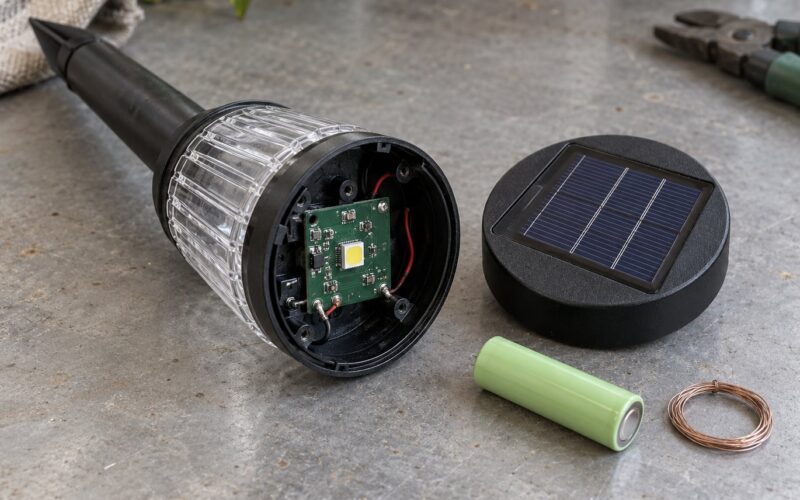
That combination is worth explaining for solar fixtures. A solar garden light charges a small battery during the day and needs that battery to last the night. Its photocell switches the lamp off the moment the panel detects daylight, so the lamp does not keep running through the following afternoon and draining the charge it depends on.
Under a tree canopy or deep under an eave, though, that same sensor may never see a bright enough day. Solar light owners report batteries that look dead after a night or two, when the real problem is that the lamp stayed lit long after dusk because it never got a clear signal that the sun was up.
What Are the Common Types of Photocells?
Photocells come in two layers of variation: what senses the light, and how the sensor connects to the fixture. Homeowners mostly need to care about the second layer, but the first one explains why two lamps behave so differently.
By sensing element: cadmium sulfide and silicon
Cadmium sulfide, or CdS, is the traditional choice. It responds slowly and gradually, which suits a simple on-off relay. It is inexpensive, widely stocked and works fine for anything that just needs to switch at dusk.
Silicon photocells react faster and hold a more consistent calibration, so they are used where dimming, adaptive output or precise control matters. They cost more and the difference is invisible on a basic path light.
Photodiode-based sensors sit at the fast, accurate end of the range and are common in photocells that dim rather than simply switch.
By connection: wire-in, twist-lock and Zhaga
Wire-in photocells have two leads and a screw terminal or a junction box. They are the standard choice for a fixture that is already wired, and replacing one means opening a box and matching two conductors.
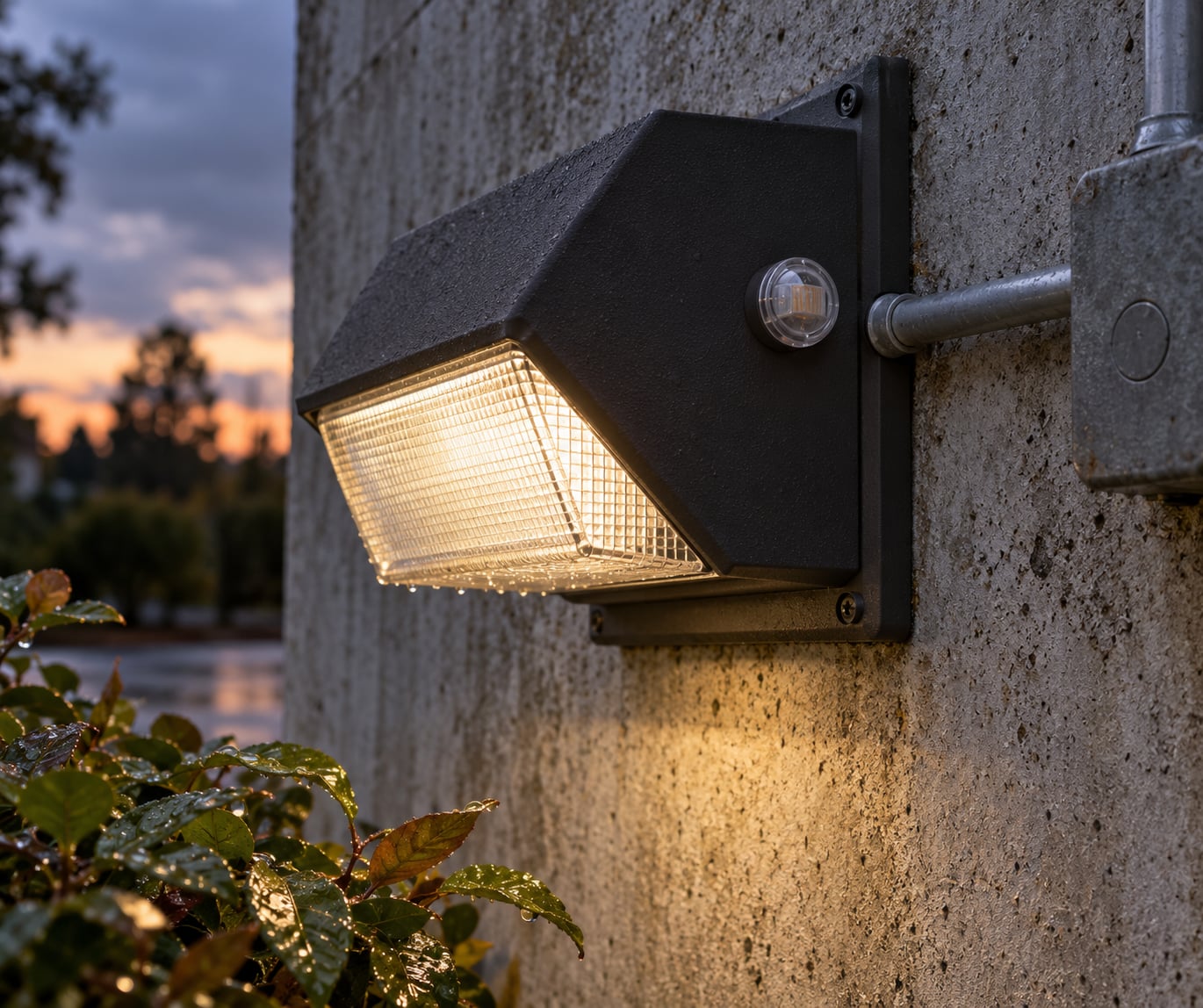
Twist-lock photocells plug straight into a socket on the outside of the fixture, usually with two pins and a quarter-turn lock, following the ANSI C136.10 pattern. This is the format most homeowners meet on wall packs, barn lights and pole fixtures, and it makes replacement a two-minute job with no wiring at all.
Zhaga Book-18 sockets are a standardised receptacle designed so that sensors and other control modules from different manufacturers can be swapped in the same fixture. If your fixture has a Book-18 socket, the sensor is no longer tied to the brand of the light.
By how the switching is configured
Built-in dusk to dawn sensors sit inside the fixture, usually behind a small dark window on the top or side. Nothing to wire, nothing to lose. If that sensor fails, the whole fixture usually gets replaced.
Adjustable photocells add the threshold dial, so you can set the lamp to come on earlier or later than the factory default. Useful under an eave or beside a wall that shades the sensor.
Switched or latching photocells are the style you can override. A small switch or tab on the sensor lets you force the light on regardless of the ambient level, which is handy when you are working on the fixture after dark.
For anything permanently installed, check the enclosure rating. Outdoor photocells are commonly marked to an IP65 or higher ingress rating, meaning they are dust tight and protected against water jets, and a UL listing such as UL 773 is the usual mark of an evaluated switching device.
How Do You Choose a Photocell for Outdoor Lighting?
Choose the sensor after you look at the location, not before. Most photocell problems come from a perfectly good sensor installed in the wrong spot.
Check the sky view first. The sensor needs an open view of the sky so it can tell bright day from dusk. Under a tree, beneath a deep eave or right against a light-coloured wall, it reads darker than the actual sky and switches on later than you want.
Look for light falling back onto the sensor. This is the number one reason an outdoor light stays on all day. The lamp’s own output, or a neighbouring fixture or a streetlight, reaches the sensor and keeps it in daylight mode. On a wall pack, a small shield or a spacer that moves the sensor out of the fixture’s own beam is often the whole fix.
Match the connection format to the fixture. Look at the socket on the fixture rather than the label. Two pins that turn and lock means a twist-lock sensor to the ANSI C136.10 pattern. Two loose leads going into a box means a wire-in model. A Book-18 socket takes a Book-18 module and nothing else.
Check voltage and load capacity. Household fixtures sit around 120 volts in North America, and the sensor has to be rated for the load as well as the voltage. Under-wattage sensors fail early, and LED drivers in particular want a sensor that tolerates their switching behaviour.
Look for the outdoor rating. A weatherproof housing, a sealing gasket and a UV-stable lens matter more than the brand name. The sensor is exposed all year, and clear lenses yellow and cloud over time, which pushes the threshold around without anyone noticing.
Decide whether you can adjust the threshold. If the fixture sits in partial shade or the path is beside a neighbour’s bright window, an adjustable sensor saves you from rejecting lamps until one happens to suit.
Follow the manufacturer’s instructions. Wiring a photocell is mains electricity. Turn the power off at the breaker, confirm the circuit is dead with a tester, and never work on a pole-mounted or street-side fixture. Those need a licensed electrician, both for safety and for code reasons.
Why Might a Photocell Not Work?
A light that stays on all day is rarely a dead sensor. It is far more often a sensor that is still receiving light, or a lens that has become opaque. Work through these in order, cheapest and most likely first.
- Clean the lens. Dirt, dust, pollen and water spots all cut the light reaching the sensor and make it behave as if it were darker than it is. A soft cloth and a little water is step one in most manufacturer troubleshooting guides, before any electrical diagnosis.
- Cover the sensor with opaque tape or a dark cloth and wait. This simulates night with no tools. If the lamp comes on within a minute or two, the fixture, the relay and the wiring are working, and the sensor itself is the problem. If nothing happens, the fault is downstream: the lamp, the driver, the switch or the supply.
- Watch for light leaking onto the sensor. Check whether the lamp, an adjacent fixture or a streetlight illuminates the lens after dark. A slight lip or a shield between the sensor and the lamp is a quick test.
- Check the adjustment dial. A dial nudged toward the sun side makes the sensor demand brighter light before it will switch, so a lamp on the correct schedule may not come on until well after dark.
- Look for corrosion or a chewed cable. Wall pack fittings and pole bases collect water. Green or white crust on the terminals, or a cable damaged by a mower or a rodent, will stop a good sensor from ever getting its signal through.
- Check the override switch. Many photocells have a tab that must be in the automatic position. A sensor left switched off will never respond to light at all.
Flickering points somewhere else. A light that cycles rapidly is usually the interaction between a photocell, a motion sensor and a dimmer all disagreeing about the state of the night, or a failing driver rather than a failing sensor.
For a solar garden light, add one more check. A panel that has lost its charge, or a photocell buried in shade, will leave you with a lamp that glows faintly for a few hours after dusk. Move the lamp into open sun and let the panel charge fully for several clear days before deciding the panel has failed.
And if the cover-the-sensor test turns the light on but the lamp then refuses to switch off at dawn, the sensor is failing in the other direction. That is a failed sensor, and the replacement is usually a part rather than a fixture.
Frequently Asked Questions
How do you know if a photocell is bad?
Cover the sensor completely with opaque tape or a dark cloth and wait a minute or two. If the light comes on, the fixture, relay and wiring are fine and the sensor has failed. If nothing happens, the problem is the lamp, the driver, the switch or the supply, not the sensor. Clean the lens with a soft cloth before you test, because dirt alone can hold a light on all night.
How do I replace a photocell sensor?
For a twist-lock sensor on a wall pack or pole fixture, switch the breaker off, confirm the circuit is dead with a tester, unscrew the old sensor a quarter turn, and pull it straight out. Match the new sensor to the socket pattern, seat it and turn until it locks. Wire-in models need a junction box opened and two conductors matched. Street-side and pole-mounted fixtures need an electrician.
What is the lifespan of a dusk to dawn sensor?
A good quality photocell on a residential fixture typically runs for many years before it needs attention, and the limit is usually the clear lens rather than the electronics. Dust, pollen, water spots and UV yellowing build up gradually and shift the threshold, so cleaning twice a year often extends the working life of a sensor considerably. Expect to replace the sensor more often than the fixture itself.
Why does my outdoor light stay on during the day?
In most cases the sensor is receiving light it should not be. The lamp’s own output, a neighbouring fixture or a streetlight can reach the lens and hold it in daylight mode, and a dirty or clouded lens makes the same thing happen. Cleaning the lens is the first fix. If it persists, add a shield or spacer between the sensor and the lamp. Only then suspect a failed sensor.
Do solar garden lights need a photocell?
Yes, and it matters more than it looks. A solar lamp stores energy in a small battery during the day and needs it to last the night, so its photocell switches the light off as soon as the panel sees daylight. Without that cut-off the lamp runs into the afternoon and drains the charge. The failure mode to watch for is a lamp under deep shade or a heavy canopy that never sees bright enough daylight to switch off.
Conclusion: Start With the Sensor and the Location
Work out whether the fixture actually needs a light sensor before buying anything. A path that should glow all night wants a photocell, and a driveway that should light only when a car pulls in usually wants a motion sensor or both together.
Then look at where the sensor sits. It needs a clear view of the sky and no light falling back onto it from the lamp or a neighbour. Get those two things right and most photocell complaints disappear before a part ever gets ordered.
When something does misbehave, clean the lens, then run the cover-the-sensor test. It takes a minute, costs nothing, and tells you whether you are chasing the sensor or the fixture. Follow the wiring instructions for whatever you find, and hand anything on a pole or over a driveway to a licensed electrician.