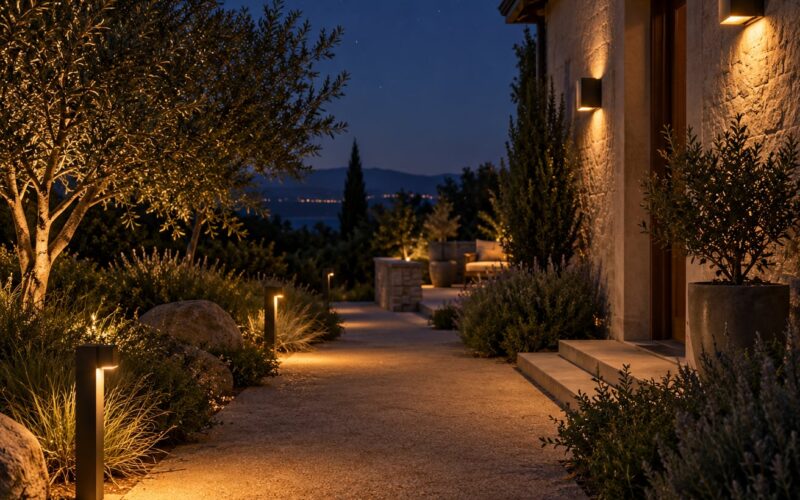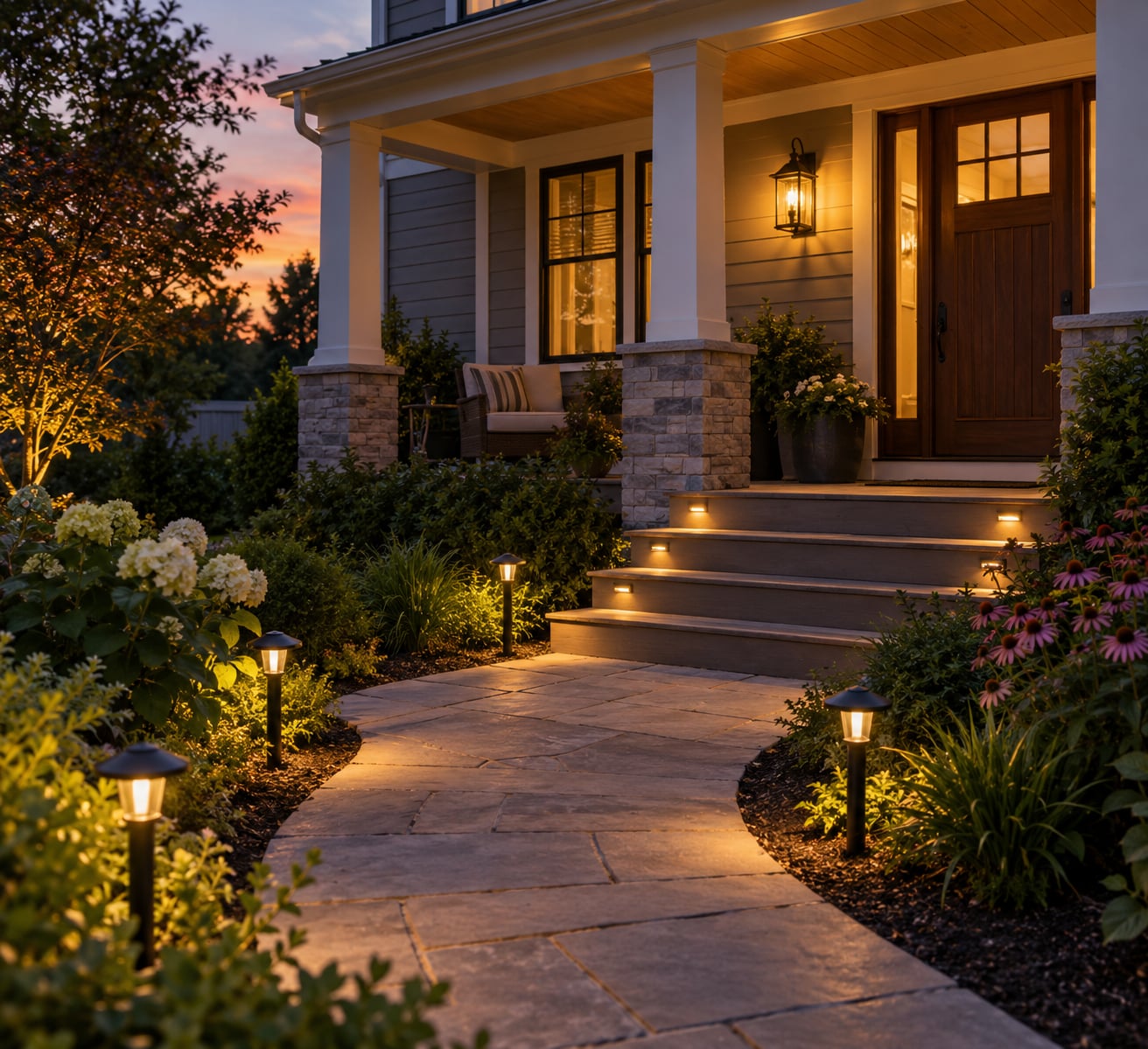
How to light a front porch comes down to three layers of light, not one bright bulb: an entry fixture at the door, downward light on the steps and walkway, and a small accent aimed at the columns or landscaping. Start by walking the porch after dark, mark the dark spots, then match fixtures to each zone.
Most people get the brightness roughly right and the aim completely wrong. A single uncovered bulb over the door washes out the steps, glares into the eyes of anyone coming up the walk, and spills light across the neighbor’s fence. Layered lighting fixes that, and it costs nothing extra to plan it properly.
A word on scope before we start. Anything involving new wiring, a new electrical box, or a circuit change belongs with a licensed electrician. Swapping a bulb or adding a solar or battery fixture does not. This guide covers both, and says clearly where the line sits.
Table of Contents
- What You Need
- How to Light a Front Porch Step by Step
- Assess the porch and identify dark areas
- Choose a layered lighting arrangement
- Select outdoor-rated fixtures and bulbs
- Install and connect the lighting safely
- Add controls and test the result
- Common Mistakes
- Safety and finishing tips
- Frequently Asked Questions
- Do I need an electrician to install a porch light?
- How can I light my porch without electricity?
- Are you supposed to leave your front porch light on all night?
- What color porch light attracts cops?
- How bright should a porch light be?
- Are solar porch lights bright enough?
- Conclusion
What You Need
The list here is mostly decisions rather than tools. Measuring before shopping saves the annoying trip back to the hardware store with the wrong backplate.
- Measurements. Porch width, depth, ceiling height, and the length of the walk from the curb or driveway to the door.
- A tape measure and a step stool so you can eyeball mounting height before you climb anything.
- Fixture type decided in advance — wall sconce, pendant, flush mount, path light, or step light. The ceiling height picks this for you more than style does.
- Bulb specifications. Lumen output, wattage, color temperature in Kelvin, and a base type that matches the socket.
- Weather rating. Any fixture exposed to rain or damp air needs a wet-location listing, and IP65 or better is the durability signal worth paying attention to on exposed pieces.
- Mounting hardware matched to the surface — masonry screws for brick or stone, standard screws for wood, and a strap or brace for anything older.
- A non-contact voltage tester and a flashlight if you are touching an existing fixture at all.
- Controls — a photocell for dusk-to-dawn, a timer, a smart switch, or a motion sensor, depending on how the porch gets used.
- A licensed electrician for any hardwired addition, new box, or circuit change.
How to Light a Front Porch Step by Step
Assess the porch and identify dark areas
Wait until it is properly dark, then walk the route from the street to the door the way a guest would. That walk is the actual test, because the things you notice from inside the house in daylight are rarely the things you trip over at night.
Mark four things specifically: the tread edges of each step, the door handle and lock, the house numbers, and the last three feet of walkway before the porch. Railings matter too, since a handrail you cannot see is worse than no handrail.
Then stand back from the street and check for the two problems that cause complaints. Light hitting a neighbor’s window is light trespass, and a bare bulb visible from the road is glare. Both get fixed by aiming down and shielding the source, which is easier to plan now than to correct later.
Choose a layered lighting arrangement
Getting how to light a front porch right is mostly a layering problem, not a shopping problem. Three layers do all the work: ambient light makes the space readable, task light goes where people walk, and accent light draws the eye to the door, the columns, or a plant.
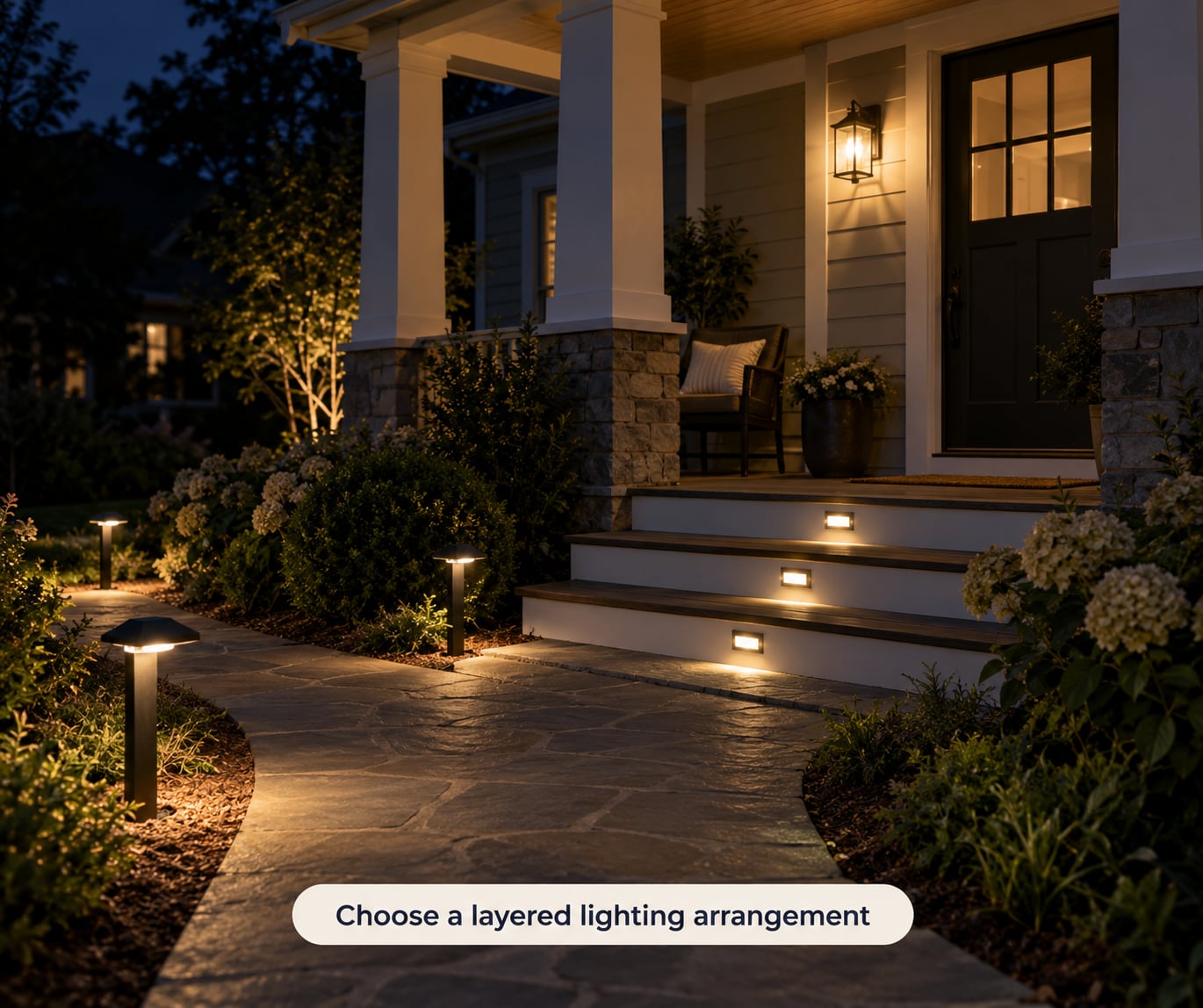
- Ambient: one fixture at the entry — a wall sconce beside the door, a pendant if the ceiling is tall enough, or a flush mount if it is not.
- Task: step lights on the risers or treads, and low path lights along the walkway. These carry the safety weight.
- Accent: a shielded fixture aimed up a column or at the door, kept low in output so it highlights rather than floods.
Fixture choice also decides your power source, and this is where most people rush.
| Approach | Install difficulty | Brightness ceiling | Best for |
|---|---|---|---|
| Line-voltage wired | Needs an electrician for new work | Highest | Covered porches needing reliable light year round |
| Low-voltage wired | Moderate, transformer included | Moderate, spread over many points | Long walks with lots of low-voltage path lights |
| Solar | No wiring, just placement | Lowest, and season dependent | Renters, garden paths, areas away from the house |
Select outdoor-rated fixtures and bulbs
The wet-location label is not negotiable. Anything under a roof edge or in an open porch gets rained on, and a fixture without that rating fails fast.
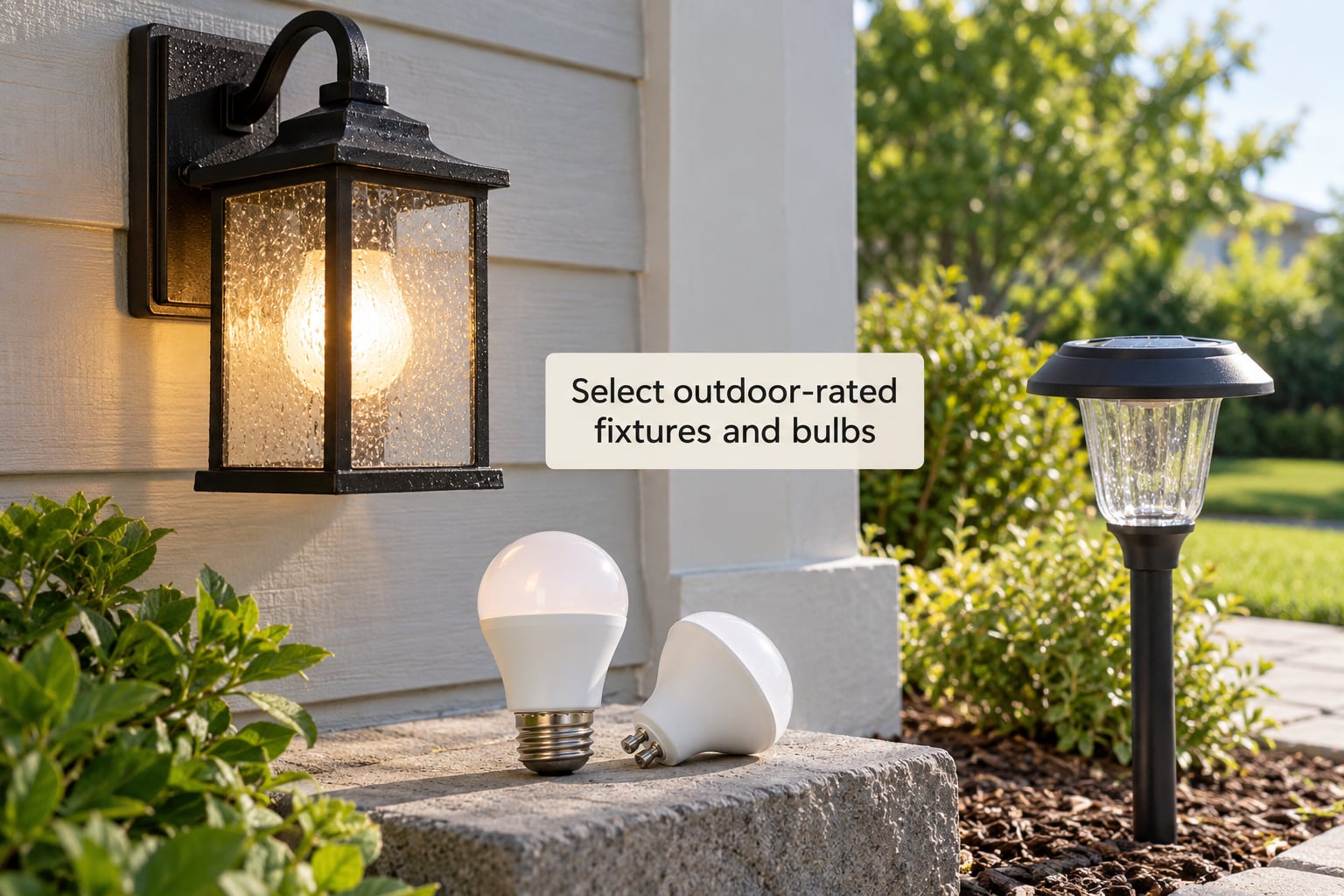
For brightness, work in lumens rather than watts. Legacy advice still talks about wattage, and a 60-watt incandescent bulb produced roughly 800 lumens while a 60-watt LED produces far less light for a fraction of the energy. Sizing by watts alone is how people end up with dim porches.
| Zone | Useful range | Notes |
|---|---|---|
| Step or riser light | 12 to 100 lumens | Anything brighter glares into the face climbing up |
| Pathway | 100 to 200 lumens | Enough to read the ground, not enough to light the street |
| Entry and porch ambient | 300 to 600 lumens | The main fixture, sized to the ceiling height |
| Security or flood | 700 to 1300 lumens | Mounted high and shielded, aimed down |
For a rough total, multiply the porch floor area in square feet by a target of roughly 5 to 10 lumens per square foot for general ambient light, then add the step and path zones separately. A 60-square-foot porch at 8 lumens per square foot lands near 480 lumens for ambient, which is one 500-lumen bulb or two 250-lumen sources spread apart.
On color temperature, warm white is the answer for most homes. Between 2700K and 3000K reads as welcoming and matches wood, brick, and most door finishes, while anything at 4000K and above starts to feel institutional in a residential entry. Keep it consistent across fixtures so the porch does not look patched together.
Two smaller specs worth checking on the box. A color rendering index of 90 or above keeps paint colors and plants looking true rather than washed out, and a narrower beam angle on task lights means less spill onto the property next door.
Install and connect the lighting safely
Start at the breaker, not the fixture. Switch off the circuit, confirm it is dead with a tester you trust, and treat the wiring as live until proven otherwise. Keep one hand out of the box when you probe anything.
Then follow the manufacturer’s instructions exactly. Check that the electrical box is grounded and in good condition, that the box is large enough for the new fixture and its wires, and that any bracket or strap is rated for the fixture’s weight — especially outdoors, where wind load is more than people expect.
Replace an existing fixture yourself if the box is sound, the wiring is in good shape, and the new fixture fits the existing footprint. Anything beyond that — a new location, an extra fixture on the run, a dimmer that needs a neutral wire, a damaged or aluminum branch circuit — is electrician territory. Aluminum wiring in particular deserves a professional.
Add controls and test the result
Controls are what keep a porch lit without wasting energy. A photocell or dusk-to-dawn sensor turns the entry light on at the right moment instead of at a fixed hour. A timer is simpler and works fine on a fixed schedule. A smart switch adds scheduling and remote control if you already run a smart home.
Motion sensing is useful along a side path or a back entrance, less so at the front door where visitors expect a steady welcome. Set any motion range high enough to catch the walkway rather than the road.
For solar fixtures, placement decides success more than the fixture does. Put the panel where it gets several hours of direct sun, tilt it 30 to 50 degrees toward the south if you are in the northern hemisphere, and keep it clear of the porch roof. A panel tucked under an eave will never fully charge, and that is the single biggest reason solar porch lights disappoint people.
Watch for sensor crosstalk too. Many solar lamps switch off when they detect any nearby light, so a bright porch sconce right beside a solar path light can keep that lamp dark all night. Separate them, or use a solar fixture with a light-blocking sensor override.
Then test after dark, walking the same route you marked at the start. Check that every step tread is readable, the numbers are visible from the street, and no fixture is visible as a bare bright dot from a passing car. If a step is still dark, add light there rather than raising the brightness everywhere else.
Common Mistakes
- Using indoor-rated fixtures. A damp location listing is not a wet location listing. Fix: check the label before you buy, not after the first storm.
- Over-bright entry bulbs. One 1500-lumen bulb at the door turns the porch into a parking lot and glares at everyone who approaches. Fix: size to the zone table and spread output across two sources.
- Cool white light everywhere. 4000K and above reads harsh at a front door. Fix: 2700K to 3000K throughout.
- Leaving steps in shadow. The door gets lit, the stairs do not. Fix: step lights on the risers, dimmed to a low output.
- Aiming fixtures at the street. Uplights and uncovered bulbs send light into neighboring windows. Fix: shield the source and angle it down or across the surface you want to highlight.
- Putting solar panels under the porch roof. They will run for a fraction of the night. Fix: full sun, tilted 30 to 50 degrees, or choose a wired fixture.
- Clustering solar lights tightly. Neighboring shades block each other’s panels. Fix: space them so each panel sees open sky.
- Ignoring hardware and sealing. Cheap screws and unsealed boxes fail fast in weather. Fix: exterior-rated fasteners and gaskets matched to the fixture.
Safety and finishing tips
Seal every exterior entry point with exterior-rated sealant or gaskets, and check the caulk lines each season for cracks. Keep fixtures clean; a dirty lens cuts output and makes a good light look weak.
Tie cable runs neatly and keep them off surfaces where water runs. Trim shrubs and planters back so they never press against a fixture or cover a solar panel.
Use the right ladder, on level ground, and never stand on the top two steps. For anything above roughly eight feet or anything involving the electrical panel, hand it to a pro.
Finally, set a small maintenance rhythm. Wipe lenses twice a year, check that step lights still seat firmly, and replace bulbs as a group when one fails so color temperature stays consistent across the porch.
Frequently Asked Questions
Do I need an electrician to install a porch light?
You usually do not need one for a simple like-for-like swap, where the new fixture fits the existing box and the wiring is in good condition. Any new location, extra fixture, dimmer requiring a neutral wire, damaged wiring, or an aluminum branch circuit should go to a licensed electrician. Check local permit rules too, since many jurisdictions require a permit for new outdoor circuits.
How can I light my porch without electricity?
Solar fixtures are the main option, and they work best where the panel gets several hours of direct sun. Place it outside any roof overhang and tilt it 30 to 50 degrees toward the equator. Battery-operated lanterns are a good backup for the entry itself. Keep in mind that solar output drops in winter and under tree cover, so plan a wired fixture or brighter bulb for the door if the walk must stay reliably lit.
Are you supposed to leave your front porch light on all night?
Leaving it on all night is not necessary and wastes energy. A dusk-to-dawn photocell turns it on at sunset and off at sunrise, a timer runs a fixed schedule, and a smart switch lets you control it from your phone. Many people keep a low-output light or a small nightlight on all night for security while the main fixture runs only when it is needed.
What color porch light attracts cops?
No color specifically attracts attention, and a blue-tinted bulb is a poor choice for a home entry. Warm white light between 2700K and 3000K is the most common residential choice and reads clearly at a distance. Visibility comes from brightness, placement, and motion sensing rather than color, so a shielded fixture aimed at the walk is far more effective than any particular bulb tint.
How bright should a porch light be?
Aim for roughly 5 to 10 lumens per square foot of porch floor for ambient light, which usually works out to 300 to 600 lumens for a typical entry. Steps need far less, around 12 to 100 lumens each, while a path needs about 100 to 200 lumens. Multiplying area by lumens per square foot, then adding the step and path zones, gives you a workable total.
Are solar porch lights bright enough?
For path and step lighting, usually yes. For lighting the front door itself, solar rarely matches what a wired fixture delivers. Most solar lamps put out enough light to follow a walkway or see a step edge, and they improve considerably when the panel sits in full sun with nothing shading it. If the entry needs dependable brightness in winter, pair a solar path with a wired or battery entry light.
Conclusion
Start by walking your porch after dark and marking what you cannot see — step edges, the door, the numbers, the last stretch of walkway. Then light each of those zones on purpose instead of hoping one bright fixture covers everything.
Keep fixtures outdoor-rated, size them in lumens rather than watts, aim them down, and set them to warm white between 2700K and 3000K. Add a dusk-to-dawn sensor so the light runs when it is needed and not before. If the job involves new wiring or a new box, have a licensed electrician handle that part. That is how to light a front porch so every zone gets what it needs without sending light next door.