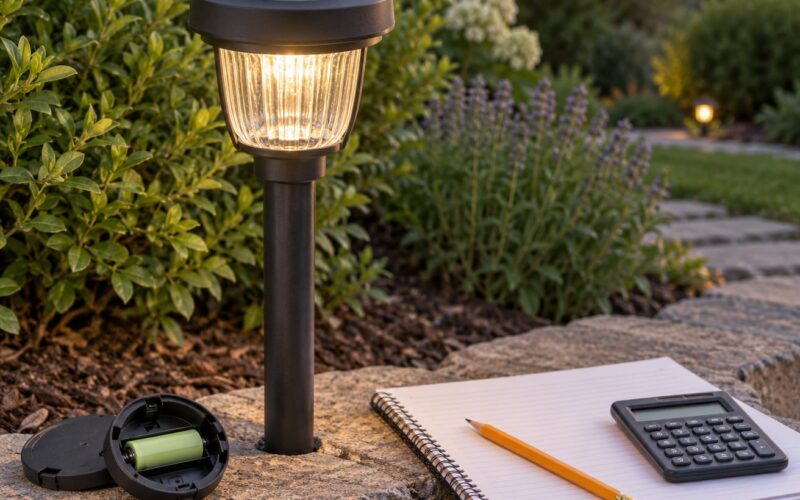
You cannot put a solar light in the household trash, and the reason is one part. The rechargeable battery inside makes the whole light regulated electronic waste, so you open the housing, pull the battery out, send that to a battery drop-off, and route the panel, circuit board, LED and plastic shell to their own streams. The job takes about 15 minutes per light once you know the sequence.
That sequence matters because most people do it backwards. They drop the entire light into a curbside bin, which is exactly the thing that causes recycling truck fires and groundwater contamination. Get the battery out first and the rest becomes ordinary sorting.
At a glance:
- Battery out first, always. It goes to a battery drop-off, never the trash or the curbside bin.
- Solar panel, LED, circuit board and wiring go to an e-waste collection site.
- Clean plastic or metal housing goes into your household recycling if that program accepts the material.
- Tape the terminals on any lithium-ion cell before you store or transport it.
- Nothing gets burned, crushed or buried, and a working light gets donated before it gets dismantled.
Table of Contents
- What You Need
- What Is Inside a Solar Light
- Step-by-Step: How to Recycle Old Solar Lights
- 1. Check the light and local recycling rules before you recycle old solar lights
- 2. Remove the rechargeable battery if the design allows
- 3. Separate the solar panel, circuit board, and other electronics
- 4. Sort glass, metal, plastic, and remaining parts
- 5. Use manufacturer take-back or certified collection options
- 6. Confirm disposal and clean up safely
- Common Mistakes
- Solar Garden Lights Are Not Rooftop Solar Panels
- What Local Rules Actually Prohibit
- Frequently Asked Questions
- Can you recycle solar lights?
- Can I throw away a solar light or put it in the recycling bin?
- How do I remove the battery from a solar light?
- Where can I take old solar lights near me?
- Should I remove batteries from solar lights I am storing?
- Can solar lights be repaired instead of recycled?
What You Need
Gather this before you start, because halfway through a dismantled light you do not want to be hunting for tape.
- A small Phillips and flat-blade screwdriver. Most plastic solar light housings are held with two or three tiny screws under the base or the stake collar.
- Needle-nose pliers or small tweezers. Battery leads in cheap lights are thin and bend easily.
- Cut-resistant gloves and eye protection. Outdoor lights live in soil and grit, and cracked plastic edges are sharper than they look.
- Clear packing tape. For covering the terminals on lithium-ion cells and nickel-cadmium cells.
- Two or three labelled containers. A rigid battery box, a small box for electronics, and your recycling bin. Do not pile the electronics loose into a cardboard box with the plastic.
- A small hardware tray or dish. Screws from eight lights add up fast, and a magnetic tray keeps them out of the vacuum.
- Your local waste rules. Search your city or county waste authority for battery, e-waste and household hazardous waste guidance before you drive anywhere.
If you only have a screwdriver and a pair of gloves, you can still do the whole job. The rest just makes it cleaner.
What Is Inside a Solar Light
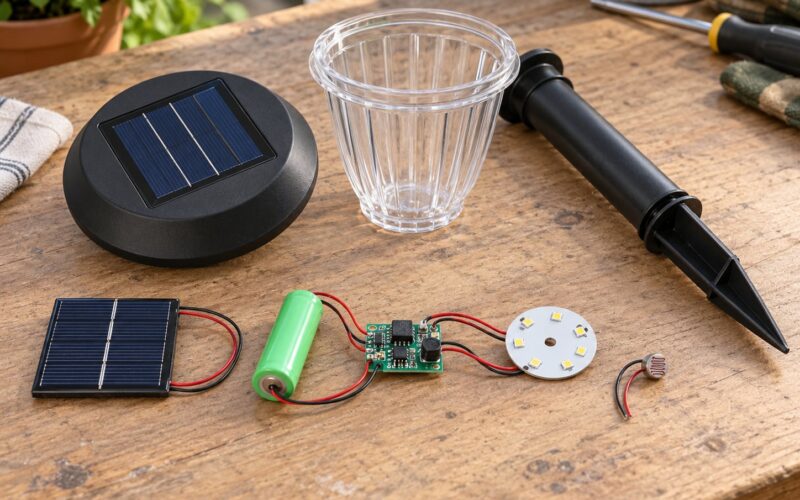
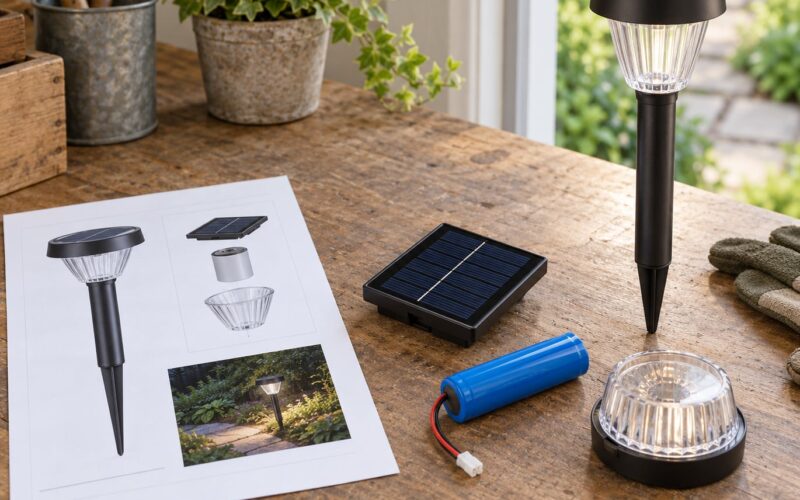
A garden solar light is a small electronic device with a battery in it, and that single fact decides everything about how it gets disposed of. The housing looks like garden decor. Inside there is a rechargeable cell, a charge controller, a light sensor, a photovoltaic panel and an LED, plus wiring tying them together.
- Housing: usually injection-moulded ABS or polypropylene, sometimes with a stainless steel or aluminium stake and a glass or acrylic diffuser.
- Solar panel: a silicon photovoltaic cell bonded to a plastic laminate and framed in plastic.
- Battery: a rechargeable cell, most often a NiMH AA or AAA pack, sometimes NiCd, and in larger fixtures a sealed lithium-ion pack.
- Charge controller and light sensor: a small circuit board that decides when to turn the LED on.
- LED and wiring: the light source, its lens and a couple of thin wire runs.
That last group is the part people forget. The housing can look like clean plastic and pass for a recycling item, but the cell plus the board plus the panel is what triggers the e-waste classification. Take the battery out and you are just cleaning up a small electronic device.
The expected lifespans explain why you are holding a box of them. A NiMH cell lasts roughly two to three years before capacity drops enough that the light stops lighting the path, while a lithium-ion pack more often makes it past five. The LED and the panel are usually still working fine after the battery gives up, which is why a battery swap usually rescues the whole light.
| Part | Typical service life | Worth replacing on its own? |
|---|---|---|
| NiMH rechargeable cell | About 2-3 years | Yes, often rescues the whole light |
| Lithium-ion pack | About 5 years or more | Usually sealed, so replace the whole light |
| LED | 10 years or more | Not worth the effort alone |
| Solar panel | 10-20 years, less if yellowed | Rarely; replace the light instead |
| Housing | Several seasons, faster in full sun | Brittle plastic usually means the end |
Step-by-Step: How to Recycle Old Solar Lights
Work on a well-ventilated outdoor surface or over a newspaper on a workbench, one light at a time. Here is the order that keeps every part in the right place.
1. Check the light and local recycling rules before you recycle old solar lights
Before you touch a screwdriver, find out whether your area treats loose batteries and small electronics as trash, as curbside recycling, or as drop-off-only material. Rules differ a lot between counties and they change, so the county waste authority page beats anything a forum told you last year.
Look at the light itself too. Cheap solar path lights use AA or AAA rechargeable cells behind a snap or screw door. Sturdier fixtures from garden centres sometimes hide a sealed lithium-ion pack in the base, and post lights may bury a larger battery pack behind a panel. Sealed packs are not yours to open.
Two quick questions settle it: is the cell removable, and does anything look swollen, dented or warm? If the answer to either is no or yes, skip straight to step 5 with the whole unit as e-waste.
2. Remove the rechargeable battery if the design allows
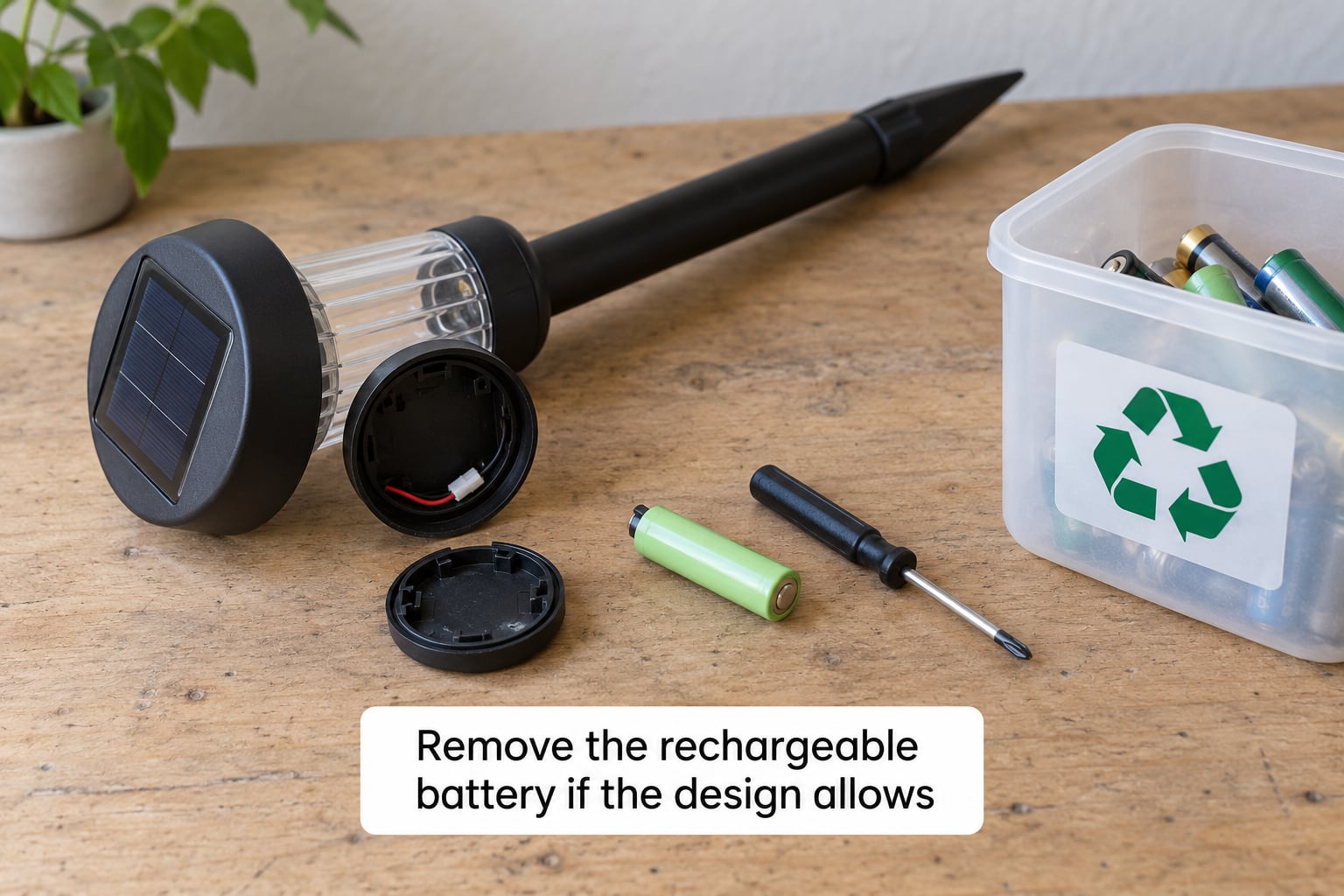
Most stake lights come apart at the base collar or under the panel. Back out the screws, lift the housing halves apart gently, and expect the cell to be sitting in a small plastic tray with two thin leads.
Pull the battery free with pliers rather than yanking the wires. If the leads are soldered directly to the cell, stop and treat the whole light as e-waste instead of cutting metal across a battery you cannot see.
Identify the chemistry from the label if you can. AA and AAA cells are almost always nickel-metal hydride, NiMH. Older and heavier ones may be nickel-cadmium, NiCd, which carries cadmium and never goes in household waste. Small flat lithium-ion packs and any built-in lithium cell need terminal taping before anything else happens.
Wrap clear tape around each nickel-cadmium and lithium-ion terminal so the contacts cannot touch anything conductive. Store each chemistry in its own container, and keep batteries away from heat, metal tools and direct sun on the driveway.
| Chemistry | Where you will meet it | Why it matters | Handling |
|---|---|---|---|
| Nickel-metal hydride, NiMH | AA and AAA cells in most stake lights | No toxic heavy metal, low fire risk | Standard battery drop-off bin, no special taping |
| Nickel-cadmium, NiCd | Older and heavier cells | Contains cadmium, a toxic heavy metal | Take-back or household hazardous waste, tape terminals |
| Lithium-ion | Sealed packs in larger post and wall lights | Fire and thermal runaway risk if punctured | Tape terminals, keep cool, certified drop-off only |
3. Separate the solar panel, circuit board, and other electronics
With the battery gone, the remaining electronics are the reason a solar light counts as e-waste rather than as scrap plastic. Set aside the small photovoltaic panel, the LED, the circuit board with its light sensor, and any visible wiring.
Do not cut, bend or flatten the panel to make it fit a bin. Damaged cells are exactly what certified recyclers are set up to handle safely, and a scratched or cracked panel belongs in the e-waste stream, not in your curbside recycling.
Keep the electronics in a rigid container so nothing rattles. Scraps of circuit board contain lead solder and small amounts of precious metals, which is precisely the material recovery that makes e-waste collection worthwhile.
4. Sort glass, metal, plastic, and remaining parts
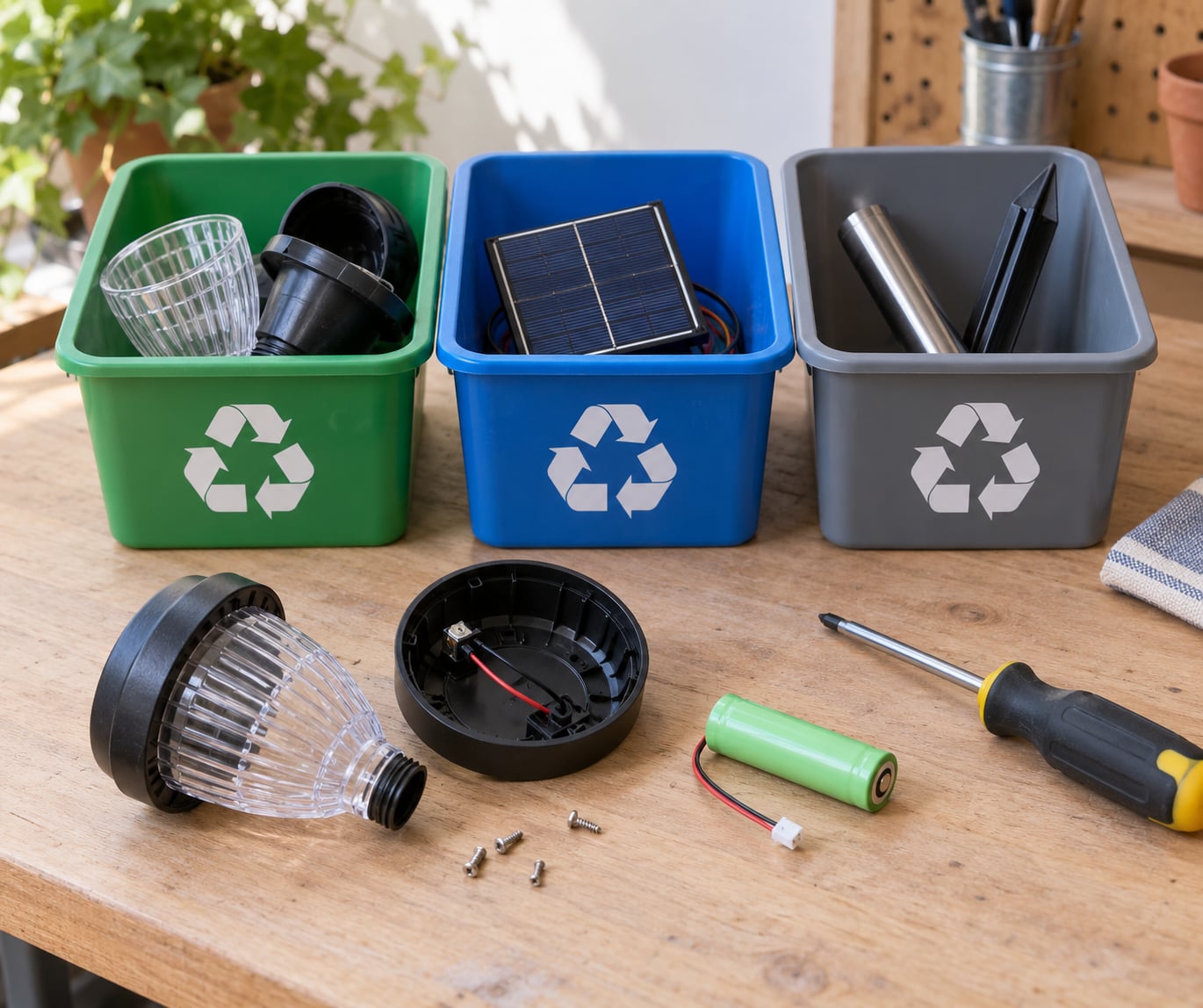
Now the easy half. The housing splits into a plastic shell, sometimes a stainless steel or aluminium stake and collar, and in decorative lights a glass or acrylic diffuser. Each of those goes to a different stream, and mixing them defeats the purpose.
| Part of the light | Material | Where it goes |
|---|---|---|
| Rechargeable cell | NiMH, NiCd or lithium-ion | Battery drop-off, household hazardous waste, or certified battery mail-back |
| Solar panel | Silicon cell on plastic laminate | E-waste collection site, unbroken |
| Circuit board and wiring | Copper, solder, insulation | E-waste collection site |
| LED and light sensor | Semiconductor, plastic lens | E-waste collection site with the board |
| Glass or acrylic diffuser | Glass or acrylic | Household recycling only if the local program accepts it |
| Housing, stake, collar | ABS or PP plastic, stainless steel or aluminium | Household recycling for clean plastic, scrap-metal stream for bare metal |
Rinse dirty plastic and let it dry before it goes in the bin, and separate the metal stake from the plastic body first. If your curbside program takes rigid plastics but not mixed-material items, the plastic shell alone often qualifies while the whole assembled light never will.
5. Use manufacturer take-back or certified collection options
Step five is where you choose the destination. The battery goes to a participating retailer drop-off bin, a household hazardous waste facility, or a certified take-back program. In the US, Call2Recycle maintains a locator for participating collection points, and most hardware and electronics chains host walk-in battery bins near the customer service desk.
Those bins are free and usually accept AA and AAA NiMH cells plus common lithium-ion batteries. Policies vary by chain and by location, so check the bin’s posted label before you drive across town. Anything the bin rejects goes to your county household hazardous waste site.
The panel, board and LED go to your municipal e-waste collection site, which often means a scheduled curbside pickup day or a fixed depot. Manufacturers of higher-end outdoor lighting sometimes run a mail-back or retailer take-back scheme, and checking the brand page or the original receipt is worth two minutes when you have a whole box of lights.
One question that comes up constantly in local forums is that people cannot find a drop-off for solar lights specifically. That is expected, because almost no site advertises a “solar light” bin. Your battery goes in the battery bin and the rest goes with e-waste, usually in the same building on the same trip.
6. Confirm disposal and clean up safely
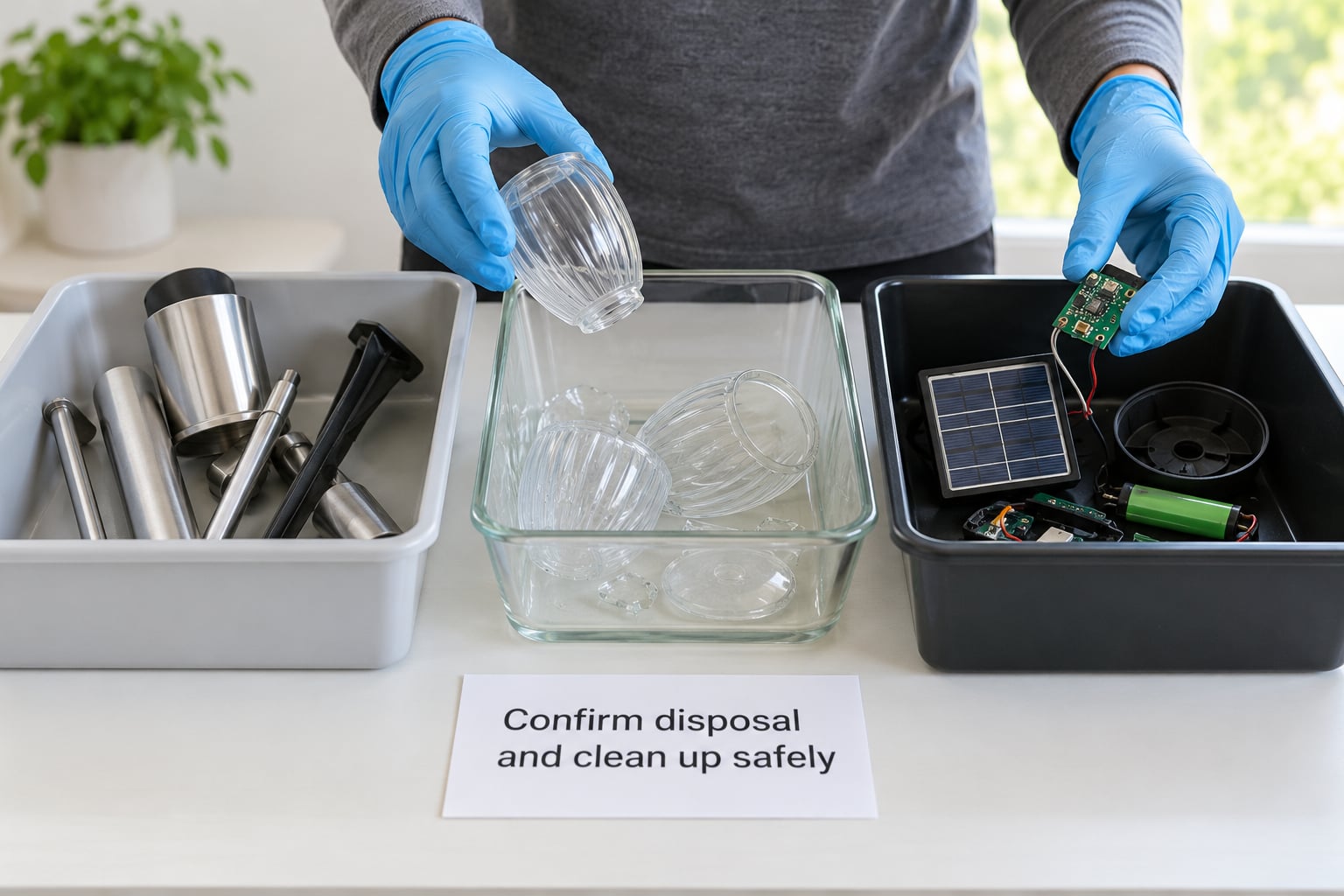
Before you leave, match what you are carrying against your containers. Every cell accounted for, every piece of electronics boxed, every housing piece sorted. Nothing loose in the car, because a NiMH cell rolling under a seat against a metal rail is exactly how damage starts.
Collect the screws, sweep the work area and check for sharp plastic edges or splinters from an old brittle stake. Wash your hands, especially after handling a swollen or leaking cell, and ventilate if you opened anything indoors.
Never burn components, never crush a battery to make it fit, and never bury a light in the garden. Lead solder, cadmium and electrolyte do not break down in soil, and yard waste composts into the wrong place entirely.
Common Mistakes
Throwing the whole light in the household trash. This is the big one, and in several US states it is illegal to trash a rechargeable battery at all. The fix is the same as the whole article: battery out, electronics separated, housing sorted.
Putting lithium-ion cells in the curbside recycling bin. Sorting facilities bale and compact material, and a punctured cell in a compactor or in the back of a truck is a known cause of fires. Tape the terminals, bag it separately and use a drop-off bin.
Forcing open a sealed housing. Cheap lights get brittle with UV exposure, and cracking the shell around a lithium pack can vent it. Sealed units go whole to e-waste.
Treating a solar light as scrap metal. The metal content is small and the light is a mixed-material electronic device, so it is not accepted as scrap and never accepted curbside as a whole. Strip the metal first.
Ignoring a swollen, dented or leaking battery. Do not ship it in a box. Tape it if you can do so without pressure, keep it away from combustible material and take it to a household hazardous waste site the same day.
Dismantling a light that still works. Most dead-looking solar lights are just tired batteries. Swap in a fresh AA NiMH, scrape the corroded battery contacts with white vinegar and a cotton swab, wipe the panel with a damp cloth, and a surprising share come straight back to life. That is a five-minute fix instead of a disposal run.
Tossing a working light instead of passing it on. Community gardens, schools, churches and yard-sale buyers all use working solar path lights, and a working light is worth more to somebody else than its parts are worth to a recycler. If the panel is yellowed, the LED is dim or the housing cracks, then it is time to recycle.
Solar Garden Lights Are Not Rooftop Solar Panels
Most results that come up when you search how to recycle old solar lights are actually about rooftop photovoltaic arrays, and the rules are completely different. A rooftop panel is a regulated item under producer-responsibility schemes, handled by certified panel recyclers and usually free through the manufacturer or installer. Nothing about that applies to the stake light in your flower bed.
A garden light carries maybe a gram or two of silicon and a single rechargeable cell. You handle it at your kitchen table with a screwdriver. The one genuinely confusing part is the panel itself: broken or cracked glass is more troublesome to recycle than the electronics, which is why a small damaged laminate should go with the e-waste rather than into a glass bin.
What Local Rules Actually Prohibit
In the US, the specific prohibition is usually on batteries rather than on lights. California prohibits disposal of rechargeable and electronic batteries in local landfills, New York bans disposal of rechargeable batteries statewide, and several other states run similar battery stewardship or universal waste programs. Municipal rules are stricter and vary block by block, which is why the curbside answer in your city can differ from the state law.
The practical version: check whether your waste authority lists batteries, e-waste or household hazardous waste as drop-off items, and treat the answer as local law rather than internet consensus. Rules differ outside the US too, so the same steps apply but the collection points are entirely different.
Frequently Asked Questions
Can you recycle solar lights?
Yes, but not in the trash and not in the curbside bin. Open the housing, remove the rechargeable battery and take it to a battery drop-off, then bring the solar panel, LED and circuit board to an e-waste collection site. Clean plastic or metal housing parts can usually go into household recycling if your local program accepts that material. Rules vary by county, so check your waste authority first.
Can I throw away a solar light or put it in the recycling bin?
Do not. The rechargeable battery makes the entire light regulated electronic waste, and many states specifically prohibit putting rechargeable batteries in household trash. A lithium-ion cell punctured in a compaction truck or a recycling truck can start a fire, and leaking electrolyte can contaminate soil and groundwater. Remove the battery first and take each remaining part to its own stream.
How do I remove the battery from a solar light?
Most stake lights open at the base collar or under the panel. Back out the two or three screws, lift the housing halves apart and lift the cell from its small plastic tray, pulling the leads with pliers rather than yanking them. If the wires are soldered straight to the cell, stop: treat the whole light as e-waste rather than cutting metal across a sealed battery.
Where can I take old solar lights near me?
In the US, the battery goes to a retailer drop-off bin, a household hazardous waste site, or a certified take-back program. Call2Recycle maintains a locator for participating collection points, and most hardware and electronics chains host walk-in battery bins near the service desk. The panel, LED and circuit board go to your municipal e-waste site, which may run scheduled pickup days.
Should I remove batteries from solar lights I am storing?
Yes, for long-term storage. Take the cells out and store them separately in a cool, dry place, because a light left out in a hot shed or on a sunny deck is a slow way to age a battery. If the cell is lithium-ion or nickel-cadmium, tape the terminals before storage and keep it away from anything metal that could short it.
Can solar lights be repaired instead of recycled?
Most of the time, yes. Nearly every light that seems dead is really just a tired battery, so swap in a fresh AA NiMH cell and clean the corroded contacts with white vinegar and a cotton swab. Wipe the panel, check the on switch and switch to dusk mode. Water damage or a badly yellowed panel is the point where repair stops being sensible and recycling starts.
Start with the pile, not the screwdriver. Set the lights on a bench, pull every battery you can remove, tape the terminals on anything lithium or cadmium, and drop those off first. Then box the panels and boards for an e-waste run, sort the clean housings, and put a couple of the lights that light up back in the ground where they were.