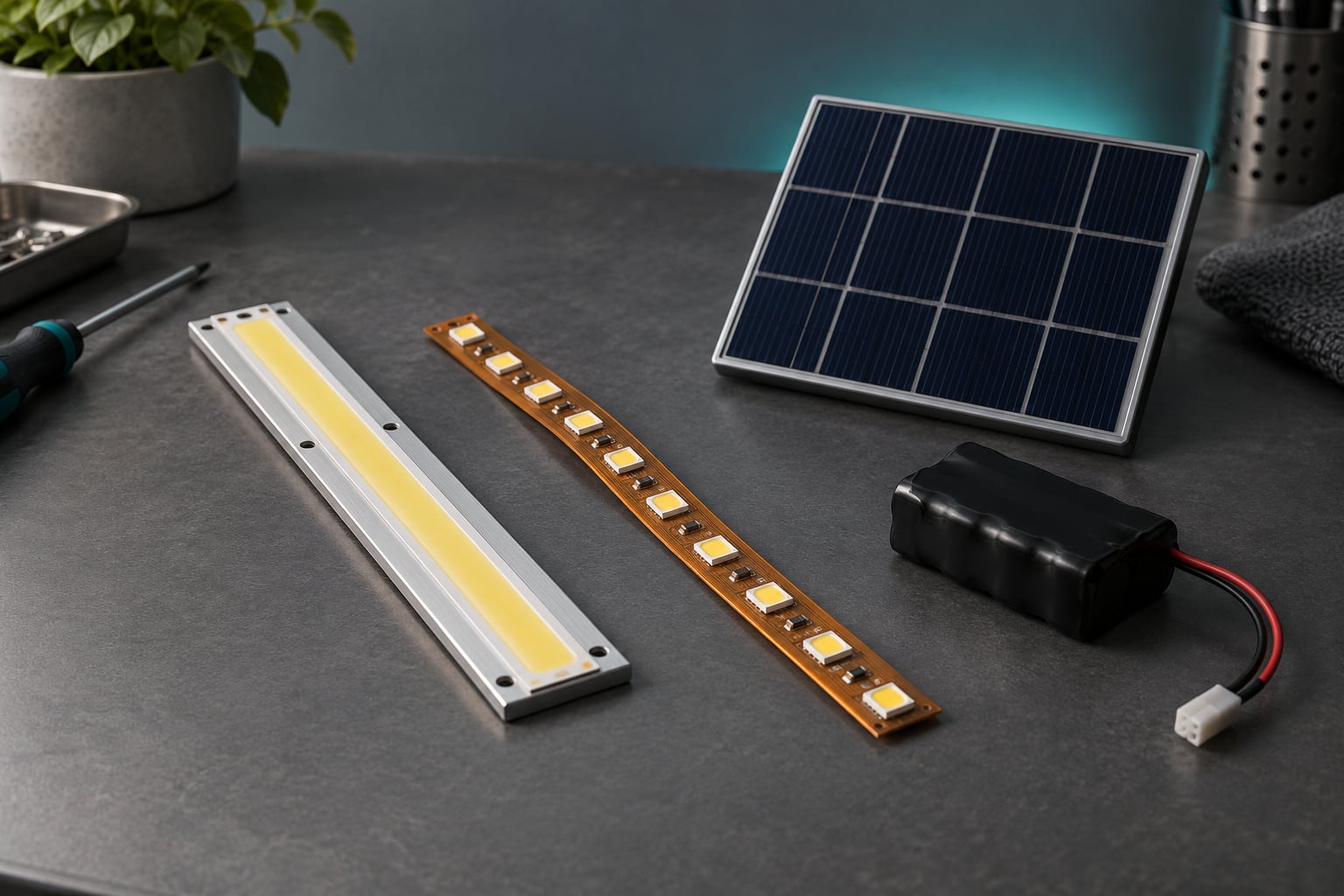
COB, or chip-on-board, LED bonds many bare LED dies straight onto one board so the light reads as a single continuous line with no visible dots. SMD, or surface-mount device, LED uses separate packaged chips — usually 2835 or 5050 — mounted in a row, so you can see each one. COB looks smoother and spreads heat better; SMD is cheaper per metre, easier to repair, and better suited to colour-changing and addressable setups. For solar garden lights, the deciding factors are usually brightness per watt, heat in a sealed housing, and how long the lamp stays lit on one night of charging.
That is the whole difference in one paragraph, and everything after it is just detail. The rest of this guide walks through how each type is built, how they behave in real outdoor fittings, and where the marketing claims you have read go wrong.
One thing worth clearing up early: COB is a type of LED. It is not an alternative to LED, and it is not an alternative to solar power. When you see “LED versus COB” on a shop page, the question is really “ordinary packaged LED or chip-on-board LED”.
Table of Contents
- COB vs SMD LED Explained at a Glance
- What Is COB LED Lighting?
- What Is SMD LED Lighting?
- SMD vs COB LED: how the package sizes differ
- How to tell COB from SMD in the hand
- COB vs SMD LED: Brightness and Light Distribution
- COB vs SMD LED: Efficiency and Solar Battery Life
- COB vs SMD LED: Heat, Weather Resistance and Durability
- IP ratings for outdoor lighting, decoded
- COB vs SMD LED: Repairability and Lifespan
- COB vs SMD LED: Cost and Value for Solar Lights
- Which COB or SMD LED Should You Choose?
- Frequently Asked Questions
- Are COB LED strips brighter than SMD?
- Is COB or SMD more energy efficient?
- Does COB LED get hot?
- Can I cut a COB LED strip anywhere?
- How long do SMD LEDs last?
- Which is better for outdoor solar lighting, COB or SMD?
- Conclusion
COB vs SMD LED Explained at a Glance
This table is the fast version. Read the right-hand column as the practical verdict for most outdoor and solar lighting projects.
| Factor | COB LED | SMD LED | Which to pick |
|---|---|---|---|
| Light appearance | Continuous, dotless line of light | Individual dots visible at close range | COB for visible fixtures, either works when hidden |
| Brightness per unit length | High, evenly spread along the strip | High at each chip, patchier between them | Depends on the chip size, not the type |
| Light distribution | Wide, smooth, no hot spots | Narrower per chip, visible spacing | COB |
| Efficiency (lm/W) | Comparable to good SMD when well cooled | Comparable; 2835 packages lead on lm/W | Either — read the published figure |
| Heat | Spreads across the aluminium substrate | Concentrated at each small package | COB in sealed housings |
| Durability outdoors | Whole module is one failure point | Individual diodes can fail separately | SMD where servicing is hard |
| Repairability | Harder — often means replacing the section | Easy — desolder and replace one diode | SMD |
| Cost per metre | Higher | Lower | SMD on a budget |
| Colour-changing and addressable control | Limited options | RGB, RGBW and addressable strips are widely available | SMD, no contest |
| Solar panel compatibility | Good for fixed small fixtures with clean lines | Good for array lamps needing spare diodes | Read lumens and IP rating first |
Two caveats on that table. Brightness is set by the chip and the drive current, not by the packaging, so a well-driven 5050 SMD strip will out-light a cheap COB strip. And IP ratings belong to the finished fixture, not to the LED type — a COB strip with no potting or sleeve is still IP20 no matter how good the chips are.
What Is COB LED Lighting?
COB stands for chip-on-board. Instead of soldering small pre-packaged diodes onto a circuit board, the bare semiconductor dies are bonded directly to a larger substrate, then covered with phosphor and epoxy. The phosphor converts the blue light from the dies into the white you actually see.
Because there is no separate plastic package around each die, the emitters sit almost touching. That is the reason people describe COB light as seamless or dotless, and it is why a COB strip shows a smooth ribbon of light rather than a row of beads.
The substrate is usually an aluminium board rather than thin fibreglass. That matters more than it sounds. Aluminium pulls heat away from the dies and spreads it across the whole surface, which is why a COB module handles heat better than the same dies in small SMD packages.
There is one trade: because everything is bonded as a single unit, you cannot swap out one failed diode. If part of a COB run dies, you normally replace that whole section.
What Is SMD LED Lighting?
SMD is a broad category, not a single chip. It means the LED die is mounted on the surface of a small ceramic or plastic package that then sits on a printed circuit board. Each package is a discrete, replaceable unit.
That discreteness is the defining trait. When you look closely at an SMD strip you can count the chips, and each one puts out its own pool of light. It is why SMD strips show a dot effect, and why an SMD strip in a profile with a diffuser looks softer than the same strip mounted bare.
SMD vs COB LED: how the package sizes differ
The four-digit codes on SMD packaging describe the chip in millimetres. The first two digits are the width, the last two the height, so a 2835 package measures 2.8 mm by 3.5 mm and a 5050 measures 5 mm by 5 mm. Bigger packages handle more power and more light per position.
Published efficacy figures for quality white packages typically sit around 270 lm/W for 2835, 250 lm/W for 5050, and 235 lm/W for 3030. Those are chip-level numbers measured in a lab with a cool substrate, so treat them as a ceiling rather than a promise for a finished solar lamp.
Larger packages mean fewer chips for the same output, which means wider spacing and more obvious dots. That is the trade you make when you go from 2835 to 5050: more punch per chip, less visual density.
How to tell COB from SMD in the hand
Four checks, in the order I would run them.
- Look at the light source itself. A COB strip shows a continuous yellow-white ribbon under the coating. An SMD strip shows separate square chips with visible gaps of bare board between them.
- Check for cut marks. SMD strips have scissors or solder-pad markings at regular intervals. A standard COB strip usually has them too but far closer together, often every 10 to 25 mm, and some only come in fixed lengths.
- Look at the board. COB sits on a rigid aluminium substrate that feels thick and cool. SMD sits on a thin, flexible brown or white PCB that bends easily in the hand.
- Read the listing twice. Marketing photos often show a different strip to the one shipped. The package code on the spec label is the most reliable clue — if it names 2835, 3528, 3535, 5050 or similar, it is SMD.
If a listing says only “COB” and shows no package code, no lm/W figure and no IP rating, assume it is a marketing description rather than a verified specification. In my experience with strip listings, missing spec codes are the single most common reason people end up with the wrong type.
COB vs SMD LED: Brightness and Light Distribution
Brightness is where the two get confused most. COB strips are often described as brighter per metre, and that is sometimes true — a COB strip can push more luminous flux out of the same length. But the packaging itself is not what makes a light bright. Chip size, drive current and how much heat the fixture can reject decide that.
Put an SMD strip and a COB strip of equal total wattage at the same distance from a wall and the difference you will see is mostly distribution, not output. COB throws a smooth, even wash along the whole length. SMD throws brighter little pools with dimmer gaps.
For paths, garden beds and deck edges, that SMD pattern shows up as scalloping — bright patches followed by dark ones. COB removes it. For spot-type fixtures where each chip sits behind its own lens, SMD is fine and often more flexible.
Glare and shadows follow from the same physics. Tight, uneven spacing with individual sources gives you more small shadows and more visible hot spots. A continuous source gives a softer, more uniform result, which is why COB shows up in display cabinets and under-cabinet runs where you will be looking at the light directly.
Beam angle matters too. COB modules typically emit across a wide angle by default. SMD chips range from narrow spot optics to wide flood, and the package code alone does not tell you which lens is fitted — you need the beam angle in degrees on the datasheet.
COB vs SMD LED: Efficiency and Solar Battery Life
This is the section that settles the argument, because it is where the contradictory claims live. Some suppliers say COB is dramatically more efficient than SMD. Others say SMD is the more efficient technology. Both claims come from comparing different things.
Two separate measures get mixed up: the efficiency of the LED itself, expressed in lumens per watt, and the performance of the finished lamp, which also includes the panel, battery, charge controller, sensor and housing.
At chip level the two are close. Quality 2835 packages reach roughly 270 lm/W and 5050 packages around 250 lm/W. COB strips from reputable makers sit in a similar range when properly cooled. Claims of a large percentage advantage usually mean the supplier compared an efficient COB module against an inefficient SMD product, not against a good one.
Where COB does have a genuine edge is thermal. Because the dies bond directly to aluminium, the heat spreads across a large surface rather than pooling in one small package. In a sealed outdoor fixture running on a small panel, that keeps the junction temperature lower, and lower junction temperature means more of the light stays usable for longer.
Solar battery life is decided mostly by three other things:
- Battery capacity in mAh. This is the single biggest factor. A lamp with a 2000 mAh battery that runs an efficient LED for four hours beats a 1000 mAh battery running a bright one for two.
- Panel size and quality. Solar lamps sized for decorative use often carry a panel that cannot refill the battery in one day. That shortfall shows up as shorter runtime in the second night of cloudy weather, not the first.
- Wattage at dusk. Leaving the lamp at full output until it drains shortens every night compared with a dusk sensor plus a motion sensor, which lets the battery sleep until someone walks past.
In practice, buying a lamp with a dusk sensor and a PIR motion trigger buys you more usable light per panel square metre than switching between COB and SMD. The LED type is the last decision, not the first.
COB vs SMD LED: Heat, Weather Resistance and Durability
Yes, COB gets hot — but so does SMD, and both stay within their rated junction temperature when they are properly mounted. COB runs cooler at the chip because of the aluminium substrate. SMD packages concentrate heat in a small area, so the board around each chip gets hotter in a bare strip.
The practical difference shows in outdoor fixtures. A solar path light with a sealed plastic housing has nowhere to put a heat sink. Whichever LED runs there needs to be current-limited so it never exceeds its rated junction temperature, and the better the thermal path, the less brightness the manufacturer has to leave on the table.
IP ratings for outdoor lighting, decoded
Weather resistance is a property of the finished product, so read the rating rather than inferring it from the LED type.
| Rating | What it means in plain terms | Typical use |
|---|---|---|
| IP20 | Touch-safe, no water protection | Indoor dry areas only |
| IP65 | Dust-tight, survives spray from any direction | Covered outdoor spots, sheltered paths |
| IP67 | Dust-tight, survives temporary immersion | Exposed paths, garden beds, near water |
| IP68 | Dust-tight, continuous immersion to a stated depth | Pool and pond fittings |
Note that many solar garden lamps carry a rating on the packaging but not on the product page. Ask for the rating of the exact variant, not of the range.
On failure patterns, SMD wins on granularity. A single failed diode leaves a small dark segment in an otherwise working strip, and you can identify which one by tracing the run. A failed COB section can take out a much longer stretch, and it is harder to isolate.
COB vs SMD LED: Repairability and Lifespan
Repairability is the clearest practical divider. Replacing a single SMD diode needs a soldering iron, a little flux and a replacement chip of matching colour and voltage. Many DIYers do it in a few minutes, and hobby builders working on high-output projects value that modularity for exactly this reason.
A COB module is one bonded unit. When part of it fails, most people replace the entire strip or the entire fixture. That is acceptable if the run is short and accessible, and expensive if it is a 10-metre run mounted under an eave.
On lifespan, published ratings cluster around 30,000 to 50,000 hours for quality products in both types. Those figures assume thermal management that a small solar lamp often cannot provide, so read them as lab conditions rather than a promise for a sealed plastic housing.
The real lifespan limiter is usually the battery, not the LED. Lead-acid cells in budget solar lights degrade through repeated shallow charge cycles, and the lamp starts dimming long before the diodes fade. Budget for a battery replacement or pick a lamp with a replaceable cell.
COB vs SMD LED: Cost and Value for Solar Lights
SMD is cheaper to buy, at the strip level and in finished fixtures. That gap is real and it is why SMD dominates low-cost solar path lights. But the purchase price is only one line in the total, and it is not always the largest one.
What actually drives value in a solar lamp is runtime per night and years before something fails. A lamp with a larger battery, a real motion sensor and a replaceable cell can beat a cheaper unit even when both use the same LED family.
A higher-priced lamp earns its cost when it delivers any of these:
- A published lumen output rather than a vague brightness claim.
- A stated IP rating for the exact variant being sold.
- A battery capacity in mAh, and a stated charging time.
- A replaceable battery cell or a warranty that covers it.
- Real heat management rather than a bare board in a sealed case.
For COB, the premium buys you the look: an even line of light with no dots, which is worth paying for when the lamp is visible from a seated position. If the lamp is buried in planting or aimed at the ground, the premium buys very little.
Which COB or SMD LED Should You Choose?
Match the type to where the light actually goes.
Choose SMD when: you are covering a larger area and want repairability, you want colour-changing or addressable control, you are running a long low-voltage run and want to be able to swap sections, or budget matters more than appearance.
Choose COB when: the fixture is compact and the LED is visible up close, you want a smooth continuous line with no dots, you are lighting display cabinets, cove or accent runs, or the housing is sealed and a better thermal path is worth having.
Use both in one project: this is common and sensible. COB for the visible decorative runs that people actually look at, SMD for the longer functional runs and anything you might need to repair in five years.
Before you settle, check these seven things on any solar lighting product page:
- Lumen output, not just wattage.
- Published efficacy in lm/W if the seller offers it.
- Colour rendering index if colour accuracy on plants or food matters to you.
- IP rating for the exact variant.
- Battery capacity in mAh and the stated charging time.
- Whether the LED is listed as COB, SMD or both, and whether the package code appears.
- Whether the battery is replaceable and what the warranty covers.
Frequently Asked Questions
Are COB LED strips brighter than SMD?
Sometimes, but not because of the packaging. Brightness comes from chip size, drive current and thermal management. A COB strip can deliver more lumens per metre, while a well-driven 5050 SMD strip can match or beat a cheap COB one. Compare published lumen output for the specific product rather than the LED type.
Is COB or SMD more energy efficient?
At chip level they are close, with quality 2835 packages around 270 lm/W and 5050 packages around 250 lm/W. Claims that one type is far more efficient usually compare a good product against a bad one. In solar lighting, battery capacity, panel size and sensor behaviour affect runtime much more than the LED packaging.
Does COB LED get hot?
It does, but its bare dies are bonded straight to an aluminium substrate, so heat spreads across the whole surface instead of concentrating in one small package. That usually means lower chip temperature than an equivalent SMD strip in the same housing. Any LED run without thermal management will still shorten its own life.
Can I cut a COB LED strip anywhere?
No. Standard COB strips have marked cut points, usually far closer together than on an SMD strip but not continuous. Free-cut or FCOB versions exist with cut marks at very short intervals. Cutting outside a marked point breaks the circuit, and cutting any strip shortens its max run and worsens voltage drop on what is left.
How long do SMD LEDs last?
Quality SMD packages are usually rated between 30,000 and 50,000 hours under lab conditions. In a real outdoor fixture the limit is often the battery and the heat inside the case, not the diode. In solar lamps the cell typically degrades first, so budget for a battery replacement rather than expecting the LED to be the weak point.
Which is better for outdoor solar lighting, COB or SMD?
For solar garden lights, SMD usually wins on repairability and price, since a failed diode does not take the whole fixture with it. COB wins where the LED is visible up close and you want a smooth dotless line, and it handles heat better in a sealed housing. Read lumen output, IP rating and battery capacity before deciding.
Conclusion
COB gives you one smooth, dotless line of light and spreads heat across its board. SMD gives you separate, replaceable chips, more choice in colour and addressable control, and a lower price per metre. Neither is universally better: pick COB for compact fixtures people will look at closely, and SMD for broad coverage, long runs and anything you may need to repair later.
Before you buy, read the specs that actually predict how the lamp will perform: battery capacity in mAh, charging time, published lumen output, the IP rating for that specific variant, and whether it has a dusk sensor, a motion sensor or both. Check the LED type last. Last updated for 2026.