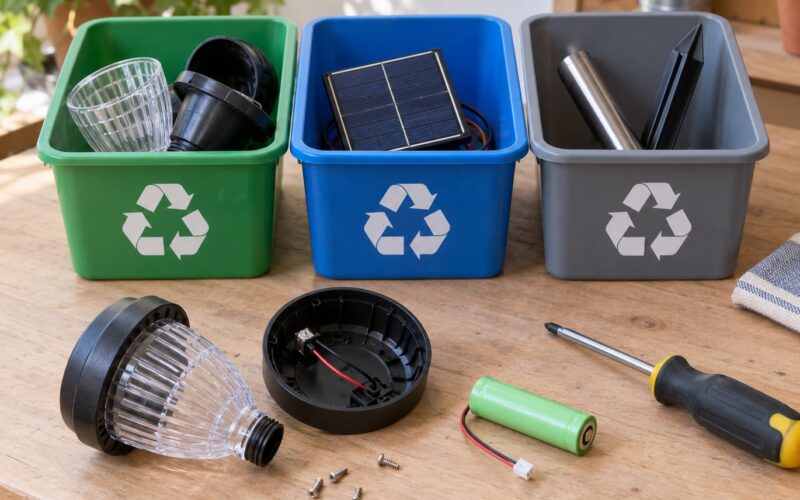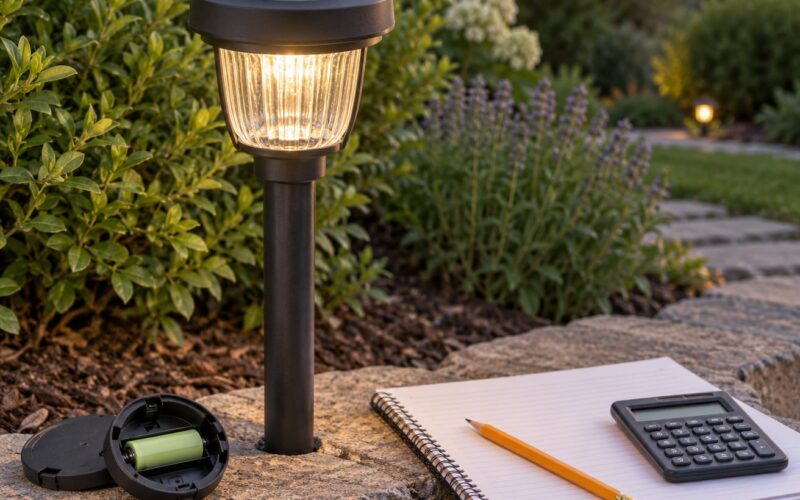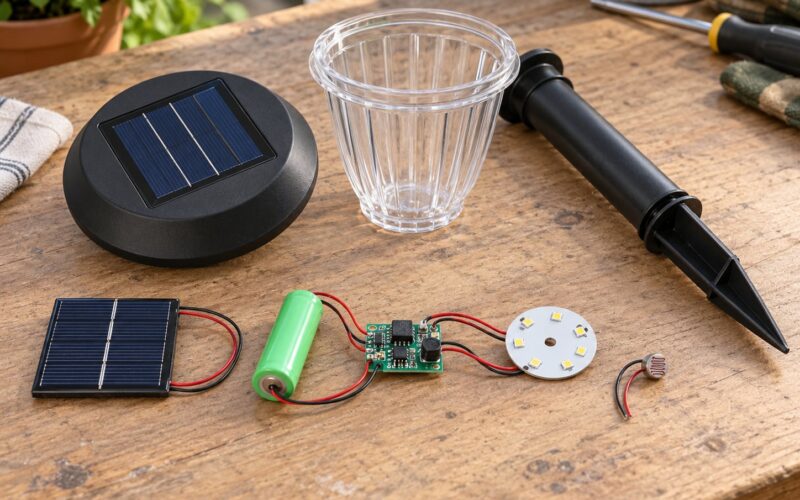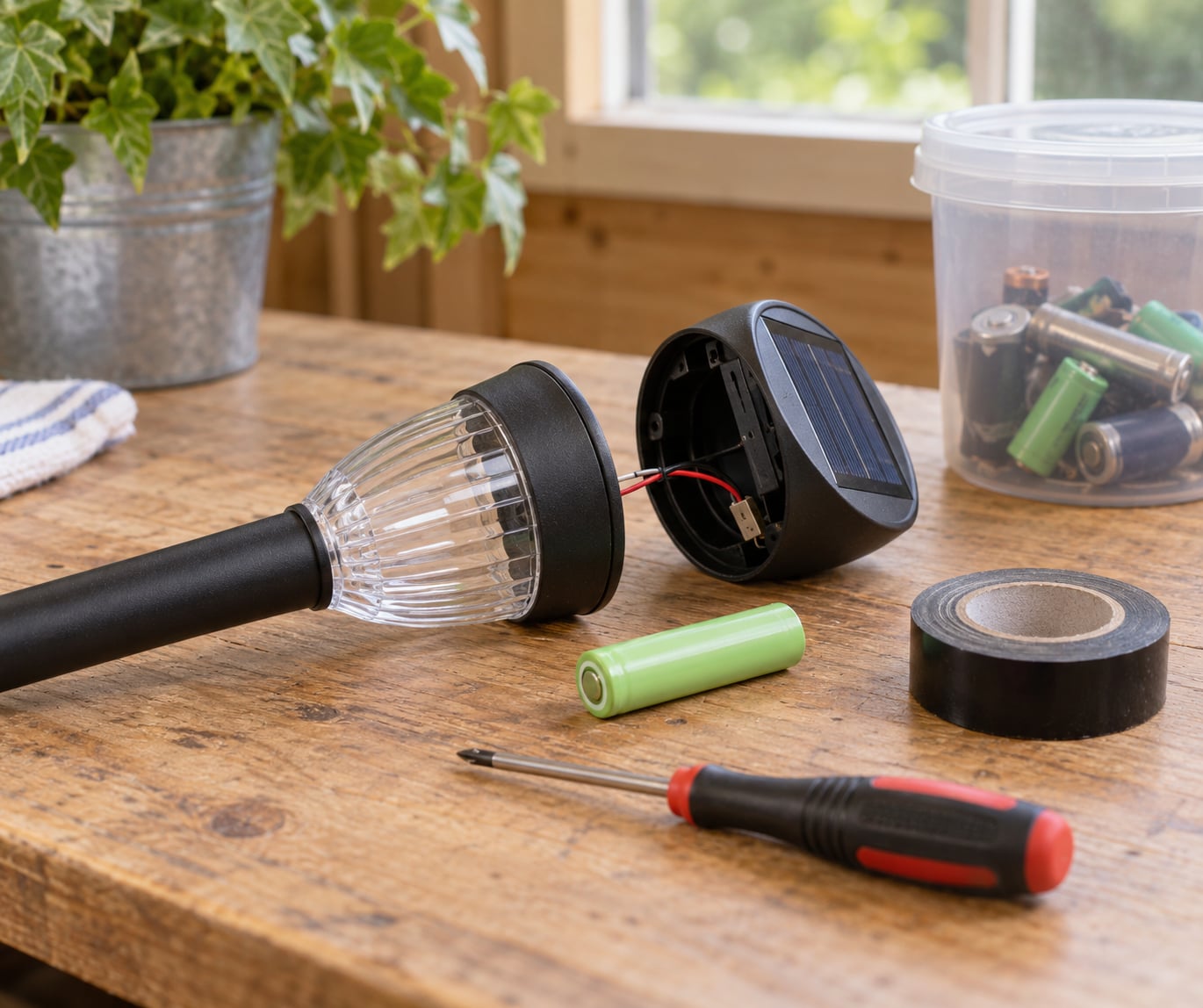
To dispose of solar light batteries safely, take the cell out of the fixture, tape both terminals with electrical or painter’s tape, and drop it at a designated battery collection point, a retail drop-off counter, or your county household hazardous waste facility. Never put a rechargeable solar light cell in household trash or curbside recycling. Most fixtures are easy to open and the whole job takes about five minutes per light.
That last part matters more than it sounds. A loose cell riding along in a curbside bin can be crushed by the truck’s compactor, and a lithium cell crushed that way can start a fire in the truck or at the material recovery facility. Alkaline, nickel-cadmium and lead cells are a different problem: they leak their metals into landfill soil and groundwater, and in many counties that is a fineable violation, not just bad practice.
Solar lights add one wrinkle general battery guides skip. The battery is usually installed, sometimes behind a sealed panel or under a friction-fit tab, so most people never think of it as a removable part at all. They leave a dead light on the post, buy another one, and the old cell sits in the housing until the plastic cracks and the whole fixture goes in the trash. Here is how to take the cell out, and where to send it.
One note before we start: rules on alkaline and rechargeable cells differ by state, county and country. Everything below follows US practice as a baseline. Check your local waste department before you rely on a specific rule, and treat anything marked rechargeable, lithium-ion, nickel-cadmium or lead-acid as “never in the trash” no matter where you live.
Table of Contents
- What You Need
- Step-by-Step: How to Dispose of Solar Light Batteries Safely
- 1. Take the light out of the sun and switch it off
- 2. Open the housing
- 3. Look at the cell before you touch it
- 4. Remove the cell without bridging the terminals
- 5. Tape the terminals
- 6. Bag it
- 7. Take it to an approved drop-off point
- 8. Clean the compartment and put the fixture back together
- How to Identify the Battery Type Before You Dispose of Solar Light Batteries
- How to Remove the Battery Safely
- Where to Take the Battery
- Common Mistakes
- Frequently Asked Questions
- Can I throw solar light batteries in the regular trash?
- Does Home Depot recycle solar light batteries?
- What happens if a lithium battery goes in the garbage can?
- What do I do with a swollen, leaking or fire-damaged solar light battery?
- Can I replace the battery in an outdoor solar light instead of recycling it?
- How do I know which battery type is in my solar light?
- Conclusion
What You Need
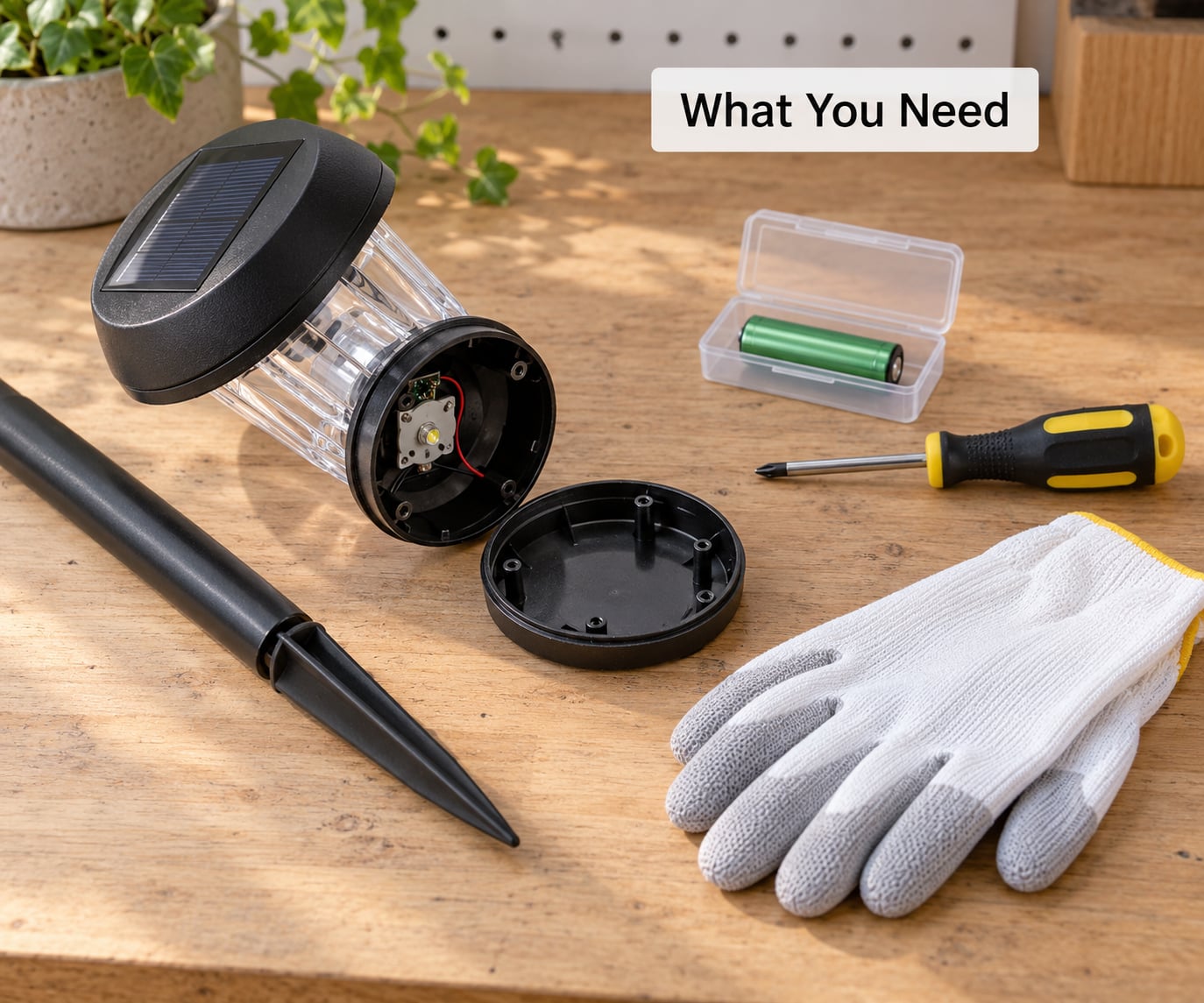
You do not need much, and you almost certainly have all of it already.
- Cut-resistant or chemical-resistant gloves. Nitrile works. A leaky alkaline cell is a skin and eye irritant, and you will be reaching into a housing that has been sitting in damp soil.
- A flat-head or Phillips screwdriver, and a small pry tool or plastic spudger. The plastic pry tool matters more than it sounds: a metal screwdriver slipped across a cell terminal is exactly the short circuit you are trying to avoid.
- Electrical tape, painter’s tape, or clear packing tape. Electrical tape is the strongest option. Painter’s tape is the one most municipal programs and retailers specifically recommend, and it is cheap and easy to find.
- A clear plastic zip bag or a small non-conductive container with a lid. A battery-only drop-off bin is ideal. A sealed metal toolbox is not, because a loose cell bouncing around inside can build charge against the wall.
- Safety glasses and a damp cloth or paper towels. For corroded compartments.
- Your local waste department’s rules. A quick search for your county household hazardous waste schedule tells you what you can drop off, when, and whether an appointment is needed.
If you do not have a zip bag, a cereal box with a taped shut lid is a reasonable stand-in for the walk to the car. It just has to be non-conductive and not rigid enough to crush a swollen cell.
Step-by-Step: How to Dispose of Solar Light Batteries Safely
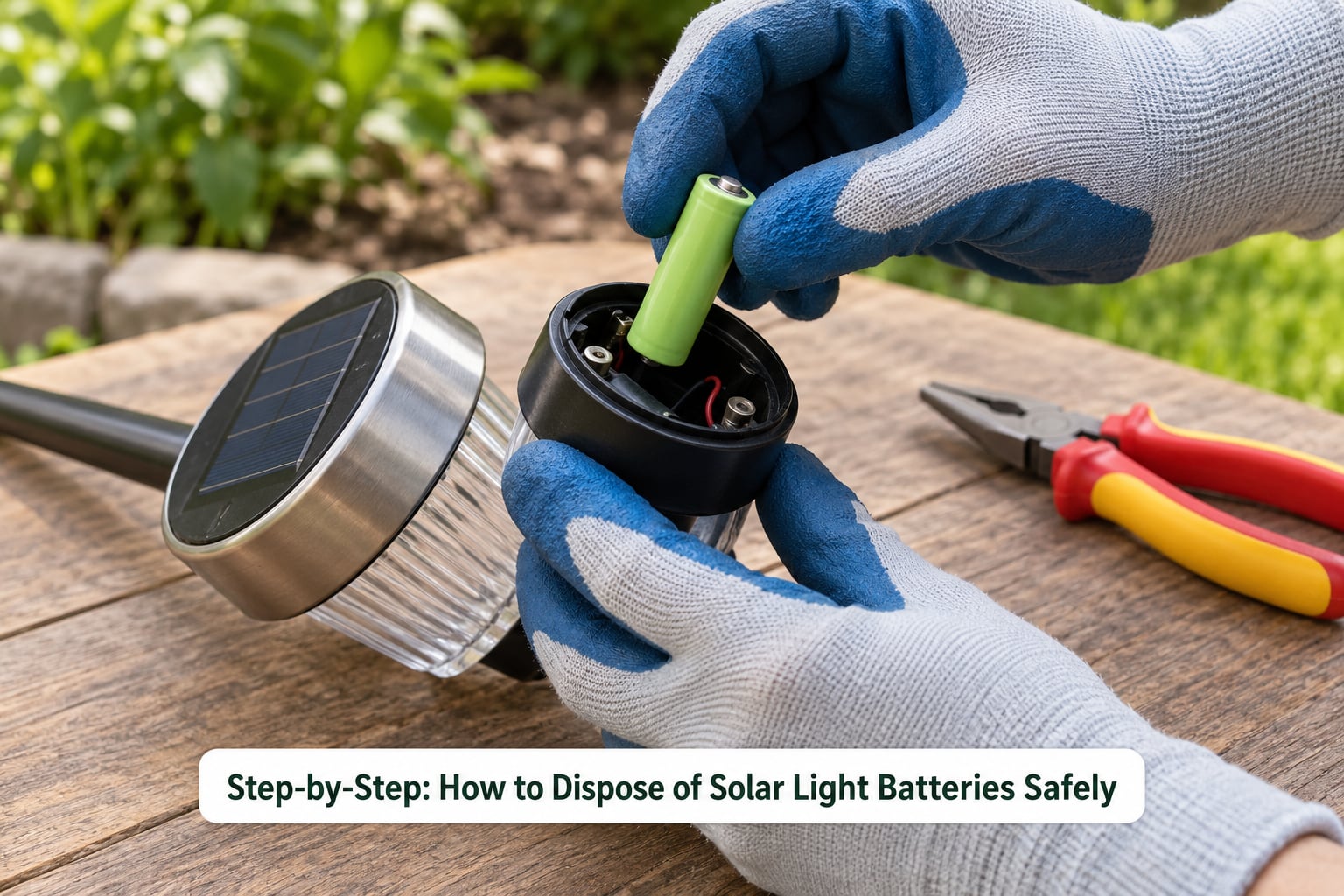
1. Take the light out of the sun and switch it off
Cover the panel with your hand or move the fixture into shade so the charge controller stops. Most solar lights have a physical on/off switch underneath; on the cheap ones that are still running after a season or two, there may not be, which is why blocking the panel matters. If the light has a mode selector, set it to off.
You know this step worked if the LED stays dark while you work. Anything else means the panel is still feeding the board.
2. Open the housing
Four styles cover almost every solar garden and path light. Push-in tab lights have a small plastic door under the base that slides and lifts. Screw-base and puck lights usually have a plate held by one or two Phillips screws underneath. Single-LED stake lights often have a twist-off or clip-on bottom plate. Solar string lights usually hide a small battery pack in an inline housing with a screw cover.
Work the screw out with your gloved hand first and drop it into a cup so it does not disappear into the soil. You know you are in when you can see the cell or the battery pack sitting loose inside the housing.
3. Look at the cell before you touch it
Hold the light so you can see the cell clearly. If it looks bulged or curved rather than cylindrical, feels warm, smells sweet or solvent-like, or has white crust or dried residue around it, stop and follow the damaged-cell steps in the FAQ below. That is a different procedure with different handling rules.
4. Remove the cell without bridging the terminals
Most battery compartments hold the cell in a spring clip or a metal tab. Press or lift the retaining tab first, then lift the cell straight out. If the terminals are bridged by a connector wire, undo the connector rather than levering the cell against it.
Never slide a metal tool down between the two terminals to pop the cell out. That is a dead short across the cell. You know the removal worked when the cell comes out in one piece and neither terminal shows a new scrape or black mark.
5. Tape the terminals
Put a strip of tape over the positive end and a separate strip over the negative end. Do not run one continuous strip along the side of the cell: it can slide and reconnect both terminals.
For a flat-topped or button-shaped cell, tape each face. For a bare wire lead, tape each wire separately. Taping is the step people skip, and it is the single thing that most prevents a dropped cell from becoming a fire in a collection truck.
6. Bag it
Put taped cells loose into a clear zip bag, or into a rigid battery-only bin if your local program uses one. Keep damaged cells separate from good ones and never loose together: one damaged cell leaking onto six good ones is how a five-battery mistake becomes a thirty-battery mess.
Store the bag somewhere cool, dry and away from anything flammable until you can drop it off. A garage shelf or a kitchen counter works; a car glovebox in July does not.
7. Take it to an approved drop-off point
Battery-only bins at grocery and hardware stores, county household hazardous waste facilities, municipal recycling centers, manufacturer take-back programs and mail-back kits all qualify. The disposal-destinations section below covers which one fits your chemistry, and which retailers actually take what.
You know the drop-off worked when the bin or facility staff accept the cells without asking you to sort them further, and when you leave with nothing in your hand. Keep the receipt if you gave one.
8. Clean the compartment and put the fixture back together
Wipe residue out of the housing with a damp cloth, let it dry fully, and reassemble the light. If you are installing a replacement cell, match the chemistry and voltage the fixture expects, and note that most cheap solar fixtures charge NiMH cells far too slowly for a lithium-ion cell.
If the housing is cracked, the panel is clouded or the board is corroded, take the whole fixture in as e-waste rather than buying a new one and trashing the old.
How to Identify the Battery Type Before You Dispose of Solar Light Batteries
Solar light cells frequently arrive with no legible marking, which is the problem forum readers keep hitting. “Does anyone know what battery this is? It has no markings” is a common post, and it is a fair question, because the answer changes where the cell has to go.
Read the label first if there is one. NiMH cells say NiMH or AA Rechargeable, Ni-Cd cells say NiCd or say rechargeable alongside a cadmium warning, lithium cells usually say Li-ion, LiFePO4 or 18650, and alkaline cells say alkaline or just show the AA or AAA size with a date code. When the label is gone, infer from the shape and the fixture.
- Short cylinder, AA or AAA size, no “rechargeable” text. Almost certainly single-use alkaline. The lowest-effort route, though your local rules still apply.
- Short cylinder with a recharge symbol, or the words rechargeable / NiMH. Route it to a rechargeable drop-off bin, not a battery-only bin for single-use cells.
- Long slim cylinder, roughly twice the length of an AA, no markings. A 18650 lithium-ion cell. This is the one to treat most carefully.
- Flat disc or small coin shape. A button or coin cell. These go to dedicated button-cell collection, and they deserve extra caution because they are the chemistry most likely to be swallowed by a child or a pet.
- Anything bigger than an AA in a fixture with a wire lead and a plug, or a sealed lead-acid pack. House or street solar lights, and some larger landscape fixtures, use these. They do not belong in a retail counter bin.
When identification is genuinely unclear, assume lithium-ion and take the more careful route. NiMH and alkaline disposal centers will usually decline an unmarked lithium cell anyway, so you would make two trips instead of one.
| Battery type in the fixture | Where it goes | Special handling |
|---|---|---|
| Alkaline AA, AAA, C, D, 9V (single-use) | Trash only where local rules allow it; otherwise a battery-only drop-off bin | Tape terminals, especially 9V, whose exposed contacts can short against metal |
| NiMH rechargeable | Rechargeable battery drop-off or household hazardous waste | Tape terminals; do not put in a single-use battery bin |
| Nickel-cadmium (NiCd) | Household hazardous waste or an approved rechargeable collection point | Contains cadmium; never curbside, never trash |
| Lithium-ion including 18650 cells | Retail drop-off that confirms it accepts lithium, household hazardous waste, or mail-back | Tape terminals; treat swelling or damage as urgent |
| Lead-acid or SLA pack | Household hazardous waste or a recycling center that takes sealed lead-acid | Keep upright; do not lay it flat if the case is cracked |
| Button or coin cell | Dedicated button-cell collection point | Keep away from children and animals; tape both faces |
That table is where most of the confusion online comes from. One source says never trash any battery, another says alkaline is fine in the trash. Both are correct somewhere, and the difference is jurisdiction, not chemistry science.
How to Remove the Battery Safely
The removal itself is the part nobody explains. Push-in tab fixtures usually have a base panel that slides one way and lifts; the tab underneath is a spring-loaded metal clip that pops up when you press it. Screw-base fixtures have a plate under the stake that comes out with a single screw. String light packs are trickier because the housing is small and the wire is short, so work the screw cover straight rather than twisting the whole pack.
Puck and single-LED fixtures are the most common failure point in practice. People pry the whole bottom off, the cell springs out, and then half of them scratch the cell wall with the screwdriver. A damaged lithium cell can look fine and fail later, so use a plastic pry tool and support the cell from underneath as it comes free.
Stop and change your approach if the compartment holds residue. Corroded batteries, particularly leaking alkaline ones, leave a white or bluish crust that is alkaline and mildly toxic. Do not brush it dry, because that aerosolizes it. Wet a cloth, wipe it out, and rinse the cloth in a sink under running water. Ventilate the area if you are working indoors.
Solar lights fail fast, and readers on gardening forums describe the frustration well: cheap lights that “never last” a season, so the disposal pile grows faster than the fixtures do. If the cell looks like it died young, check whether the panel is shaded for most of the day before blaming the battery. A light that never gets sun and a light with a dead cell look identical from the driveway.
Where to Take the Battery
Start with whatever is closest, then confirm what it accepts before you drive over.
Retail drop-off. Big-box hardware stores are the default answer. Users on Candle Power Forums report that Home Depot takes alkaline and zinc-carbon cells, and that IKEA takes lithium-ion. That pattern holds up as general guidance: hardware counters usually want single-use alkaline and rechargeable NiMH, while lithium-ion acceptance depends on the chain and sometimes the individual store.
Lowe’s and Best Buy run battery collection programs with similar chemistry rules, and their store pages list what the counter takes. Ace hardware and many grocery chains host public battery kiosks in the entryway, and those kiosks are usually single-use cells only, often with a limit of a few batteries per person per visit. Library and fire-station drop boxes are common in some counties and rare in others. Check your specific store before you go: people get turned away constantly because the front desk assumed a different chemistry.
County household hazardous waste. The most reliable destination and the only one that takes everything. Most facilities run on fixed days a few times a month, require you to stay in your car at a bay, and may not accept batteries at all without a listed HHW appointment. Some counties run separate battery-only events where the line moves faster.
Municipal recycling centers and transfer stations. Usually free for residents, but many only take batteries curbside on your collection day if you live inside the service area.
Manufacturer take-back and mail-back programs. The practical answer in rural areas, where the nearest drop-off point may be an hour away. Mail-back programs supply a kit with packaging designed to survive shipping. Some cost nothing; others are reverse-logistics programs where you pay the return shipping.
Locator tools. Call 2 Recycle and Earth911 both map drop-off sites by address, and most county waste departments publish their own HHW calendar with the same information for a narrower area.
Rural readers sometimes defer disposal for years, accumulating cells in bags, and the pile itself becomes the hazard. If your nearest option is far, the mail-back kit is the honest answer, not another season of storage.
One thing to get right here: household trash and curbside recycling are two different rules, and the more dangerous one is curbside recycling. A recycling bin goes straight to a materials sorting line, which is exactly the crush-and-shred environment that ignites a lithium cell.
Common Mistakes
Dropping lithium cells into the blue recycling cart. Compactor trucks and sorting lines crush loose cells. Fix: curbside recycling is for bottles, paper and containers only; batteries go to a battery-only bin or an HHW facility every time.
Putting the whole dead light in the trash with the cell inside. Many places will not accept it, and the cell becomes a fire risk downstream. Fix: pull the cell first, route it, then deal with the fixture.
Skipping the taping. A bare cell in a shared bin can short against another cell and heat up. Fix: two separate strips, one per terminal, before the cell goes anywhere near a collection container.
Sealing a damaged cell in a metal box for the car ride. A heated cell in a conductive container is a worse version of the problem you were avoiding. Fix: a non-conductive container, or a clear bag in a cardboard box, never a sealed metal case.
Puncturing or crushing a swollen cell to make it fit the bin. Swelling means the cell is already in a failed state and can vent or ignite without warning. Fix: leave it alone, isolate it, and go to household hazardous waste, where staff handle damaged cells directly.
Assuming one store takes everything. Fix: call the counter or check the retailer’s page first, especially with lithium-ion or button cells, and remember that program limits often apply.
Hoarding. One practical tip caps all of these. Put the taped cells in the bag the moment you remove them, and set a date. Batteries left in a jar through a humid summer can leak onto everything in the jar, and a leak turns a two-minute drop-off into a cleanup job.
Frequently Asked Questions
Can I throw solar light batteries in the regular trash?
It depends on the chemistry and your local rules. Single-use alkaline cells are legal in household trash in many US states, though not all. Rechargeable NiMH and NiCd, lithium-ion, button cells and lead-acid batteries are prohibited from curbside trash and curbside recycling in most jurisdictions, and some states fine households for violations. When in doubt, use a battery-only drop-off bin or your county household hazardous waste facility.
Does Home Depot recycle solar light batteries?
Home Depot takes alkaline and zinc-carbon batteries at the customer service desk, and most locations also accept rechargeable cells. Lithium-ion acceptance varies by store, so call ahead if your fixture has an 18650 cell. Lowe’s and Best Buy run similar counter programs, and grocery and drugstore kiosks usually accept single-use cells only, often with a small per-visit limit.
What happens if a lithium battery goes in the garbage can?
It rides in a compactor truck, where it can be crushed or punctured by trash, broken glass or metal. A crushed lithium cell can vent flammable electrolyte and ignite, and fires in trucks and at sorting facilities are a well-documented cause of property loss. That is why lithium-ion batteries are excluded from curbside collection in most places and are the reason you should tape the terminals before any drop-off.
What do I do with a swollen, leaking or fire-damaged solar light battery?
Isolate it in a non-conductive container such as a clear bag inside a cardboard box, do not puncture or crush it, and do not seal it in a metal container. Keep it away from anything flammable and take it straight to a household hazardous waste facility, where staff handle damaged cells. Do not put it in a public battery bin, which is not equipped for a cell in that condition.
Can I replace the battery in an outdoor solar light instead of recycling it?
Yes, and it is usually worth doing. Match the replacement to the original chemistry and voltage, since a lithium-ion cell will not charge properly on the slow trickle charger built into most cheap fixtures. Rechargeable NiMH AA or AAA cells work well and let you keep using the panel instead of replacing the whole light. Tape and recycle the old cell through the steps above.
How do I know which battery type is in my solar light?
Read the label first: NiMH, NiCd, lithium-ion or alkaline. With no markings, use the shape. Short AA or AAA cylinders are usually single-use alkaline or NiMH, and a long slim cylinder about twice the length of an AA is a lithium-ion 18650. A disc is a button cell. If identification is genuinely unclear, treat it as lithium-ion and use the more careful disposal route.
What about the rest of the light? Once the cell is out, the panel, plastic housing and circuit board are e-waste. If the fixture still lights up with a new battery, keep using it. If it does not, take it to an e-waste collection event or a manufacturer take-back program rather than the trash.
Conclusion
Start by taking the light out of the sun and switching it off. Then open the housing, look for swelling or residue before you touch the cell, remove it without bridging the terminals, and put a separate strip of tape on each one.
Bag the taped cells, keep them cool and dry, and take them to a battery-only bin, a retail counter that accepts your chemistry, or your county household hazardous waste facility. Nothing rechargeable, lithium or cadmium goes in household trash or curbside recycling. If the cell is swollen or leaking, skip the drop-off bin and go straight to hazardous waste staff.
And check your own local rules, because alkaline disposal in particular is not the same everywhere. Last reviewed in 2026; your county waste department page is the final word.