Tree shade slows solar charging by blocking the light that cells turn into current. A panel in shade still charges a little, but slower, and the energy that never gets generated is energy your battery never stores. Here is what actually happens, and what you can do about it.
I have watched a pathway light go from a full night of glow to about two hours after a single oak grew over it. Nothing about the light changed. The sun did.
This guide covers both scales of the problem: a rooftop array with a mature canopy over one corner, and the small solar garden lights most people actually own. The physics is the same in both cases.
Table of Contents
- What Is the Effect of Tree Shade on Solar Charging?
- How Much Can Trees Reduce Solar Power?
- What Types of Tree Shade Matter Most?
- How Do Trees Affect Solar Charging Through the Day and Seasons?
- How trees affect solar charging in the morning, afternoon and through the year
- How Can You Tell If a Tree Is Interfering with Your Solar Light?
- How Do You Solve Tree-Shade Problems for Solar Charging?
- Can Solar Lights Still Work Under Partial Tree Shade?
- Should You Move a Solar Light or Cut Back the Tree?
- Frequently Asked Questions
- Can solar lights charge under tree shade?
- How many hours of direct sun does a solar garden light need?
- Does a bigger solar panel fix tree-shade charging problems?
- Are solar lights suitable for a shaded garden?
- Can I move a solar light after installing it?
- Should I remove branches to improve solar charging?
What Is the Effect of Tree Shade on Solar Charging?
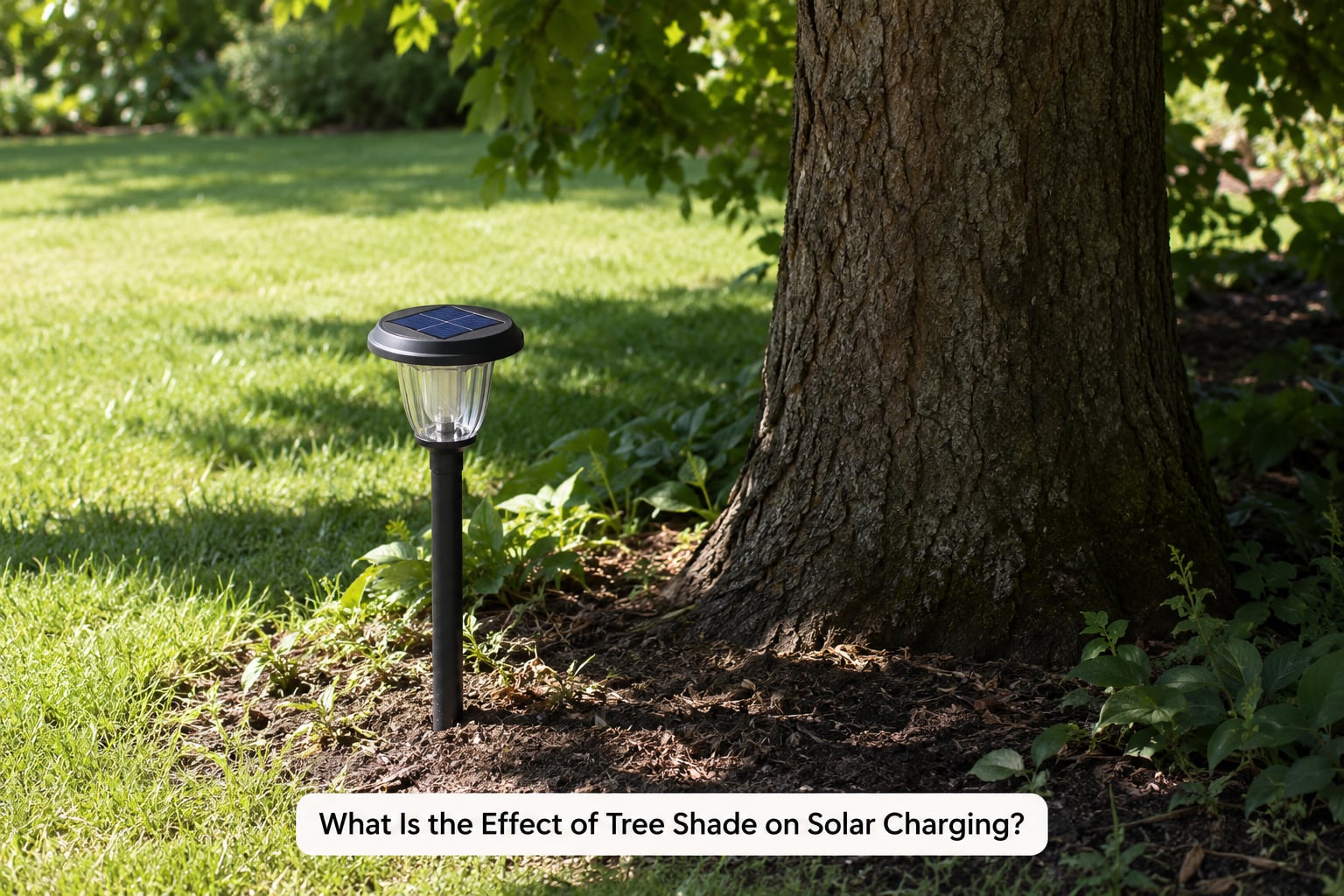
Shade reduces how much electricity a solar panel generates, and that lost energy is never available to charge a battery. Because panel cells are wired together, shading part of one panel drags down everything connected to it, so a small patch of shadow can cost far more output than its size suggests.
Three situations come up constantly, and they behave very differently.
Full sun means the panel sees direct light for most of the day. Charge time is short, the battery reaches full capacity, and the light runs all night. This is the baseline every product rating assumes.
Partial shade is the frustrating one. The panel gets usable light, but it arrives in patches as branches move, so charging is intermittent and rarely completes. A panel that catches two hours of broken sun will often underperform one that catches a steady hour and a half.
Heavy or constant shade is close to a dead panel. If a light spends its day under a canopy, it may gain a trickle of charge that the overnight drain immediately eats. Expect dim output and short runtimes rather than nothing at all.
How Much Can Trees Reduce Solar Power?
There is no single number, and anyone quoting one for your garden is guessing. What the loss looks like depends on panel technology, shade density, how long the shade lasts, battery condition, weather, and what the light has to power overnight.
What people actually observe is more useful than a formula. A small-panel test on r/boondocking measured around 155W in full sun with the panel aligned as well as possible. In a shade demonstration, a handful of small leaves alone was labelled a 20-30% reduction, and one test shaded seven of eight panels. Those are different symptoms of the same mechanism.
Here is how the common situations translate to what you would notice:
| Shade situation | What the panel does | What you notice |
|---|---|---|
| Brief moving shadow | Output dips and recovers as the branch moves | Light still runs a full night, maybe with a slightly shorter first-hour brightness |
| Edge-of-canopy, a few hours each day | Partial charging, never quite reaching full | Light dims earlier in the evening and may cut out before midnight |
| Deep canopy, most of the day | Trickle charge at best | Light barely lights, or the battery drains overnight and never recovers |
| Winter shadow, leaf-off tree | Still loses output, from the low winter sun angle | Garden looks fine in summer and dim in midwinter |
| Leaf litter and sap on the panel | Light is absorbed before it reaches the cells | Output drops gradually and never returns to spec |
Note the last row. Dirt and pollen cost you the same photons that shade does, and owners often blame a tree branch for a soiling problem.
What Types of Tree Shade Matter Most?
Dense canopies hurt most. A thick evergreen blocks a large share of light for all twelve months, so it is the hardest case to plan around. Deciduous trees drop their leaves, which helps in winter and hurts in summer, but leaf-off is not the same as shade-free.
Small-leaved species are sneakier than they look. Fine leaves scatter light, and dappled shade across a panel is harder on a wired system than one solid shadow, because different cells keep getting dragged up and down.
Fast growers change the math on you. Something planted as a small accent can shade a light within three growing seasons, and the tree that caused the problem keeps expanding for decades after you accept it.
Moving branches matter too. A still branch is something you can work around; a branch that sweeps across the panel every afternoon means the light’s charge level resets before it ever reaches full.
And trunk shadows deserve more attention than they get. A trunk is opaque all year, so it casts a fixed obstruction through every season while the leaves above it come and go. That single fact explains most of why how trees affect solar charging changes between one season and the next.
How Do Trees Affect Solar Charging Through the Day and Seasons?
Shade is a moving target, and it never sits where you measured it in spring. The sun tracks a different arc in each season, so the same tree puts its shadow somewhere else on the ground and somewhere else on your panel.
How trees affect solar charging in the morning, afternoon and through the year
Morning shade comes from whatever stands to the east of the panel, and east-facing panels lose their cheapest hours first. Afternoon shade from the west is worse in summer, when the sun is high but the canopy is also at full leaf. Midday sun is the hardest to lose, because a panel almost directly overhead clears most canopies.
Winter throws its own problem. The sun rides low across the sky, so shadows stretch for tens of feet and can reach panels that see clean sun all summer. A garden can look perfect in July and underperform badly in January.
| Season | Deciduous trees | Evergreen trees | Charging impact |
|---|---|---|---|
| Spring | Leaf cover fills in fast, shade arrives suddenly | Shade is constant and predictable | First drop in daily runtime usually shows up now |
| Summer | Densest canopy, longest afternoon shadows | No change, same shade as spring | Worst case for both types |
| Autumn | Leaves thin, light gaps open up | Unchanged | Charging partially recovers, litter adds soiling |
| Winter | Leafless but still casting low, long shadows | Unchanged, and the low sun reaches deeper under the canopy | Evergreen shade is worst in winter |
Neighbouring branches can also redirect light rather than simply block it, bouncing moving highlights across a panel in a pattern that is hard to predict and harder to design around.
How Can You Tell If a Tree Is Interfering with Your Solar Light?
Five minutes of observation tells you more than a week of guessing. Work through it in this order.
Watch the panel at three times of day. Mid-morning, solar noon and mid-afternoon. Note what covers the panel and for how long. A two-minute glance tells you nothing; a timed look tells you everything.
Compare against a control. Put a second identical light, or a multimeter on the same panel, somewhere in open sun. Comparing a shaded light to an unshaded one removes the guesswork about what the weather is doing that day.
Check the charge indicator before dark and again at dawn. A light that shows a full or near-full indicator in the morning got its charge. One that shows empty never did, and the tree is the reason.
Open the battery compartment and look. Swollen or corroded cells, a green or white crust on the terminals, or moisture inside the housing all point at battery failure rather than shade. A battery that cannot hold a charge will not be rescued by moving the light into better sun.
Move the light to open sun for two days. This is the test that settles it. If the same light, same battery, charges properly in the open, the tree was the problem. If it still fails, buy a battery before you touch the tree.
How Do You Solve Tree-Shade Problems for Solar Charging?
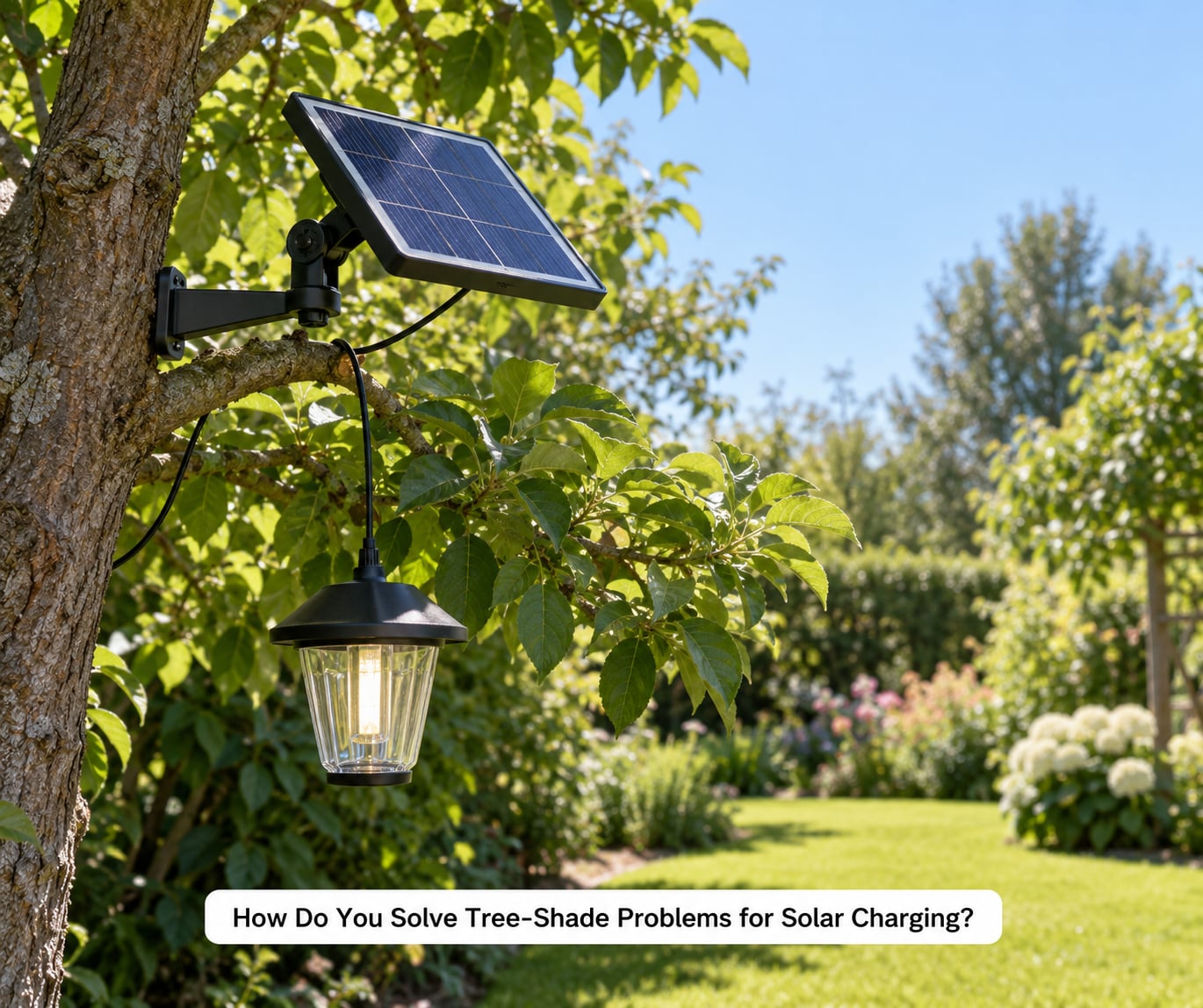
Work down this list in order, and stop as soon as the light charges properly. Each step costs more or risks more than the one after it, which is how trees affect solar charging in a practical sense: mostly as a placement problem.
Move the light to open sun. It is free, it takes a minute, and it solves most garden-light problems completely. A path light on a spike can move two feet in ten seconds.
Raise the panel above the shade line. A small bracket or a length of conduit holding the panel above low branches often fixes a light that sits in perfect ground-level shade.
Tilt the panel toward the light gap. If the sun comes through one side of the canopy, angle the panel into that gap. A panel facing the open sky beats a flat panel fighting leaves.
Switch on the light for a shorter window. Many fixtures have a mode setting or a timer. Cutting the expected night runtime roughly in half makes partial shade workable instead of hopeless.
Fit a light with a larger panel and a bigger battery. More panel area only helps if some of it sits in the sun, and a larger battery holds a partial charge better than a small one.
Trim the branches. This works and it is the point where a homeowner’s weekend becomes a tree-care job. See the next section before touching a mature tree.
Add a separate charging panel. For an off-grid cabin, an RV or a small equipment charger, a dedicated panel mounted clear of the canopy in open sun can feed a battery inside the shade line.
Two cautions. Electrical work on mains-connected solar fittings belongs to a licensed electrician, and any panel or battery change should follow the manufacturer’s specifications rather than a rule of thumb from the internet.
A warning that fits here: a low sun over panels creates a real burn and fire hazard, so check for dead limbs hanging above an array and get them assessed before you spend a summer watching them move in the wind.
Can Solar Lights Still Work Under Partial Tree Shade?
Yes, in a fair number of cases. Partial shade is workable when the panel gets several hours of usable light rather than a few stray minutes, when the shade arrives in the evening instead of the morning, and when the fixture is only expected to light a path for a few hours rather than all night.
Estimate it like this: multiply your usable direct-sun hours by a rough conversion for the panel area you have, then compare that to what the light needs for its brightest hours. Most path lights need a full day of sun for a full night of run time, so halving the sun means halving the brightness or the hours.
Bright winter shade is the exception worth making. A bare-branch shadow in January costs far less than the same footprint of leaves in July, and some lights look dim in December yet run properly from spring onward.
Panels mounted just outside a canopy, rather than directly under it, are the sweet spot. Near enough to blend into the planting, far enough to see open sky through most of the day.
Should You Move a Solar Light or Cut Back the Tree?
Move the equipment. It costs nothing, it takes an afternoon, and it never puts the tree at risk. Re-siting a light, tilting its panel or mounting the panel higher solves the overwhelming majority of cases, and it stays solved.
Trimming makes more sense when the light cannot be moved, such as a panel built into a path or fixed to a fence post with no open sun on the other side. Crown raising lifts the lower canopy to clear the sun path, and crown thinning removes branches to open light gaps through the crown. Both are proper pruning jobs for a qualified arborist, not for a ladder and a hand saw.
Removal is the last option, not the first. It is irreversible, and it is usually the one homeowners regret. Arborists on r/arborists tend to reframe the debate usefully: trees cool the home, shade the garden and sequester carbon, while the panels offset emissions from electricity generation. Both assets are worth keeping where possible.
If the tree stays, design around it. Slow-growing species placed on the north side of a property, kept back from the roofline, cost you nothing in lost sun. Check local tree ordinances before any pruning, and keep major work well clear of the root plate, since cutting roots and cutting canopy cause very different damage.
Frequently Asked Questions
Can solar lights charge under tree shade?
Yes, but slowly. A shaded panel still generates current, just less of it, and a light that only gets two hours of broken sun may not recover enough charge to run all night. The fix is usually relocation, a higher panel, or a fixture that runs a shorter window rather than removing the tree.
How many hours of direct sun does a solar garden light need?
Most path and garden lights expect six or more hours of direct sun to fill the battery for a full night. Three to four hours of clear sun can still work if the battery is in good condition and the light is set to a shorter runtime. Off-grid users treat three to four hours as the practical floor for a worthwhile install.
Does a bigger solar panel fix tree-shade charging problems?
Only partly. A larger panel helps if the extra area sits in open sun, but a bigger panel sitting in the same shade collects proportionally little more light. Adding area and adding exposed area are different fixes, and only the second one solves a shading problem.
Are solar lights suitable for a shaded garden?
They work in a shaded garden, with expectations adjusted. Choose lights with a larger panel, plan for shorter runtime, and set them to switch on at dusk rather than run all night. A shaded garden is a poor fit for a single bright light at the far end of a path, and a fine fit for a row of low-output markers.
Can I move a solar light after installing it?
Almost always. Most solar lights sit on a spike or a stake, so you can lift them out and reposition them in a minute. If the light is wired into a landscape lighting circuit or fixed to a structure, have an electrician handle the move rather than pulling on the cable yourself.
Should I remove branches to improve solar charging?
Trimming works, but use crown raising or crown thinning rather than cutting the tree back hard, and hand anything substantial to a qualified arborist. Removing branches damages the tree’s defences and reduces the canopy it needs, so it should be the answer when moving the light is genuinely impossible.
If you do one thing this weekend, watch your light’s panel at noon and again at four o’clock, then move the fixture to the brightest spot you have. Tree shade is a placement problem far more often than it is a tree problem, and placement takes minutes to fix. That is the whole answer to how trees affect solar charging: less light arrives, less charge is stored, and the cheapest remedy is almost never cutting anything down.