If your grid goes out for a few hours, a battery or portable power station will carry the essentials quietly and automatically. If the outage runs for days in summer heat, a generator keeps running as long as you have fuel. That single difference — stored energy versus burned fuel — is the core of the solar panels vs generator for backup power question, and it decides the answer for most households.
Both options are sold as “backup power” and they solve the same problem in completely different ways. Solar panels alone are not backup power at all; the panels stop at sunset, so a battery is what actually carries the house through a night. Generators have no such limit on runtime, but they bring noise, exhaust, fuel logistics, and servicing into a space that sits ten feet from your back door.
Below is a straight comparison based on what the two systems physically do, what forum owners report after real outages, and where each one quietly falls short.
Table of Contents
- Solar Panels vs Generator for Backup Power at a Glance
- Power Output and Runtime
- What a typical household actually needs
- Why batteries run out sooner than people expect
- Output and surge
- Solar Panels vs Generator for Backup Power: Costs
- Before you switch anything on
- What it costs to run
- Incentives and payback
- Noise, Convenience, and Everyday Use
- Reliability, Maintenance, and Safety
- Carbon monoxide and placement
- Electrical safety
- Installation and Backup Capacity
- Matching capacity to your loads
- Which Should You Choose?
- Frequently Asked Questions
- Do you still need a generator if you have solar panels?
- Can solar panels power a whole house during a power outage?
- Will a 400W solar panel run a refrigerator?
- How long can a solar battery run during a power outage?
- Is a whole house standby generator worth it?
- Can you run a generator and solar at the same time?
- Conclusion
Solar Panels vs Generator for Backup Power at a Glance
| Criterion | Solar with home battery | Generator |
|---|---|---|
| Power source | Sunlight captured and stored as chemical energy | Gasoline, propane, diesel, or natural gas burned on demand |
| Typical output | 3 kW to 10 kW continuous from a home battery, scaling with added modules | 3 kW portable units up to 20 kW and above for standby models |
| Storage | 10 kWh to 40 kWh common for whole-home backup | Tank capacity limits runtime, typically hours to days per fill |
| Outage runtime | Limited by stored kWh and refills only when the sun is out | As long as fuel keeps arriving, day or night |
| Fuel or energy needs | None; recharges from the array or the grid | Continuous refuelling, plus fuel stabiliser for stored petrol |
| Noise | Silent to a faint inverter hum | Loud enough to hear indoors, especially portable models |
| Emissions | Zero at the point of use | Carbon monoxide and exhaust gases at the outlet |
| Maintenance | Panel cleaning and battery health monitoring | Oil changes, filters, spark plugs, fuel stabilisation, annual service |
| Expected lifespan | Panels often exceed 25 years; batteries usually warrant around 10 | Roughly 10 to 15 years for the engine before a major rebuild |
| Switchover | Near instant, usually under a second | Seconds to a minute for standby models via transfer switch |
| Best use cases | Frequent short outages, essential loads, quiet neighbourhoods | Multi-day events, heat pumps, well pumps, workshops |
Power Output and Runtime
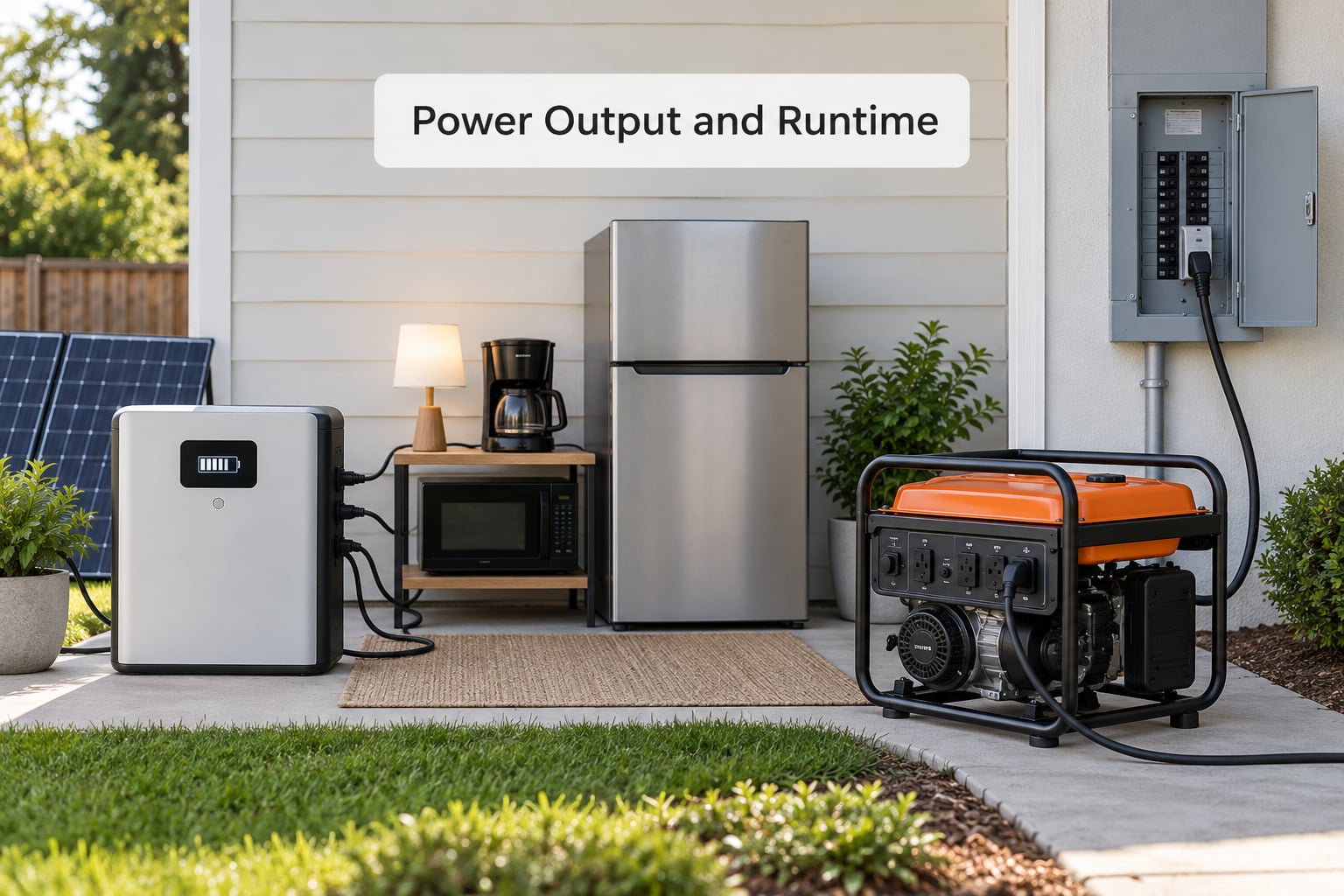
Runtime is the whole argument, and it splits cleanly along one line. A battery has a fixed pile of stored energy measured in kilowatt-hours. A generator converts fuel into electricity as fast as you burn it, so its runtime is a delivery problem rather than an energy problem.
A modern fridge averages roughly 100 to 200 watts while its compressor runs, and a cubic foot of freezer holds about the same draw. A refrigerator cycling on and off uses somewhere near 1.5 kWh across a day. Multiply that by three days of outage and a modest 5 kWh battery looks generous until you add lights, a router, a laptop, and phone charging.
What a typical household actually needs
Most essential loads — refrigerator, freezer, internet router, a few LED lights, phone chargers, a medical device — land between 1 kWh and 3 kWh per day. Heat pumps, well pumps, electric water heaters, and freezers in a garage swing much wider. A 1.5 kW well pump cycling for a few minutes an hour can add 1 kWh or more a day on its own, which matters a great deal for rural homes that depend on it.
The forum consensus on r/prepping matches that arithmetic: people argue that solar can carry lights and a water pump through several sunless days, while agreeing it is not equivalent to household power.
Why batteries run out sooner than people expect
Two things eat a battery faster than the label suggests. The first is round-trip loss — a lithium iron phosphate bank returns a bit less energy than it stores. The second is the recharge gap: once the panels stop, there is no refuelling until sunrise, so a household that starts an outage at full charge ends the second night considerably behind.
Owners on r/Generator describe the pattern clearly. A user in Southern California lost power for about a week, and neighbours with solar had nothing to show for it but their generators. That single report is the clearest argument in the whole debate — after several cloudy days, stored energy runs out and there is no tank to refill.
Generators have the opposite failure mode. Their limit is supply, not capacity. A user on tdpri.com reported around five minutes of switchover and a 30 to 40 percent battery top-up on a sunny day from solar, which is the case for pairing the two rather than choosing between them.
Output and surge
Generator output is described in watts of running power plus surge capacity for motors kicking on. Battery output is described in continuous kilowatts with the inverter doing the conversion. A well pump or a refrigerator compressor is a motor with a hard startup spike, so an inverter rated near the same figure as the load will trip on startup. Sizing headroom matters more than headline capacity.
Solar Panels vs Generator for Backup Power: Costs
Cost splits into two categories that point in opposite directions. Solar costs far more before you switch it on and almost nothing after. A generator costs a fraction as much up front and keeps charging you every time it runs.
Before you switch anything on
A portable power station with a small folding panel is an entry-level purchase most households make without thinking hard about it. Whole-home solar battery backup with an inverter, a critical loads panel, a transfer switch, and an electrician is a different order of project — several times the equipment cost of a comparable generator, plus permitting and any service panel upgrade the utility requires.
SolarDIY and solarpaneltalk regulars make the same arithmetic point without much disagreement: batteries run much more expensive per kilowatt than a generator. One veteran summary is that generators are a very cost effective solution for backup power and many off-grid homes will still own one.
What it costs to run
Once installed, a battery recharges from sunlight that would otherwise go unused. A generator burns fuel whether or not the sun is out, and fuel has to be carried to the house, stored safely, and kept fresh. Over a decade, or over even a handful of serious outages, the fuel line item is the largest single difference in the comparison.
The counterweight is battery replacement. Warranties commonly run about ten years, and capacity fades gradually before that point. Households who keep a system for fifteen to twenty years should expect one or more battery replacements inside the ownership period, and that replacement belongs in the same column as fuel costs when you total up the years.
Incentives and payback
Federal residential clean energy incentives have applied to qualifying battery storage for years, though eligibility and amounts shift with legislation, so check the current rules before you count on a specific figure. Incentives narrow the gap on the front end without changing the operating-cost picture at all.
Homeowners on early-retirement.org, who saw roughly six outages a year lasting two to twenty hours, concluded that whole-house portable generator backup was the convenient balance for them. That is an honest answer for heavy, frequent, short interruptions. The economics only tilt hard toward storage when the battery also reduces your grid bill between outages, which is a different question than backup power alone.
Noise, Convenience, and Everyday Use
Batteries are silent and automatic. When the grid drops, the inverter notices, the system isolates from the grid, and the house carries on. There is nothing to pull out of a shed, no extension cord through a window, and no smoke to close the neighbours’ windows against.
Generators are loud. A portable model running at full output is audible indoors with the windows open, and neighbours hear it clearly, which is why noise rules and HOA restrictions come up so often in discussions of standby models. Standby generators are quieter because they run at lower load with better sound dampening, but they are still machines sitting outside your house.
Beyond noise, a generator asks for regular human attention: checking oil, running the fuel tank dry or adding stabiliser, replacing a spark plug, keeping the exercise start cycling. A battery asks you to wipe dust off panels twice a year and watch a phone app.
For occasional use, solar wins on effort. For genuine emergency use, the generator’s simplicity at 2 a.m. in the rain is worth a lot, and nothing else starts as fast without hunting for a key or a fuel can.
Reliability, Maintenance, and Safety
Solar depends on sunlight. Multi-day overcast weather removes the refill mechanism entirely, which forum users describe as the single most-cited limitation of solar-only plans. Battery age is the second dependency — old cells hold less and deliver less peak power, so an ageing system can trip on loads it used to handle comfortably.
Generators depend on fuel, spark plugs, oil pressure, and air filters, and they depend on you noticing a problem before it strands you. A generator that will not start in January because of stale fuel is a familiar and avoidable failure.
Carbon monoxide and placement
This is where the safety comparison is not close. A generator produces carbon monoxide, which is odourless and colourless, and fatal when it accumulates indoors. Health authorities advise running combustion generators outdoors, well away from doors, windows, and vents, and never in a garage, basement, shed, or enclosed porch. Generators used as backup power belong outdoors.
A battery has no combustion, no exhaust, and no carbon monoxide risk. It introduces different hazards instead — lithium chemistry fire risk from a damaged or overcharged unit, and electrical work that must be done to code by a licensed electrician. Batteries with thermal management and certified cell design handle the first of these well.
Electrical safety
Both systems require an interlock. A transfer switch or an outlet-specific interlock prevents two sources of power feeding the same circuit, which is how backfeed injuries happen. Portable generators need this every time; a grid-tied solar inverter needs anti-islanding protection and the utility’s permission before it operates in an outage. DIYers run into interconnection rules constantly, and the forum advice is consistent: get the permit and the electrician.
Installation and Backup Capacity
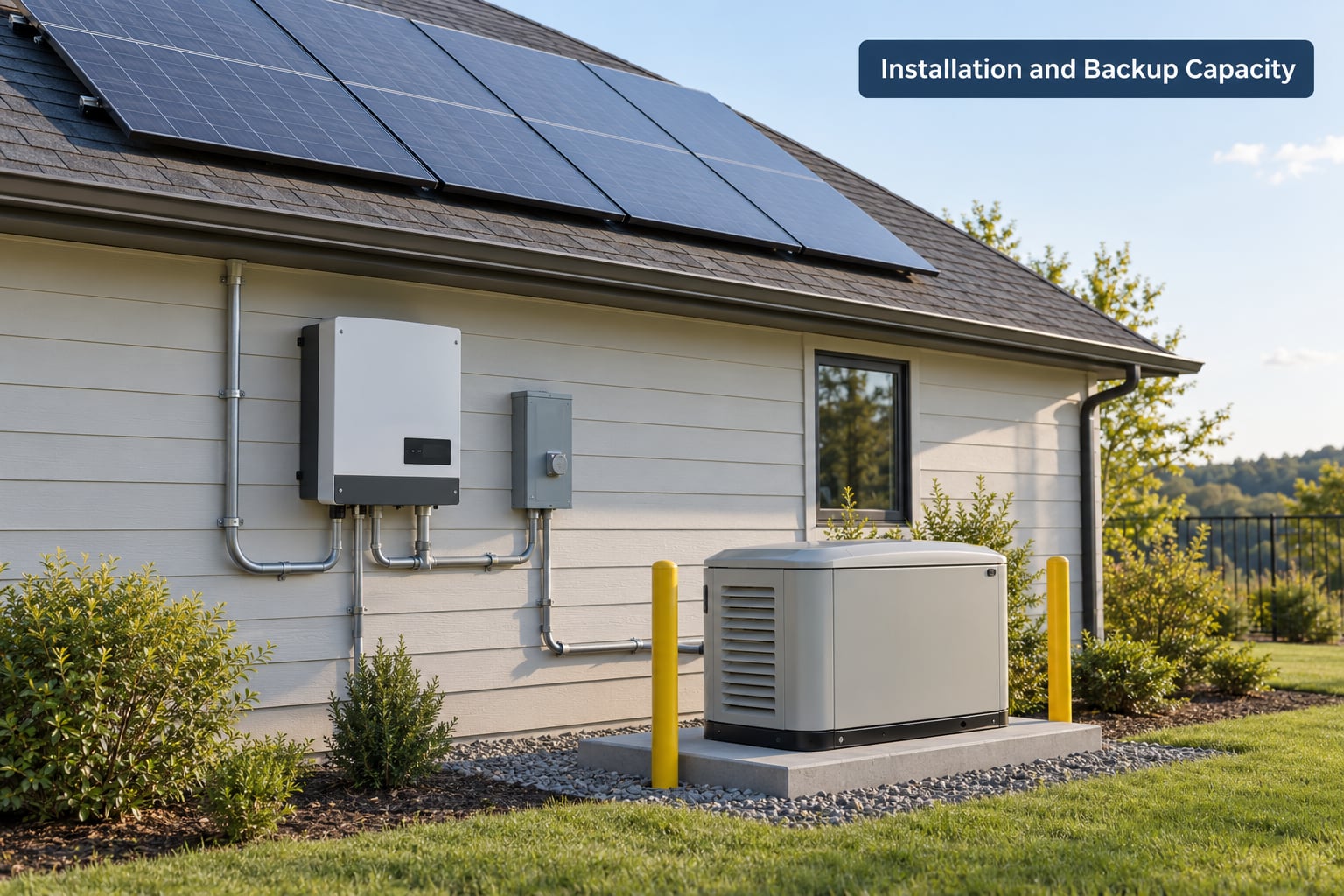
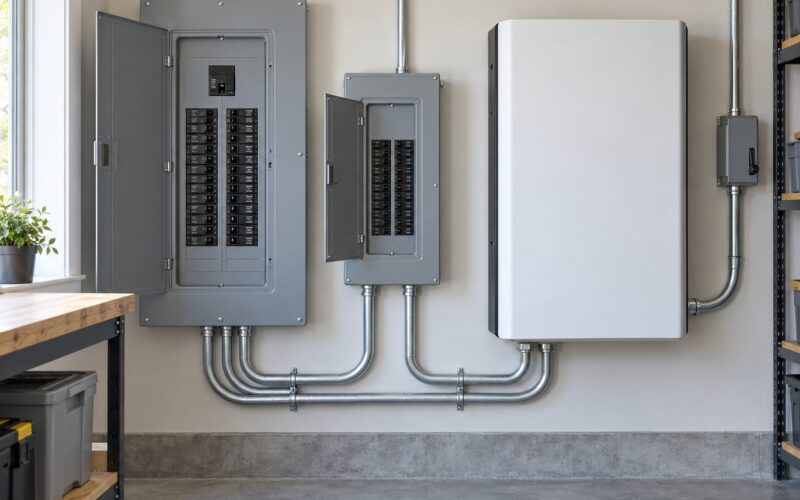
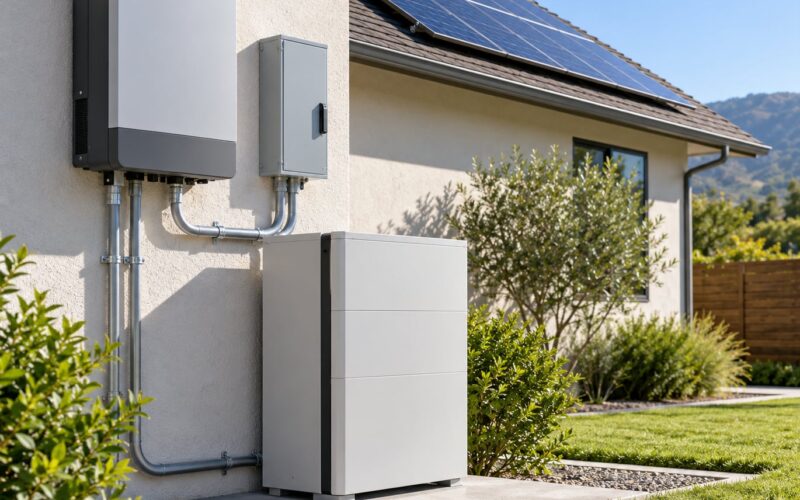
A solar backup system is a small power plant. It needs panels or an existing array, a hybrid inverter that can operate without the grid, a battery bank, and a transfer device to isolate from the utility. Grid-tied systems that were never designed for outage use will shut down the moment power fails, so the islanding capability has to be specified deliberately rather than assumed.
A portable generator needs a rated output matched to your loads, a transfer switch, a properly sized extension lead or a standby inlet, and an outdoor pad with clearance. A standby generator adds a permanent enclosure, an automatic transfer switch, fuel plumbing for natural gas or a large propane tank, and utility coordination for gas service work.
Matching capacity to your loads
One r/Generator thread shows how the decision actually gets made. Two senior homeowners weighing a 20 to 24 kWh battery and solar system against natural gas asked about dependability and safety, including civil disruption and electromagnetic pulse scenarios, not just storms. That is a reasonable question to ask, and the honest answer is that storage handles the first hours of any event cleanly while fuel handles the long tail.
Start by listing the loads that actually matter, adding their daily kilowatt-hours, sizing storage for two to three days, then sizing panels for a daily recharge. If the panel-to-battery ratio is too low, the battery sits depleted and the system cannot recover between cloudy spells.
Two sizing conventions come up often. Peak sun hours are the usable equivalent hours of full sun a region gets per day, and they range from around four in the upper Midwest to six or seven across the Southwest — the difference between a system that recharges comfortably and one that does not. The 33 percent rule refers to the US federal residential clean energy credit, historically covering roughly a third of qualifying system cost; programs change, so confirm what applies in 2026 before relying on it.
Which Should You Choose?
Choose solar with battery storage when outages are frequent but short, when your essential loads stay modest, when noise matters, and when the roof gets real sun. Choose a generator when outages run long or arrive with heat, when you need to run a heat pump, well pump, freezer full time, or shop tools, or when fuel is easy to obtain.
Ask five questions before you spend anything:
- How long do outages actually last where I live, and how often do they happen?
- What does my essential load list add up to per day in kilowatt-hours?
- Does my roof or yard get enough direct sun to recharge a battery?
- Can I get fuel during the exact kind of event I am preparing for?
- Will a generator’s noise and exhaust work with my neighbours and my local rules?
Now run the scenarios. For a two-hour outage, either option works and a portable power station is easier. For a three-day storm with mixed weather, a battery sized for essentials holds up if you manage consumption; a generator carries heavy loads without debate. For a week-long outage, only a fuel source is realistic, and one r/Generator report of solar-equipped neighbours running out mid-week is exactly why.
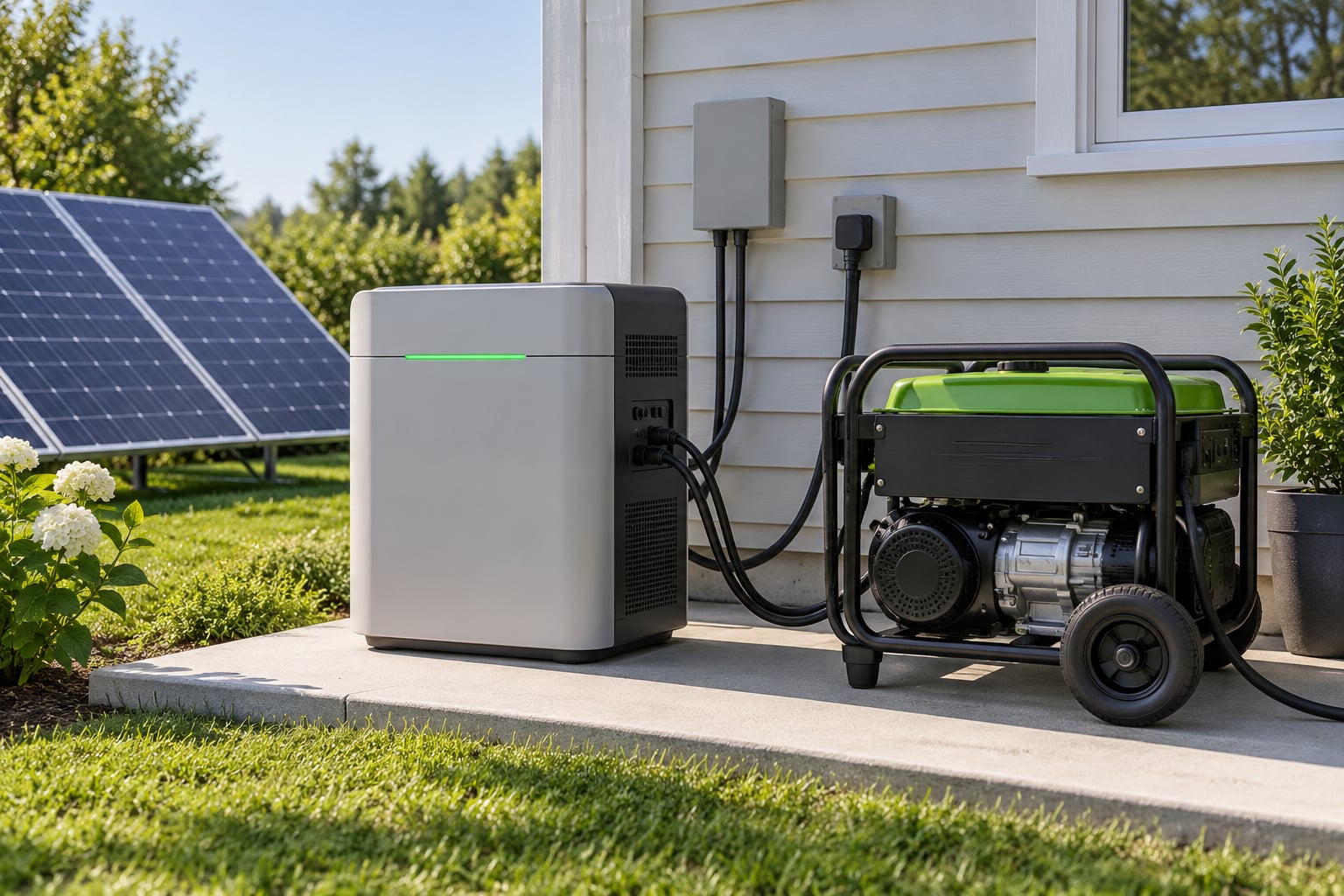
Consider the hybrid when the stakes are high. Solar with battery handles the first hours automatically, and the generator covers the battery when it runs low or when the weather stays grey. Owners on r/solar describe the ideal setup as a generator whose job is to charge the batteries, which keeps the fuel load far smaller than running a generator flat out for days.
One caution about language. A “solar generator” is usually a portable battery that panels charge. It does not generate anything, and prepper forums keep encountering buyers who expected generation and received a battery with a solar panel attached.
Frequently Asked Questions
Do you still need a generator if you have solar panels?
Usually, yes, if the outage lasts more than a day. Solar panels stop producing power at sunset and cannot run a home without a battery, and a battery only carries you as far as its stored kilowatt-hours plus whatever the sun puts back the next day. Forum owners report running out of stored charge by day two or three during multi-day cloudy events. Most households who live in outage-prone areas end up running both: battery for the essentials and automatic switchover, generator for the long tail.
Can solar panels power a whole house during a power outage?
Only with a battery designed for outage use and an inverter that can island from the grid. Most grid-tied inverters shut down the moment the utility power fails, which is a safety feature, so the outage capability has to be specified when the system is installed. Even then, a typical whole-home battery covers essential loads rather than everything: a fridge, freezer, lights, router, and outlets. Heat pumps, water heaters, and well pumps usually exceed what a residential battery can deliver.
Will a 400W solar panel run a refrigerator?
A single 400W panel cannot power a refrigerator directly. It can charge a battery that then runs one. A typical fridge uses about 100 to 200 watts while the compressor runs and roughly 1.5 kWh over a full day of cycling. In good sun, a 400W panel produces around 1.6 to 2 kWh a day after losses, which is enough to keep one fridge and a few lights going indefinitely but leaves nothing for a freezer, microwave, or well pump.
How long can a solar battery run during a power outage?
It runs until the stored kilowatt-hours are gone, plus whatever the panels add back. A 20 kWh usable battery at a realistic household draw of about 2 kWh an hour covers roughly ten hours with no sun at all. With good sunlight, panels refill several hours of consumption each day, so a system can hold indefinitely. During a multi-day overcast event, refill stops and owners report reaching the limit around day two or three.
Is a whole house standby generator worth it?
It is worth it when outages are frequent, your household needs to run heavy loads such as a heat pump or well pump, or you depend on electricity for medical equipment and cannot tolerate downtime. Standby models start automatically and can carry most of a home, but they need fuel, annual servicing, and outdoor placement well clear of doors and windows. For short, occasional outages, a portable generator with a transfer switch often covers the same need for far less money and a smaller pad.
Can you run a generator and solar at the same time?
Yes, and it is the setup many owners land on. The two are wired so the generator charges the battery bank rather than feeding the house directly, which means the fuel load is much smaller than running a generator at full output for days. Installation needs a transfer arrangement that prevents two sources from feeding the same circuit, and it should be designed by a licensed electrician to your local code.
Conclusion
Start with a list, not a product. Write down the loads you cannot live without and add up their daily kilowatt-hours, then count how often and how long outages actually happen where you live. That answer usually settles the question before any equipment gets quoted.
After that, check your sun exposure and installation conditions, work out what fuel access looks like in the scenario you are preparing for, and compare total cost over ten years rather than the first invoice. Get a licensed electrician involved either way, and keep the generator outdoors, well away from any opening into the house.
For most households the practical answer is a hybrid: solar and battery for the essentials that switch on by themselves, plus a generator for the days when stored energy is not enough. Whichever way you go, buy for the outage you will actually have rather than the marketing claim about running your whole house.