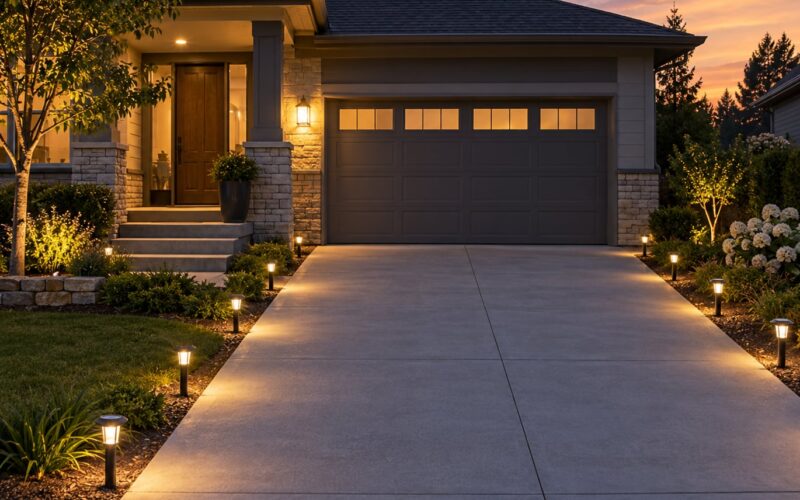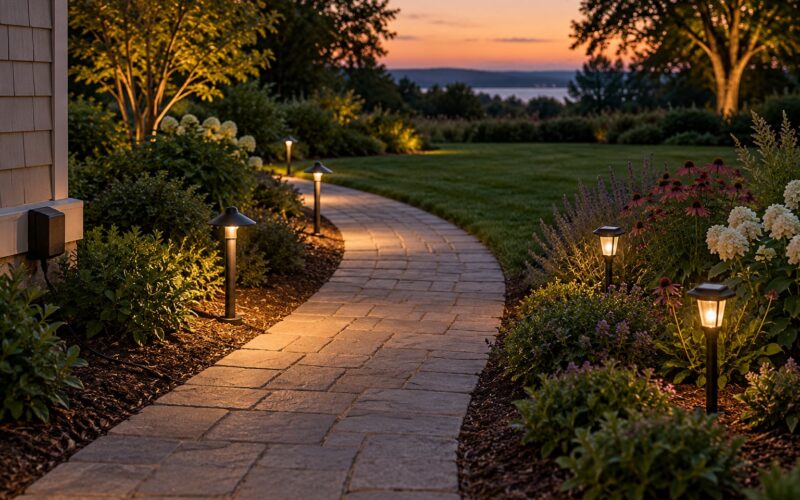
If you are weighing solar vs wired landscape lighting pros and cons for your yard, the short version is this: solar wins on install effort and running cost, wired wins on brightness, consistency and how many years it keeps working. Most homeowners land somewhere in the middle, using solar in open sunny spots and wiring the paths, steps and entry points that genuinely need dependable light.
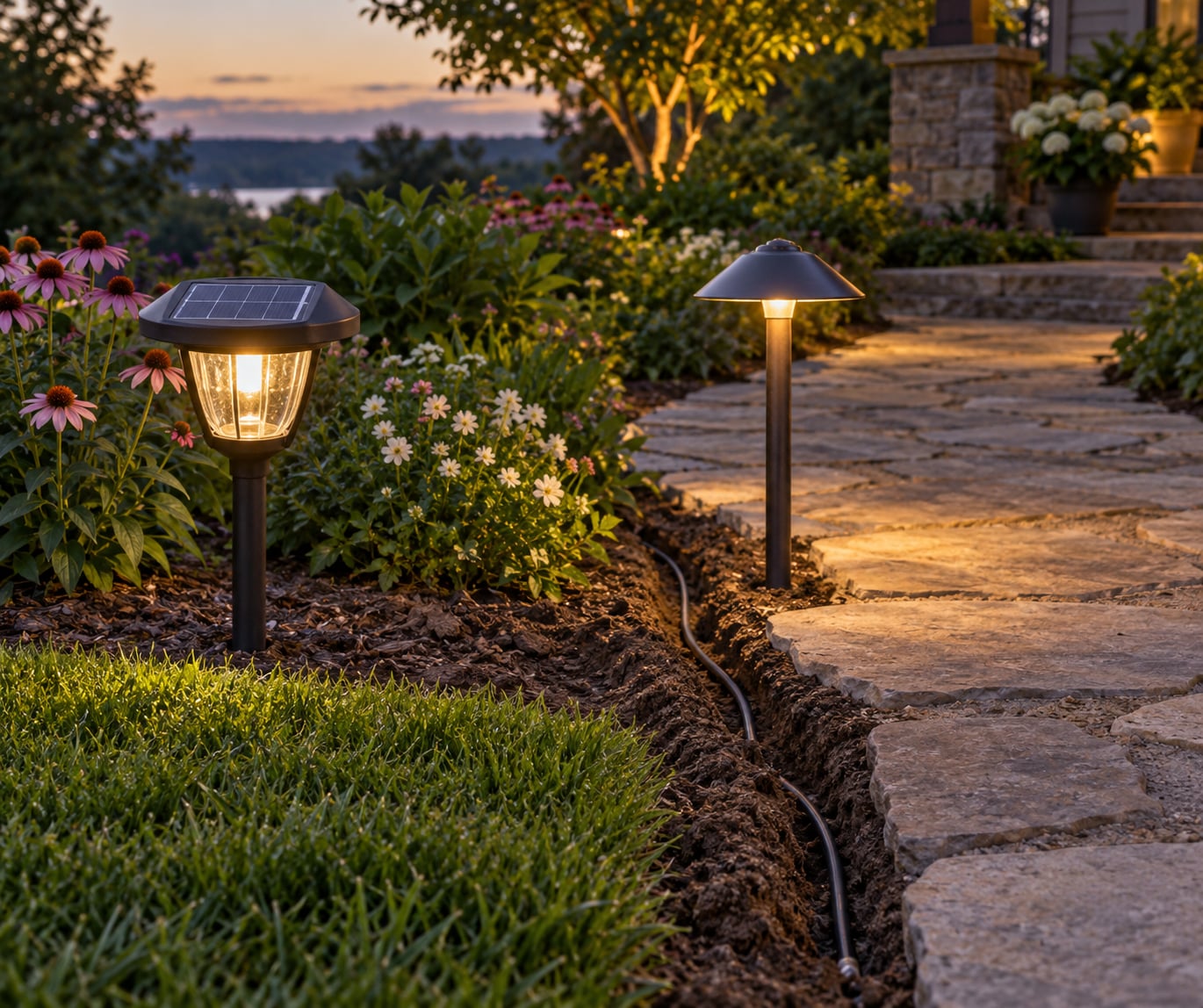
Both systems end up lighting the same things, a front walkway, a garden bed, a patio, a driveway edge. They differ in where the power comes from. Solar landscape lighting charges a small panel during the day, stores that energy in a rechargeable battery, and switches on at dusk through a photocell. Low-voltage wired landscape lighting runs 12V current from a transformer plugged into an outdoor GFCI outlet, pushing it through buried copper cable to each fixture.
That single difference cascades into everything else, brightness, how much digging you do on day one, what you are doing on the roof of the fixture five years later, and whether the path stays lit when the weather turns.
Table of Contents
- Solar vs Wired Landscape Lighting Pros and Cons at a Glance
- Installation and Wiring: Which Option Is Easier?
- How solar installation actually works
- How wired installation actually works
- Upfront Costs and Ongoing Expenses
- What actually drives the price
- Thinking about cost over ten years
- Brightness, Coverage, and Design Options
- Coverage and beam control
- Smart control and scheduling
- Matching existing fixtures
- Reliability in Rain, Snow, and Long Winters
- Winter performance, honestly
- Climate guidance by region
- Maintenance, Battery Replacement, and Lifespan
- Why solar garden lights fail early
- What wired maintenance involves
- Solar vs Wired Landscape Lighting: Which Should You Choose?
- Best fits for solar
- Best fits for wired
- Large yards and mixed systems
- Before you commit
- Frequently Asked Questions
- Is solar landscape lighting cheaper than wired lighting?
- Do solar landscape lights work in winter?
- Do solar lights need electrical wiring?
- Which is better for a large yard?
- How long do solar landscape lights last?
- Can I install landscape lighting myself?
- Conclusion
Solar vs Wired Landscape Lighting Pros and Cons at a Glance
| Criterion | Solar | Low-voltage wired |
|---|---|---|
| Installation | Stake it in, done in minutes per fixture | Trench cable, mount transformer, plan voltage drop |
| Upfront cost | Low, fixture by fixture | Higher, cable and labor add up fast |
| Operating cost | None, no electricity used | A few dollars a month on the meter |
| Typical brightness | Ambient, roughly 10 to 100 lumens per fixture | Bright, roughly 200 to 1000+ lumens per fixture |
| Consistency | Varies with sun, season and panel angle | Constant output until switched off |
| Nightly runtime | About 4 to 8 hours after a full charge | All night, limited only by the timer |
| Maintenance | Panel cleaning, battery swap every 1 to 3 years | Bulb swaps, occasional cable and transformer checks |
| Lifespan | Fixture 3 to 5 years, batteries shorter | 10 to 15 years or more with LED upgrades |
| Relocation | Move it anywhere with sun | Fixed once the cable is buried |
| Best fit | Renters, remote beds, shaded-to-partial zones | Paths, steps, driveways, security and trees |
One more row worth adding in your head, even though it is not a spec: smart control. Wired low-voltage systems pair with timers, photocells, dimmers and app-based controllers far more easily, because the power is already there. Solar fixtures can be smart, but each unit carries its own battery to maintain.
Installation and Wiring: Which Option Is Easier?
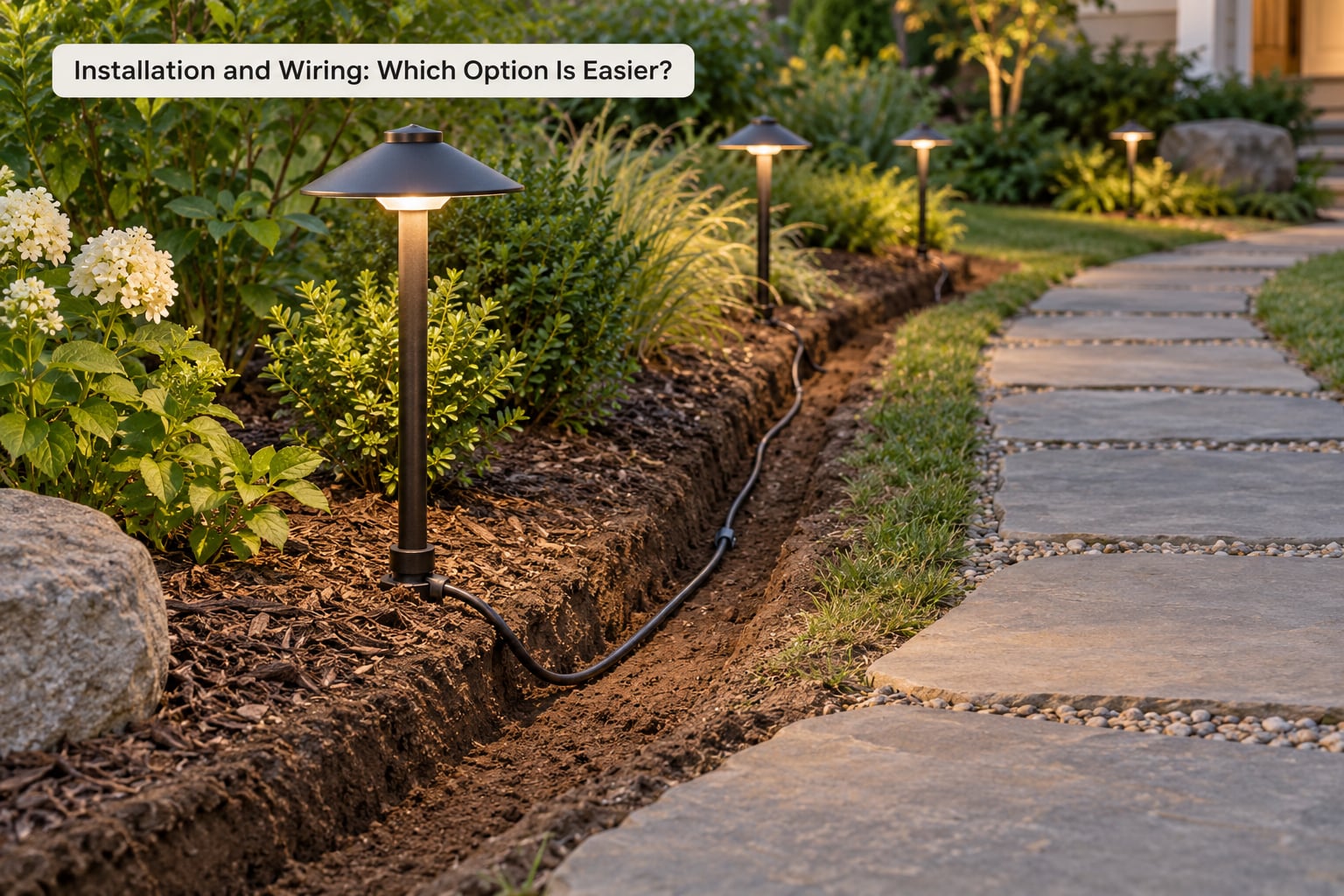
Solar is easier by a wide margin. A stake light goes into the ground wherever you want it, and the only real decisions are which side faces south and how much shade the spot gets. If you later decide the light belongs somewhere else, you pull the stake and move it.
How solar installation actually works
The panel needs roughly six hours of direct sun to reach a useful charge, and it needs to see that sun, not the light bouncing off a wall. North-facing fixtures, under-eave positions and beds under mature trees are where most disappointed solar buyers end up.
Panels also fog with pollen, dust and rain film, and a dirty panel quietly cuts output. That is a hose-and-cloth job twice a year, not a big deal, but it is a job.
How wired installation actually works
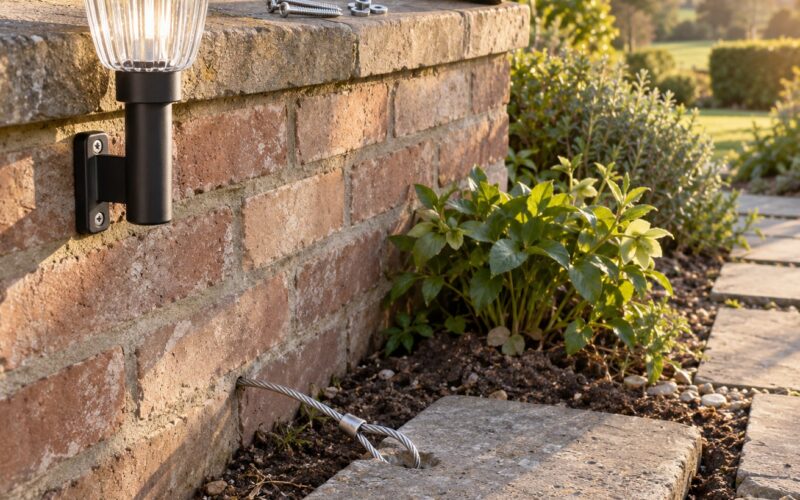
A wired system needs a transformer mounted near a GFCI-protected outlet, low-voltage cable buried typically 6 to 12 inches deep, and connections that stay dry. Fixtures then daisy-chain off that cable. Buried cable is usually the least enjoyable part of the job, especially around trees with roots you would rather not cut.
Two mistakes show up again and again. The first is running the wrong wire, including doorbell or doorbell-style cable, which forum DIYers on Mike Holt’s boards warn against for lighting runs. The second is undersizing the transformer or ignoring voltage drop over a long circuit, which is why distant lights look dim and yellowish while the ones near the transformer look fine.
There is a scheduling problem nobody mentions in product descriptions. If a landscaper is also in the yard, the electrician and the landscaper have to share the schedule, and one of them moving the date costs you money. On a Houzz thread, a homeowner described avoiding a hardwire project entirely and going solar as the interim solution for safety lighting for aging parents.
Neither system is hazardous to install if you follow the manual, but anything involving your home’s electrical panel, an outdoor receptacle or line-voltage work belongs with a licensed electrician. Check local code and permit rules before you trench, because requirements vary by county and a retrofit may need inspection.
Upfront Costs and Ongoing Expenses
Solar is cheaper to start, and it stays cheap to run. You buy the fixture and you own it outright. There is no cable, no transformer, no electrician, and nothing on the utility bill after installation.
Wired costs more up front because you are paying for infrastructure. The cost components are fixtures, low-voltage cable, the transformer, weatherproof connections, whatever trenching or restoration the yard needs, and labor if you hire it out. Cable length adds up faster than people expect once you route around trees, walkways and planting beds.
What actually drives the price
For solar, quality spread is enormous. A cheap stake light with a small panel and a weak battery may look fine in summer and disappoint you by the second winter. Paying more for a larger panel, a lithium battery and a real IP weather rating buys the runtime difference between four hours and eight.
For wired, project size drives everything. A six-light front path is a weekend. A whole-property plan with tree uplighting on mature oaks is a different job entirely, and the trenching portion often costs as much as the fixtures.
Thinking about cost over ten years
On paper, solar wins the operating side forever because it burns no electricity. In practice, count battery replacements. If you replace a battery every two years on a 12-light system, that is six battery purchases over a decade, and the arithmetic stops looking as clean as the marketing suggests.
Wired systems keep working year after year. LED bulbs are the weak point there, and those are cheap to swap one at a time. All figures people quote for either system are typical US ranges that shift by region and change over time, so get your own quotes rather than trusting a number from a forum post.
Brightness, Coverage, and Design Options
Wired lighting is simply brighter. A low-voltage LED path light commonly puts out 200 lumens or more, and spotlights aimed at trees run far higher. Solar path lights cluster around 10 to 100 lumens, which reads as a soft glow rather than usable illumination.
That gap decides what each system can do. Ambient and decorative work, a gently lit garden bed, a marker along a path edge, a glow near a step, solar handles well and cheaply. Task lighting, safety lighting on stairs, security lighting across a driveway, tree uplighting on a big canopy, that is wired territory.
Texags forum users put it plainly, saying they were not happy with the strength of light from solar LEDs they had tried. On Bogleheads, people note that both solar and low-voltage spotlights can fall short when the goal is lighting something as large as a flagpole. Neither technology rescues you from bad fixture placement.
Coverage and beam control
Wired spotlights give you aiming control, tilting a hood to wash a trunk or a facade without spilling into a neighbor’s window. Beam spread and color temperature are also choices you control, and mixing warm and white LEDs across a property is straightforward when everything is on one circuit.
Solar fixtures offer fewer options. Stake lights are usually fixed-beam and fixed-color, and larger solar bollards give more output at a bigger footprint and higher cost. Design range exists, mostly in bollards, wall lanterns and modern spike lights, but you are choosing from a narrower shelf than you are with wired.
Smart control and scheduling
Wired wins this one outright. A timer or photocell on the transformer turns the whole system on at dusk and off at a set hour, and dimmers, in-line controllers and app-connected switches add scheduling, zones and dimming without touching each fixture.
Solar can do the same things, but every fixture is its own island with its own battery to keep alive, which means more units to mount, more batteries to age and more panels aimed correctly. For a two-light bed, who cares. For a full property, the maintenance trail grows.
Matching existing fixtures
A Reddit r/landscaping thread on patio lighting put one recurring reason for going wired plainly: matching what is already on the house, inside and out. If your exterior fixtures are already wired and you want a consistent look, solar is the harder path. If you are starting from nothing, the visual gap matters much less.
Reliability in Rain, Snow, and Long Winters
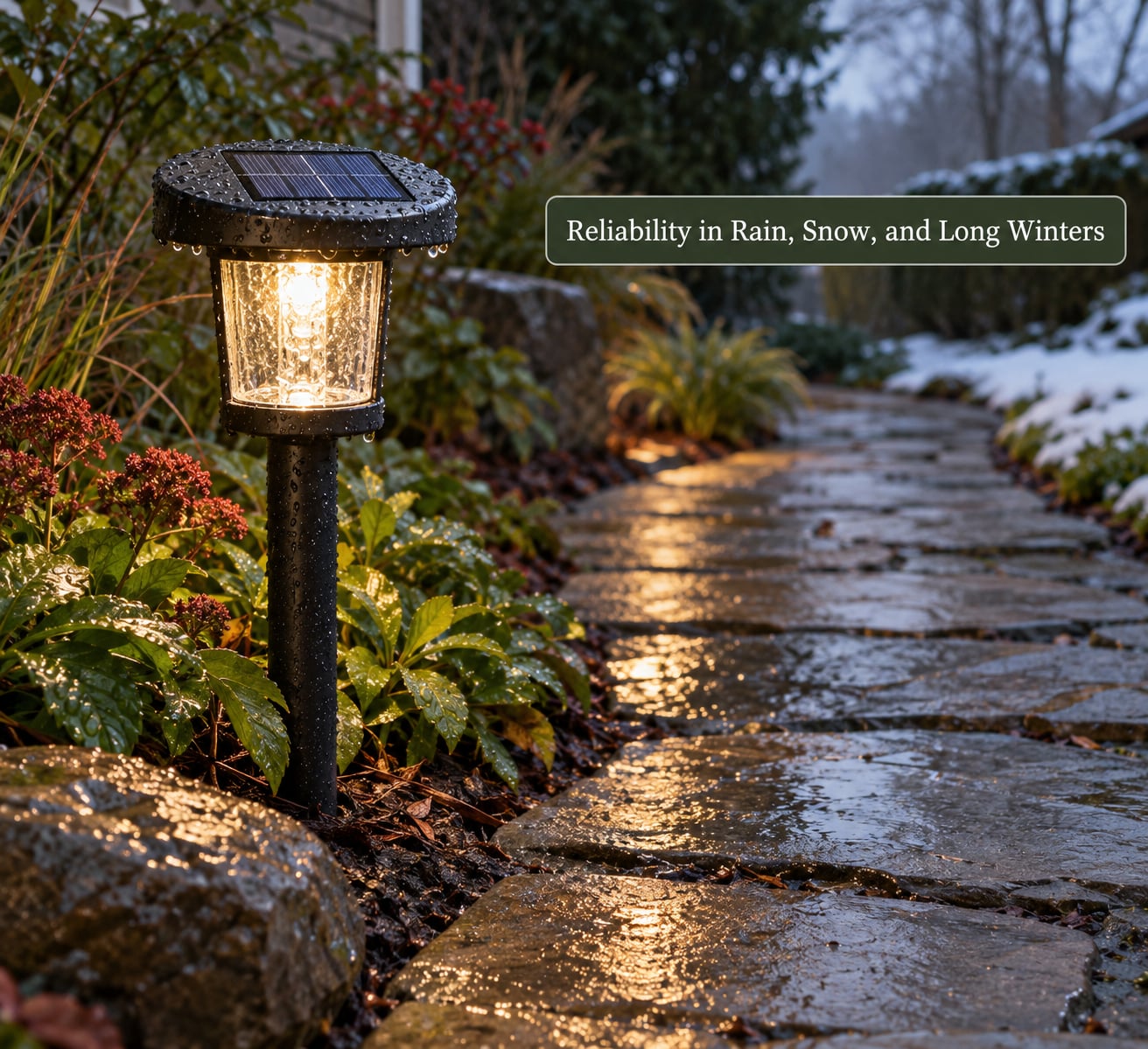
Wired lights do not care about the forecast. Once the transformer and photocell are set, the output is the same on a rainy Tuesday in November as it is in July, and they keep going at full strength for years. That predictability is the main reason people who have been burned by solar go back to wired.
Solar depends on the sun, obviously, but the details matter more than people expect. Panel orientation, how many hours of direct sun the spot gets, battery capacity, temperature and the season all feed into how long the light lasts at night.
Winter performance, honestly
Winter is when solar shows its age. Days are shorter, so panels charge less, and cold reduces battery output. A light that runs eight hours in June might manage four in December, and that is normal behavior rather than a defective unit.
Cloudy stretches hit harder than cold does. Two days of overcast skies in the Pacific Northwest will drain a partially charged battery and you may get nothing that night. In northern states, that is the single most common complaint about solar outdoor lights.
Climate guidance by region
In the Southwest and along the Gulf Coast, solar performs close to its best case most of the year. Strong sun, mild winters, and fewer cloudy stretches mean the runtime hit is small.
In the Upper Midwest and Northeast, solar still works for decorative accents in open, unobstructed spots, but treat runtime as a four-hour light rather than an all-night one. Wired is the safer pick for anything you need at two in the morning.
In the Pacific Northwest, cloud cover makes solar the weaker option for path and safety lighting, and it makes panel placement critical. A north-facing or shaded fixture there will disappoint every time.
Snow is its own problem for both systems. Panels buried under a foot of snow stop charging until they clear, and fixtures in drifts can get damaged by the weight. Wired lights need a clear fixture lens and a check for water intrusion at connections after a rough winter.
On the Mike Holt forums there is a pointed observation worth weighing: most stores cut back on hardwired low-voltage lights in favor of solar ones that put out very little light. Retailers follow what sells, and that is a fair warning about what the current crop of cheap solar fixtures delivers.
Maintenance, Battery Replacement, and Lifespan
Solar needs regular hands-on care. Wipe the panel, swap the battery when runtime drops off, and check that the stake has not started to lean. Most units use a standard rechargeable cell, and the swap is usually a few minutes with a screwdriver.
Why solar garden lights fail early
When people ask why solar lights do not last, the answer is almost never the LED. It is the panel getting shaded by something that grew, the lens staying dirty, or a cheap battery that will not hold a charge through the winter.
Battery quality varies enormously between budget and premium units. Expect a service life of roughly one to three years, and expect cheaper panels to underperform in partial shade. A light that sits under a tree canopy for a year will never fully charge no matter what the packaging claims.
Fixtures themselves usually last three to five years before the housing, seal or panel degrades. That is the honest answer to how long solar landscape lights last, and it is why people end up re-buying the same garden every couple of seasons.
What wired maintenance involves
Wired systems are quieter. Clean lenses occasionally, replace LED bulbs as they burn out, and once a season make sure the transformer is venting and the photocell is not shaded. Cable failures are rare if connections were made properly, but a chewed cable from an auger or a shovel is a real and common repair.
Voltage drop is the other long-term issue, and it does not fix itself. If your far lights have been dim since day one, the circuit is probably undersized and the fix is a larger transformer or a second run, which means calling in help.
A wired low-voltage system with quality fittings and LED bulbs commonly lasts 10 to 15 years before anything but bulbs needs attention. Some transformers last longer than the fixtures. That lifespan gap is the strongest practical argument for wiring, and it is the one homeowners mention most often when they say they stopped wanting to replace lights every two or three years.
Solar vs Wired Landscape Lighting: Which Should You Choose?
Pick solar when you rent, when the bed you want lit sits far from a circuit, when you want zero electricity use, or when the spot gets solid direct sun and you are content with softer light.
Pick wired when you need reliable light for steps, a driveway, a front entry or elderly family members walking at night, when you want trees and architecture lit properly, or when you already have a transformer and spare capacity on an existing circuit.
Best fits for solar
Renters and short-term homes, since you can take the whole system with you. Garden beds and vegetable plots away from the house. Low-traffic decorative areas, a back patio corner, a pond edge. Any place where digging would wreck landscaping you just paid to install.
Best fits for wired
Front walkways and stairs where brightness and consistency matter for safety. Driveways and entry points where you want real security lighting. Large trees and architectural details. Pool and water-adjacent areas where even, dependable coverage reduces the trip risk. Properties you plan to own for a while.
Large yards and mixed systems
On a large property, most people stop asking which system wins and start zoning it. Wire the front walk, the steps and the driveway because that is the light you depend on. Use solar for the far corners of the grounds, the shed, the tree line and the garden beds where digging is expensive and the light is decorative.
For a yard with heavy shade, treat shade as the dividing line rather than distance. Anything under canopy or on a north wall goes wired if light matters there, solar if it does not.
Before you commit
Check four things: how many hours of direct sun each planned solar spot really gets, whether you have an accessible outdoor GFCI outlet near where a transformer would go, how much of your yard actually needs task lighting rather than ambience, and honestly, whether you will clean panels and change batteries.
If the answer to that last one is no, wired is the cheaper option over time even though the invoice is larger on day one.
Frequently Asked Questions
Is solar landscape lighting cheaper than wired lighting?
Solar costs less to start and nothing to run, since it burns no electricity. Wired costs more up front because of cable, a transformer, trenching and often labor, then adds a small amount to the utility bill. Over ten years, factor in battery replacements on the solar side and compare that against how long a wired LED system keeps working.
Do solar landscape lights work in winter?
They work, but expect less. Winter days are shorter and cold reduces battery output, so a light that runs eight hours in June may manage four in December. After several cloudy days a partially charged battery may not light at all. If you need dependable all-night light in a cold or cloudy climate, wired is the better bet.
Do solar lights need electrical wiring?
No. Solar fixtures are self-contained, with a panel, battery and photocell in the housing. You stake them in the ground and they charge during the day. Wired low-voltage systems need a transformer plugged into a GFCI-protected outlet plus buried cable running to each fixture, which is the whole reason they cost more to install.
Which is better for a large yard?
A mixed setup usually wins. Wire the front walk, steps, driveway and entry because that light has to be reliable and bright. Use solar for far corners, garden beds and the shed, where digging is expensive and the lighting is decorative. Trying to wire a full acre gets expensive fast, and trying to run one solar system across it leaves the dark corners dark.
How long do solar landscape lights last?
Fixtures typically last three to five years, and the rechargeable battery usually needs replacing sooner, roughly every one to three years. Shade and dirty panels shorten that timeline. A quality wired low-voltage system with LED bulbs commonly runs 10 to 15 years with only occasional bulb changes, which is the real difference in lifespan.
Can I install landscape lighting myself?
Solar is a safe weekend project, since there is no wiring at all. A low-voltage wired system is also a common DIY job, but you need to size the transformer, avoid voltage drop over long runs, use the correct cable, and bury it properly. Anything touching your panel or a line-voltage receptacle belongs with a licensed electrician, and check permit rules first.
Conclusion
Solar wins where digging is expensive, sunlight is reliable and the light is decorative. Wired wins where the light matters, meaning steps, paths, entries, driveways and trees, and where you would rather install once and stop thinking about it.
Assess five things in order: how much direct sun your planned spots actually get, whether you have an accessible outdoor outlet for a transformer, how much coverage you need versus how much is ambience, what your budget looks like for day one, and whether you will genuinely maintain panels and batteries. Get shade on the yard before you commit, and the choice usually makes itself.