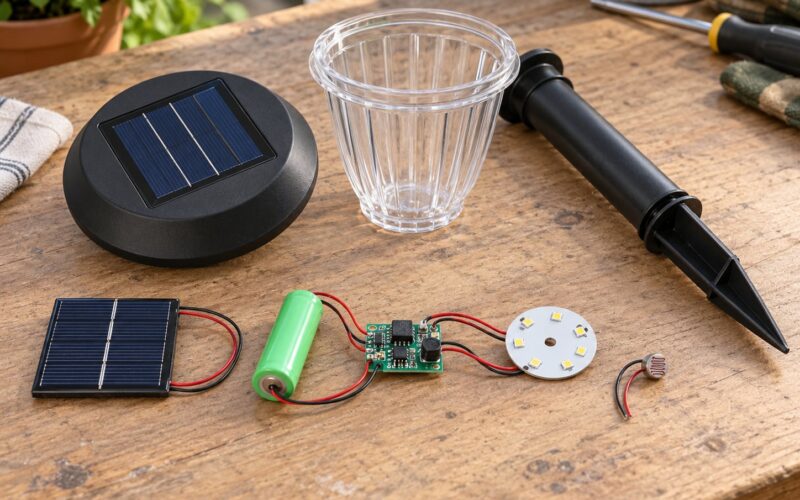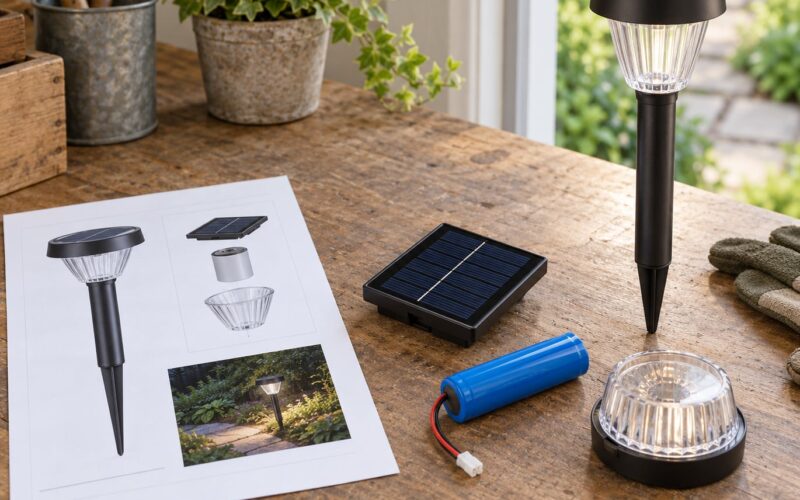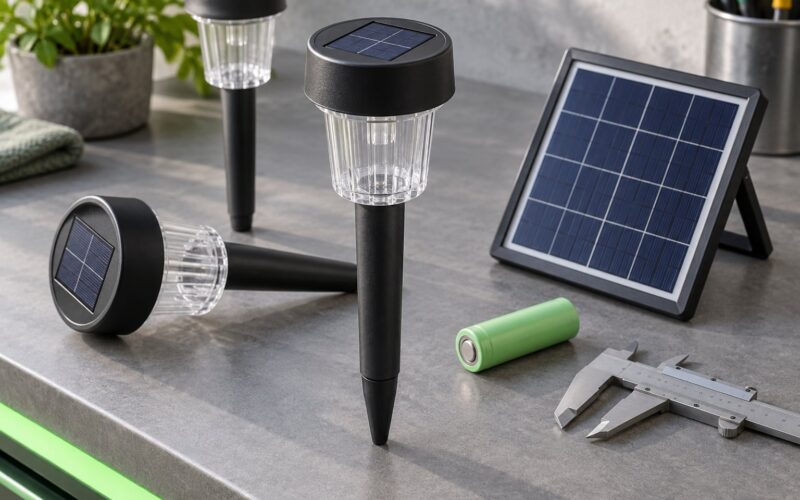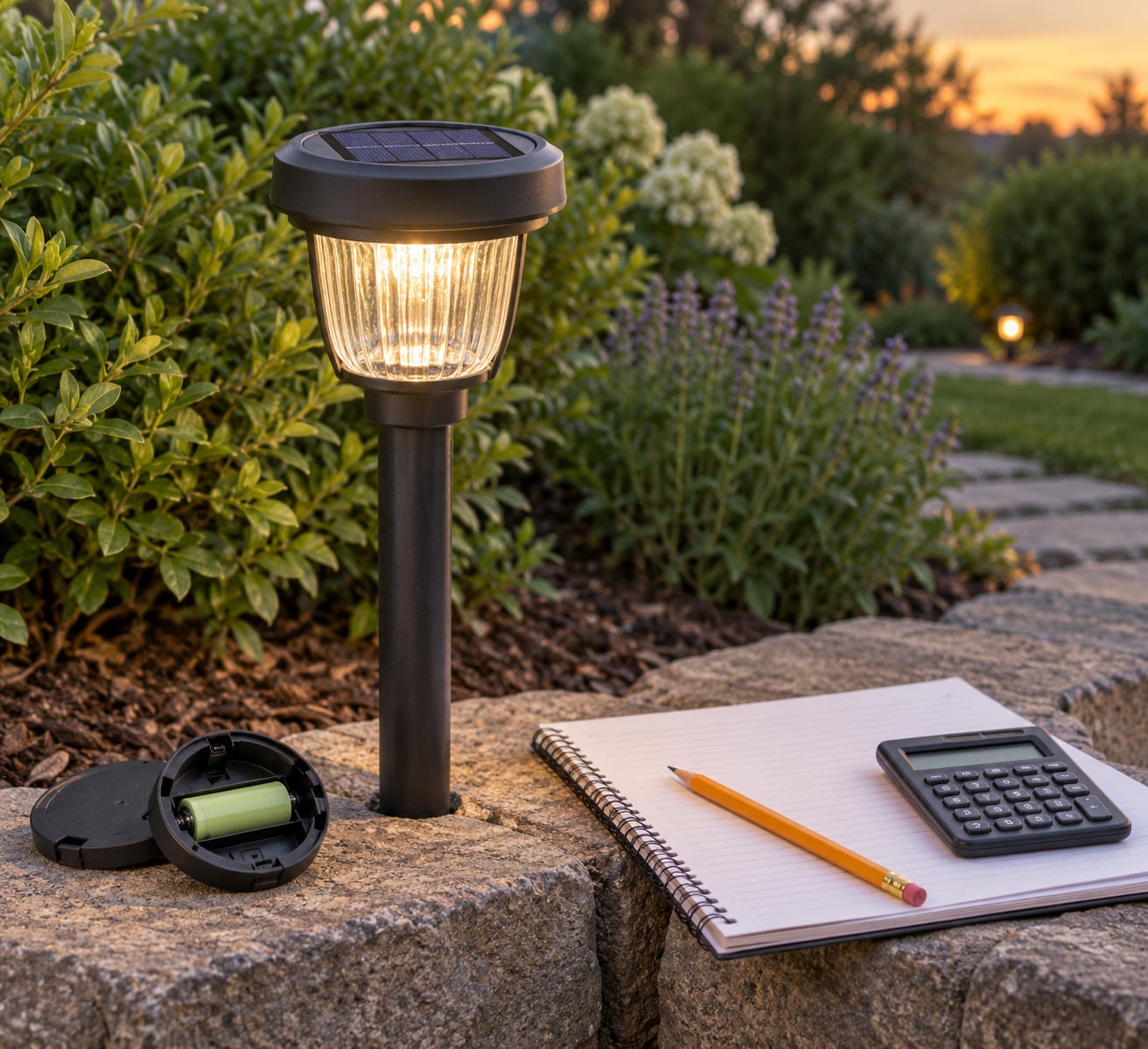
Estimating solar light runtime takes about ten minutes and four numbers: the battery’s amp-hour rating, its voltage, the lamp’s wattage, and how many hours a night it actually stays on. Usable battery watt-hours divided by lamp wattage gives you hours of light, and then you shave that number back for depth of discharge, charging losses and the season. Get that habit right and a printed spec sheet stops being a sales pitch and turns into something you can check.
Most garden lights are quoted at their best: a full charge in summer sun, a panel at the perfect angle, nothing overhead. Your driveway is none of those things. The method below is deliberately pessimistic, which is why the finished number usually looks more like reality.
Master formula: Runtime (hours) = (battery amp-hours x battery volts x usable fraction) / (lamp wattage x duty cycle)
The usable fraction is where the honesty lives. Multiply a depth-of-discharge limit of 0.8 by a charge reality factor of 0.6 to 0.75, and you get something between 0.48 and 0.6. That single multiplier is the difference between a light advertised for eight hours and one that quits at eleven at night in January.
Table of Contents
- What You Need
- Step-by-Step
- Step 1: Find the lamp voltage and wattage
- Step 2: Convert battery mAh into usable watt-hours
- Step 3: Work out the duty cycle
- Step 4: Check the charge side against peak sun hours
- Step 5: Divide, then sanity-check
- Work it backwards: sizing a battery for a target runtime
- A quick way to estimate solar light runtime with no spec sheet
- How to Adjust the Estimate for Weather and Season
- Common Mistakes
- Treating rated mAh as usable energy
- Ignoring the LED wattage
- Using peak sunlight hours as charging time
- Forgetting conversion losses
- Comparing incompatible voltages
- Trusting a single sunny-day test
- If the light dies after two hours: work through this order
- Frequently Asked Questions
- Why do my solar lights only stay on for 2 hours?
- How many hours does a solar battery last?
- Why do solar lights suddenly stop working?
- Can I use 600mAh instead of 300mAh in solar lights?
- What is the 20% rule for solar panels?
- Why do solar lights not charge in winter?
- Conclusion
What You Need
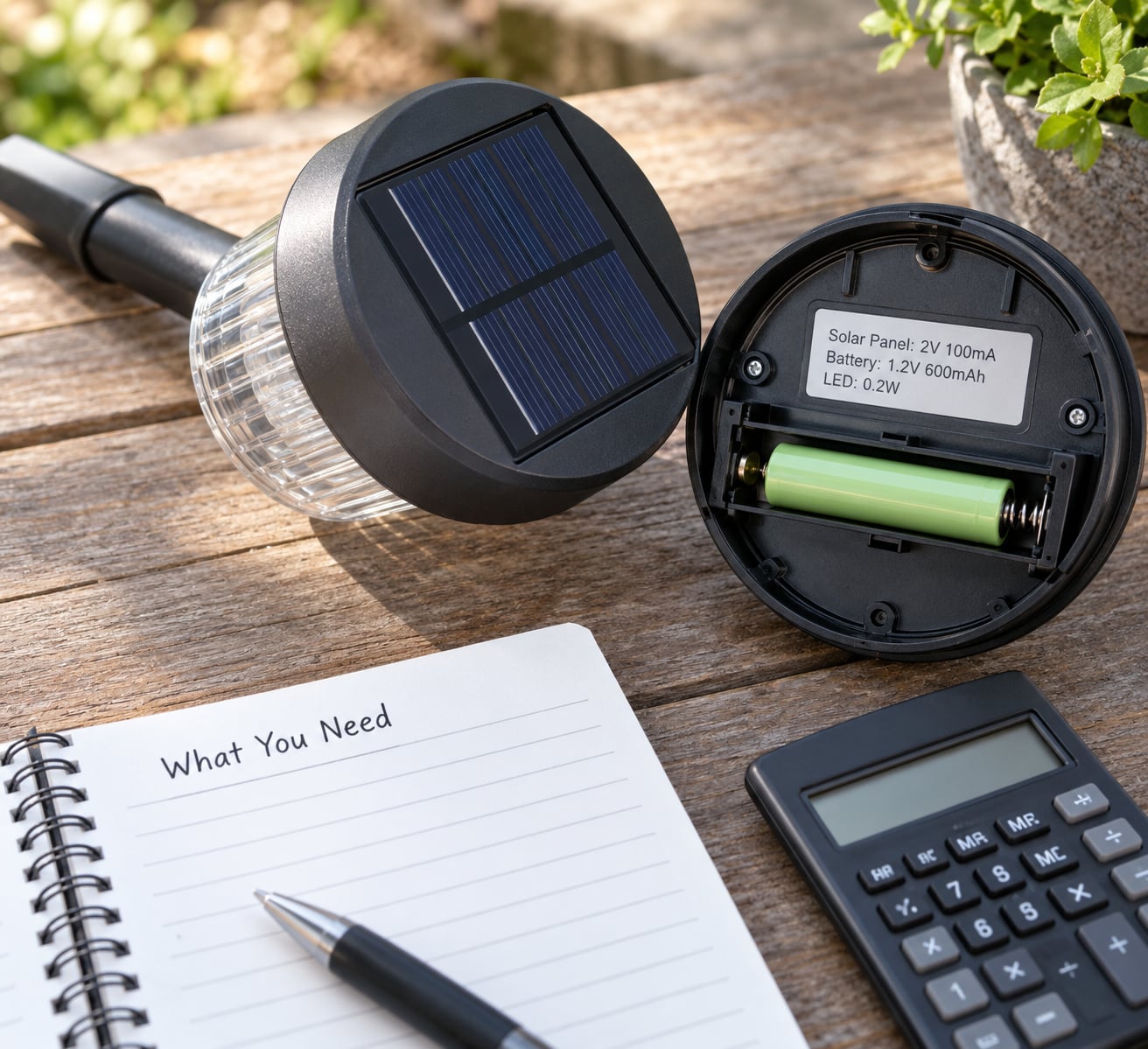
Everything you need is printed on the light itself, or on the little paper insert nobody reads. Pull these five items together before touching a calculator.
- Battery voltage. Almost always 3.7V for a single 18650 lithium cell, or 7.4V for two in series. Older NiMH path lights sit at 2.4V or 3.6V. The number sits on the cell wrapper or on the sticker inside the battery door.
- Battery capacity in mAh. A typical garden path light carries 1200mAh to 2600mAh. A cheap bollard might claim 4000mAh and deliver half of that after a year of summer heat.
- Lamp wattage. The LED count is a poor guide. A “6 LED” post light can draw anywhere from 0.8W to 2.5W. Find the wattage on the spec label, or estimate it from the brightness setting and the LED count: roughly 0.1W to 0.4W per LED.
- Panel wattage. Small path lights run 0.5W to 2W. A post or street light runs 6W to 20W. This number matters for the charge check in step 4.
- Rated runtime and the light’s mode switch. Note whether it offers high, medium and low brightness, a timer, or a motion sensor. Duty cycle is the biggest single variable in the whole calculation.
You also need one piece of local information: roughly how many peak sun hours your spot gets. A fixed number that is good enough for a first pass is 4 hours in summer and 1.5 in winter for a temperate inland location. Lower that for coastal or heavily overcast areas, raise it for clear desert regions.
Step-by-Step
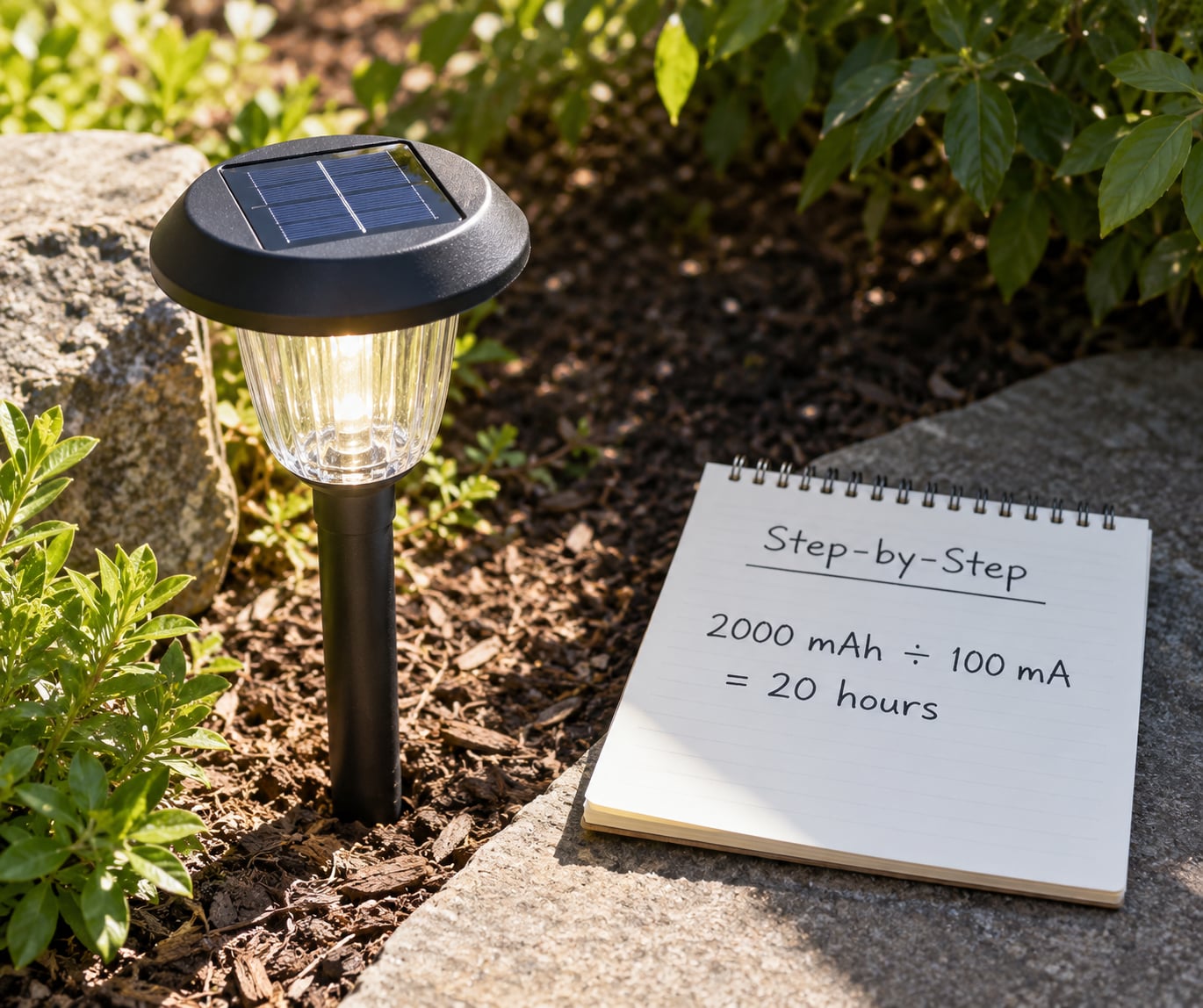
Step 1: Find the lamp voltage and wattage
Voltage and wattage come first because everything else multiplies or divides by them. Open the battery compartment and read the sticker on the cell, then look for the output rating printed on the fixture or on the power switch.
If the wattage is missing entirely, count the LEDs and multiply by a per-LED draw of 0.2W for a warm path light and 0.35W for a bright bollard or post head. Check the estimate afterwards against the light’s actual brightness: a 1W fixture is a marker light, a 3W fixture will throw real light onto a path.
Step 2: Convert battery mAh into usable watt-hours
Divide mAh by 1000 to get amp-hours, then multiply by the cell voltage to get watt-hours. A single-cell 3.7V 2000mAh battery holds 3.7 x 2.0 = 7.4 watt-hours.
Now apply the usable fraction. Take 0.8 for depth of discharge, the level below which a lithium cell starts to suffer. Multiply by a charge reality factor of 0.75 for a clear summer day, or 0.5 for an ordinary overcast one. That single-cell example gives 7.4 x 0.8 x 0.75 = 4.44 usable watt-hours, or 2.96 watt-hours in poor conditions.
Step 3: Work out the duty cycle
Duty cycle is the fraction of the night the lamp is actually drawing full power. An always-on light on a six-hour timer is 60%. A light that dims to a tenth of its output after five hours is closer to 35%. A motion-sensed light firing eight times for 30 seconds each is under 1% of the night, though the sensor’s own standby draw keeps the real figure nearer 5% to 10%.
| Light mode | Approximate duty cycle | Runtime multiplier |
|---|---|---|
| Always on, whole night | 100% | 1.0x |
| Timer, 6 hours of a 10-hour night | 60% | 1.7x |
| Dim to 10% after 5 hours | 35% | about 2.9x |
| Low brightness mode all night | 10% to 15% | 7x to 10x |
| Motion sensor, 8 triggers a night | 5% to 10% effective | 3x to 6x in practice |
Motion lights never deliver the theoretical multiplier. Sensor standby current and repeated shallow cycles eat a good part of the saving, so treat anything beyond 6x with suspicion.
Step 4: Check the charge side against peak sun hours
An estimate is only worth having if the panel can refill the battery. Take panel watts, multiply by peak sun hours, then multiply by 0.7 for controller and wiring losses. That gives usable watt-hours collected per day.
Compare that with the energy the light burns in one night: lamp wattage x hours lit. A 1W panel in a spot with 3 peak sun hours collects about 2.1 watt-hours per day. A 0.6W lamp burning for 10 hours needs 6 watt-hours a night. The panel is not keeping up, so the battery never reaches full charge and the light settles into a permanently half-full cycle. That is the single most common reason a nominally 8-hour light runs 3.
Step 5: Divide, then sanity-check
Usable watt-hours divided by lamp wattage gives hours on a full charge at that duty cycle. Then check the charge side from step 4: the energy collected per day should exceed the nightly burn. If it does not, the real runtime settles at the energy the panel can deliver rather than the energy the battery is holding.
| Fixture | Battery | Lamp | Usable Wh (clear summer) | Calculated runtime | Realistic winter runtime |
|---|---|---|---|---|---|
| 2-LED path light | 3.7V 1200mAh | 0.6W | 3.7 x 1.2 x 0.8 x 0.75 = 2.66 | about 4.4 hours | 2 to 3 hours |
| 8-LED bollard | 3.7V 2600mAh | 1.2W | 7.7 x 0.8 x 0.75 = 4.62 | about 3.8 hours | 2 hours |
| Single-head post light | 7.4V 5000mAh | 3.0W | 37 x 0.8 x 0.75 = 22.2 | about 7.4 hours | 4 to 5 hours |
| Bollard on low mode | 3.7V 2600mAh | 1.2W at 12% | 4.62 | about 32 hours | 10 to 14 hours |
Run one of those rows and the pattern is obvious. Bigger lights look efficient on paper because the battery scales faster than the LED draw, yet their realistic winter figures are still short, because the charge side gets worse as the sun weakens.
Work it backwards: sizing a battery for a target runtime
To answer the reverse question, start from the hours you want and work up. Required watt-hours equal lamp wattage x hours x duty cycle multiplier, then divide by 0.8 and by your charge reality factor to get the battery you need.
For a 1.2W bollard you want lit for 6 hours: 7.2 watt-hours needed, so 7.2 / 0.8 / 0.6 = 15 watt-hours of battery. At 3.7V that is roughly 4050mAh, so a genuine 4000mAh cell or a 5000mAh cell would do it in clear weather. The catch is charging time. That battery needs a panel that can put back at least 7.2 watt-hours a day, which means around 4W of panel with decent sun, not the 1W panel most cheap fixtures ship with.
Add roughly a third to the target and you get a buffer for two or three overcast nights in a row, which is what experienced DIY builders do: they size for roughly twice the naive capacity and check the numbers are honest rather than optimistic.
A quick way to estimate solar light runtime with no spec sheet
When the sticker is gone, estimate from the panel instead. A path light with a panel under 1 square inch and 2 to 3 LEDs draws about 0.5W and holds a cell of 1200 to 2000mAh, so expect 3 to 5 hours in summer and 1 to 2 in winter. A bollard with a panel the size of a playing card and 8 LEDs runs 1 to 1.5W with a 2000 to 3000mAh cell, giving 4 to 5 hours in summer. A post light with a panel the size of a paperback runs 2 to 3W with a 5000mAh cell, giving 6 to 8 hours in summer.
If you have no panel measurement either, time it. Note the time the light switches on after dark and the time it goes out, then repeat across a clear day and an overcast day. Two evenings of note-taking beats an hour of arithmetic.
How to Adjust the Estimate for Weather and Season
The charge reality factor is the part everyone gets wrong, so it is worth thinking about rather than guessing. The same 20W panel that pushes out around 120 watt-hours on a perfect midsummer day can deliver close to half that on an average day in October. Your estimate should use the average, not the best day.
| Condition | Charge reality factor | Equivalent derating multiplier | Effect on runtime |
|---|---|---|---|
| Lab or perfect summer day | 0.75 | 1.2x | Full calculated figure |
| Clear spring or autumn day | 0.6 | 1.5x | About two-thirds of calculated |
| Average overcast year | 0.45 | 1.9x | About half of calculated |
| Overt winter with a short day | 0.3 | 2.5x or worse | One-third or less |
Peak sun hours move with latitude and season, and the swing between summer and winter is the reason lights seem to break in autumn. These are rough planning figures rather than survey data, so treat them as a starting point and adjust for your own sky.
| Location | Summer peak sun hours | Winter peak sun hours |
|---|---|---|
| Clear desert, US Southwest | 6.5 | 4.0 |
| Florida and the Gulf Coast | 5.0 | 3.5 |
| Midwest US | 4.5 | 1.8 |
| Northeast US | 4.0 | 1.3 |
| Pacific Northwest | 3.0 | 1.0 |
| Southern England | 4.5 | 0.8 |
Four things quietly cut into a garden light’s runtime beyond the arithmetic.
Shade. A fence, a shed roof or a tree canopy can halve the panel’s output while still reading as “outdoors” in the listing. Watch the spot for a full day before blaming the battery. A path light under an overhang is essentially a light with no charge side.
Panel angle and cleanliness. A panel lying flat collects noticeably less than one tilted toward the sun, and a thin film of dirt or bird mess cuts more than you would expect. Wipe the surface and reposition once a season.
Cold. Lithium cells lose usable capacity in cold conditions, and a battery kept near freezing delivers less than its label promises. Cold nights are part of why December figures fall short of October ones in the same location.
Sensor behaviour. A dusk-to-dawn sensor in a dark corner under dense foliage can leave a light on through the afternoon, or a faulty PIR can leave it flickering all night. Both drain the battery faster than any calculation allows for.
Two rules of thumb cause more confusion than anything else here. The 20% rule says do not draw a battery below 20% state of charge, which protects cell life. The 33% rule appears when sizing a battery bank for several overcast nights: you keep roughly two days of reserve. Both are the same idea at different scales. For a garden light, plan on 0.8 usable depth of discharge for a lithium cell and keep one cloudy night in reserve, which is closer to the 33% thinking than the 20% one.
Common Mistakes
Treating rated mAh as usable energy
This is the big one, and it is where most estimates double. A 3000mAh battery is not 3000mAh of night-time energy. Apply 0.8 for depth of discharge and your charge reality factor on top, and a 3000mAh cell at 3.7V delivers roughly 5.3 watt-hours in clear weather, not 11.1.
Ignoring the LED wattage
LED count is a marketing number. Two fixtures can both claim 8 LEDs and draw 0.9W and 2.4W, which is a 2.6x difference in runtime from the same battery. If you cannot find a wattage, estimate per LED and keep a margin.
Using peak sunlight hours as charging time
A panel does not bank hours. Two hours of direct sun does not create four hours of stored charge. Peak sun hours already measure the energy, so treat them as energy arriving, then apply a charge reality factor rather than pretending the deficit is free.
Forgetting conversion losses
The controller, the wiring and the panel’s own efficiency each take a cut. Skipping them is the reason a light calculated at 8 hours measures 5. Multiply your collected energy by 0.7 before comparing it to the nightly burn.
Comparing incompatible voltages
Two cells in series at 7.4V hold twice the watt-hours of one cell at 3.7V with the same 3000mAh rating. Comparing mAh across fixtures with different cell counts produces nonsense. Compare watt-hours.
Trusting a single sunny-day test
One bright afternoon tells you the light works. It tells you nothing about October. Time the light across a clear day, a cloudy day and an ordinary day, then take the ordinary figure as your answer.
If the light dies after two hours: work through this order
Start with the free fixes and work down, because they fix most cases.
- Clean the panel and check whether anything shades it between 9am and 4pm.
- Check the switch. A light set to OFF, or stuck in a mode the sensor cannot trigger, will never light properly.
- Open the battery compartment and look for corrosion or a swollen cell. Clean the contacts, and note that a bulging battery is a fire risk worth handling immediately.
- Check the battery’s age. NiMH cells in cheap lights often fade within a year or two, and lithium cells run two to four years depending on heat. Replacement cells cost very little and are the most common fix.
- Measure the panel’s output in full sun with a multimeter on the voltage setting. If it reads close to zero when the light is uncovered, the panel or its connection has failed.
- If the fixture has a USB port, charge it from mains overnight and see whether it runs a full night. If it does, the panel side is the problem; if it does not, the battery or controller is.
- Look for water. A failed seal after a season of rain and frost is common, and it corrodes the battery contacts first.
If a light has no visible battery compartment, as many sealed fixtures do, the practical move is to test it with a USB charge if the port exists, and otherwise replace the whole fixture. People often store these lights indoors over winter, and a sealed light that sits uncharged for a month can come back with a battery that refuses to hold anything.
One more caution before you upgrade: a bigger battery only helps if the panel can refill it. Doubling capacity from 300mAh to 600mAh doubles the runtime only if the panel collects enough energy to top the larger cell up each day. On a small panel the light simply sits at half charge and gives you the same two hours with less effort.
Frequently Asked Questions
Why do my solar lights only stay on for 2 hours?
Usually the panel is not collecting enough energy to refill the battery, or the battery itself is worn out. Check for shade across the panel, clean the surface, confirm the switch is set to on, and test the light with a USB overnight charge if it has a port. If it runs a full night on mains power, the panel side is at fault. If it does not, the battery has probably degraded and is the cheapest fix.
How many hours does a solar battery last?
It depends on usable watt-hours and lamp wattage. A 3.7V 2000mAh cell stores 7.4 watt-hours, and after a 0.8 depth-of-discharge limit and a 0.75 charge reality factor that is about 4.4 usable watt-hours. Against a 0.6W lamp that is roughly 7 hours on a full summer charge, closer to 3 hours in ordinary winter conditions. Run the numbers on your own light rather than trusting the rated figure.
Why do solar lights suddenly stop working?
The most common causes are a dead battery, a dirty or shaded panel, water ingress that has corroded the contacts, or a switch still set to off. Check the switch and the panel first since those are free. Then inspect the battery compartment for corrosion or a swollen cell. Lights stored indoors for weeks without charging often come back with a battery that holds nothing at all.
Can I use 600mAh instead of 300mAh in solar lights?
Only if the panel can refill the larger cell in a day. Doubling capacity also doubles the energy the lamp needs after dark, and a small panel may never top it up, leaving the light permanently half charged. If your panel is at least 2W and the spot gets three peak sun hours, a larger cell is worthwhile. Match the voltage and chemistry, and never mix cell types in one pack.
What is the 20% rule for solar panels?
The 20% rule is a depth-of-discharge limit. It says you should avoid drawing a battery below 20% of its rated state of charge, which protects cell life and capacity over time. For a garden light, that means treating 80% of the rated amp-hour figure as the realistic working capacity before you even account for charging losses. Related, the 33% rule usually appears when sizing a system with two or three days of cloudy-weather reserve.
Why do solar lights not charge in winter?
Winter brings fewer daylight hours, lower sun angles and more cloud, so the panel collects far less energy, sometimes under half the summer figure. Cold also reduces the capacity a lithium cell can deliver. The result is a light that starts the night partially charged and quits early. Choose fixtures with larger panels, run them in low mode, or accept a shorter lighting window and position them where they are needed most.
Conclusion
The fastest way to estimate solar light runtime is four moves: read the battery’s volts and amp-hours, read the lamp’s wattage, count the real peak sun hours your spot gets, and divide usable watt-hours by wattage and duty cycle. That is the whole method.
Start deliberately conservative, because a low estimate you improve on feels better than a high one you cannot explain. Then time the light across one full charge cycle before you trust the number, and re-check in December when the figure drops.
One last thing worth keeping straight for 2026: if you swap in a bigger battery, confirm the panel can refill it before you celebrate. Capacity you cannot recharge is just a heavier box.