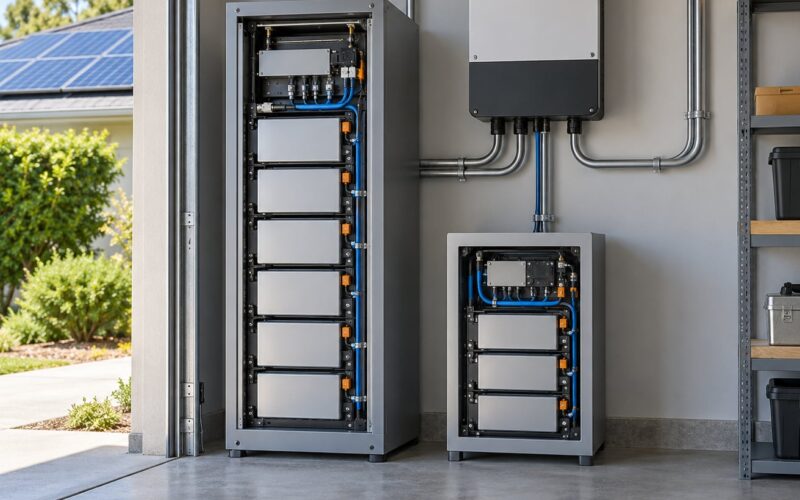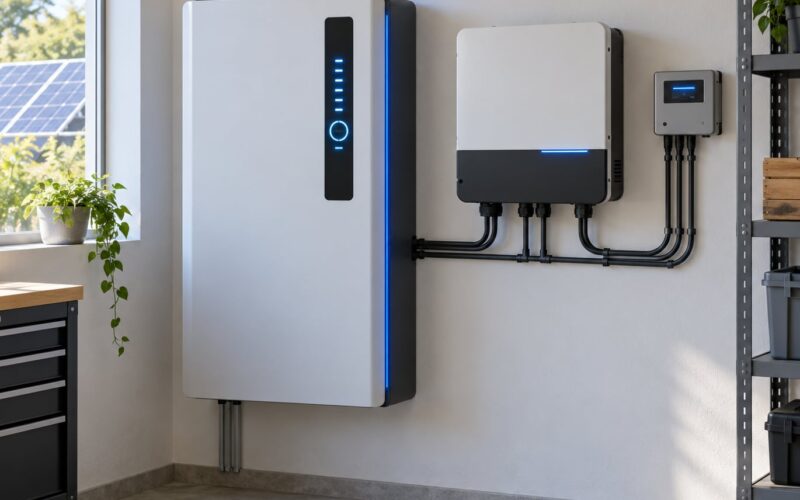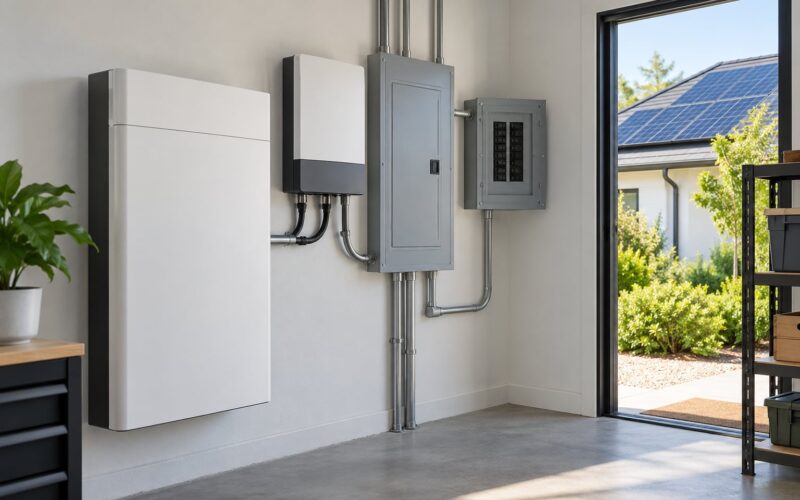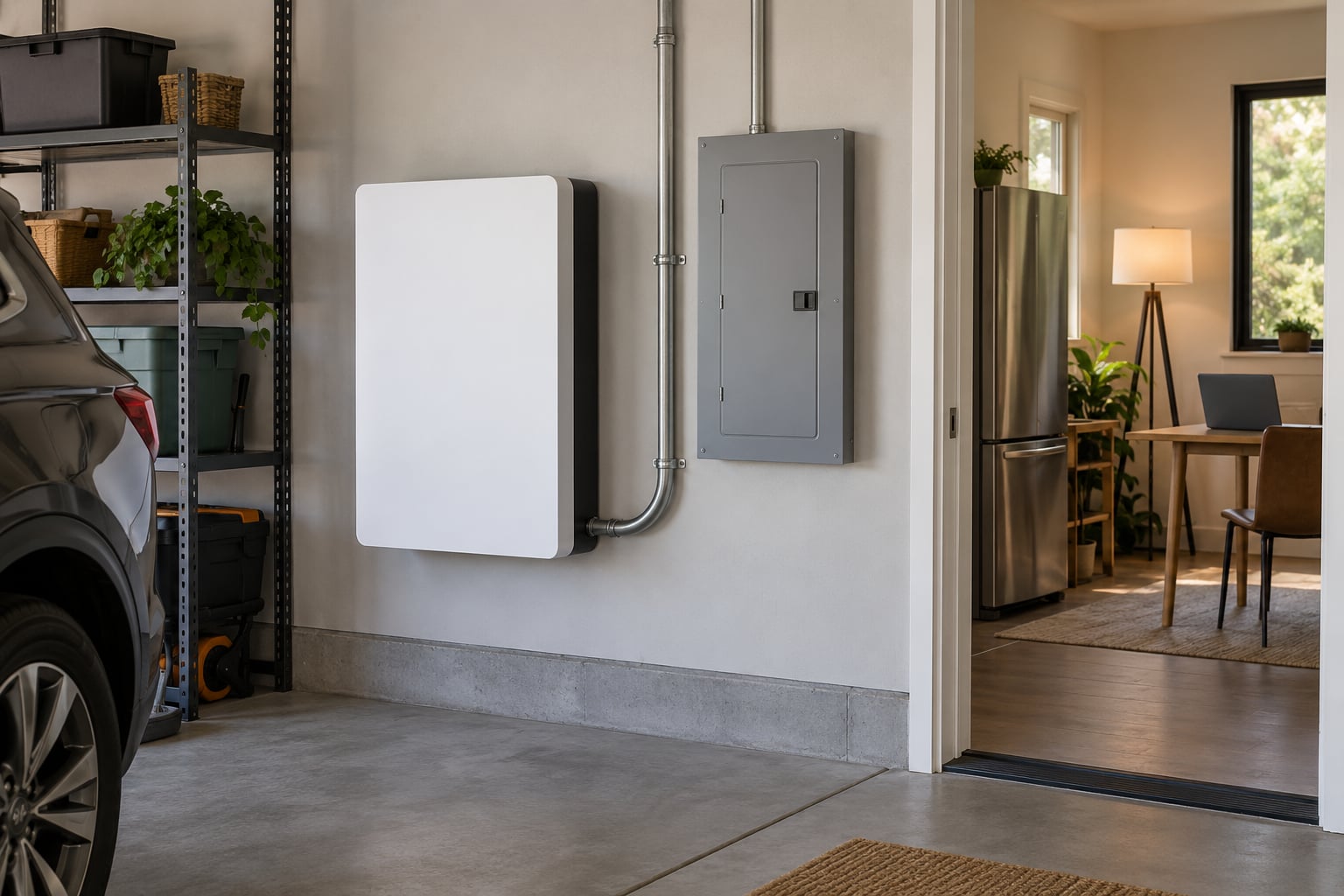
A standard home backup battery of roughly 10 to 13.5 kWh can power a house for 12 to 24 hours if you run only essentials like lights, a refrigerator and Wi-Fi. Run a full household with heating or cooling going and the same battery lasts 3 to 6 hours. Turn on central air conditioning, an electric water heater or a space heater and you are looking at 2 to 4 hours.
That is the short answer to how long can a home battery power a house. Everything below unpacks it, because the honest number depends almost entirely on what you plug in.
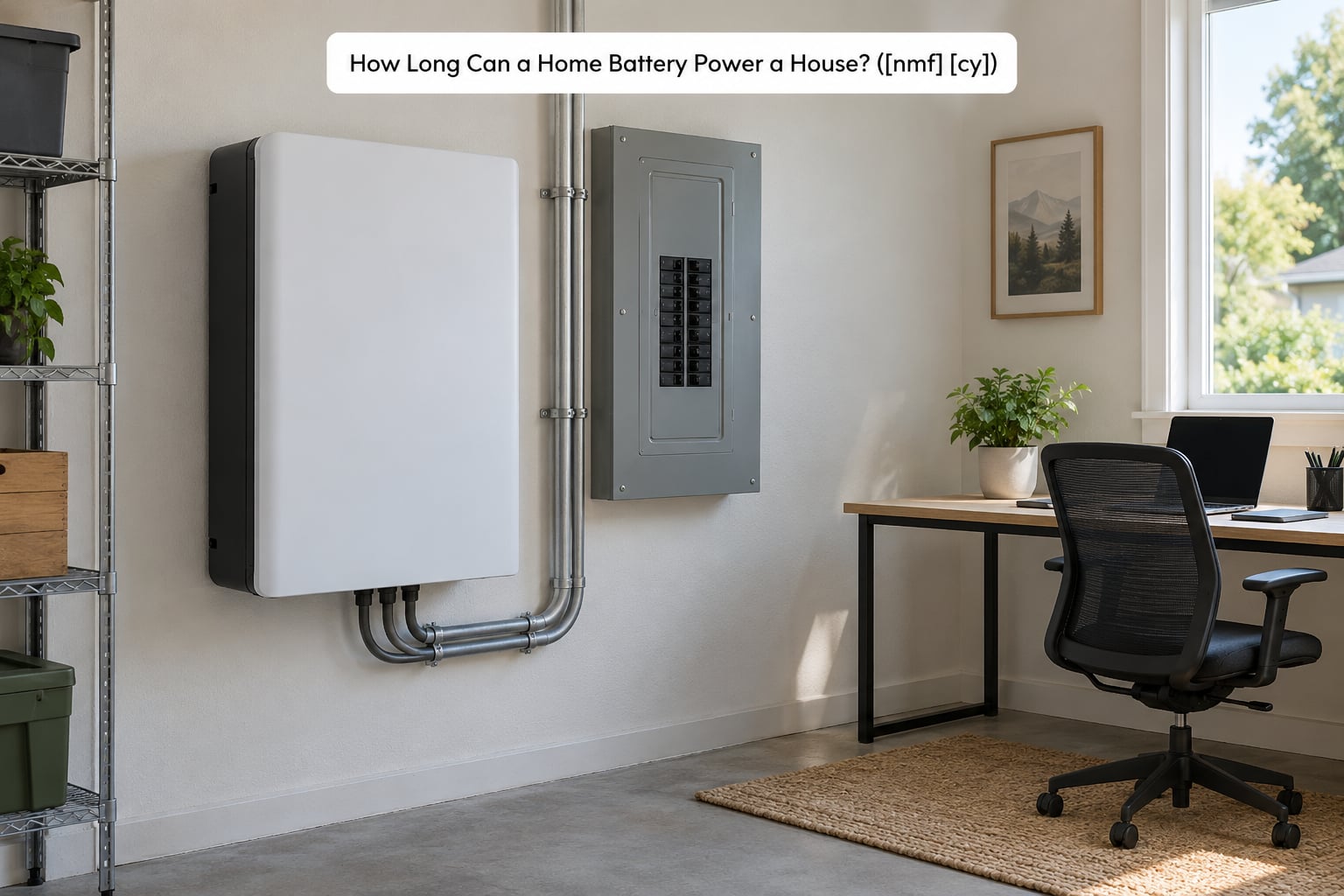
Three factors change runtime more than anything else:
- Energy use: the average number of kilowatts your home pulls while the battery is discharging.
- Battery size in kWh: how much energy is actually stored, after depth of discharge and inverter losses.
- Solar integration: whether panels refill the battery during daylight hours of the outage.
One more thing worth clearing up early, because it trips up a lot of people. Runtime and lifespan are different questions. Runtime is hours per outage. Lifespan is how many years the battery lasts. Most confusion on this topic comes from reading a ten-year warranty and assuming it means ten years of running your house.
Runtime vs lifespan. Runtime answers “how long can a home battery power a house” during one outage, and runs from a few hours to a couple of days. Lifespan answers “how long should a house battery last,” and is measured in years and charge cycles. Home lithium batteries commonly carry a ten-year or roughly 6,000-cycle warranty while holding 70 to 80 percent of original capacity. A battery you only use during storms still ages on the calendar.
Table of Contents
- What Determines Home Battery Runtime?
- Usable capacity, not nameplate capacity
- Average load in kilowatts
- Depth of discharge and inverter losses
- Continuous power and surge capacity
- Battery age and temperature
- A worked runtime calculation
- How to Calculate Battery Runtime
- Step 1: Work out your daily consumption
- Step 2: Work out your usable capacity
- Step 3: Divide
- What that looks like for real appliances
- How Many Hours Can Different Battery Sizes Last?
- Essential Power vs. Whole-House Power
- Does Solar Charging Increase Battery Runtime?
- How to estimate the usable solar contribution
- Why Actual Runtime May Be Shorter
- How to Choose the Right Battery for Your Home
- Frequently Asked Questions
- Can a home battery power a house for a whole night?
- How many hours can a home battery power one refrigerator?
- Is a home battery better than a generator during an outage?
- Can solar panels keep a home battery running indefinitely?
- What size battery is needed to power a house?
- Does a home battery work when the electricity goes out?
- What to Do First
What Determines Home Battery Runtime?
Runtime is a division problem. Stored energy goes in one side, load comes off the other side, and the answer comes out in hours. Once you know which numbers belong on each side, the mystery disappears.
Usable capacity, not nameplate capacity
The number on the sticker is nameplate capacity. You will never get all of it. A lithium iron phosphate battery is typically discharged down to about 90 to 95 percent of nameplate, and a lead-acid battery to about 50 percent. Installers and forum regulars both use the phrase “nameplate is not usable” for this reason.
On top of that, every battery loses energy moving through its inverter, and round-trip efficiency on good lithium systems runs in the ballpark of 90 to 94 percent.
Average load in kilowatts
kWh is stored energy. kW is the rate your appliances draw while running. Runtime needs both, which is where most online answers fall apart.
The U.S. Energy Information Administration puts average residential consumption at roughly 29 to 30 kWh per day. Spread over 24 hours that is an average load near 1.2 kW. Real outages do not run at average, though. A quiet evening with the fridge, some lights and a router sits around 0.5 kW.
Depth of discharge and inverter losses
Chemistry matters here more than most shoppers expect. An LFP battery gives you 90 to 95 percent of its nameplate. An AGM or flooded lead-acid battery gives you roughly half, so a “10 kWh” lead-acid bank is really a 5 kWh reserve. Multiplying your battery age factor in, and a five-year-old lithium pack might only deliver 88 percent of its original capacity.
Continuous power and surge capacity
Continuous output is the sustained draw. Surge capacity is the startup spike, and it is what trips people out. A refrigerator compressor can pull roughly 1,200 W for a second or two on start. A well pump or sump pump can spike to three or four times its running draw.
A battery that survives normal running can still fail the moment a compressor kicks on. This is the single most common “it died during the outage” story in battery backup forums.
Battery age and temperature
Lithium storage loses 2 to 3 percent of capacity per year in normal conditions. Cold is the bigger surprise: charging below freezing is restricted on most systems, and a battery sitting at 28 percent charge with no grid power may simply refuse to discharge until it warms up. Winter outages in cold climates cut runtime more than most owners expect.
A worked runtime calculation
Take a 13.5 kWh battery with LFP chemistry and a 94 percent inverter efficiency. Usable capacity is 13.5 multiplied by 0.95, then by 0.94, which comes to about 12.1 kWh.
- Essentials at 0.5 kW: 12.1 divided by 0.5 is roughly 24 hours.
- Partial home at 1.5 kW: 12.1 divided by 1.5 is roughly 8 hours.
- Whole home at 2.5 kW: 12.1 divided by 2.5 is roughly 5 hours.
- Whole home with central AC at 5 kW: 12.1 divided by 5 is roughly 2.4 hours.
Same battery, four answers. That is why anyone quoting you a single number for home battery runtime is either simplifying or guessing.
How to Calculate Battery Runtime
Three steps, and you can do all of it with a utility bill and a tape measure.
Step 1: Work out your daily consumption
Open a recent electricity bill, find the total kWh used for the month, and divide by 30. A 900 kWh month means about 30 kWh per day, which is right at the national average.
Step 2: Work out your usable capacity
Take nameplate kWh, multiply by depth of discharge for the chemistry (0.95 for LFP, 0.50 for lead-acid), then by inverter efficiency (about 0.92). This is your honest reserve.
Step 3: Divide
Usable kWh divided by average kW gives hours. Usable kWh divided by daily kWh gives days. A community calculation on r/BatteryBackup puts it neatly: at a constant 200 W load, a 1 kWh battery gives roughly 4 to 4.5 hours after conversion losses. Work that ratio backwards and you have a sanity check for any number you are quoted.
What that looks like for real appliances
Below is what each appliance actually costs you. These are illustrative averages, not specifications, and figures vary by model and how hard you run them.
| Appliance | Typical running watts | kWh per day | Hours on a 10 kWh battery | Hours on a 13.5 kWh battery |
|---|---|---|---|---|
| Refrigerator | 150 W | 1.2 | 55 | 75 |
| Chest freezer | 100 W | 0.8 | 83 | 112 |
| Router and modem | 15 W | 0.36 | Over 500 | Over 700 |
| LED lighting, whole home | 60 W | 0.5 | 130 | 180 |
| Television | 100 W | 2.4 | 83 | 112 |
| Washing machine | 500 W | 0.6 | 16 | 22 |
| Microwave | 1,200 W | 0.6 | 6.9 | 9.3 |
| Space heater | 1,500 W | 6 | 5.5 | 7.5 |
| Mini-split heat pump | 1,000 W | 6 | 8.3 | 12 |
| Sump pump (running) | 600 W | 1.5 | 13 | 18 |
| Well pump (running) | 1,000 W | 2 | 8.3 | 12 |
| Electric range oven | 3,000 W | 1.2 | 2.7 | 3.7 |
| Clothes dryer | 3,000 W | 1.5 | 2.7 | 3.7 |
| Central air conditioning | 3,500 W | 21 | 2.3 | 3.2 |
| Electric water heater | 4,000 W | 8 | 2 | 2.8 |
| EV charger, Level 2 | 7,000 W | Varies | 1.2 per hour of charging | 1.6 per hour of charging |
Two entries deserve a second look. Refrigerators and freezers cycle on and off, so those high hour figures describe continuous run, not a full day of normal duty cycling. A forum owner running a fridge and freezer on a Powerwall reported keeping it going two days, which fits the arithmetic once you account for the compressor duty cycle.
The other is the Level 2 EV charger at the bottom of the table. One hour of charging eats about 12 percent of a 10 kWh battery, or 7 kWh. That matches a report in r/TeslaSolar where an owner found the battery at 28 percent during a grid outage and realized the car was drawing from it the whole time.
How Many Hours Can Different Battery Sizes Last?
This is the fastest way to see how long can a home battery power a house at your actual load. The figures below assume LFP chemistry, roughly 92 percent inverter efficiency, and a full charge at the start of the outage.
| Battery size | Usable reserve | Essentials only (0.5 kW) | Partial home (1.5 kW) | Whole home (2.5 kW) | Whole home plus HVAC (5 kW) |
|---|---|---|---|---|---|
| 5 kWh | About 4.2 kWh | 8 hrs | 3 hrs | 1.7 hrs | Under 1 hr |
| 10 kWh | About 8.3 kWh | 17 hrs | 5.5 hrs | 3.3 hrs | 1.7 hrs |
| 13.5 kWh | About 11.2 kWh | 22 hrs | 7.5 hrs | 4.5 hrs | 2.2 hrs |
| 20 kWh | About 16.6 kWh | 33 hrs | 11 hrs | 6.6 hrs | 3.3 hrs |
| 27 kWh and up | About 22 kWh | 45 hrs | 15 hrs | 9 hrs | 4.5 hrs |
Real results differ from this table. Equipment specifications, the reserve percentage your installer sets, battery age and local conditions all move the numbers, and some systems hold back a portion of capacity for grid-tied backup use.
One thing the table cannot show is how long an outage lasts. For a two-hour flicker after a felled branch, a 5 kWh battery is plenty. For a hurricane that takes the grid out for five days, you need solar or stacking, not a bigger number in column one.
Essential Power vs. Whole-House Power
Most home batteries are installed with a critical load panel, a smaller sub-panel that separates the circuits you care about from the ones you can live without. That panel holds the refrigerator, the freezer, lights, outlets, Wi-Fi, a sump pump and maybe one or two lamps.
Whole-home backup puts the main panel on the battery instead, so everything stays live. The battery still has the same amount of energy in it. The load is simply much higher, which is why whole-home runtime in the table above is roughly a fifth of essentials-only runtime.
Some loads resist backup no matter how big the battery is. Central air conditioning, electric resistance heating, the electric water heater, the oven and the clothes dryer are the classic group, because they draw kilowatts rather than watts. Heating and cooling alone can account for 40 to 60 percent of household energy use, which explains why the same battery lasts three days in a mild climate and three hours in Phoenix in July.
A hybrid approach often works best: essentials on the battery, and a grid or generator connection for the big loads. You can also pair a battery with a generator so the generator handles what the battery cannot, and let the battery cover the ten-second transfer switch gap while it starts.
Does Solar Charging Increase Battery Runtime?
Yes, when conditions allow, and it is the single biggest change to the answer. Without solar, runtime is a countdown: energy in divided by load out. With solar, the battery refills during daylight, so the number stops being a fixed hour count and becomes a rolling supply.
Real reports show what that looks like. A Powerwall owner documented riding out a 48-hour power outage with solar support, reported via Electrek. A commenter in a Facebook Powerwall group described having power for ten days after a hurricane. Neither of those is a lab result, and both depend on panel size, weather and how disciplined the household was about load.
How to estimate the usable solar contribution
Take the array’s rated output in kilowatts and multiply by peak sun hours for your location, then apply a realistic efficiency factor.
A 5 kW array in a region with four peak sun hours produces 20 kWh on a clear day. Apply 75 to 80 percent for real-world losses from soiling, orientation, temperature and inverter conversion, and you have roughly 15 to 16 kWh arriving. On an overcast day, expect 20 to 30 percent of that.
The cloudy-day caveat matters more than anything else here. A three-day storm with overcast skies produces almost no recharge, so a solar-paired system sized for one sunny day still needs enough stored energy to reach the next clear afternoon. That is the margin a good installer designs for, and it is why panel size is a separate conversation from battery size.
Why Actual Runtime May Be Shorter
Most disappointed battery owners are not dealing with a defective pack. They are hitting one of these.
- Cold weather. Charging below freezing is restricted, and discharge capacity drops in low temperatures. An outage in January costs you hours before it costs you convenience.
- Battery age. Losing 2 to 3 percent of capacity per year compounds. A battery sized with no margin at install day has none left in year eight.
- High-draw appliances. A central air conditioner or space heater cuts runtime to a small fraction of the plan.
- EV charging during the outage. The default on many systems is to keep charging the car. Lock that out before the storm.
- Phantom loads. DVRs, set-top boxes, phone chargers, game consoles and always-on appliances run quietly around the clock. A stack of small draws can shave a surprising amount off a night of backup.
- Standby consumption. The battery and its inverter draw a small amount of energy every day just to stay ready.
- Surge trips. A compressor starting on a battery that cannot handle the spike shuts the whole system down mid-outage.
- Low state of charge. If the battery was not full when the outage started, every number above shrinks by the same proportion.
One more worth knowing: batteries do not hold a full charge forever if left alone. A calculation posted on solarpaneltalk worked out that at roughly 500 W of daily overhead, two Powerwalls sit untouched deplete in about 27 days. Manufacturers suggest topping up a backup-only battery a few times a year to keep it full.
When the grid comes back, a grid-tied system reconnects on its own and starts recharging. If the battery reaches empty it shuts down cleanly rather than damaging itself; you lose backup until it has power again.
Any of this involves panels, transfer switches and potentially a service entrance change. Have a licensed electrician size and install it, and follow the manufacturer’s manual for clearance, ventilation and temperature limits.
How to Choose the Right Battery for Your Home
Work through this list before you look at any brand.
- List the loads that must stay on. Fridge, freezer, a lamp or two, internet, maybe a sump pump or medical device. That is your essential-loads target.
- Decide between essentials and whole home. Essentials take far less battery. Whole home costs more and depends on your inverter’s continuous output.
- Check continuous and surge power, not just capacity. Your inverter needs to cover running draw plus the largest startup spike on a critical circuit. A compressor surge around 1,200 W is a good minimum.
- Confirm backup panel compatibility. An essential-loads setup needs a critical load panel and a transfer device. Verify your equipment is designed to work with it.
- Compare usable capacity, not nameplate. Ask for the depth of discharge and the inverter efficiency, then multiply.
- Decide about solar. Solar turns a fixed hour count into a rolling supply, and it is what gets you through a multi-day outage.
- Plan for generator integration if you want it. Check whether the battery can bridge the transfer switch gap and stay online while the generator runs.
For sizing, one 13.5 kWh battery covers essentials for roughly a day. Two cover a full day at typical consumption. Three add a cloudy-day buffer. Five or more is the range people reach for when running a whole house off-grid.
Frequently Asked Questions
Can a home battery power a house for a whole night?
Yes, on essential loads. A 10 to 13.5 kWh battery typically delivers 12 to 24 hours of fridge, freezer, lights and internet, which covers a night comfortably and part of the next day. Running central air, a water heater or space heaters at the same time drops that to 2 to 6 hours.
How many hours can a home battery power one refrigerator?
A refrigerator averages about 150 W while running and roughly 1.2 kWh per day across its compressor cycles. From a full 10 kWh battery you get around 55 hours of continuous running, or several days of normal duty cycling. The same fridge on a 13.5 kWh battery extends to roughly 75 hours.
Is a home battery better than a generator during an outage?
It depends on the outage length. Batteries run silently, start instantly and need no fuel, which suits overnight and multi-day events. Generators give far more continuous power and are cheaper per hour of runtime. Many owners pair both so the battery carries essentials and bridges the transfer switch gap.
Can solar panels keep a home battery running indefinitely?
Not reliably. Solar can keep a battery charged through a long outage, but only with daylight, and overcast weather can cut production to a fraction of normal. Documented reports describe 48-hour and even 10-day outages with solar, but those still depend on panel size and careful load control.
What size battery is needed to power a house?
For essential loads only, one 10 to 13.5 kWh battery covers roughly a day. To run a whole home at typical consumption, two batteries get you close to 24 hours. Three add a cloudy-day buffer, and five or more support multi-day off-grid operation. Match the inverter to your largest startup surge as well.
Does a home battery work when the electricity goes out?
Yes, and it detects the outage and takes over in seconds. Most home systems switch within a few seconds, fast enough that you barely notice. If the battery is empty or cold, it may not start until it has power to recharge, so keep it topped up and check its app before storm season.
What to Do First
Write down the appliances that absolutely must stay on, then check their nameplates for running watts and estimate how long you need each one through a night. Add those together for your energy requirement and check the largest startup spike among them.
That single list, taken to a qualified solar or electrical professional, tells you both the battery size and the inverter capacity you need. Work out how long can a home battery power a house for your household specifically, and the answer will be a number you can defend rather than a range you have to guess at.