If you are searching for how often to clean solar panels, the honest answer is simple: most residential systems need attention once or twice a year, and in a rainy climate with a tilted array, once a year or even less. Dusty, coastal, agricultural, and construction-heavy locations need more frequent service, often every three to six months.
The better approach than a calendar is a condition. Look at the panels, check what the inverter or monitoring app says, and clean when grime shows up or output falls further than the weather explains. That is the whole rule, and the rest of this guide is the how.
Most of the work takes an afternoon on a ground-mounted array and is genuinely risky on a steep roof. Where safety is in question, hire someone who does this for a living.
Table of Contents
- What You Need
- Step-by-Step
- How Often to Clean Solar Panels in Practice
- Check the System Before You Clean
- Choose a Safe Cleaning Method
- Clean Without Damaging the Panels
- Check the Result and Record the Next Cleaning Date
- Common Mistakes
- Frequently Asked Questions
- How often should residential solar panels be cleaned?
- Does rain clean solar panels automatically?
- Can I clean solar panels with a pressure washer?
- Should I clean solar panels in winter?
- How do I know whether dirty panels are reducing output?
- Can homeowners safely clean solar panels on the roof?
- Conclusion
What You Need
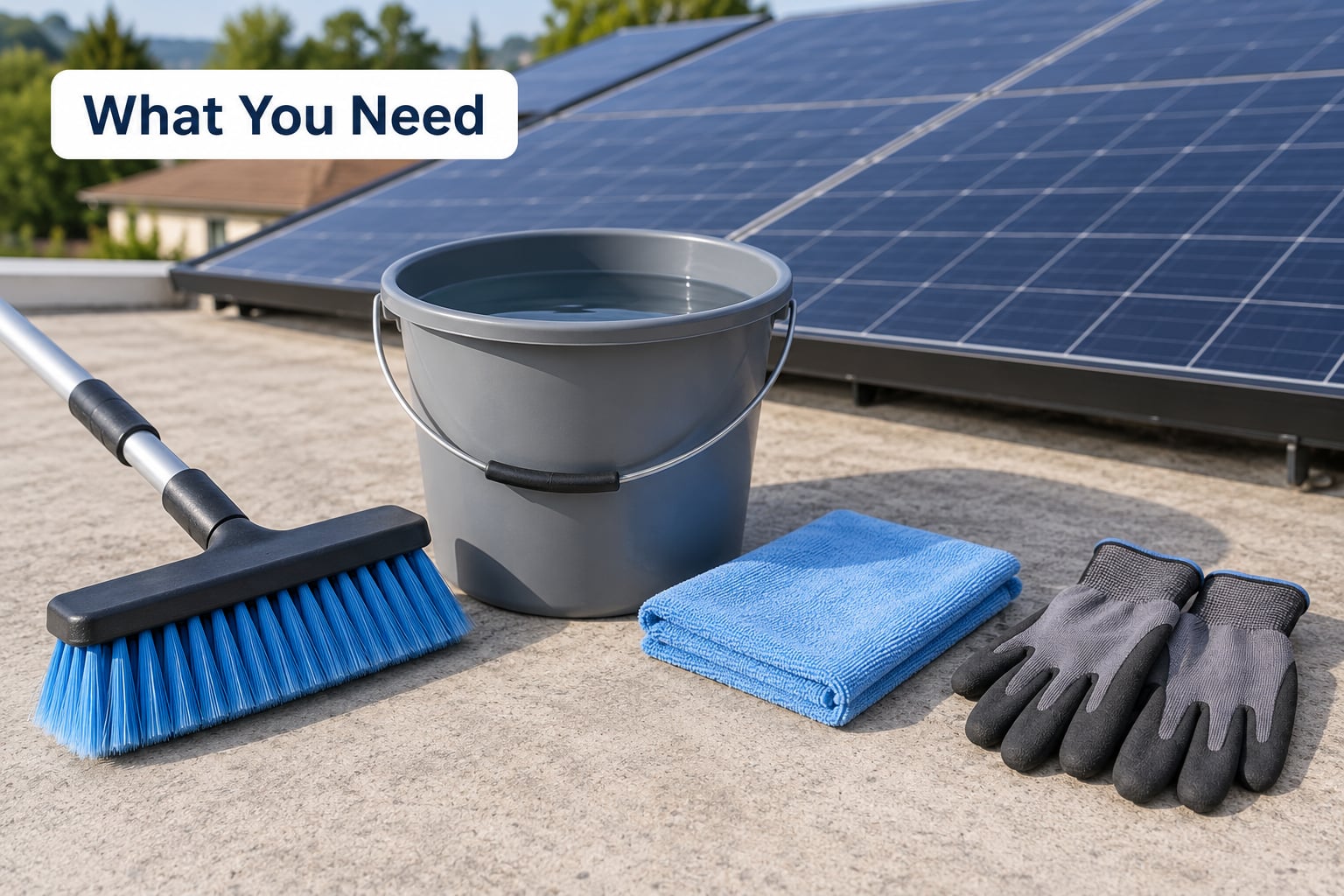
Gather everything before you climb anything. Half-finished cleaning means leaving a hose, a bucket, and a damp brush sitting on a roof, which is how slips happen.
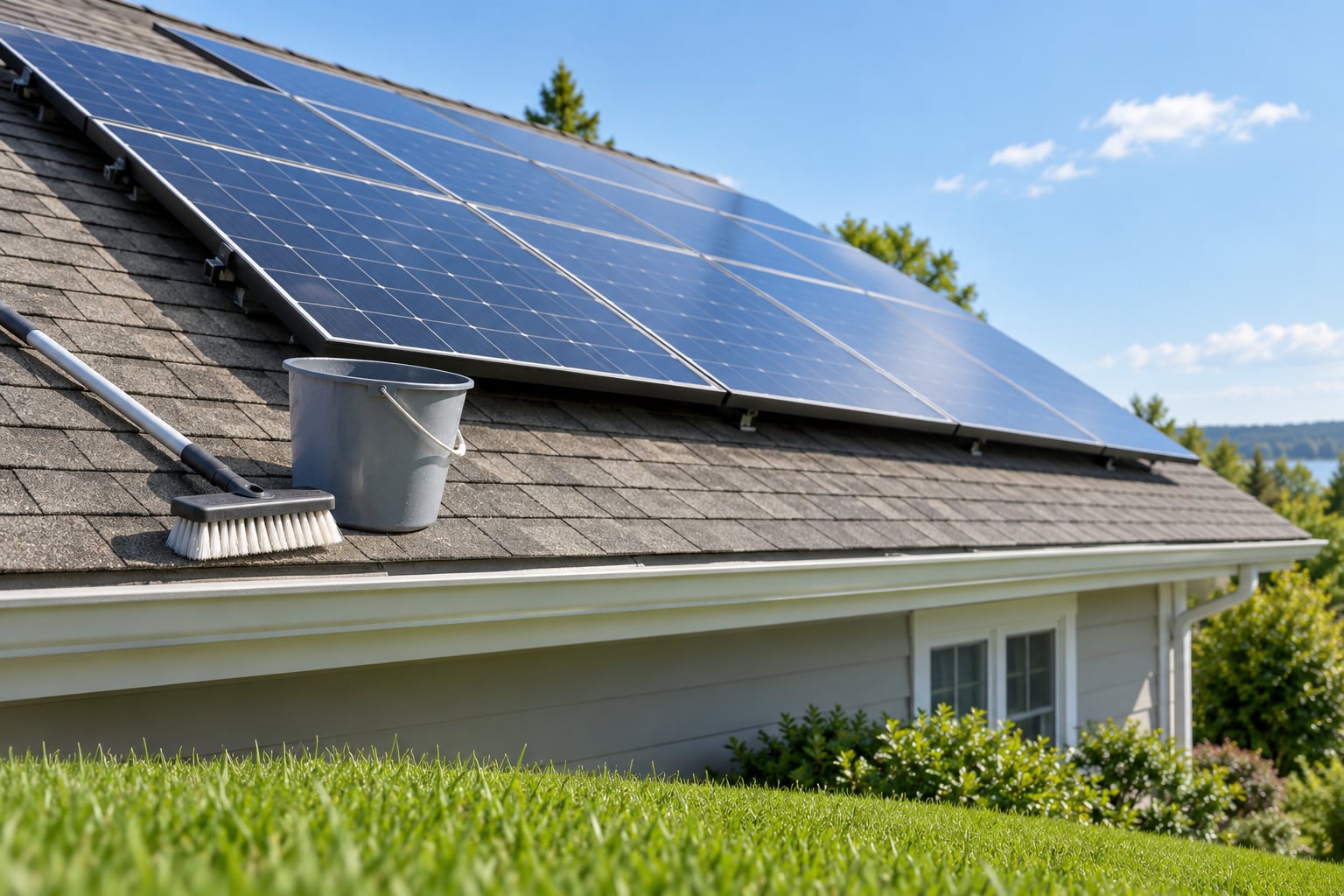
- A soft-bristle brush or non-abrasive panel brush. Never a household scrub brush, and never anything with a nylon scourer pad.
- Clean lukewarm water. A garden hose at low pressure does most of the work.
- A microfiber cloth or soft sponge for edges, frames, and any spot that does not rinse clean.
- Gloves with grip, and non-slip boots with a proper tread, not smooth-soled shoes.
- A stable ladder or roof-access equipment rated for the pitch, or a long-handled brush pole for ground-level reach.
- A mild, manufacturer-approved detergent if the panel maker allows one. Check the installation manual first.
- Your installer’s warranty and maintenance instructions. A few minutes reading these saves a costly mistake.
Skip the pressure washer, the ladder-climbing without a spotter, and any cleaner with ammonia, solvents, or abrasive particles. Those three cause most of the damage people regret.
Step-by-Step
How Often to Clean Solar Panels in Practice
The frequency that matches most homes is one to two cleanings a year, timed to when buildup actually accumulates rather than to a fixed date. Push that interval shorter where the air or the water is dirty.
| Environment | How often | Why |
|---|---|---|
| Rainy climate, tilted roof | Once a year, or less | Rain sheds most loose dust before it settles into a film |
| Desert or high-dust | Every 3 months | Fine grit builds fast and bakes onto the glass in heat |
| Coastal and salt air | Every 3 to 6 months | Salt spray leaves a mineral film that rain does not remove |
| Farmland and pollen country | Every 3 to 6 months, timed to pollen seasons | Pollen and agricultural dust mat down and hold moisture against the glass |
| Near highways or construction | Every 6 months, more during active building | Road film, grit, and concrete dust coat the surface |
| Wildfire or smoke area | As soon as it is safe | Soot and ash are oily and stick hard |
| Under trees or near birds | Twice a year and after storms | Leaves, twigs, and droppings create localized hot spots |
Ground-mounted arrays are the easiest to maintain and tolerate more frequent cleaning. Rooftop arrays need a ladder or a pole, which usually decides the method before you decide anything else. Portable and RV panels are the smallest but the fiddliest, since the connectors and frames are easy to scratch.
Check the System Before You Clean
Open your inverter display or monitoring app before touching a rag. You are looking for a gap between what the system should be producing today and what it is actually producing.
Most portals show daily, weekly, and monthly energy production. Compare the current month against a comparable month with similar weather, ideally a month with the same sun angle and no cloud cover. A shortfall of around 5 percent on an otherwise clear month is a normal soiling loss. A drop of 20 percent or more deserves investigation, and a fall to roughly a third of expected output means something is genuinely wrong.
If output looks normal and the glass looks clean, skip the cleaning. Dirt is not the answer to every low-production month, and cloud cover, a dirty neighboring roof, snow, or a failing string will all look identical from the monitoring app alone.
Choose a Safe Cleaning Method
Pick the gentlest method that will do the job, and match it to how the array is mounted.
- Plain water rinse. Best for loose dust and light pollen. Low-pressure hose, early or late in the day.
- Soft brush with water. The workhorse for grime that has bonded to the glass. Wet first, brush gently, rinse.
- Manufacturer-approved mild detergent. Only for oily film like smoke residue, and only if the maker permits it. Dilute it.
- Professional service. The right call for anything above a one-story roof, for panels on a steep pitch, or for arrays you cannot reach from the ground with a pole.
Waterless options exist, from electrostatic brushes to vibration-based systems, but they suit commercial installations more than a homeowner with a dozen panels.
Clean Without Damaging the Panels
Work on a cool day, ideally early in the morning or in the evening. Midday glass can reach well over 100 degrees Fahrenheit, and cold water on hot glass can micro-fracture the cells. This is the single most common homeowner mistake.
- Read the warranty first. Some manufacturers specify a cleaning method or restrict certain chemicals, and using the wrong one can complicate a warranty claim.
- Wet the panels first. Always. Brushing dry grit across glass is what creates micro-scratches.
- Work the soft brush lightly from one edge to the other, staying off the frames and never leaning weight on the modules.
- Rinse thoroughly from the top down so dirty water runs off the panels instead of drying onto them and leaving mineral streaks.
- Let the surface dry naturally. Do not climb back up to squeegee unless you already have safe access set up.
Never walk on the panels. Frames are designed to carry wind and snow loads spread across their mounting points, not a person on one corner. If a soft brush pole cannot reach from the ground, stop and call a professional.
Check the Result and Record the Next Cleaning Date
Stand back and look for streaks, hard-water spotting, and patches of remaining grime, especially along the lower edge where water settles. Grime near a junction box or on the frame does not affect output but signals that the panel has been neglected.
Worth it for a large system: check the monitoring app again two to three weeks later and compare with the same period before cleaning. Then write the date, the method, and the conditions in a note. Most households forget within a month, and a phone reminder set for the same season next year is the whole scheduling system.
Common Mistakes
Cleaning at midday in summer. The fix is simple: start before eight or after six, on a day the roof is cool.
Using a pressure washer. High-pressure water can drive water past the seals, crack cells, and void a warranty. Keep it gentle or skip it.
Brushing dry with an abrasive pad. The fix: wet the glass first and use a brush labeled non-abrasive.
Adding detergent or vinegar without checking the manual. Some coatings and sealants do not tolerate either. Read the panel’s care instructions.
Walking on the modules to reach a better angle. Use a roof anchor, a platform, or a pole brush. If none of those are practical, hire out.
Assuming every dip in output is dirt. Check the monitoring data, the weather, and the shading before paying for a cleaning that changes nothing.
Frequently Asked Questions
How often should residential solar panels be cleaned?
Most residential systems need cleaning once or twice a year. In a rainy climate with a tilted roof array, an annual clean or even less is usually enough. Dusty, coastal, agricultural, and construction-heavy homes need it every three to six months. Rather than counting months, look at the glass and compare your output against a comparable clear month.
Does rain clean solar panels automatically?
Rain helps a lot on a tilted, glossy panel, washing off most loose dust before it can set. It does not remove pollen that has matted down, oily soot, bird droppings, or the mineral film salt spray leaves behind, and it leaves hard-water spotting in the process. On a flat or nearly flat array, rain barely rinses the surface at all.
Can I clean solar panels with a pressure washer?
Avoid it. High-pressure water can force moisture past the seals, micro-fracture cells, and strip protective coatings, and most manufacturers treat it as misuse during a warranty claim. A garden hose at low pressure plus a soft non-abrasive brush is enough for almost every residential job. If grit is baked on, a professional with the right equipment is a better bet.
Should I clean solar panels in winter?
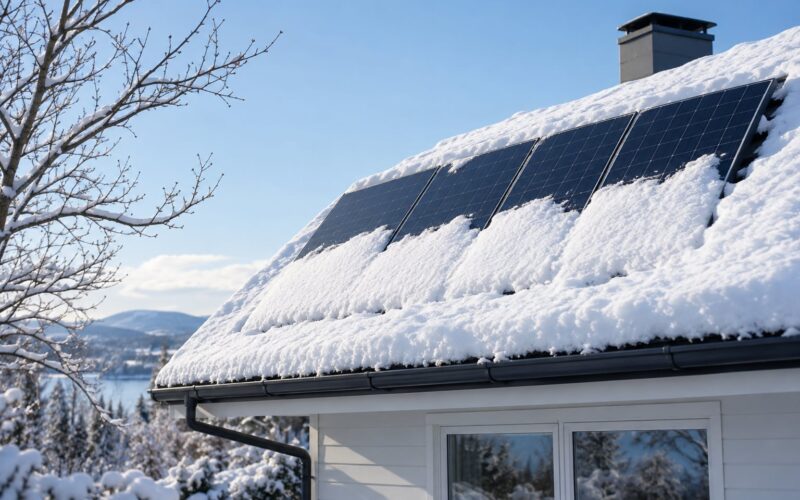
You can, but spring is usually easier. In freezing areas, panels can carry a snow and ice layer, and water that freezes in a frame crack causes real damage. Wait for a cool, dry day above freezing. After winter storms are a good trigger to check for debris, since twigs and leaves collect in gutters and on rails through the season.
How do I know whether dirty panels are reducing output?
Compare your monitoring app or inverter data across months with similar weather. A gap of roughly 5 percent on an otherwise clear month is ordinary soiling loss. A drop of about 20 percent or more points to something worth investigating, and output near a third of expected means a fault, a heavy shading problem, or serious soiling. Pair the numbers with a look at the glass.
Can homeowners safely clean solar panels on the roof?
Only if access is genuinely safe. Never walk on the modules themselves, and use a long-handled brush pole from the ground whenever it will reach. For panels above a one-story roof or on a steep pitch, hire a professional who has fall protection and the right equipment. Panels are also live whenever the sun is up, so keep water and tools away from connectors and junction boxes.
Conclusion
Look at the panels and check the monitoring data on a schedule you will actually keep, then clean when grime appears or output slips further than the weather accounts for. Most people need once or twice a year, and once a year in a rainy climate is genuinely enough.
When you do clean, start with water and a soft brush on cool glass, read the warranty before adding anything to the bucket, and never walk on a module. For a steep, high, or hard-to-reach roof, that is the moment to stop and hire a qualified professional. The savings from a clean are worth less than the cost of a fall or a cracked panel.