Cold weather affects solar batteries in two separate ways. It cuts the energy you can actually take out of the pack — roughly 10-20% of usable capacity disappears below 5°C, and far more below freezing — and it stops the pack accepting a charge below about 0°C/32°F. The lost capacity comes back when the battery warms up. Charging a frozen lithium cell does not.
That difference matters more than most people expect, because winter is when you need a battery most. Solar production is at its lowest, heating loads are at their highest, and the cheapest hours on an off-peak tariff are the coldest hours of the day.
Table of Contents
- How Cold Weather Changes Solar Battery Performance
- Why Cold Temperatures Reduce Battery Output
- Why Charging Can Be Slower in Winter
- Does Cold Weather Permanently Damage Solar Batteries?
- Why Solar Garden Lights May Not Turn On in Winter
- How to Protect Solar Batteries in Cold Weather
- How to Check Whether a Battery Recovered After Warming
- Frequently Asked Questions
- Do solar batteries die permanently in cold weather?
- Can I charge a solar battery when it is below freezing?
- Will a cold solar battery work again after it warms up?
- Should I bring outdoor solar lights indoors during winter?
- Is cold weather less harmful to lithium or lead-acid solar batteries?
- What to Do Before Winter Arrives
How Cold Weather Changes Solar Battery Performance
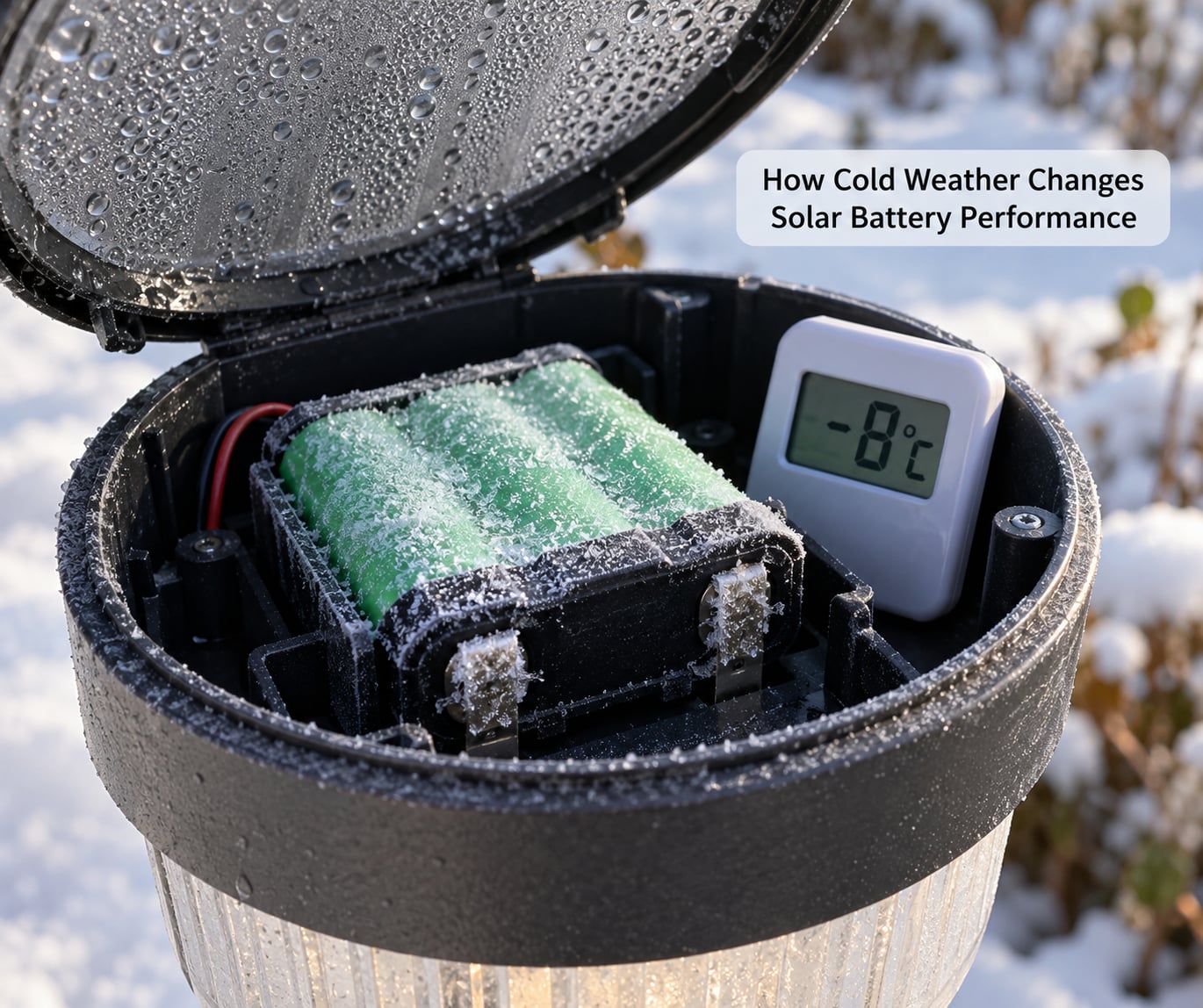
Cold changes five things at once, and they do not all start at the same temperature. The table below shows typical ranges for lithium iron phosphate (LiFePO4) packs. NMC and lead-acid behave differently at the cold end, and every manufacturer publishes its own limits, so treat these as ranges rather than specifications.
| Cell temperature | Usable capacity | Charge acceptance | Other effects |
|---|---|---|---|
| 25°C / 77°F | About 100% (rated) | Full, fastest rate | Nominal; the reference point |
| 10°C / 50°F | About 95-100% | Full | Little to notice |
| 5°C / 41°F | About 80-90% | Full, some reduction | The line most datasheets warn about |
| 0°C / 32°F | About 70-80% | Blocked or heavily throttled by most BMS | Voltage sags under load |
| -10°C / 14°F | About 30-80% | Blocked | Internal resistance rises sharply |
| -20°C / -4°F | About 30-60% on non-cold-rated cells | Blocked | Some output cut off entirely |
| -30°C / -22°F | About 6-12% on non-cold-rated cells | Blocked | BMS may refuse to discharge |
The bottom two rows come from a DIY Solar Forum thread where a member with a 500Ah 52V bank in a cold mountain battery room measured usable capacity for cells that were not cold-rated, discharging at roughly a 0.15C rate. Cold-rated cells hold much more of their rating at those temperatures, which is the entire point of paying for them.
Recovery is the good news. Warm the same pack back to room temperature and usable capacity returns to its normal figure, usually within an hour or two for a small pack. Nothing was consumed. What was consumed was your margin.
Why Cold Temperatures Reduce Battery Output
Inside every lithium cell is an electrolyte carrying ions between electrodes. Warm, it flows easily. Cold, it thickens, and the ions slow down the way traffic slows on a congested road.
Slower ions mean higher internal resistance, and higher internal resistance means the terminal voltage sags as soon as you draw current. A pack that is 90% full on a mild day can read as 70% and trip a low-voltage cutoff on a cold one, without anything being wrong with it.
Discharge in the cold is generally less of a problem than charging in the cold. Pulling energy out of a cold battery is a temporary inconvenience. Pushing energy into one can leave metal deposited inside the cell, and that part does not wash off.
Why Charging Can Be Slower in Winter
A cold battery may accept a charge more slowly even when sunlight is available and the panels are producing normally. The battery management system reads cell temperature from sensors inside the pack and either throttles the charge current or refuses charge entirely below its set limit, which for most LiFePO4 systems sits around 0°C.
Solar makes this worse. Winter days are short, the sun sits low, and useful production arrives later in the morning — exactly when the pack is at its coldest. Some owners report the charge not restarting until midday even on a self-heating model, because the pack needs a few hours of solar input before the heater has anything to work with.
Forum threads are full of this: an owner in a UK solar group found a garage battery reaching only about 30% overnight, and another on Escapeforum saw a Victron system reboot because early-morning solar could not supply enough current to hold voltage up.
Does Cold Weather Permanently Damage Solar Batteries?
Usually no. Most of what cold does to a solar battery is temporary, and the chemistry difference below is what decides whether it stays temporary.
The permanent risk is lithium plating. Push charge current into a lithium cell while it is below its charging temperature and lithium metal deposits as thin plates on the anode instead of intercalating properly. Enough of it, and you get dendrites, internal short circuits, and a cell that can fail without warning. This is the reason every reputable lithium battery carries a low-temperature charge inhibit.
Discharge is different. Running a pack low in the cold does not plate it, though it does push it toward the deep-discharge zone, where lead-acid and lithium behave badly in different ways.
| Chemistry | Minimum charge temperature | Cold behaviour | Main cold risk |
|---|---|---|---|
| LiFePO4 | 0°C / 32°F typical, some models lower or higher | Loses capacity gradually; recovers fully when warm | Plating if charged cold without BMS protection |
| NMC | 0°C / 32°F typical, many datasheets stricter | Similar pattern to LFP | Plating, plus tighter voltage limits |
| Lead-acid | No hard minimum, but freezing damages it | Capacity drops hard; a deeply discharged cell can freeze and crack | Permanent freeze damage and sulphation |
Storage is its own case. An unused battery held at 50-80% state of charge, in a cool dry place above freezing and checked every few weeks, is a stable battery. One left fully discharged in a freezing shed is not.
Why Solar Garden Lights May Not Turn On in Winter
Solar garden lights fail in winter for boring, checkable reasons, in roughly this order. Work down the list and most of them are solved in a couple of minutes.
- Not enough winter charge. A small pack that gets a few usable hours of sun a day may never climb out of a partial state of charge, especially if several cloudy days run together.
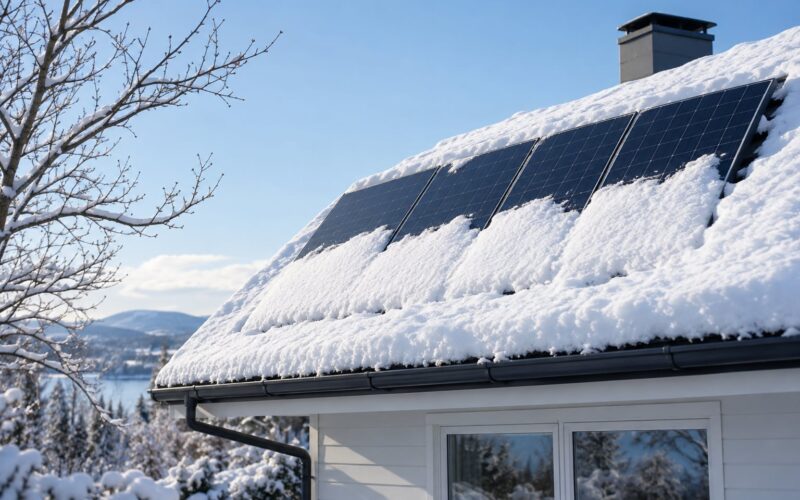
- Snow or leaf litter on the panel. A panel under a thin layer of snow can collect almost nothing. Reach it with a soft roof rake from the ground rather than climbing up with a scraper.
- Shade that did not matter in summer. A bare tree or a building shadow moves across the panel for hours on a low winter sun.
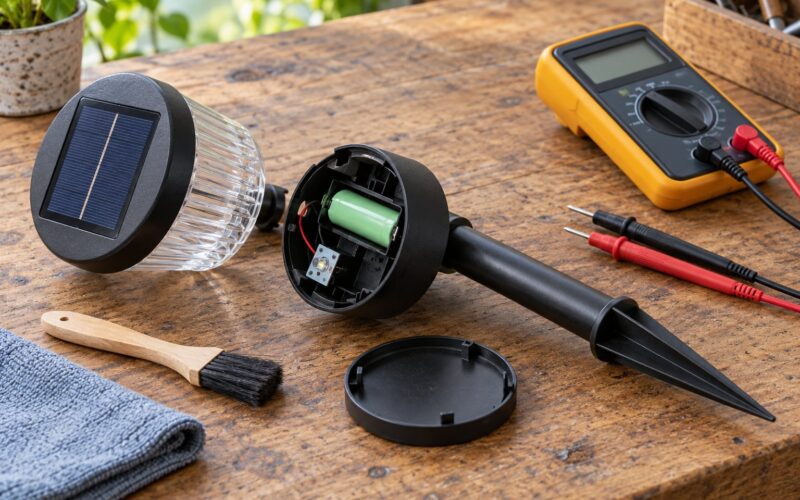
- A tripped or dead battery. Small packs shut down and stay down. A full charge on a meter, or a swap with a known-good battery of the same type and size, tells you which it is.
- Moisture in the enclosure. Corrosion on the contacts or water inside the battery compartment drops the voltage before the light ever reaches full output.
- Sensor fault. A light sensor stuck on, or a dusk sensor that never fires, looks exactly like a flat battery.
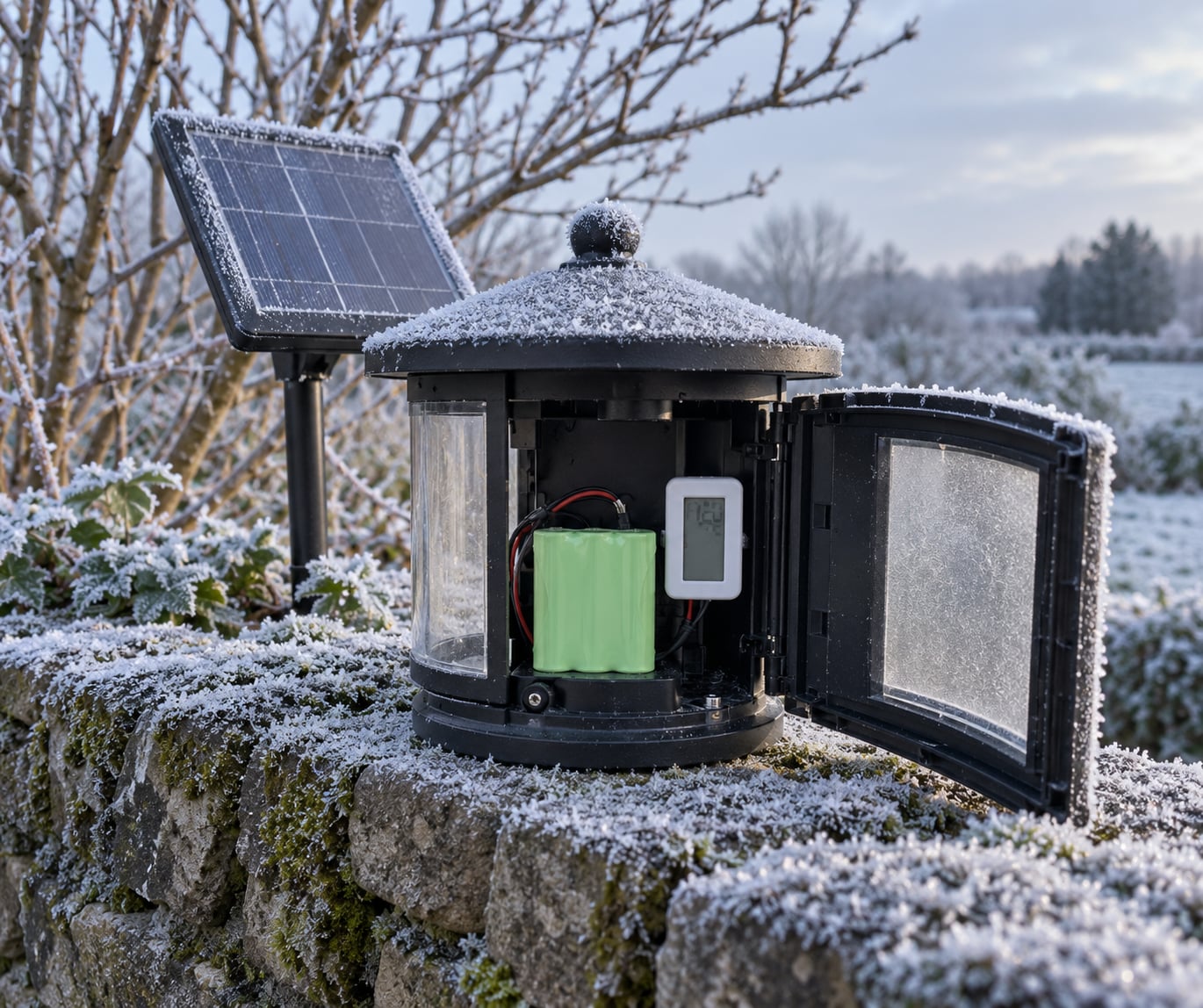
- Low-temperature charge cutoff. Some packs simply will not take charge below freezing, and the only fix is to move them somewhere warmer until the panel has put something in.
How to Protect Solar Batteries in Cold Weather
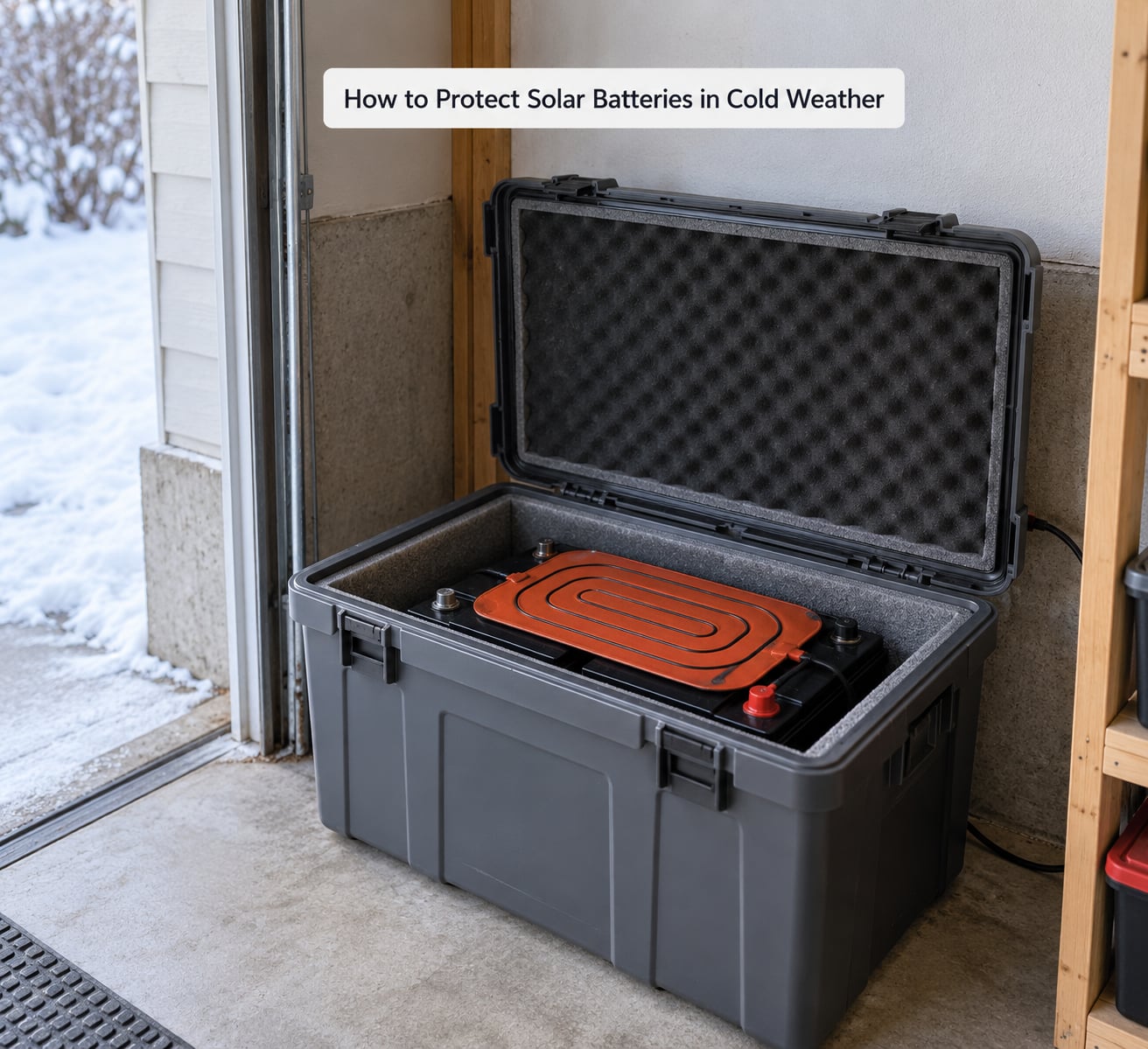
Start with where the battery sits, because that decides most of what follows. An indoor utility room in a house that is heated at all beats an unheated garage, and a shed or loft is the worst of the usual options.
| Location | Typical winter result | Verdict |
|---|---|---|
| Inside the home, heated | Near rated performance all winter | Best |
| Heated garage or plant room | Close to rated, minor dips on cold nights | Good |
| Insulated but unheated garage | Throttling on the coldest nights, capacity loss in deep cold | Acceptable with a warm pack |
| Unheated garage, no insulation | Charge suspended for long stretches in a real cold snap | Poor without mitigation |
| Shed or loft | Follows outdoor temperature, often with a wide swing | Avoid if you can |
Then work through the practical steps.
- Check the datasheet before anything else. It gives the charge minimum, the discharge minimum, and whether the pack is cold-rated. Those three numbers drive every other decision.
- Move the panel if you can. A panel on a south-facing wall or at a steeper angle sheds snow and catches more low-angle winter sun. A ground-mounted panel in the shade is the worst combination.
- Clear snow early. Once a day in the first week after a snowfall is enough. Leave snow sitting and the pack spends its whole charge budget trying to compensate.
- Insulate the enclosure. Foam board or a purpose-made wrap around a cabinet slows the temperature drop. Cover it loosely and leave ventilation clear — a pack that generates heat in an airtight box is a different and much more dangerous problem.
- Consider a low-wattage heat mat. A 30W to 60W pad on a 12V or 24V pack can hold a cell temperature safely above its charge limit. It draws a small continuous load, which is exactly why it belongs on a battery that already has margin.
- Buy a self-heating pack if your site is genuinely cold. Several home battery brands now ship a built-in heater that brings the cells up before charging resumes. That solves the cold-morning charge window without you wiring anything.
- Do not chase the charge with load. Keeping the state of charge high through winter is worth more than any single trick, and avoiding deep discharge protects cells that will still be there in spring.
On home systems, treat all of this as information for a qualified installer rather than a work order. Anything involving mains-side connections, new circuits or enclosure heaters belongs with a licensed electrician, and any battery work should follow the manufacturer’s manual. Lithium batteries fail dramatically rather than quietly, and a battery that has been dropped, punctured or heated by a damaged pad is not something to troubleshoot in a shed.
How to Check Whether a Battery Recovered After Warming
Let the pack sit in a warm, dry place for an hour or two first, then work through this in order.
- Look at it. Swelling, a cracked case, white residue or a leaking cell means stop and replace. Cold alone does not do any of those.
- Check the terminals. Corrosion and moisture on a solar light’s contacts are common and cheap to fix with a contact cleaner and a dry cloth.
- Read the voltage or state of charge. A rested pack reading far below what it should tells you the discharge is real. A pack that reads near full and still does nothing points at the light or the sensor instead.
- Charge it under control. For a small removable pack, a proper charger at a low rate in normal indoor conditions is safe and quick. Never feed a lithium pack from a solar panel or a cheap USB source just because it sat in the cold — that is exactly the forced cold-charge case.
- Re-test in place. After a full charge, put it back and watch one full cycle from dusk to dawn. If it fails the same way again with a known-good battery and a clean panel, the fault is in the light.
For an installed home battery, the equivalent check sits in the inverter app. Most systems log cell temperature and show a cold fault or charge inhibit message explicitly. If the pack charges normally once it is above the limit, nothing is broken. If it refuses at 10°C, that is a real fault and your installer or the manufacturer should hear about it.
Frequently Asked Questions
Do solar batteries die permanently in cold weather?
Usually not. The capacity a solar battery loses in the cold comes back as soon as the pack warms up, because nothing was consumed — the cells just delivered less energy at higher internal resistance. The one permanent risk is charging a lithium cell below its charge temperature, which can plate lithium metal onto the anode. A battery with a working low-temperature charge inhibit should refuse that charge rather than accept it.
Can I charge a solar battery when it is below freezing?
No. Most LiFePO4 and NMC packs specify a minimum charge temperature around 0°C/32°F, and the battery management system blocks charge below it. Charging below that limit can cause lithium plating, which does not reverse. If you need charge in the cold, use a self-heating pack, warm the enclosure above the limit first, or wait until the cells are above it.
Will a cold solar battery work again after it warms up?
In most cases yes. Bring the pack to a warm, dry place and leave it for an hour or two, and usable capacity returns to its normal figure. What does not come back is damage from charging below the limit, or from a lead-acid cell that froze while deeply discharged. Check the pack visually after warming, since swelling or a cracked case is not a cold symptom.
Should I bring outdoor solar lights indoors during winter?
For a few weeks, yes, and it is the simplest fix there is. Indoors the pack charges properly and the light works normally again. Left outdoors, the panel may not deliver enough charge in winter to get the pack out of a partial state of charge, and a light that sits below its cutoff will not switch on at dusk. Store any removed pack around half charge if it is staying unused.
Is cold weather less harmful to lithium or lead-acid solar batteries?
Lithium iron phosphate handles cold more gracefully. Its capacity loss is reversible once the pack warms up, and a BMS blocks cold charging before plating can occur. Lead-acid loses capacity sharply when cold and, if deeply discharged, the electrolyte can freeze and crack the cell — that damage is permanent. Lead-acid also recovers more slowly once it has been deeply discharged.
What to Do Before Winter Arrives
If you do one thing, test the battery. Charge it fully, leave it overnight in a warm room, and check the state of charge the next morning. A pack that cannot hold a charge overnight has a problem that cold will make worse, and finding it in autumn is far cheaper than finding it in January.
After that, work down the list: clean and reposition the panel for winter sun, confirm the light sensor switches on at dusk, check the manufacturer’s charge and discharge temperature limits against your site’s typical winter temperature, and replace any unit that no longer holds a charge.
Understanding how cold weather affects solar batteries comes down to one rule. Cold reduces what a battery can give you today and comes back later. Cold charging takes something away permanently, and no amount of warming brings it back. Keep the pack above its charge limit, keep it away from deep discharge, and the same battery will still be working for you next spring.