Shade on a roof hurts a solar array far more than most homeowners expect, because the loss is not proportional to the shaded area. A shadow crossing one corner of a panel can pull down output for a whole string of panels, and the rest of the array keeps running well below what the sales sheet promised. Knowing how roof shade affects solar panels before you sign a contract is the difference between a system that pays for itself and one that argues with you for a decade.
The mechanism is electrical, not optical. Panels are wired in series, current is limited by the weakest link, and a shaded cell is a very weak link. That is also why module-level electronics, the right panel layout, and an honest site survey matter more than the efficiency number printed on the datasheet.
Table of Contents
- How Does Roof Shade Affect Solar Panels?
- How roof shade affects solar panels wired in one string
- What Types of Roof Shade Matter Most?
- Temporary Shade vs. Permanent Shade
- How Much Solar Output Is Lost to Shade?
- How to Tell If Roof Shade Is a Problem
- How to Reduce the Impact of Roof Shade
- What Shade Does to Solar Panel Design and Safety
- String planning and equipment
- Rapid shutdown, roof access and fire safety
- Monitoring and warranty
- Frequently Asked Questions
- Can a little shade on a roof significantly reduce solar panel output?
- Do solar panels work if only part of the roof is shaded?
- Should I remove trees that shade my solar panels?
- Can solar panels be installed around a chimney or other roof obstruction?
- Do microinverters or power optimizers fix shade problems?
- How can I tell whether my panels are underperforming because of shade?
- What Should You Do First?
How Does Roof Shade Affect Solar Panels?
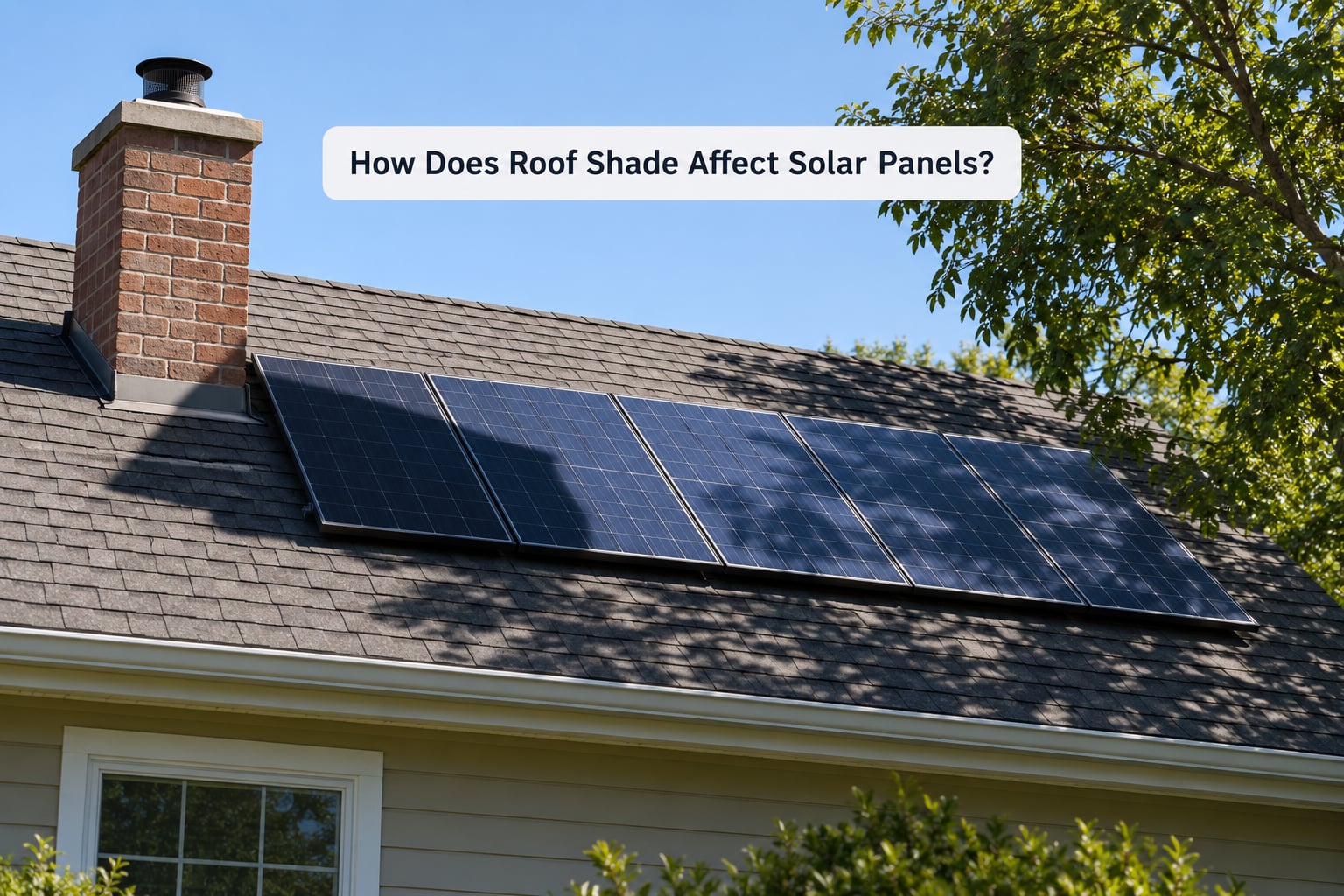
Shade blocks the sunlight reaching shaded cells, so those cells stop or slow producing while the rest of the array stays in full sun. A partly shaded row still makes some power, but the shaded section can drag down the output of every panel wired with it.
Solar cells convert light into direct current. Wired in series, that current has to pass through every cell in the string, and the whole string settles at the pace of the weakest cell. A shaded cell produces less, so the current flowing past it drops, and the panels downstream cannot push their rated current through that bottleneck.
Every panel also carries internal bypass diodes designed to route current around a shaded section. They help, but they work in discrete blocks, so a panel can lose a meaningful slice of its output even after the diodes do their job.
| Shade level on the array | Likely production impact | What it means for you |
|---|---|---|
| Direct sun, no obstructions | Close to the modeled annual production | The system performs as designed. Most disputes start when this case is assumed but never verified. |
| Partial shade, a strip or corner of a few panels | Losses far larger than the shaded percentage, and often the entire affected string | Layout and inverter choice matter enormously here. Module-level electronics can recover much of it. |
| Full shade over most or all of a panel | A fully shaded panel produces very little, sometimes in the 10 to 25 percent range of its potential depending on the shade type | Panels in full shade are usually worth removing from the design rather than paying for hardware that will sit dark. |
How roof shade affects solar panels wired in one string
Panels connected in a single string share one current path, so one bad panel caps the whole run. Splitting an array into several shorter strings, or giving each panel its own electronics, removes the shared bottleneck entirely.
What Types of Roof Shade Matter Most?
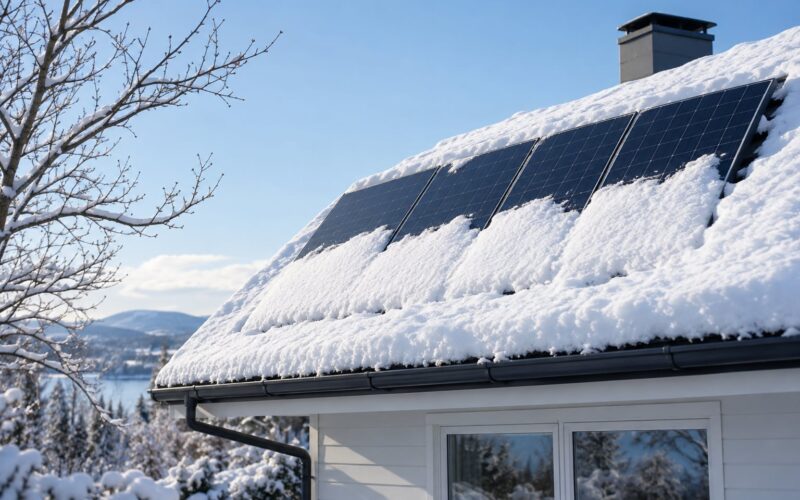
Shade divides into temporary sources that come and go, and permanent sources that stay put all year. Temporary shade such as a passing cloud is diffuse and usually costs little, because the whole panel sees roughly the same reduced light. Hard-edged objects like a chimney or a satellite dish are different, and they create a sharp boundary that the series wiring cannot ignore.
Common permanent offenders on a residential roof include:
- Chimneys, which throw a shadow that moves and changes length through the day
- Plumbing and attic vents, plus bathroom and kitchen exhaust stacks
- Dormers and roof windows on complex roof shapes
- Satellite dishes, antennas and rooftop cable runs
- Parapet walls and raised edges on flat roofs
- Trees, both mature canopy and fast-growing new growth
- Neighboring buildings, which matter most in dense neighborhoods and dense forest
- The roof’s own geometry, where a low pitch or a dormer shades the row behind it
Whether the damage stays local or spreads across the array comes down to wiring. In a traditional design, one shaded panel drags down everything in its string, no matter how far away the sunny panels are. In a design with module-level electronics, each panel operates on its own, so a shaded corner costs you the shaded panel and little else.
Row-to-row shading is worth calling out separately. On a shallow-pitched roof, the first row can shade the row behind it early and late in the day, which is a layout problem rather than an obstruction problem, and one a good installer fixes by spacing and tilt rather than by equipment.
Temporary Shade vs. Permanent Shade
Temporary shade changes on a schedule you cannot control. Permanent shade sits on the roof and affects the same panels every clear day. Sorting the two apart early tells you which problems you can fix and which you have to design around.
| Shade source | What changes over time | Can it be improved? |
|---|---|---|
| Clouds and haze | Minutes to hours, and it softens the whole panel at once | Nothing to fix. Diffuse light loss is small and temporary. |
| Seasonal tree canopy | Leaves, growth and the sun’s angle combine, so a tree that clears the array in winter may block it in summer | Trimming or removal, subject to local rules and arborist advice. Growth means a one-time trim buys a few years. |
| Chimney and vent shadows | Length and position swing through the day and change with the sun’s angle by season | Layout. Panels are often shortened, split into more strings, or kept clear of the shadow band. |
| Rooftop equipment and dishes | Fixed, but its shadow slides as the sun moves | Sometimes. Relocating equipment is easier at design stage than after the panels are up. |
| Neighboring buildings and parapets | Fixed, worst in winter when the sun sits low | Usually not. Design around it, or put panels on a different roof plane. |
| Self-shading between rows | Fixed geometry, worst early and late in the day | Yes. Row spacing, tilt and layout changes solve most of it. |
Morning shade deserves its own warning. Solar output peaks in the middle of the day, so shade between roughly 9am and 3pm hurts annual production far more than shade at the edges of the day. A tree that shades your roof until mid-morning costs more than its shadow area suggests, because it is blocking production during the hours that matter most. The counterweight is the low winter sun, which can clear an obstruction that blocks the roof in summer, which is why annual production matters more than any single day.
How Much Solar Output Is Lost to Shade?
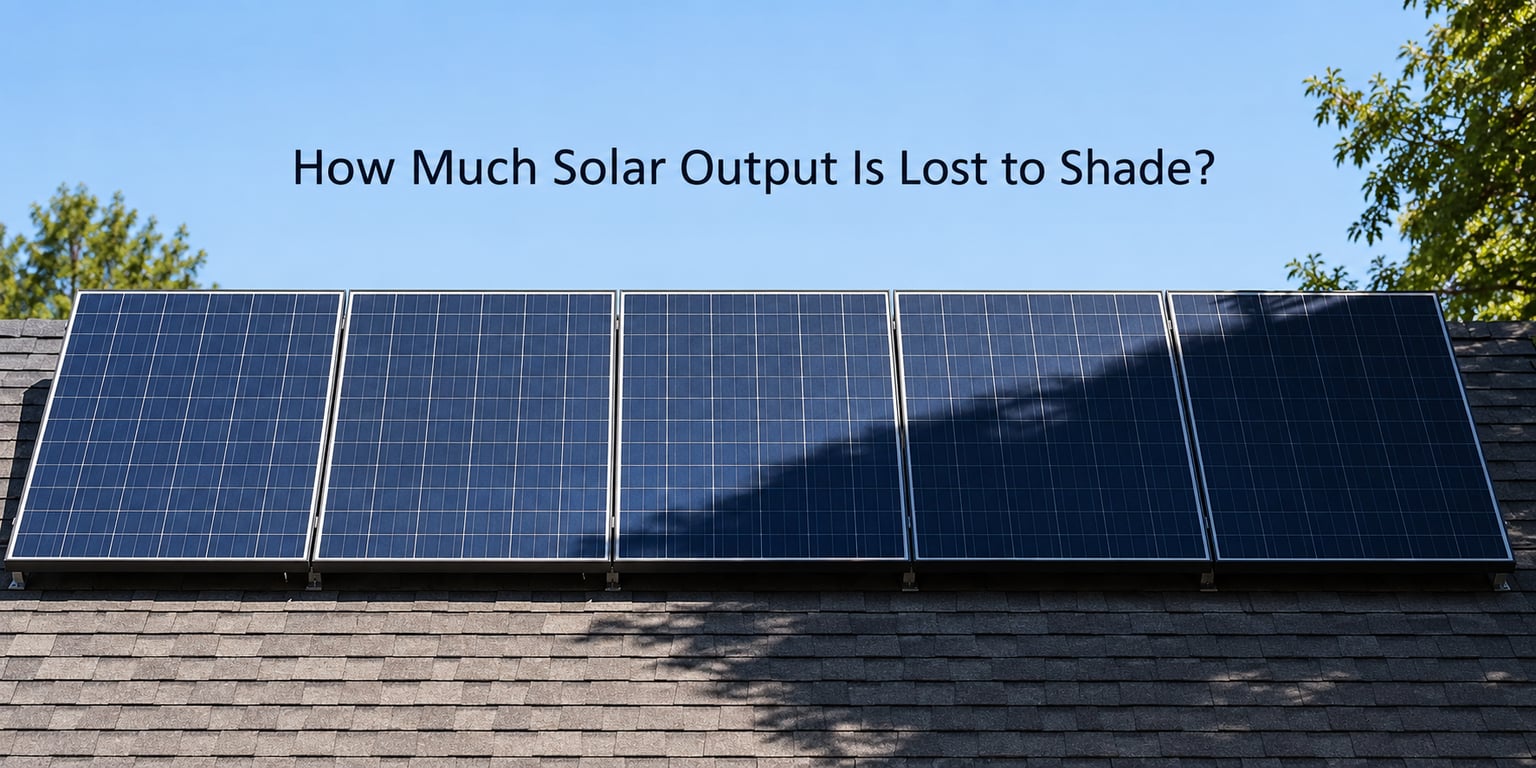
There is no single honest percentage, which is why the numbers you find online seem to contradict each other. Some sources quote 10 to 25 percent for a fully shaded panel, others quote 50 to 80 percent for partial shade, and both are describing different situations. The lower figure is a nearly dark panel still making a trickle. The higher figure is a healthy panel whose neighbors are clipped by a string-level bottleneck.
| Scenario | Output impact | What decides the outcome |
|---|---|---|
| Thin edge shade, a rod or cable across a small part of a panel | Often modest, sometimes severe | Where on the cell the shadow falls and whether bypass diodes can isolate it |
| A strip of shade across roughly 10 percent of a panel | Can pull a whole series string down by half or more | String design above all. Split the string or add module-level electronics and the loss largely disappears. |
| About a quarter of a panel shaded | Severe in a series string, moderate with per-panel electronics | Inverter architecture and how many panels share the shaded section |
| Half a panel shaded | Severe, and a warning sign for hotspots | Hotspot protection. Prolonged partial shading can damage cells and void warranties. |
| Most or all of a panel shaded | Little or no useful output from that panel | Design decision. Usually better left out of the array. |
Six variables move the number more than the shaded percentage does: where the shade falls, when it falls, the sun’s seasonal path, the wiring layout, the inverter and panel-level electronics, and which electrical connections the shade touches. A site-specific production estimate from a qualified installer, ideally built with sun-path or LIDAR modeling for your exact roof, is worth more than any rule of thumb in this article.
One more thing to watch: soiling, snow, heat and a poor orientation can each shave a few percent, and none of them behave the way shade does. Shade is the only one that can halve a healthy-looking system’s output on a clear day, which is why it is worth chasing down before signing anything.
How to Tell If Roof Shade Is a Problem
You can run most of this audit yourself in an afternoon, from the ground, with no roof access. If the result worries you, that is exactly the moment to have a professional look at the roof and the electrical design.
- Watch the roof at several times on a clear day. Note when shadow first touches each area, roughly when it lifts, and whether it lands in the middle of the day.
- Come back in a different season. Leaf-off and leaf-on, or summer and winter, show opposite extremes. Shade that only appears in one season still counts against annual production.
- List every obstruction and mark its shadow length. A chimney shadow is roughly two to three times taller than the chimney at a typical sun angle, so measure the object and the shadow separately.
- Map the shade onto the planned panel layout. Draw which panels get hit, when, and for how long. This is the sketch your installer needs to size strings and equipment.
- Ask for a sun-path model, not a guess. Tools such as Solar Pathfinder or a LIDAR survey show exactly which panels are hit in each season and hour.
- Ask what the estimate assumes. Get the annual kWh figure in writing, plus the assumptions behind it: orientation, tilt, and how shade was modeled.
- Compare production against clear-sky expectations. After install, a monitoring app that shows per-panel or per-string output makes a shaded section obvious, because one unit lags the rest on sunny days.
Watch from the ground. Do not climb onto a roof to check shadows, and keep clear of roof access points and ladders while carrying anything. Anything involving the roof surface, rafter loading or the electrical system belongs with a licensed professional.
How to Reduce the Impact of Roof Shade
Options run from free to invasive, and the order below roughly follows how much disruption each one causes. Start at the top and stop as soon as the projected production is good enough.
- Choose a clearer roof area. Often the whole answer. Moving the array to an unobstructed plane is cheaper than any equipment upgrade and produces more than it saves.
- Adjust the layout. Shift panels, shorten rows, widen spacing between rows and change the tilt so a dormer or a neighboring wall stops landing on the array.
- Trim vegetation. Effective, and not free. Trees grow back, and trimming or removal can need local approval, a protected-species check or a certified arborist. Get advice before cutting anything large.
- Relocate obstructions where practical. A vent pipe or a dish mount moved before install costs almost nothing; moved after install, it means roof work and a re-inspection.
- Add module-level electronics. Microinverters or power optimizers let each panel run independently, so a shaded panel costs you that panel instead of its neighbors. In a badly shaded string design this is often the single biggest recovery available.
- Redesign the array. Add a second inverter with a second MPPT, split one long string into two, or drop the worst-placed panels entirely. More hardware on a small system usually underperforms a smaller, better-planned one.
Three cautions. Trimming trees may require permission and professional work, and a badly pruned tree is a liability. Electrical changes belong to a licensed electrician under local rules. And module-level electronics reduce shade losses; they do not manufacture sunlight that never arrives.
What Shade Does to Solar Panel Design and Safety
Shade decisions made at the design stage are cheap. The same decisions made after the array is on the roof mean re-roofing, new penetrations and a new permit, so shade belongs in the conversation before the first panel is ordered.
String planning and equipment
A shade analysis tells the designer how to break the array into strings, and how many MPPT inputs the inverter needs. Skip that and the shading quietly sets the design for you, usually in the worst way.
Rapid shutdown, roof access and fire safety
Shade also changes where the wiring runs and how much of the roof stays accessible for inspection. Follow the manufacturer’s instructions and the code requirements for rapid shutdown and labeling, and have a licensed professional evaluate anything structural, roofing-related or electrical.
Monitoring and warranty
Panel-level monitoring is how you confirm a fix worked, and shade is a common condition in warranty exclusions. Read the shading language in the production guarantee before you sign, and get written confirmation of the annual production figure the installer is assuming.
Frequently Asked Questions
Can a little shade on a roof significantly reduce solar panel output?
Yes, and the loss is often larger than the shaded area suggests. Because panels in a string share a current path, a shadow across a small part of one panel can pull down output for every panel wired with it. A shade strip covering roughly a tenth of a panel has been reported to cost half or more of a string’s output. Module-level electronics such as microinverters or optimizers are the usual fix.
Do solar panels work if only part of the roof is shaded?
They do, and most installations with some obstruction are still viable. The work is to keep the shaded panels electrically separate from the sunny ones, and to design the strings so a shaded section cannot cap the whole array. A site survey that models shade by hour and season tells you the real annual production figure. If shading is severe, moving to a clearer plane often beats adding equipment.
Should I remove trees that shade my solar panels?
Not automatically. If the shadow falls outside the middle-of-the-day production window, or the panels sit in a different season’s clear area, the tree may cost you very little. If it shades the array roughly 9am to 3pm, the annual loss is serious. Consider trimming before removal, check whether local rules or a protected-species status applies, and have a certified arborist advise before any cutting.
Can solar panels be installed around a chimney or other roof obstruction?
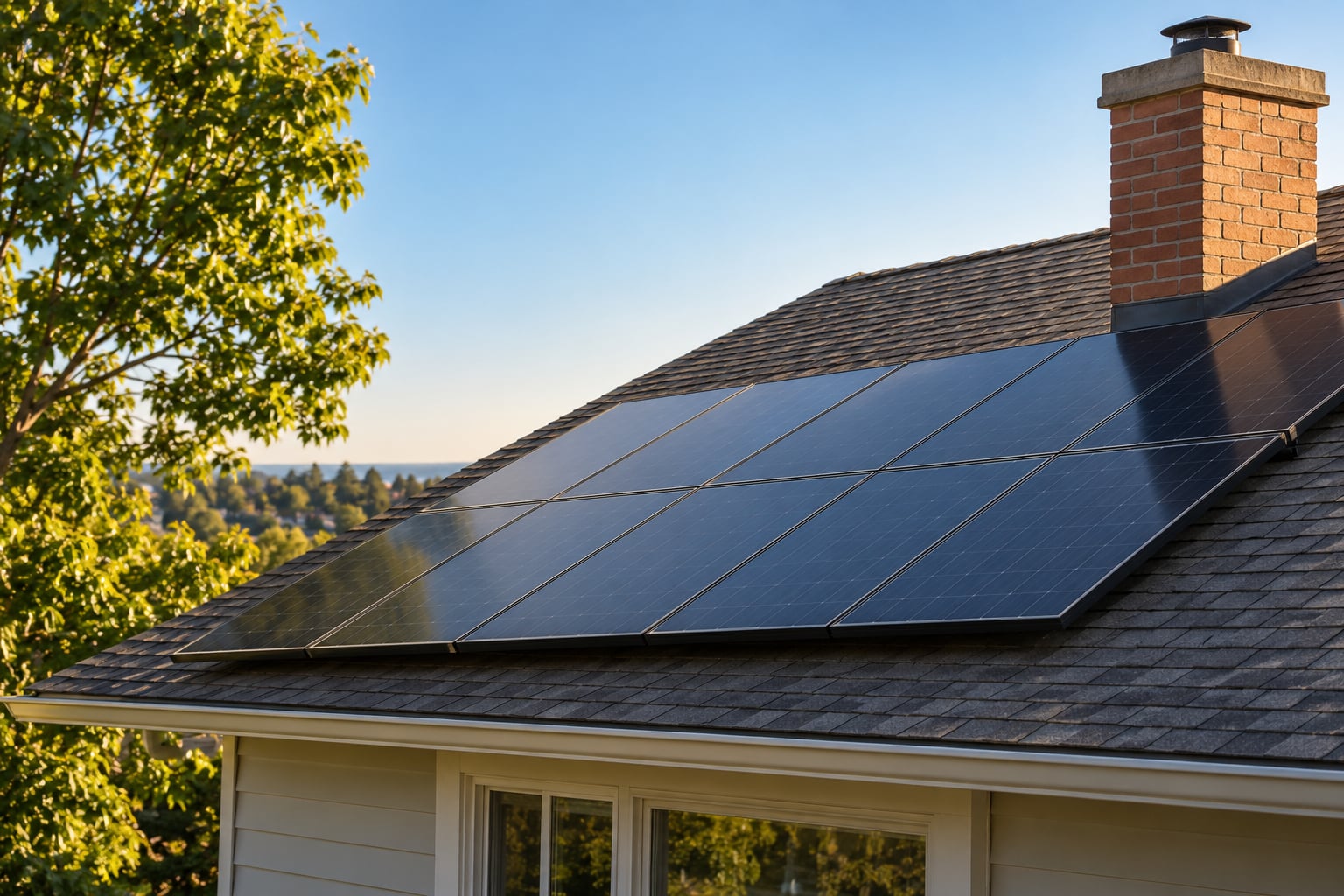
Yes, installers work around chimneys, vents, dormers and dishes every day. The panel rows are shortened or split into more strings so the shadow band does not sit across a whole run, and the area under the shadow may be left empty or fitted with a shorter module. Ask to see the shade map that shows which panels are hit and when. Leave proper clearance around the obstruction for maintenance and roof access.
Do microinverters or power optimizers fix shade problems?
They fix the wiring part of the problem. With a microinverter or optimizer on each panel, a shaded panel drops to its own output instead of holding back every panel in its string, so recovery in a partly shaded design is often dramatic. They cannot help a panel that receives no sunlight at all, and they cost more hardware and more points of failure. A shade estimate should compare both options before you choose.
How can I tell whether my panels are underperforming because of shade?
Compare your production data against a clear-sky baseline for your site on the same days, and look at the pattern rather than a single number. Shade losses track the sun: output sags in the morning or late afternoon on clear days and recovers around midday. Per-panel or per-string monitoring makes it obvious, because one shaded unit trails the rest. A persistent shortfall on clear days at noon points at something other than shade, so have an installer check it.
What Should You Do First?
Document the shade pattern before anything else, then get a site-specific production estimate. Spend an afternoon watching the roof from the ground across a few times of day and in a second season, sketch which panels get hit and when, and hand that to the installer to model.
Ask them to model the proposed layout, say which strings would need bypass diodes, optimizers or a second inverter, and put the expected annual kWh in writing. If nobody will produce that estimate for your roof, the number in the contract is a guess, and a guess is what the argument looks like three summers later.