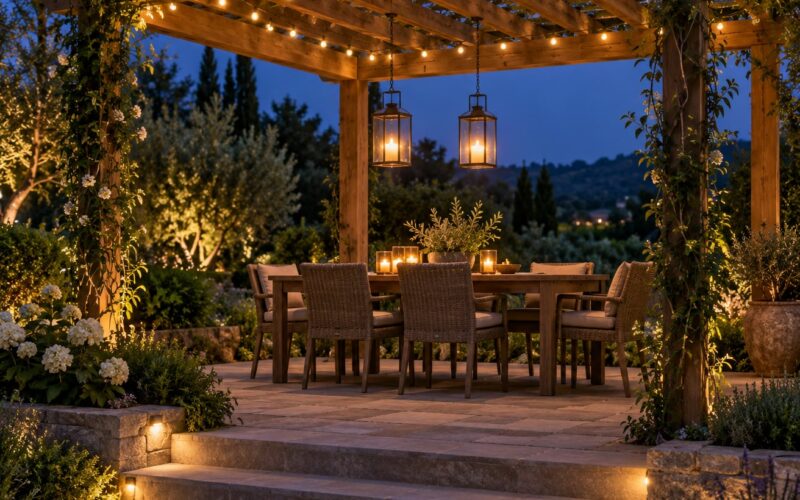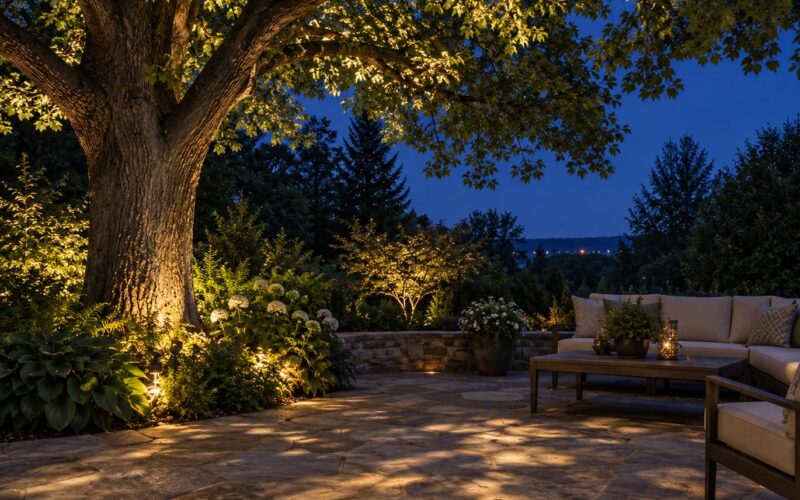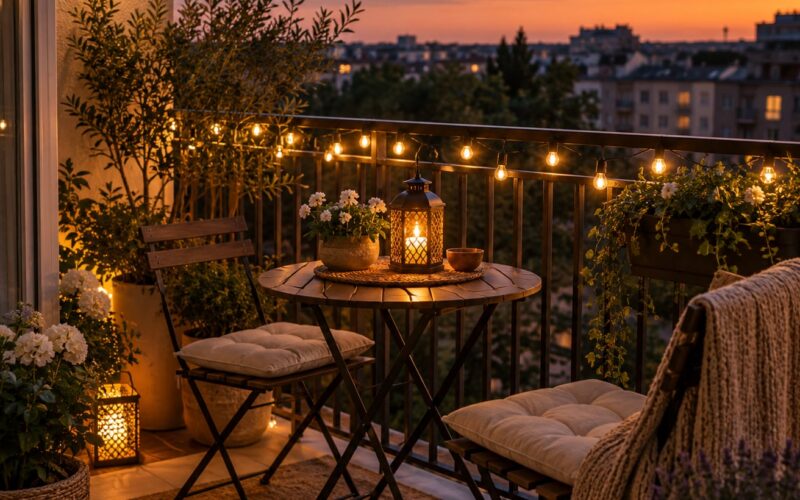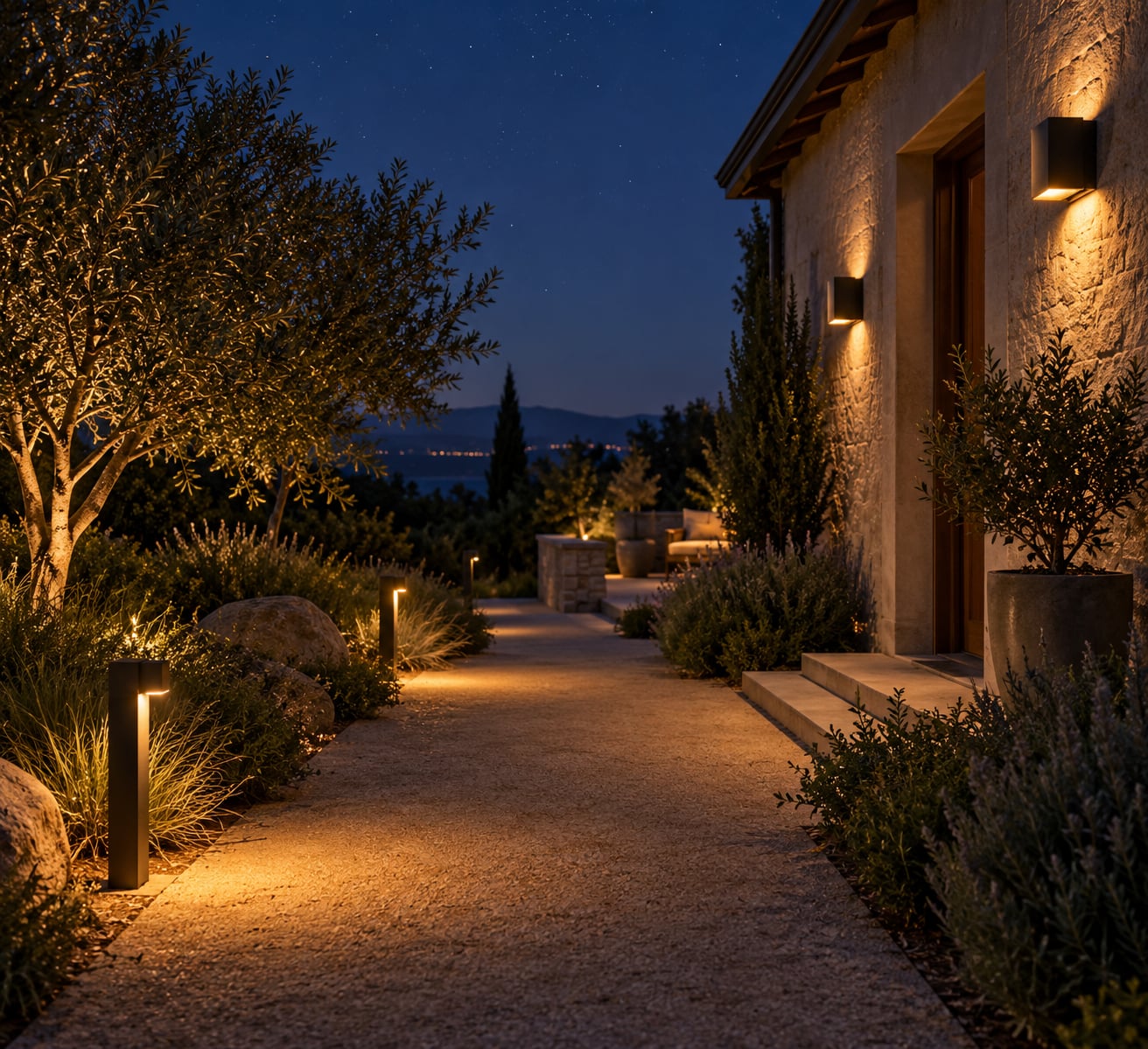
Dark sky friendly outdoor lighting means any exterior fixture that sends its light down onto the ground instead of up into the sky or across into a neighbour’s windows. That single idea shapes everything else: shield the bulb, aim it below the horizontal, keep the color at 3000K or warmer, and use no more brightness than the task actually needs.
Most of the light pollution outside a home comes from a handful of fixtures that were never aimed well, not from the whole house. Swap or re-aim those and your yard gets just as usable with a fraction of the spill.
Below is what each part of the phrase means, how to read a fixture label without guessing, and what to change first if you want darker skies and a calmer street.
Table of Contents
- Dark Sky Friendly Outdoor Lighting at a Glance
- What Does Dark Sky Friendly Outdoor Lighting Mean?
- How Do You Reduce Light Pollution from Outdoor Fixtures?
- What Color Temperature Is Best for Dark Sky Friendly Lighting?
- How Bright Should Outdoor Lights Be?
- Which Outdoor Light Fixtures Are Dark Sky Friendly?
- How Should Outdoor Lighting Be Positioned Around a Home?
- Do Motion Sensors, Timers, and Dimming Help?
- Are Solar Outdoor Lights Dark Sky Friendly?
- What Should You Look for on an Outdoor Lighting Product Label?
- Frequently Asked Questions
- Is dark sky friendly lighting the same as turning off all outdoor lights?
- What color light is considered dark sky friendly?
- Are motion sensor lights better for reducing light pollution?
- How can I make existing outdoor lights dark sky friendly?
- Do solar garden lights reduce light pollution automatically?
- Does dark sky friendly outdoor lighting still provide enough security?
- Conclusion
Dark Sky Friendly Outdoor Lighting at a Glance
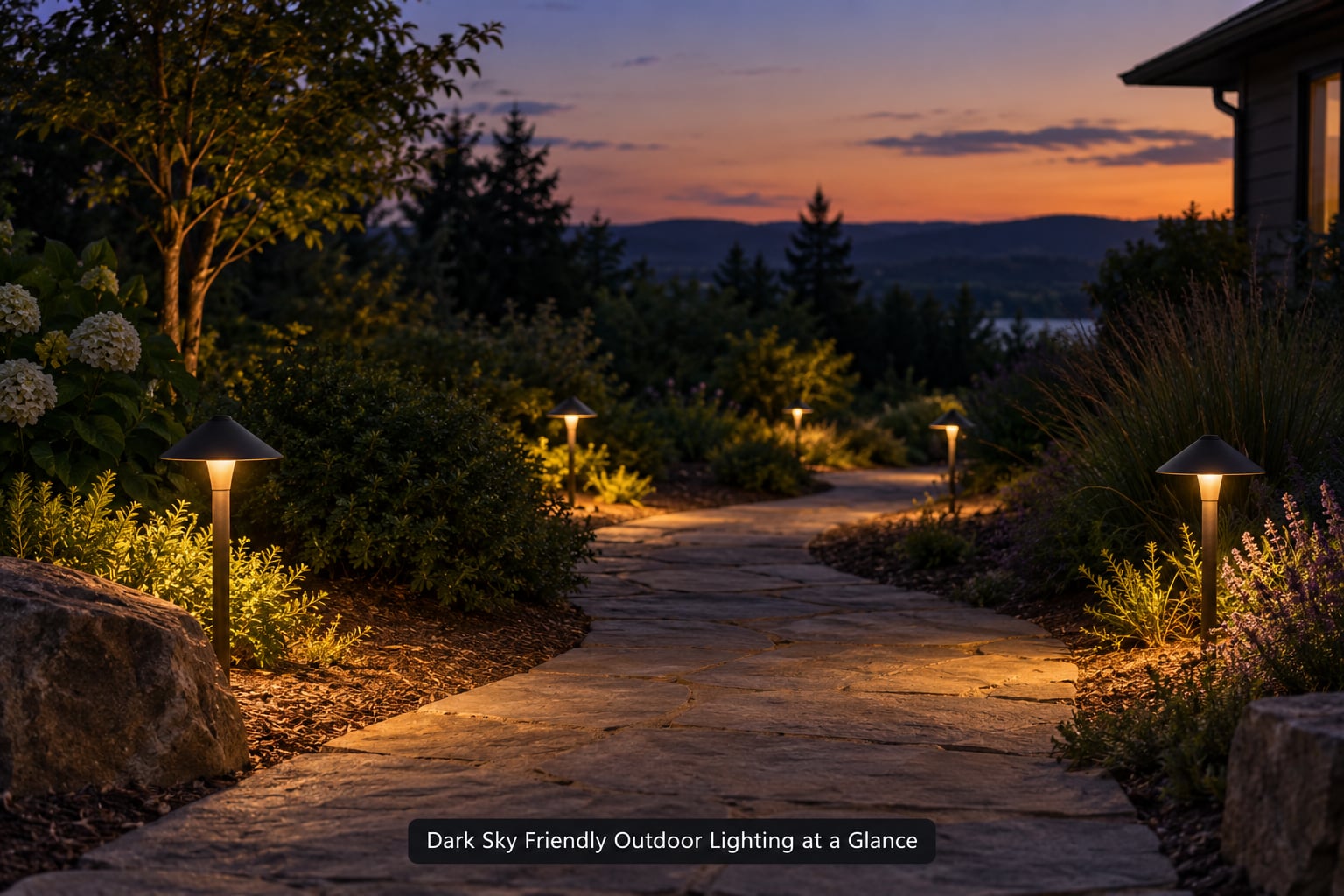
Dark sky friendly outdoor lighting is lighting that directs illumination downward to reduce glare, avoid wasted energy, and limit light pollution. A compliant fixture shields its light source so nothing escapes above the horizontal plane, aims the remaining light at the ground, and stays at or below 3000K in color temperature.
| Design element | What dark sky practice requires | Where it matters most |
|---|---|---|
| Light direction | Below the horizontal plane, aimed down | Wall packs, floodlights, path lights |
| Shielding | Bulb hidden from view, no uplight or halo | Any fixture mounted above eye level |
| Color temperature | 2700K preferred, 3000K maximum | All exterior fixtures, especially near woods |
| Brightness | Lowest output that still lights the task | Steps, paths, doors, driveways |
| Controls | Timer, photocell, motion sensor or dimmer | Rear yards, driveways, garages |
| Coverage | Light the area that needs it, nothing more | Yards bordering open land or other homes |
What Does Dark Sky Friendly Outdoor Lighting Mean?
Light that leaves a fixture and travels upward scatters off air molecules and moisture, and the result is the orange haze over a town that locals call sky glow. The same upward light washes out faint stars for tens of miles in every direction.
It also reaches places it was never meant to. Bright light spilling over a fence and into a bedroom is called light trespass, and glare from an unshielded fixture is the reason people on dark streets can see nothing but a halo.
Wildlife feels it too. Insects orient toward light, so they gather around bright fixtures until they exhaust themselves; birds migrating at night navigate by natural dim starlight and get disoriented by a lit path; bats change their feeding patterns when a yard stays bright for hours.
Being dark sky friendly does not mean having no outdoor lights. It means using lights that put light on the steps, the door, and the path and nowhere else. A dark, unlit walkway is a safety problem, and so is a floodlight that blinds anyone walking it.
How Do You Reduce Light Pollution from Outdoor Fixtures?
Six habits cover most residential outdoor lighting. Work through them in order, because the first two do the heavy lifting.
- Aim every fixture down. Anything at or below eye height naturally points where you want it. Anything above it needs a shade that physically blocks upward light.
- Shield the light source. A fixture is only fully shielded if you cannot see the bulb from any angle above the fixture. Glare disappears when the source is hidden.
- Use the least effective brightness. Most exterior areas need far less light than fixtures ship with. A brighter lamp on a dimmer or photocell beats an oversized fixture.
- Pick warmer color. 2700K is the sweet spot; 3000K is the ceiling most dark sky guidance accepts.
- Limit the hours. Timers, photocells and motion sensors cut both skyglow and the electricity bill.
- Skip areas that do not need light. Decorative uplighting of trees is the single most common source of home skyglow, and it is almost never needed for safety.
People who retrofit their own yards generally find that swapping a bright floodlight for a shielded wall sconce, or dropping to a lower-lumen bulb with the same coverage, removes the complaint without any loss of visibility.
What Color Temperature Is Best for Dark Sky Friendly Lighting?
Lower color temperature wins for outdoor use. Blue-rich light scatters more through the atmosphere, so the same lumen output at 4000K produces more visible skyglow than the same output at 2700K.
| Color temperature | Skyglow impact | Wildlife impact | Where it makes sense outdoors |
|---|---|---|---|
| 2200K | Lowest | Warmest, least disruptive | Decorative garden accents, screened fixtures |
| 2700K | Low | Friendly | Best default for paths, doors, steps |
| 3000K | Moderate | Generally acceptable | Maximum many dark sky programs accept |
| 4000K | Noticeable | More disruptive | Task areas where visibility matters, such as a driveway |
| 5000K and above | High | Most disruptive | Best avoided outdoors near homes and open land |
If you want slightly cooler light for a genuinely hard task, keep that fixture low, shielded and on a control rather than banning the color outright. A 3000K fixture that only runs when someone walks up beats a 5000K fixture burning all night.
How Bright Should Outdoor Lights Be?
Brightness should match the task and the distance, not the size of your property or how expensive the fixture was. Approximate starting points are below; most homes can drop an existing fixture by a tier and notice almost no difference from the doorway.
| Area | Approximate output per fixture | Notes |
|---|---|---|
| Steps and stair risers | 50 to 200 lumens | Light the tread, not the yard |
| Garden paths | 100 to 300 lumens | Space fixtures so pools overlap slightly |
| Front door and entry | 300 to 800 lumens | Shielded wall sconce, mounted either side of the door |
| Driveway and garage apron | 1,000 to 2,000 lumens | Full cutoff wall pack or gooseneck on a timer |
| Backyard entertaining area | 500 to 1,500 lumens | Layer low bollards with a dimmer |
| Decorative accents | Under 300 lumens | Keep shielded and keep it off the tree trunk |
Two rules cover most mistakes. Never buy a fixture by its wattage equivalent when a lumen figure is printed right there, and never size a path light as if it needs to light the whole yard.
Which Outdoor Light Fixtures Are Dark Sky Friendly?
Five fixture families pass the test consistently. Fully shielded wall packs have a solid back and a deep hood that hides the lamp from above. Downward-facing path lights have a solid cap over the bulb and throw light to the ground in a short cone.
Covered step lights sit inside the riser or under the tread, so the source is hidden from anyone standing. Lensed bollards use a flat lens and internal optic to send light down the path without a visible halo. Shielded solar garden lamps are fine only when they follow the same rules, which many cheap ones do not.
On the box or spec sheet, look for four things: a statement that the fixture is fully shielded, a light distribution that keeps output below the horizontal, a color temperature at or under 3000K, and a lumen output close to what you need. A photograph of the installed fixture at night, showing the cone going down, tells you more than the word “architectural” on the box.
Fixtures that fail quickly are open-top globe lights, most floodlights with a flat clear lens, uplights aimed at trees, and any decorative lantern hung from a soffit with nothing above the bulb.
How Should Outdoor Lighting Be Positioned Around a Home?
Position does as much work as the fixture. Mount path and step lights low, at or below about three feet, so the beam lands where people walk. Wall-mounted fixtures belong beside a door or above a garage door with the lamp hidden above the horizontal.
Do not light what does not need it. A driveway apron, the front path and the door are the areas worth covering; the neighbor’s fence, the sky above the tree line and the whole side yard are not. Keeping fixtures tight to the structure also cuts light trespass, which is the part neighbors actually complain about.
For a dark backyard, start at the steps and the seating area rather than the far corner. Add a low bollard line along the path, put a shielded wall pack on the back door, and leave the rest dark. A backyard that is bright at the edges and dark in the middle is the layout that leaks the most light upward.
Do Motion Sensors, Timers, and Dimming Help?
They help more than any fixture swap, because light that is off produces no skyglow at all. A photocell or dusk-to-dawn sensor handles the sunset math, a timer removes the overnight burn, and a motion sensor cuts a fixture down to a few minutes of actual use.
The three-layer approach is the practical version of this idea. Keep a small amount of low, shielded light on all night for path safety, add motion-activated light for approaches, and add a switch or smart schedule for the areas you use occasionally. The continuous layer stays dim so the triggered layer can be brighter without startling anyone.
Set motion sensors narrowly so they trigger on movement in the area you care about, not on every person walking down the street. A sensor that stays lit for ten minutes after one small detection turns a good fixture back into a permanently lit one.
Are Solar Outdoor Lights Dark Sky Friendly?
Not automatically. Solar power tells you where the electricity comes from, not where the light goes, and many inexpensive solar lamps shine up through an exposed bulb or a clear dome.
Check the same three things you would on a wired fixture: can you see the bulb from any angle above the lamp, does the light leave in a downward cone, and is the color at or under 3000K? A bright ring of glow around the top of a solar stake light is the tell that it fails.
Solar does make one retrofit easy, since no wiring is needed, which makes it a decent choice for a path or a backyard post far from an outlet. Choose a model with a photocell that actually switches the lamp off in daylight, and skip the ones with a brightness dial turned to maximum because they fade after a few weeks.
What Should You Look for on an Outdoor Lighting Product Label?
Read the label before the fixture, not after it is installed. Here is the checklist that matters.
- Shielding language. Fully shielded, full cutoff or downward directed, stated plainly.
- Color temperature. A published CCT figure of 2700K or 3000K. No figure is a warning sign.
- Lumen output. A real number you can match to the task.
- Distribution. An indication that output stays below the horizontal plane; a BUG rating is the standardized way this is reported.
- Controls. Photocell, motion sensor, dimmable driver or scheduling listed on the spec sheet.
- Ingress protection. An IP rating appropriate to the location, since outdoor fixtures still need weather protection.
- Installation instructions. Mounting height and aiming guidance, which is where the real compliance happens.
- Certification. DarkSky International is a nonprofit that certifies luminaires and advocates for responsible lighting; it does not enforce local rules. A self-printed “dark sky friendly” label on the box means the manufacturer is making the claim, not a third party.
That last distinction is the one people get wrong most often. Dark sky friendly is a description any seller can use. DarkSky Approved is a specific, third-party program, and a municipal lighting ordinance is a local legal requirement. Know which one you are dealing with before you buy.
Frequently Asked Questions
Is dark sky friendly lighting the same as turning off all outdoor lights?
No. Dark sky friendly lighting still lights your paths, steps and doors, it just directs that light down and away from the sky and your neighbour’s windows. Turning off every exterior light is not the goal, and an unlit walkway creates its own safety problem. The goal is useful light on the ground and nowhere else.
What color light is considered dark sky friendly?
Warm light, generally 2700K or lower, with 3000K treated as the upper limit in most dark sky guidance. Blue-rich light from 4000K and above scatters more in the atmosphere, so it produces more visible skyglow and has a stronger effect on insects, birds and human sleep rhythms. Cooler light is workable if the fixture is shielded and controlled.
Are motion sensor lights better for reducing light pollution?
They are the fastest and cheapest improvement on a typical property. A motion sensor cuts a fixture down from twelve hours of nightly use to a few minutes, and light that is off cannot create skyglow. Set the detection zone narrowly so the sensor triggers on movement in the area you care about, not on every passerby, and shorten the hold time if it stays lit too long.
How can I make existing outdoor lights dark sky friendly?
Start with the worst offenders. A floodlight on the back of the house aimed at the yard usually cannot be re-aimed and needs replacing with a full cutoff wall pack or a shielded gooseneck. Path lights with exposed bulbs usually can be swapped for capped models. Then replace cool white bulbs with 2700K or 3000K LEDs and add a photocell or timer so everything switches off when it is not needed.
Do solar garden lights reduce light pollution automatically?
No. Solar power describes the energy source, not the light distribution. Many inexpensive solar stake lights send light upward through an exposed bulb or a clear dome, which creates exactly the uplight dark sky lighting is meant to avoid. Check that the bulb is hidden from above, that the beam points down, and that the color temperature is 3000K or warmer before buying.
Does dark sky friendly outdoor lighting still provide enough security?
It can, as long as the light is placed where it matters rather than scattered everywhere. A shielded fixture over the door, a low lit path and motion-activated light at the driveway cover the areas people actually approach. Bright unshielded light is often more dangerous than useful because glare blinds the person walking toward it and hides the edges of a path from everyone else.
Conclusion
Audit the property after dark and write down every fixture you can see the source of. Replace the exposed or oversized ones with shielded fixtures pointed at the ground, drop to 2700K or 3000K bulbs, and put a timer or motion sensor on anything that burns all night. That sequence fixes most of the glare, the skyglow and the neighbor complaints without turning off a single light you actually use.