LEDs win on energy use, plain and simple. A quality LED lamp that puts out the same number of lumens as a halogen lamp typically draws 75% to 85% less power, runs far cooler, and lasts many times longer. Halogen still makes sense in a few narrow cases, mainly where a fixture is built around it or you specifically want a warmer glow at high output.
I’ve had path lights on both technologies on my own property, and the difference is not subtle when you count the electricity at the end of the year. The trouble is that most comparisons stop at a savings percentage with no arithmetic behind it, so below I’ll show the actual numbers: watts, hours, kilowatt-hours and cost, all worked through so you can plug in your own rate.
All of the cost figures here use a sample rate of 17 cents per kilowatt-hour, which is a reasonable middle-of-the-road US residential rate. Your utility’s rate is the only number you need to swap.
Table of Contents
- LED vs Halogen Outdoor Lighting Energy Use at a Glance
- How Much Energy Do LED and Halogen Outdoor Lights Use?
- LED vs Halogen Outdoor Lighting Energy Use: Daily Cost Example
- Which Technology Delivers Better Outdoor Brightness?
- How Do Lifespan, Maintenance and Weather Resistance Compare?
- What Are the Safety and Installation Differences?
- Swapping Halogen for LED in an existing low-voltage system
- Which Should You Choose?
- Frequently Asked Questions
- Does halogen outdoor lighting use more electricity than LED?
- How many lumens do I need for an outdoor light?
- Do LED lights work properly in cold outdoor weather?
- Is a higher-wattage LED always brighter and more energy efficient?
- Can I replace a halogen bulb with LED in the same outdoor fixture?
- Conclusion
LED vs Halogen Outdoor Lighting Energy Use at a Glance
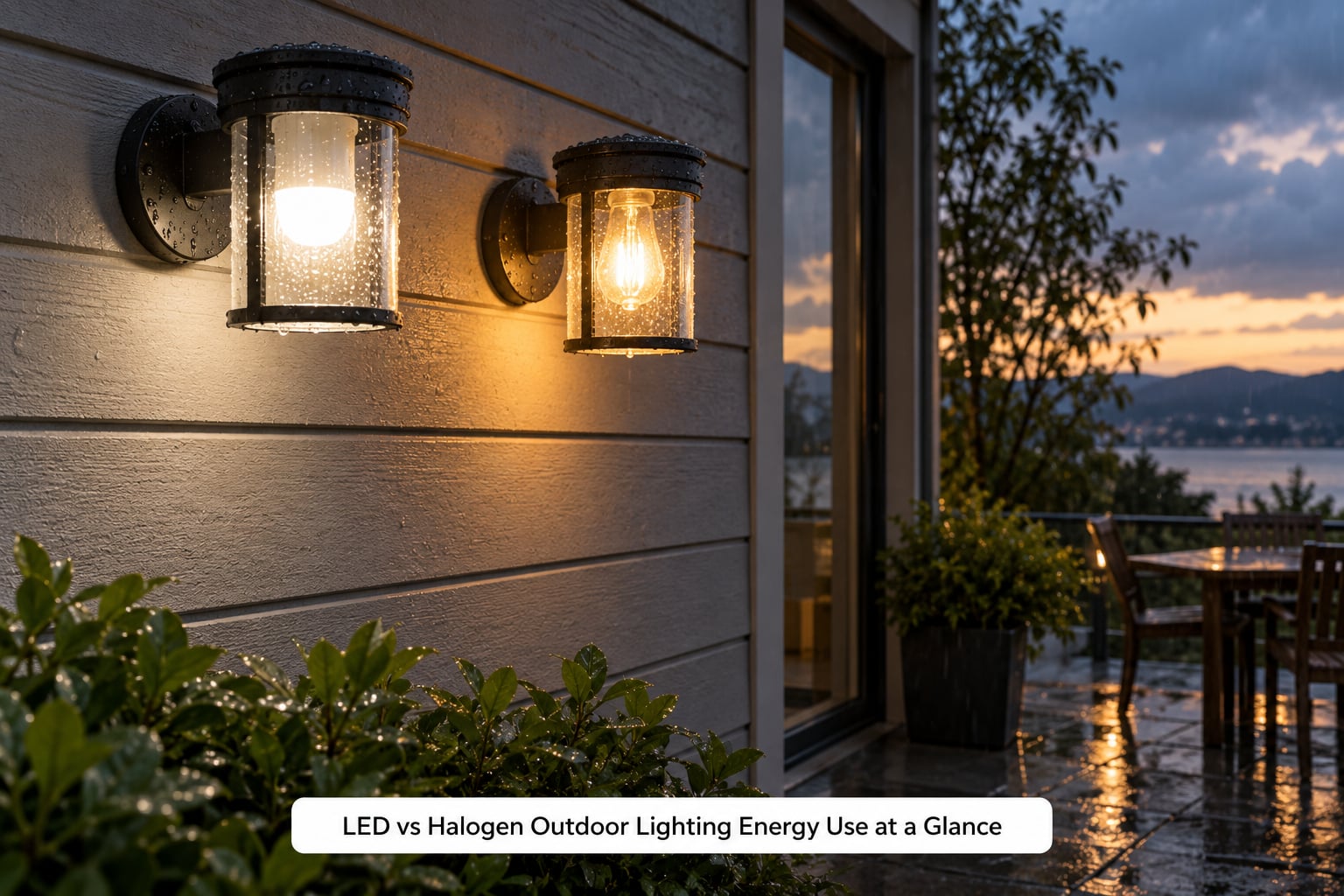
| Factor | LED | Halogen |
|---|---|---|
| Typical lamp power for a path light | 0.5 to 3 W | 10 to 20 W |
| Typical lamp power for a floodlight | 8 to 30 W | 50 to 100 W |
| Annual energy, one 50 W halogen at 6 h a night | 17.5 kWh for an 8 W LED | 110 kWh |
| Annual electricity cost, same lamp at 17 cents per kWh | About 3 dollars | About 19 dollars |
| Rated lifespan | 25,000 to 50,000 hours | 1,000 to 3,000 hours |
| Years of use at 6 hours a night | 11 to 23 years | Under a year and a half |
| Brightness per watt | 80 to 130 lumens per watt | 12 to 20 lumens per watt |
| Color temperature range | Warm 2200K to daylight 6500K | Around 2800 to 3000K only |
| Heat output | Low; mostly cool to the touch | Hot enough to burn skin |
| Outdoor durability | No filament or glass envelope to shock or corrode, but still needs an appropriate IP rating | Fragile glass envelope, tungsten filament, corrosion risk on exposed fittings |
| Best use | Paths, patios, decks, driveways, security lighting, decorative accents | Existing halogen-only fittings, very warm light, high output from a single small bulb |
Two worked substitutions show the scale. An 8W LED replacing a 50W halogen lamp cuts annual energy from 110 kWh to 17.5 kWh, saving about 92 kWh a year at six hours a night.
Step it up and a 15W LED lands near the output of a 100W halogen, dropping annual use from 219 kWh to 33 kWh and saving about 186 kWh a year.
How Much Energy Do LED and Halogen Outdoor Lights Use?
Halogen lighting is an improved incandescent. Current runs through a tungsten filament until it glows, and a small amount of halogen gas around it slowly redeposits evaporated tungsten back onto the filament. That regeneration cycle extends life a little, but it does not change the fundamentals: roughly 80% of the energy going into a halogen lamp leaves as heat, and it leaves in every direction.
An LED moves electrons across a semiconductor junction, and the light comes out of a small chip already pointed in a forward direction. Very little of the input energy is wasted as heat, and very little spills sideways into your eave or the neighbor’s fence. That combination of higher efficacy and built-in directionality is why the wattage gap is so large.
When you compare numbers, separate the lamp from the fixture. The wattage on the lamp box is the lamp’s draw, but a fixture with a built-in driver or photocell adds a small amount on top, usually well under a watt. Low-voltage path systems add a transformer loss of a few percent too.
Solar fixtures sit outside this comparison entirely. They draw no grid electricity at all, though the panel’s real output depends on hours of direct sun, and cheaper panels often deliver noticeably less light than a comparable wired LED.
LED vs Halogen Outdoor Lighting Energy Use: Daily Cost Example
Take a single path light burning six hours a night, 365 nights a year. At 17 cents per kilowatt-hour:
- 10W LED: 0.010 kW x 6 h x 365 = 21.9 kWh a year, about 3.72 dollars
- 50W halogen: 0.050 kW x 6 h x 365 = 110 kWh a year, about 18.62 dollars
- Difference: 88.1 kWh and about 14.90 dollars a year, per lamp
The formula is simply watts divided by 1000, multiplied by hours per day, multiplied by 365, multiplied by your rate per kilowatt-hour. Change the rate and every number on this page scales with it.
Scale it to a real system and the picture gets clearer. Ten 50W halogen path lights running six hours a night burn about 1,095 kWh a year. Swap them to 10W LEDs and that falls to 219 kWh, a saving near 876 kWh, or roughly 149 dollars a year at this rate. Over ten years, that gap is around 8,760 kWh.
For context, residential lighting overall is usually only a modest slice of a household’s electricity, so expect this to move your total bill rather than transform it. On a whole yard with twenty-plus fixtures, though, the number becomes noticeable every month.
Which Technology Delivers Better Outdoor Brightness?
If you are weighing led vs halogen outdoor lighting energy use, compare lumens, not watts. Lower wattage does not mean dimmer, and plenty of people overshoot when they assume otherwise. A halogen lamp’s lumens-per-watt number sits around 12 to 20; a decent outdoor LED runs 80 to 130. Halogen has to be given far more power simply to reach the same brightness.
Beam spread matters outdoors in a way it does not indoors. Halogen throws light in all directions, so path lights rely on shields and reflectors to aim it downward, and every bit that hits the shield is wasted. LEDs aim light from the chip itself, so a well-designed path light needs less shielding and delivers more usable light on the ground. That is an outdoor-specific efficiency gain on top of the wattage saving.
Color temperature is where the switch feels biggest. Halogen sits near 2800 to 3000K, a warm amber. LEDs cover everything from about 2200K warm through 6500K daylight, so you can match halogen’s warmth or move cooler. Landscapers often find that 2700K to 3000K keeps foliage looking natural, while very cool white can flatten plant color.
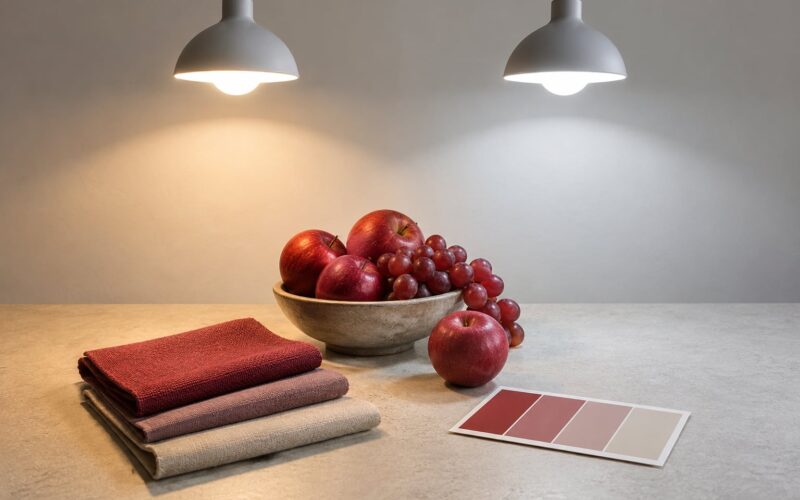
Color Rendering Index, or CRI, measures how faithfully a lamp shows true colors. Halogen scores very high, typically CRI 95+. Cheap LEDs sometimes drop to CRI 70 or lower, which makes reds and greens look muddy. If you are lighting a garden or a painted door, check the CRI rating and pick 90 or above.
One quirk worth knowing: because LEDs emit almost no ultraviolet or infrared, insects are far less drawn to them, and you will not get the cloud of “fireflies” that hovering over a halogen path light in summer.
How Do Lifespan, Maintenance and Weather Resistance Compare?
Quality halogen outdoor lamps are usually rated 1,000 to 3,000 hours. Quality LEDs are commonly rated 25,000 to 50,000. At six hours a night, that halogen bulb is finished in roughly seven to twelve months, while the LED is still going after more than a decade.
Translation for your wallet: a halogen path light is a spring and autumn errand. Several people in outdoor lighting forums describe the opposite experience with LEDs, since the original fittings are usually still in place and nobody remembers where they are.
Weather resistance is where lamp technology matters less than fixture rating. Both halogen and LED fittings are sold with an IP rating, and that number, not the bulb inside, tells you whether the fixture handles rain, spray and dust. An LED dropped into an unsealed fitting gains nothing from its own durability.
Cold weather actually favors LEDs. Halogen performance dips as ambient temperature falls, and its filament takes longer to warm. LED output holds up better in winter, though very cold conditions can still reduce driver output slightly on some models. Heat is the opposite story: an LED sitting in direct summer sun in a sealed housing can dim as it protects itself.
Enclosed and fully sealed fittings are the classic failure case. A halogen lamp needs air around it; sealing one in an enclosed fixture raises its temperature and shortens its life badly. Many LED fixtures are rated for enclosed installation, but check the box.
What Are the Safety and Installation Differences?
Heat is the biggest practical difference. A 50W halogen lamp puts out enough radiant heat to burn skin on contact, and in dry summer conditions that heat and an exposed bulb are a real fire concern if a fitting is surrounded by dry vegetation or mulch. LEDs run cool enough to handle in most cases, which also makes them safer for people and pets walking past.
Dimmability needs a word of caution. Halogen dims smoothly on most dimmers. LEDs flicker, buzz or refuse to dim unless the lamp is specifically marked dimmable and matched to the dimmer. Mixing brands on one dimmer is a reliable way to get flicker.
Follow the fixture and lamp manufacturer’s instructions every time, switch the power off at the breaker before touching anything, and use a qualified electrician for hardwired or mains-voltage work. If a fitting is old, brittle or outdoors-worn, replace the fitting too rather than just the lamp.
Swapping Halogen for LED in an existing low-voltage system
For led vs halogen outdoor lighting energy use in a low-voltage system, the transformer, not the bulb, is what causes trouble. Halogen transformers were sized for higher loads, so replacing every lamp with a fraction of the power can leave the unit badly underloaded, and some models hum, flicker or fail early as a result.
Voltage drop is the other one. On a long run, resistance in the cable sags the voltage, and distant fixtures dim. Halogen masked this because its filament resistance falls with temperature. LEDs with constant-current drivers show the sag plainly as flicker, uneven brightness, or early failure.
A practical sequence: check what the transformer is rated for in watts, add up the new LED load, and confirm it lands somewhere sensible rather than near zero. Look for a unit marked as an LED driver or a magnetic transformer with a minimum load. Keeping a mix of legacy halogen and new LED on one circuit works sometimes and flickers other times, so all-LED is the cleaner outcome.
If the transformer is old enough to predate LED drivers entirely, replacing it is usually the tidier fix and is a job for an electrician. Once the swap is done, a photocell or timer is the next lever worth pulling.
Which Should You Choose?
Choose LEDs for nearly everything: path lights, patio and deck lighting, driveways, security floods, tree uplighting, porch lamps. The energy saving is large, the runtime is long, and you stop doing seasonal bulb changes.
Stay with halogen only where a fixture genuinely requires it, such as a specific fixture listing a halogen lamp type, or where you need a single small bulb to deliver unusually high output and a very warm glow. Some specialty high-output fixtures and certain dimming setups still lean that way.
Bulb choice is only part of the energy lever. Runtime controls cut far more than bulb swaps do: a dusk-to-dawn photocell stops the fixtures burning all night, a timer gives you a hard cutoff, and a motion sensor on a back path means that light only runs when someone walks it. If you keep the same LEDs and add a photocell, you often save more than the swap did.
For locations where running a cable is a hassle, solar LED fixtures use no grid electricity at all. Weigh them on runtime, panel size and placement: a shaded or north-facing spot will disappoint, while a fixture with a clear southern view and a replaceable battery can last a full season between swaps.
People sometimes ask whether LEDs really show up on the bill. They do, but with a caveat: residential lighting is only a small share of total household electricity, so the saving is a steady monthly trim rather than a dramatic drop. Where a yard has many fixtures or long runtimes, it becomes real money.
Frequently Asked Questions
Does halogen outdoor lighting use more electricity than LED?
Yes, substantially. For the same light output, a quality LED usually draws 75% to 85% less power than a halogen lamp. A 50W halogen path light burning six hours a night uses about 110 kWh a year; an 8W LED doing similar work uses roughly 17 kWh. Over ten years that is a gap of around 880 kWh per fitting.
How many lumens do I need for an outdoor light?
Roughly 100 to 300 lumens for a path light, 400 to 800 for a step or wall light, and 1,300 to 4,000 for a floodlight covering a driveway or back door. Match the lumens to the area you actually need lit rather than to a wattage figure, and check that the fixture is rated for outdoor use with an appropriate IP rating.
Do LED lights work properly in cold outdoor weather?
Yes, generally better than halogen in cold conditions. Halogen output drops and takes longer to warm up as the temperature falls, while LED output holds steadier in winter. Very low temperatures can trim driver output slightly on some models, but the effect is small. Heat is the more common issue: a sealed LED fixture in direct summer sun may dim slightly to protect itself.
Is a higher-wattage LED always brighter and more energy efficient?
No. Within the same fixture family, more watts usually means more brightness but lower efficiency, because the driver runs harder and loses more to heat. Comparing across products, wattage tells you nothing useful, because lumens per watt varies widely. Compare the lumen rating and the efficacy figure instead, and pick the lowest wattage that still hits your required lumens.
Can I replace a halogen bulb with LED in the same outdoor fixture?
Often yes, but check three things: the fixture’s maximum wattage rating, whether the lamp is enclosed-rated, and whether the bulb form fits. On low-voltage systems, also check the transformer, since an old halogen unit can be badly underloaded once every lamp is LED and may hum or fail early. Switch off power first, and use a qualified electrician for hardwired work.
Conclusion
For led vs halogen outdoor lighting energy use, LED is the clear winner on running cost, lifespan and heat, typically cutting electricity 75% to 85% for the same brightness and lasting 25,000 to 50,000 hours instead of 1,000 to 3,000. Halogen remains reasonable only where a specific fixture calls for it or you need very warm, high-output light from a small bulb.
Before you swap anything, check three things: the lumens you actually need, the fixture’s IP rating for outdoor use, and whether the transformer or dimmer will handle an LED load. Then run the arithmetic for your own setup: watts divided by 1,000, times hours per night, times 365, times your electricity rate. The answer usually pays for the lamps in a single season, and photocells or timers can cut the rest.