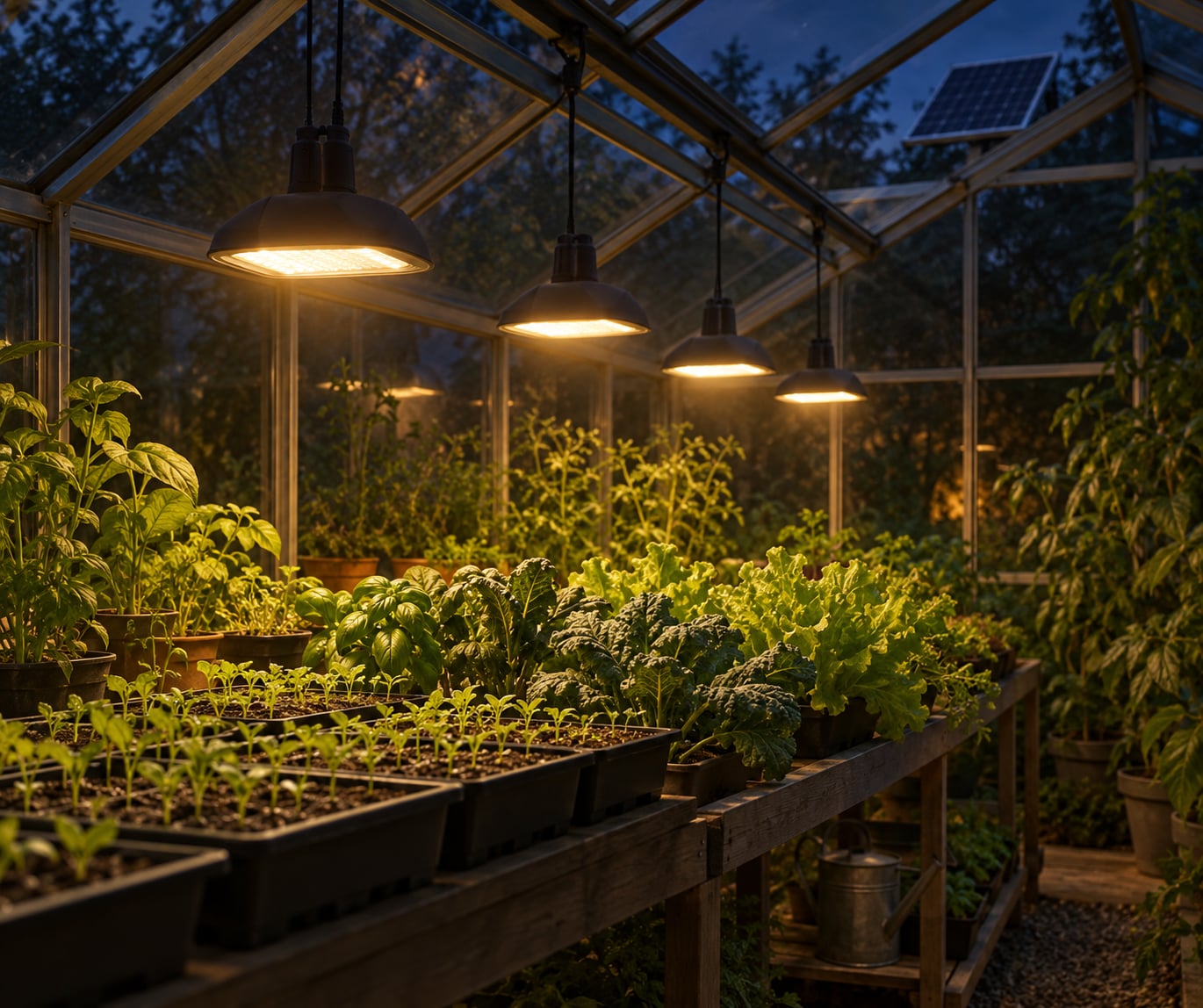
To light a greenhouse at night, you mount low-heat grow lamps above the canopy, switch them on automatically at dusk, and run them only long enough to top up the day’s sunlight to your crop’s daily light target. For most growers that lands somewhere between 12 and 14 total hours of light across a 24-hour cycle, not 24 hours of lamp time. Set it up in an afternoon and you should know within one night whether the arrangement works.
The reason people get this wrong is that light and heat get tangled together. Several of the top pages for this question are really about keeping a greenhouse warm, and a lamp that produces a little warmth is not the same thing as a lamp that produces usable photons. Sort those two jobs out first and the rest gets much simpler.
Another wrinkle: plenty of people asking this have no mains power at all. A remote greenhouse, a polytunnel at the bottom of a field, a shed converted into a propagator. For those, solar is not a compromise, it is the only option that works, and it works well if you size the panel and battery honestly.
Table of Contents
- What You Need
- Step-by-Step
- Plan the Lighting by Plant Stage
- Choose Solar, Battery, or Mains-Powered Lights
- How to Light a Greenhouse at Night for Even Coverage
- Install the Fixtures Safely
- Set a Timer and Check the Photoperiod
- Test the System Overnight
- Common Mistakes
- Maintenance and Safety Tips
- Frequently Asked Questions
- How many hours should a greenhouse be lit at night?
- Can solar lights provide enough light for plants inside a greenhouse?
- How far above seedlings should a grow light be positioned?
- Do greenhouse lights need to run all night?
- Is mains-powered LED lighting cheaper than solar for a greenhouse?
- Can I use decorative solar garden lights to grow plants?
- Conclusion
What You Need
Before you buy anything, five pieces of information decide almost everything else. Write them down.
- What stage are the plants at? Seedlings on a propagation bench need a close, gentle light. Mature leafy plants and fruiting crops need reach and intensity.
- How much floor area are you lighting? Measure length and width of the growing bench, not the whole glasshouse if you only use part of it.
- How many daylight hours does your site actually get in the darkest months? A local almanac or a sunrise and sunset app will give you the number faster than guessing.
- How much sun hits the solar panel spot? Check in winter, not summer. A roof ridge in December is worth more than a south wall in June.
- What power do you already have? Mains, a solar and battery system, or nothing at all.
Then the equipment list: your lamps, a controller, and the boring safety gear that people skip and regret.
- Lamps with a stated wattage, a stated light output, and an ingress protection rating of IP65 or better if any water will reach them.
- A controller, either a plug-in digital timer, an astronomical timer, a photocell light sensor, or a smart plug.
- Extension leads and connectors rated for outdoor or damp-location use, plus a residual current device or GFCI-protected outlet.
- Cable clips, greenhouse-safe hangers, and a spirit level.
- A thermometer and hygrometer you can read at a glance from outside the glass.
Step-by-Step
Plan the Lighting by Plant Stage
Different plants want different daily light totals, so the schedule falls out of the crop rather than the calendar. Work out the gap between what the crop needs and what the sky gives you in the darkest weeks, and that gap is your nightly lamp hours.
Seedlings and cuttings are the hungriest light users relative to their size. They need long days at lower intensity, and they punish you quickly with long, pale stems if the fixture is hung at adult height. A seedling bench wants light closer, softer, and for longer.
Leafy greens and herbs sit in the middle. They do fine topping up short winter days and they will not thank you for a hot, low fixture pressing down on the leaves. Flowering crops want the most total light and tolerate long days better than most growers expect, but they still need a genuine dark period.
Overwintering tropicals and houseplants are the opposite case. Their problem in winter is not hours so much as weak light, and many of them prefer a slightly shorter day. If you are keeping a banana or a hibiscus alive until spring, consistency matters more than a number.
Choose Solar, Battery, or Mains-Powered Lights
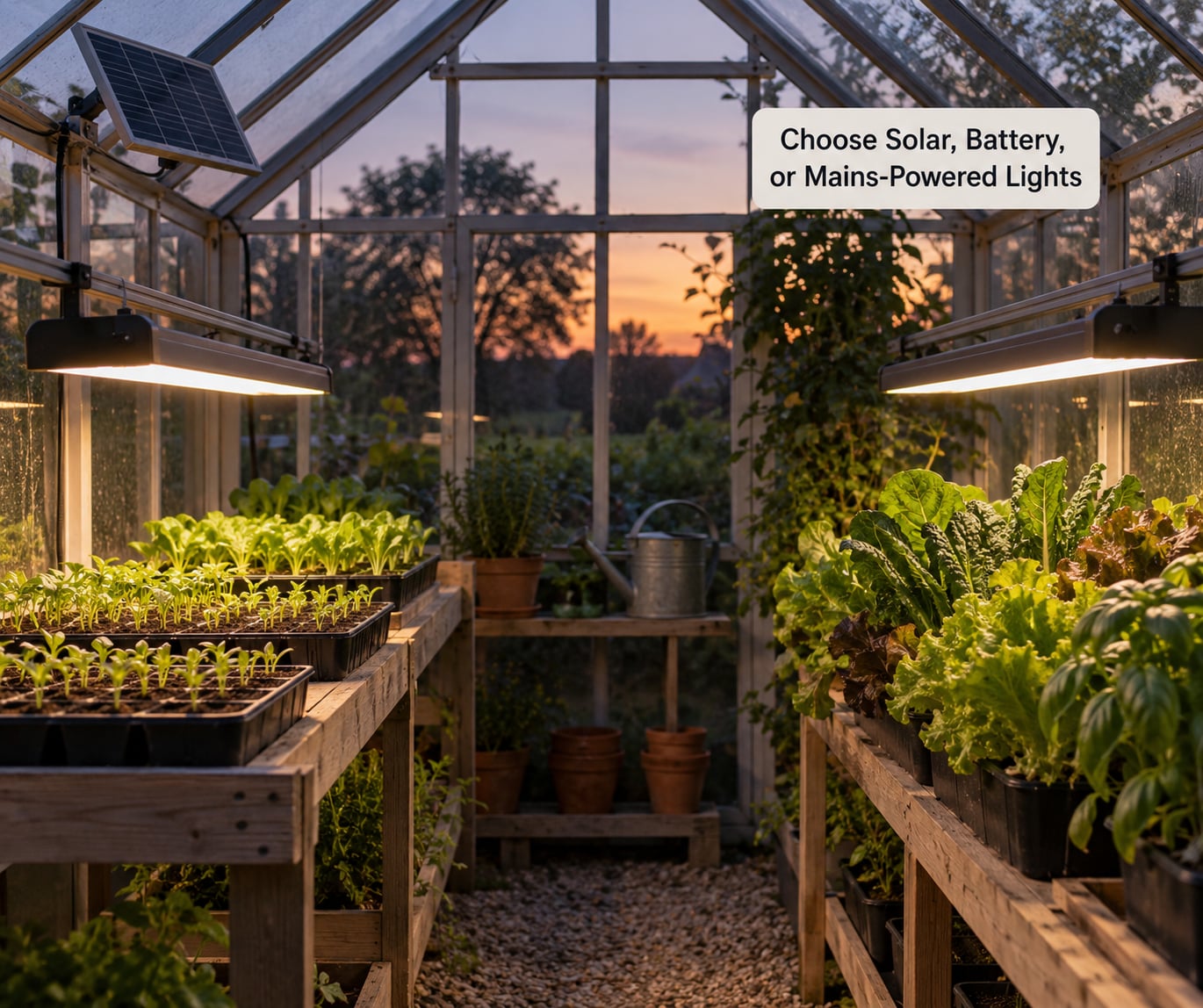
Three power options, and the honest trade-offs between them.
Mains-powered LED grow lights give the strongest and steadiest output. They run every night regardless of weather, they dim, and they are the right choice whenever you have a socket and a safe way to reach it. Their weakness is obvious: cable runs across a damp floor and a constant draw on the meter.
Battery-backed solar systems store what the panel collected during the day and release it after dark. These are how you light a greenhouse with no mains power at all, and they are also a decent backup for a glazed structure where running a lead outside is awkward. The trade-off is capacity. Cloudy weeks in December can produce a fraction of a summer day’s charge, so the system has to be sized for the worst week rather than the average one.
Small integrated solar lamps are the cheap, simple option, and they work well for a seed tray or a small propagator. Expect a modest output and a fixture that is usually weather-rated rather than horticultural. They are a sensible first step for a cold frame or a hobby bench.
Whatever you pick, read the specification before installation, not after. Look for the rated lamp wattage, the lumen or photon output, the ingress protection rating, the recommended mounting distance and the stated battery capacity in amp-hours. A specification sheet that gives you all five is worth more than a marketing photo.
How to Light a Greenhouse at Night for Even Coverage
Even coverage comes down to mapping the area and spacing fixtures so their beams overlap. One bright fixture in the centre of a bench gives you a bright centre and dark corners, and the corners are where the plants go leggy.
Measure the growing area and write the dimensions down. Divide that footprint into zones roughly the size of one fixture’s spread, then aim for two or three overlapping zones rather than one big beam. Overlapping edges is what removes the shadows.
Height matters more than most people expect. Higher is broader and more even but weaker at the canopy; lower is stronger and hotter with a much smaller footprint. As a starting point, hang lamps 6 to 12 inches above a seedling tray and 12 to 24 inches above a mature canopy, then adjust upward if leaves show bleaching or heat stress.
Check the beam spread, not just the wattage. A wide reflector at 18 inches covers far more bench than a narrow one at the same distance, and it does it with less heat concentrated on any single leaf.
Install the Fixtures Safely
Secure mounting comes first. Screw into the frame or a proper hanging bracket rather than cable ties on a glazing bar, because a lamp that shifts a few millimetres over a season ends up scorching whatever it touches.
Route cables along the frame, clip them at regular intervals, and keep every connection and plug above bench height where water runs. In a greenhouse, condensation is normal rather than exceptional, so treat any connector as if it will get wet and seal the ones that cannot.
Check local electrical requirements before you change anything fixed. If you are modifying existing mains wiring, extending a circuit, or adding anything outside the greenhouse, that is qualified-electrician work in most places. Do not run a lead through a door that opens onto a wet floor.
Keep clearance between lamp housings and any combustible material, follow the manufacturer’s spacing guidance, and never daisy-chain extension leads. Buy the outdoor-rated lead rather than the one already coiled in the shed.
Set a Timer and Check the Photoperiod
The photoperiod is the total light your plants get in 24 hours, sunlight plus lamp. Work out that total first, then subtract your darkest-month daylight hours to get the number of lamp hours you actually need.
An astronomical timer is the cleanest option because it tracks sunset and sunrise on its own, so the schedule shifts with the season without you touching it. A photocell light sensor does the same job reactively by detecting darkness. A plain plug-in digital timer works fine too, it just needs resetting when the clocks change.
Set the schedule so lights come on at dusk and go off well before sunrise. Most growers run 4 to 6 hours overnight in midwinter and gradually reduce that to zero as days lengthen. Avoid light leaking all night, both because it wastes power and because many crops, tomatoes among them, respond badly to a disrupted dark period.
Test the System Overnight
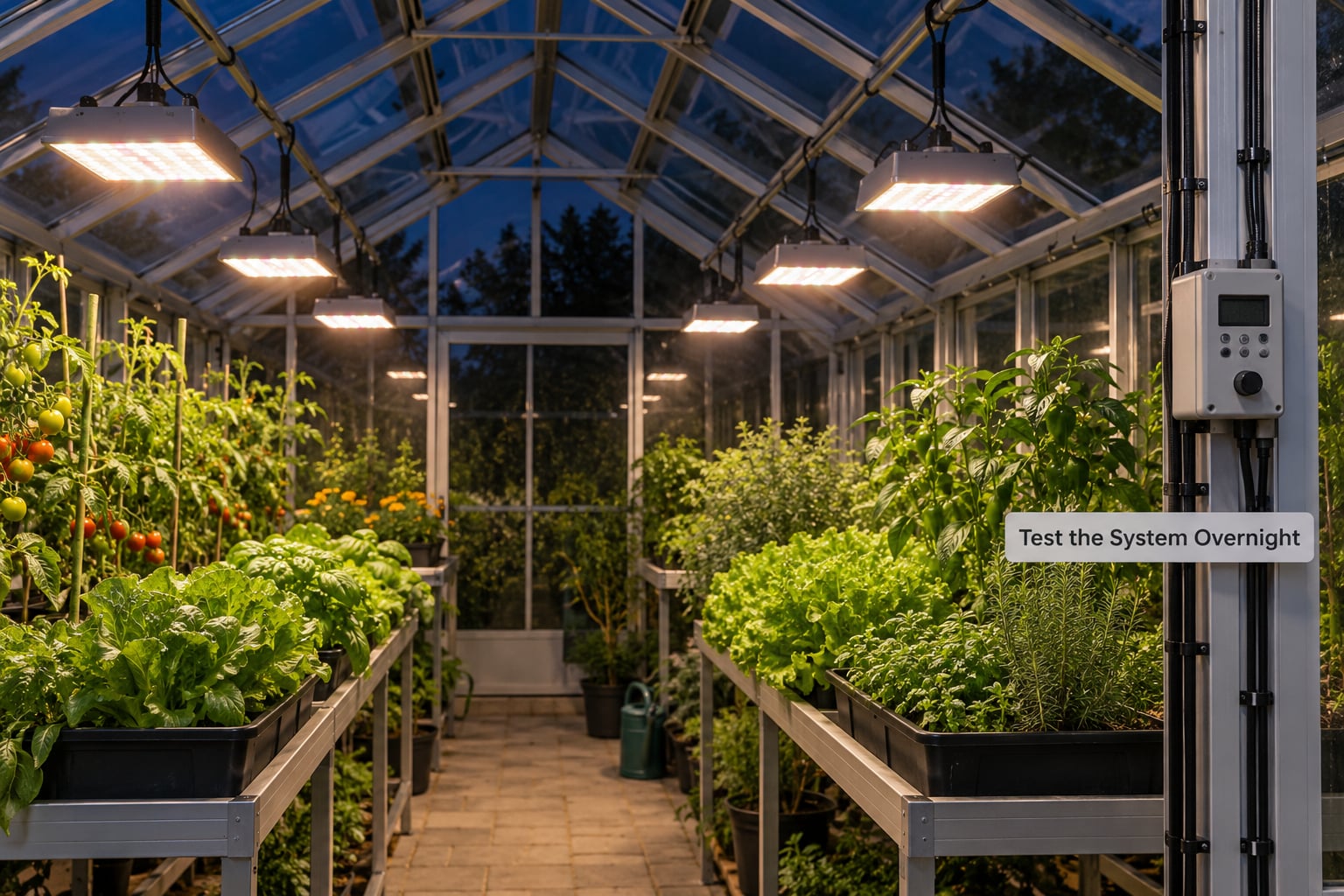
Stand in the greenhouse after dark with the lamps running and look for four things. Coverage: are the corners as bright as the middle, and is there any leaf sitting in a hot spot under a housing? Heat: put a hand at canopy level and compare it to the far end of the bench. A lamp that makes one end noticeably warmer needs to move up or get spread out.
Check the timer function by watching it switch, or by testing it over a short cycle before you trust it for a whole week. With solar, check that the controller is not reporting a depleted battery at switch-on, and note how long the lamps ran compared with how long the panel was in sun.
Finally, look for moisture anywhere it should not be. Damp connectors, a beading lens, or a cable that has pulled loose from a clip are all cheap to fix tonight and expensive to find later. Adjust the arrangement before you rely on it, because a setup that looked fine at eight in the evening can be a hot spot by one in the morning.
Common Mistakes
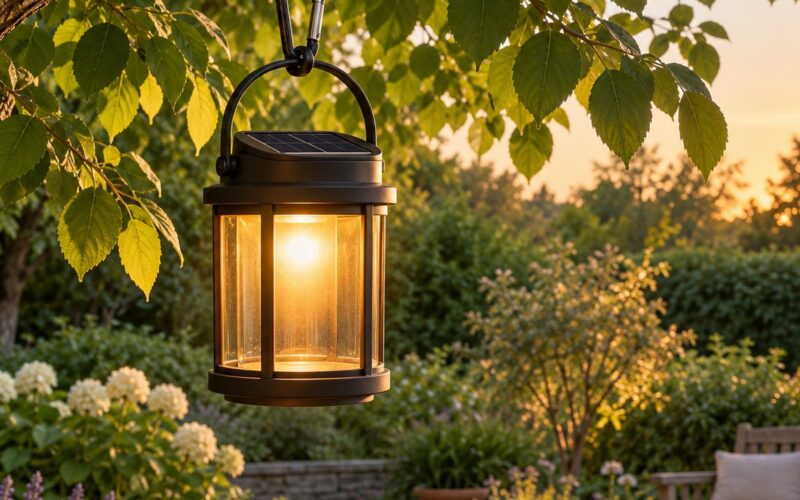
The first mistake is using decorative solar garden lights for plant growth. They are engineered to make a path visible for an hour or two, not to deliver usable light for photosynthesis. They will look convincing under a bench and do nothing above it.
The second is getting the photoperiod wrong in both directions, which is more common than people expect. Too few hours gives stretched, pale growth. Running lamps 24 hours a day gives you electricity waste, extra heat, and a dark period that many crops need for normal flowering and fruit set.
The third is hanging lamps too close to foliage, especially single high-wattage fixtures. The tell is bleached, curling or papery patches on the upper leaves facing the lamp. The fix is height, and it costs nothing.
The fourth is ignoring cloudy-day performance. A solar system sized on a sunny June week will disappoint you in a grey December. Test through a stretch of dull weather before you depend on it.
The fifth is daisy-chaining extension leads or running one across a wet floor to reach a socket. That is the mistake with actual consequences, and it is entirely avoidable.
Maintenance and Safety Tips
Wipe the solar panel every few weeks, more often in dusty conditions. A dirty panel loses meaningful output, and it is the single easiest thing to improve in a solar setup.
Clean lamp lenses gently so you do not scratch them, check that hangers and cables are still tight, and look for corrosion on any metal exposed to condensation. Protect connectors with a weatherproof cover or move them inside the frame line.
Test your backup power once a month by switching to mains or by unplugging the panel and seeing whether the lamps hold up. A battery that has quietly failed in storage is common and disappointing.
Read the manufacturer’s instructions and follow them. Wattage, mounting distance, ventilation and cleaning intervals are all specified for a reason, and the manual is more current than anything you will find in a forum thread.
Frequently Asked Questions
How many hours should a greenhouse be lit at night?
Enough to top up the day’s sunlight to your crop’s daily target, which for most crops lands between 12 and 14 total hours of light per 24-hour cycle. In midwinter that usually means 4 to 6 hours of lamp time after dusk, tapering to none as days lengthen. Seedlings tolerate long days at lower intensity; fruiting crops want more total light but still need an uninterrupted dark period.
Can solar lights provide enough light for plants inside a greenhouse?
For a propagation tray, a small propagator or an off-grid greenhouse, yes, a properly sized solar system does the job. The constraint is the worst week rather than the average one, so size the panel and battery for a run of cloudy December days. Small integrated solar lamps suit young plants; mature fruiting crops generally want more output than a single solar fixture delivers.
How far above seedlings should a grow light be positioned?
Start 6 to 12 inches above the seedling tray and raise it as plants grow. Seedlings need light close by and will stretch toward a source that sits at adult height, producing long pale stems. If upper leaves bleach, curl or develop papery patches, the lamp is too close and needs another few inches of clearance. Keep the distance consistent across the whole bench.
Do greenhouse lights need to run all night?
No. Running lamps through the whole night wastes electricity, adds unwanted heat and removes the dark period that many crops, tomatoes and peppers included, rely on for normal flowering and fruit set. Switch them on at dusk and off before sunrise, and shorten the schedule as spring daylight arrives. A timer or light sensor prevents the all-night run nobody plans.
Is mains-powered LED lighting cheaper than solar for a greenhouse?
Mains LED lighting is cheaper per hour of light and gives steadier output with no battery losses, so on running cost alone it usually wins where a safe socket exists. Solar wins on installation and on sites with no power at all, and it can act as a useful backup. Compare the total over a season rather than the fixture alone, and include battery replacement in the calculation.
Can I use decorative solar garden lights to grow plants?
No. Decorative solar lights are built to make a path visible for an evening, not to deliver the wavelengths and intensity a plant can photosynthesise with. They will look convincing in a photograph and do very little above a seedling tray. Use purpose-built grow lamps with a stated light output and ingress rating, or accept that you are lighting for decoration rather than for growth.
Conclusion
Start with three things: measure your growing area, decide what stage your plants are at, and work out how many hours of reliable nighttime light your chosen system can actually deliver on the dullest week of winter rather than the best one. Get those numbers before you buy a lamp, and the rest of the setup takes an afternoon. Once the schedule is right, the greenhouse keeps growing long after the sun has gone.