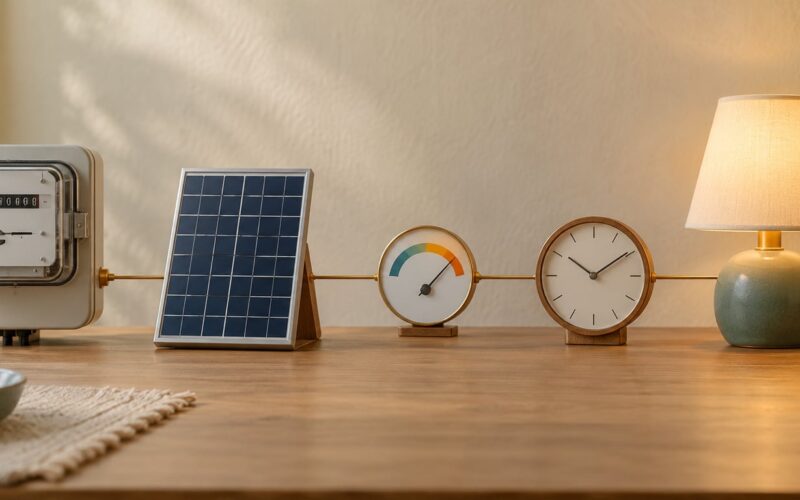
Alternating current (AC) reverses the direction of electron flow about 60 times a second, while direct current (DC) flows in one direction only. That single difference shapes everything about your home: the outlets on your walls carry AC, your solar panels and batteries produce DC, and an inverter sits between the two. Here is the plain-English version of AC vs DC explained for homeowners, without the electrician vocabulary.
If you have ever read a spec sheet, opened a phone charger, or watched an installer describe a battery as “AC coupled” without explaining why, you have bumped into this. Most people get through a decade in the same house without ever needing the detail, which is fine right up until you install solar, add a battery, or buy a charger.
Table of Contents
- AC vs DC Explained for Homeowners: At a Glance
- AC vs DC Explained for Homeowners: The Core Difference
- How AC and DC Flow Through a Home
- AC vs DC at a Glance: Voltage, Cables and Safety
- AC Coupled vs DC Coupled Solar and Batteries
- Where Homeowners Encounter AC and DC
- Which Should You Choose?
- Frequently Asked Questions
- Is household electricity AC or DC?
- Do solar panels produce AC or DC?
- Why do solar systems need an inverter?
- Can AC and DC be connected directly?
- Is DC safer than AC for home use?
- Which type of current do LED lights and USB chargers use?
- Conclusion: Start With Your Energy Source
AC vs DC Explained for Homeowners: At a Glance
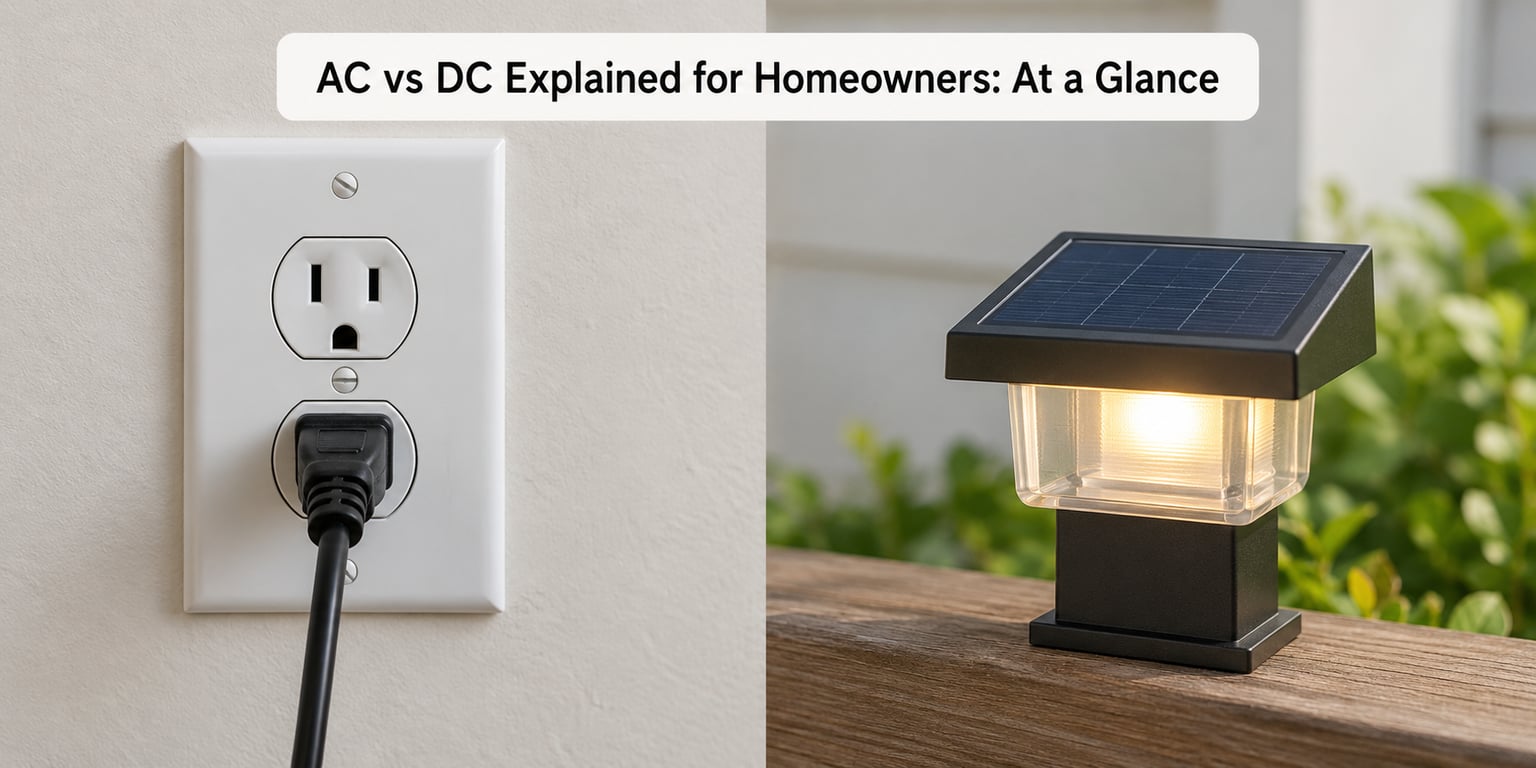
This table covers every criterion that matters inside a house. Nothing here is exotic science, it is just how power moves.
| What to compare | AC (alternating current) | DC (direct current) |
|---|---|---|
| Direction of electron flow | Reverses roughly 60 times a second in US homes, 50 times in much of the rest of the world | One direction only, continuously |
| What your outlets carry | 120V and 240V, both AC | Never delivered by a standard wall receptacle |
| Voltage transformation | Easy. A transformer steps voltage up for transmission and back down for your house | Hard. You need active switching electronics to change DC voltage |
| Transmission over distance | Efficient at high voltage, which is why the grid moves power this way | Lossy over long runs at low voltage |
| Equipment that converts it | Inverter converts DC to AC; the grid steps it up and down | Rectifier converts AC to DC inside chargers and electronics |
| Where you meet it at home | Everything plugged into a wall outlet, plus your main service | Panels, batteries, phone and laptop charging, LED drivers, EV electronics, most circuit boards |
| Break interruption | Breakers trip reliably because current crosses zero 120 times a second | Arcing is more persistent, so interruption needs care |
| Conversion penalty | Grid-tied solar converts DC to AC, losing a few percent of the energy as heat | Batteries store DC directly with no conversion in or out |
Two questions come up constantly, so here they are straight: a 120V outlet is AC, and a 240V outlet for your oven or dryer is also AC. Both are alternating current. There is no standard residential receptacle anywhere in the world that hands you DC.
AC vs DC Explained for Homeowners: The Core Difference
Direct current is the simpler of the two. Electrons move from the negative terminal toward the positive terminal and keep going in that one direction. A single AA battery is direct current, and so is the charge sitting in your phone right now.
Alternating current is what comes out of your wall. The voltage swings positive, then negative, then back again, and the electrons slosh back and forth with it rather than marching steadily forward. In US homes that cycle completes 60 times per second, which is why engineers call the grid 60 Hz.
The river analogy works well here. Direct current is a river flowing one way. Alternating current is a tide: water moves in, then drains out, then comes back, on a schedule. Neither is stronger than the other, they just behave differently and suit different jobs.
Solar panels are direct current because of how they work. Light knocks electrons loose in silicon, and those electrons have nowhere to go but one direction through the external circuit. Batteries are direct current for the same reason the chemistry insists on it. Alternating current is what the grid runs on, and that is why a device that runs on DC has to sit behind something that converts it.
The War of Currents in the 1880s is worth knowing about, because it explains why the choice was settled by infrastructure rather than physics. Thomas Edison backed direct current and pushed it hard, because DC was simpler to demonstrate and safer at low voltages. George Westinghouse and Nikola Tesla backed alternating current, and AC won once utilities could step voltage up for long transmission lines and back down for houses.
Edison’s DC was not a technical failure. It worked fine within a short radius of a generating station. It just could not economically cross the distance between a power plant and a suburb.
How AC and DC Flow Through a Home
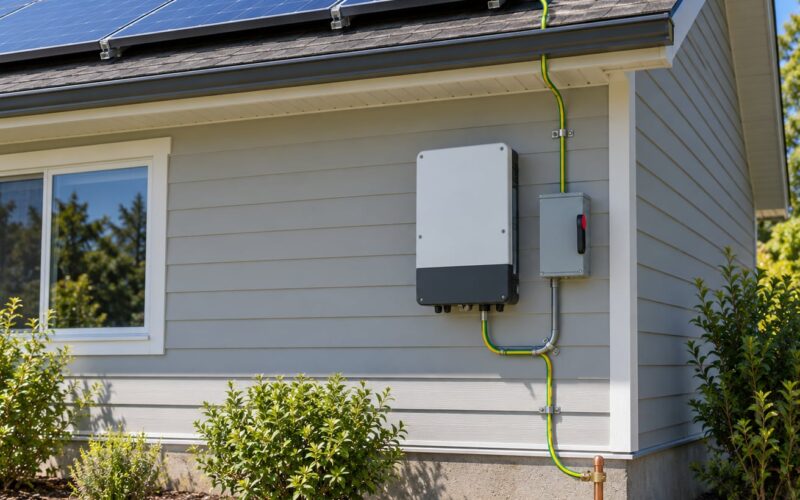
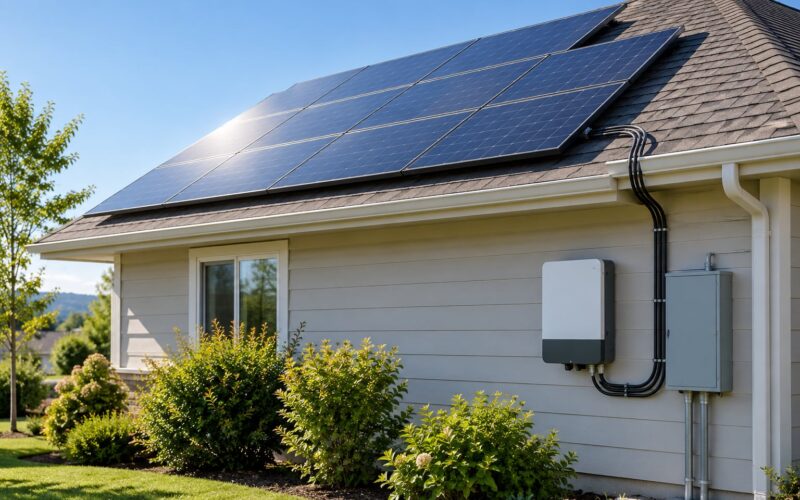
Follow a single path and the whole topic clarifies. Start at the sun. A panel’s photovoltaic effect produces direct current, and panels are wired together in series and parallel strings to build a usable voltage, typically somewhere in the range of a few hundred volts for a residential array. Every wire on the roof and every connector on the side of the house is carrying DC at this stage.
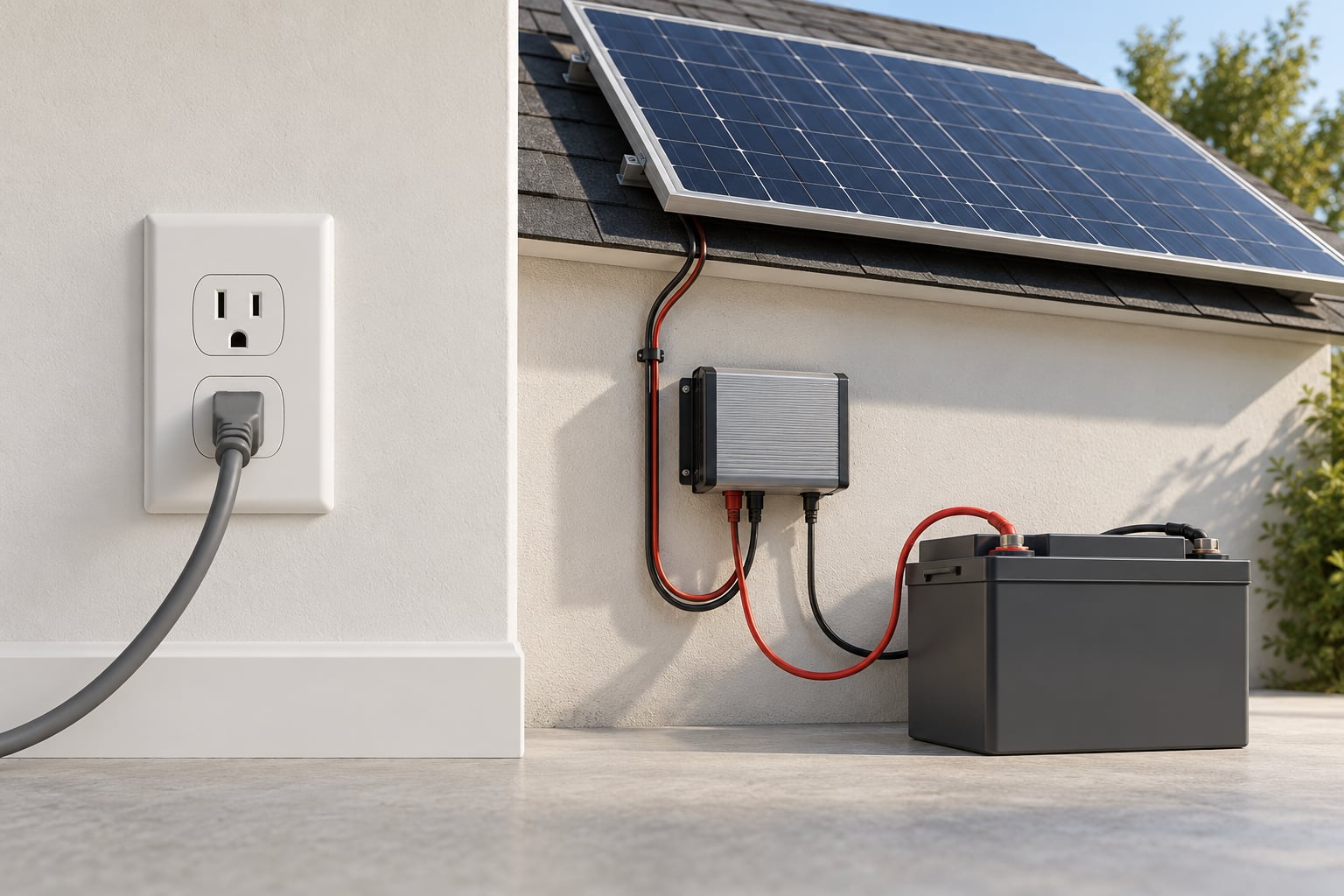
That DC lands on a charge controller or straight into a hybrid inverter. A charge controller regulates a battery’s input so it does not overcharge. An inverter does the translating, converting DC into AC with a waveform matched to what the grid expects. From the inverter onward, everything is alternating current: the run back to the main panel, the breaker that serves the kitchen, the receptacle on the wall, and the wire inside your toaster.
So your house is an AC domain with DC neighbourhoods inside it. The rooftop, the garage wall where the battery sits, and the charger on the drive are DC territory. Everything downstream of the inverter is AC.
One more conversion happens in almost every appliance you own. The wall delivers AC, the device’s internal rectifier turns it into DC, and the circuit board runs on DC at whatever low voltage it needs. Your television, laptop, and phone all do this silently, which is why the little brick on your charger says “AC input” while the device it feeds runs on DC.
AC vs DC at a Glance: Voltage, Cables and Safety
Voltage and current trade places between the two systems, and that is the part that matters when you plan an installation. Pushing the same power through a conductor needs less current at higher voltage, and lower current means less heat wasted in the copper.
That single fact is why a regional grid steps generation up to hundreds of thousands of volts. It is also why a DC system often needs heavier gauge cable to move the same power to the same distance. Cable sizing is not a preference, it is a calculation based on voltage, current, run length and the local electrical code.
On safety, both currents can injure and both can kill, and honest explainers resist the tidy slogans. Direct current tends to cause sustained muscle contraction, which can hold someone onto a conductor. Alternating current at 60 Hz is more likely to disturb heart rhythm, and its regular reversal is what makes it easier for a standard breaker to interrupt. Neither is safe to touch.
The absolute version, that DC is deadly and AC is safe, is what forum regulars push back on hardest. Follow the equipment specs, use code-compliant gear, and hire a licensed electrician for any change to your panel or service. The current type matters far less than voltage, current, contact duration and the path through your body.
AC Coupled vs DC Coupled Solar and Batteries
This is where installer jargon earns its keep. An AC-coupled battery has its own inverter, so it meets the main panel on the AC side and looks to the grid like another generator. A DC-coupled battery connects on the DC side of the hybrid inverter, sharing one conversion stage.
DC coupling loses less energy because solar and battery power avoid a round trip. AC coupling is easier to retrofit onto a house that already has a solar inverter, which is why most installers treat it as the path of least resistance on existing systems.
One thing to insist on when a salesperson says “AC battery”: the battery chemistry is still direct current regardless. AC coupling describes how the battery talks to your panel, not what is stored inside it. Forum discussions about this distinction run long, and the confusion is entirely the sales industry’s fault, not the hardware’s.
Where Homeowners Encounter AC and DC
Grid supply. The service arriving at your meter is AC, typically split-phase 120/240V at 60 Hz. Every receptacle in the house is on the AC side, and that includes the ones powering your coffee maker and your space heater.
Solar panels. Pure DC, roughly 600 to 800 volts on a modern residential array before the inverter. If you read a spec label on a panel or look at the DC side of your inverter’s monitoring app, that is the number you are looking at.
Home batteries. DC inside, always. What varies between systems is the inverter stage that turns it into house-usable AC.
USB-C chargers and phone bricks. The charger takes AC in at 120V or 240V and rectifies it to low-voltage DC for the device. The label on the brick lists input and output so it works in either country, and that is also why a cheap cord that cannot carry the right current makes your phone fall back to slow charging.
LED lighting. Household bulbs run on AC at the wall and use a small internal driver to convert it to the low-voltage DC that the LED chips need. If the driver fails, the bulb goes dark rather than flickering, which is the tell that the driver, not the LED, is the weak part.
EV charging. The charger itself is an AC device that draws from the panel and rectifies internally to charge the battery’s DC pack. Level 1 and most Level 2 home chargers work this way. DC fast charging inverts the logic, sending DC to the car directly, which is why those chargers need grid-sized equipment that most homes cannot host.
Power tools and motors. Plug-in tools run on AC. Cordless tools run on a DC battery pack with a converter built into the pack. Both exist because each matches the job.
Energy monitors and smart panels. These devices often display both sides of your system, and knowing which is which saves real confusion. Solar production appears on the DC side, grid import and export appear on the AC side, and household consumption is the gap between them.
Which Should You Choose?
For your household circuits, the grid connection and anything feeding the utility, the answer is settled: AC. Building a DC house would mean replacing every outlet, every appliance cord, every transformer and most of the grid. That cost is why homes stay on AC even as the devices inside them move steadily toward DC.
For generation and storage, choose DC. Solar is DC from the photon to the wire, and batteries store DC natively. Forcing DC through an AC-only path would be silly.
For electronics, appliances and anything with a rectifier inside, use DC. Low-voltage DC is what circuit boards want, and the reason your charger exists at all is that your grid cannot supply it directly.
For a solar installation, you need both, plus an inverter as the bridge. The array and battery supply DC, the inverter turns it into grid-matched AC, and your existing panel and outlets handle the rest untouched. When a quote lists equipment, ask which devices sit on the DC side, which sit on the AC side, and how many conversion stages are between the panels and your kitchen.
If you are planning work on your panel, service or a new circuit, a licensed electrician should do it. A solar installer should size your inverter and conductors for the manufacturer’s specs, and any of them can pull the equipment’s own documentation to show you the numbers rather than asking you to take their word.
Frequently Asked Questions
Is household electricity AC or DC?
Household electricity is alternating current. A standard US receptacle delivers 120V AC, and the 240V circuit used for an electric range, dryer or water heater is also AC, split into two 120V legs. Very little DC reaches a residential wall outlet at all, which is why every device that needs DC includes a rectifier inside it.
Do solar panels produce AC or DC?
Solar panels produce direct current. Light striking the silicon cells frees electrons that can only travel one way through the external circuit, so panel output is DC no matter what you connect to it. A typical residential array sits in the few-hundred-volt range on the DC side before an inverter converts it to AC for your panel and the grid.
Why do solar systems need an inverter?
Because the grid runs on AC and the panels produce DC. An inverter switches that direct current into alternating current with a waveform and frequency your utility will accept, and it regulates the output so power matches what the house is drawing at that moment. Grid-tied inverters also handle grid synchronization and shut down safely when the grid fails.
Can AC and DC be connected directly?
No. Connecting an AC source directly to a device expecting DC, or the reverse, does damage rather than work. You need a rectifier to turn AC into DC and an inverter to turn DC into AC. Plugging a DC supply into an AC appliance usually produces no operation at all, while feeding AC into a DC circuit can overheat wiring and devices quickly.
Is DC safer than AC for home use?
Neither is safe to touch, and treating this as a contest is misleading. Direct current can cause sustained muscle contraction that holds you onto a conductor, while 60 Hz AC is more likely to disrupt heart rhythm and arcs across a gap more readily. Voltage, current, contact duration and body path matter far more than the current type, so follow code and use qualified help.
Which type of current do LED lights and USB chargers use?
Both take AC from your wall and convert it to DC internally. An LED bulb houses a small driver that rectifies 120V AC down to the low-voltage DC the LED chips need, and a USB charger rectifies 120V or 240V AC into the low-voltage DC your phone or laptop expects. The conversion is why chargers carry a label listing both AC input and DC output.
Conclusion: Start With Your Energy Source
AC and DC differ in one thing only: whether electron flow reverses. Alternating current serves your walls because transformers can raise and lower its voltage cheaply, and direct current produces your solar power and stores in your batteries because that is what physics gives you for free.
Before you pick a cable, controller, inverter or installer, work out where the power comes from. Grid power means AC and standard outlets. Panel output and battery storage mean DC and equipment rated for it. Anything that sits between the two needs an inverter, and anything that draws from AC to run on DC has a rectifier you can read about in its own manual. That single question resolves most of the jargon before it reaches you.