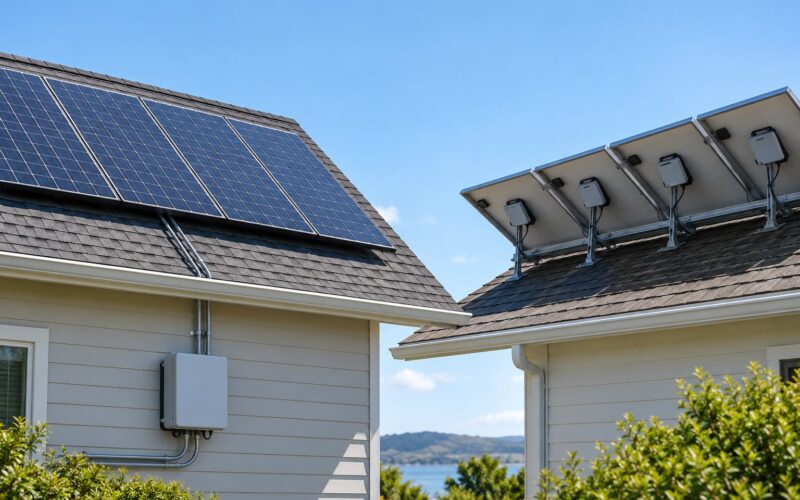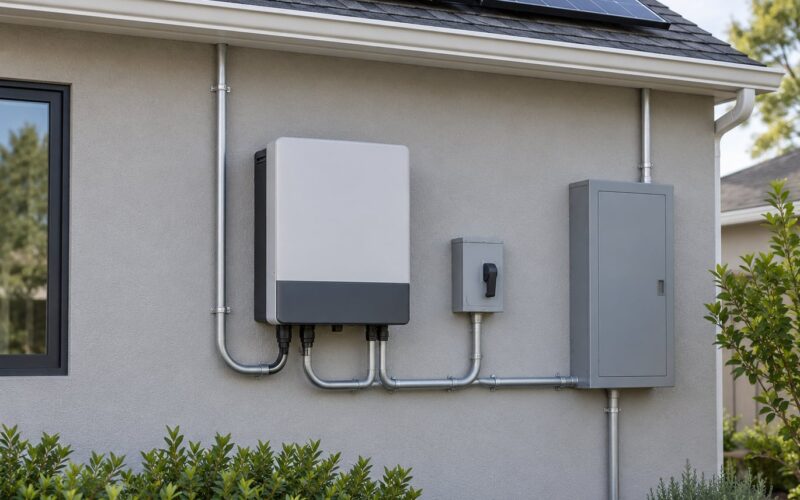
To read your electric bill for solar planning, you need three numbers: your metered kilowatt-hours for each billing period, your tariff or rate plan, and the fixed charges that sit outside your energy usage. Those three items let you build an annual kWh baseline, size a system, and estimate what solar will and will not save you. With three to twelve months of statements, the whole exercise takes about an hour.
The bill itself is never the hard part. The hard part is that most people look at the total dollars due, and total dollars reflect rate changes, fixed fees and last year’s weather, not how much electricity the house actually used.
Here is the sequence that works: pull the kWh, strip out everything that is not metered energy, average it across a full year, check which rate plan you are on, and only then start sizing. Below is each step in detail, plus the mistakes I see repeatedly and the questions installers always ask for.
Table of Contents
- What You Need
- How to Read Your Electric Bill for Solar Planning, Step by Step
- Find the Billing Period and Account Details
- Where to Find Your kWh Usage for Solar Planning
- Separate Usage From Fixed Charges
- Calculate Your Average Monthly Consumption
- Check the Rate Structure and Time-of-Use Details
- Estimate Solar Savings Without Guessing
- Record the Baseline for a Solar Quote
- Common Mistakes When Reading a Bill for Solar
- Frequently Asked Questions
- What part of an electric bill should I use for solar planning?
- Do fixed utility charges disappear when I install solar?
- How many months of electric bills should I bring to a solar installer?
- Can I plan for solar if I rent my home?
- Does every exported kilowatt-hour save the same amount?
- What if my usage changes after I get a solar quote?
- Conclusion
What You Need
Gather these before you open anything, because the process goes faster when you are not hunting between tabs.

- Your last three to twelve bills. Three is the bare minimum. Twelve gives you the seasonal swing, which matters more than most people expect.
- A recent utility statement in PDF form. Web statements often hide the kWh breakdown behind a graph. The PDF statement almost always shows the line items.
- Your account details. Account number, meter number, service address and rate plan name. Most utilities print all four near the top of page one.
- A spreadsheet or a calculator. Nothing fancy. Four columns is enough: month, kWh, energy charges, fixed charges.
- Your meter’s current reading. Some utilities show it on the bill, some do not. If yours does not, the meter face is usually on the side of the house.
One optional tool changes the quality of the result: your utility’s interval or smart meter data portal. Monthly bills give you a monthly total. Interval data gives you hour-by-hour usage, which reveals exactly when your household uses power. If your utility offers a Green Button download, grab it while you are gathering.
How to Read Your Electric Bill for Solar Planning, Step by Step
Work through these seven steps in order. Each one feeds the next, and skipping ahead is how people end up with a system sized for the wrong year.
Find the Billing Period and Account Details
Start at the top of page one. You are looking for the service address, account number, meter number and the name of your rate plan, which some utilities print in a box labelled “Rate Schedule” or “Tariff”.
The billing period is the single most useful line on the document, because a period that runs from the 3rd of one month to the 2nd of the next is 30 days, not a calendar month. Utilities show it in a few different ways: “Your statement for March 3 to April 2”, “Statement period 03/03 – 04/02” or “Service from 03/03” or a similar date pair. Write down the start and end date exactly as printed.
These details matter whenever you compare months. If one statement covers 28 days and another covers 31, dividing each by the same number gives you a meaningless comparison. Two different meters on one account, common in multi-unit buildings, also show up here as separate meter numbers with separate kWh lines.
Where to Find Your kWh Usage for Solar Planning
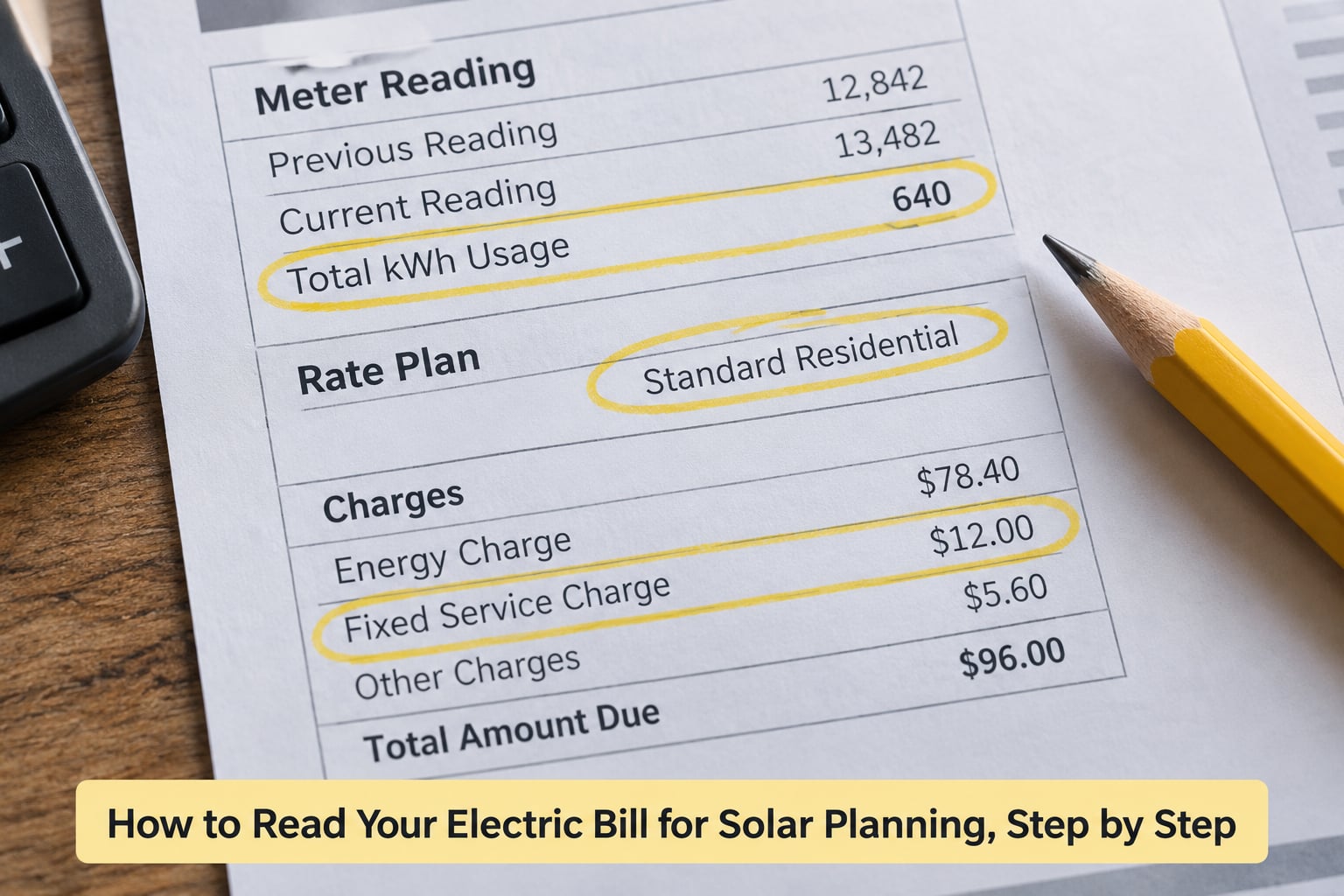
Your metered usage is measured in kilowatt-hours, abbreviated kWh, and it is the only number that genuinely matters for sizing. It sits in the summary section of the bill, usually labelled “Your Usage” or “Electricity Usage” or “kWh Usage”.
Utilities show usage in one of three ways. Some print a single line with the total for the period. Some print “Current Reading”, “Previous Reading” and “kWh Used”, which invites you to subtract. Some print nothing but the meter reading and expect you to track it yourself across statements.
If the bill shows two readings, the subtraction is simple. A current reading of 48,215 and a previous reading of 46,970 means you used 1,245 kWh for that period. Write down both numbers and keep the running total, because that is how you catch a misread later.
One warning here. A demand charge is measured in kilowatts, not kilowatt-hours, and it appears on residential bills in some markets and on nearly every commercial bill. A line reading “kW” is the highest power you pulled in a single moment, not how much energy you used over the month. If you copy that number into a sizing spreadsheet, your system will come out badly undersized. Find the kWh line and ignore the kW line for sizing purposes.
A second warning: some utilities show several kWh figures at once, including a “Total Usage” number that sums several meters. Pick the line that corresponds to your meter number, and use the total only when there is genuinely just one meter.
Separate Usage From Fixed Charges
Now split the bill into what solar can reduce and what it cannot. This is the step that explains why so many homeowners with solar still pay a bill every month.
Energy charges are the per-kWh rates multiplied by your metered usage. Supply or generation charges cover the cost of producing the electricity. Delivery or distribution charges cover the wires, poles and meters that move it to your house. Transmission charges cover the higher-voltage lines between the generator and your utility. Taxes and regulatory levies are added on top, sometimes as a percentage of the subtotal.
Fixed charges do not move with your usage at all. A customer or service charge, a meter or metering charge, a capacity charge, a paper bill fee or a wildfire mitigation charge appear on every statement whether you use 200 kWh or 2,000 kWh. Solar does not touch them, because you are still connected to the grid and still occupying a meter.
Here is a worked example of how those lines stack up on a sample statement showing 900 kWh used in the period.
| Line item | How it behaves |
|---|---|
| Energy or supply charge, per kWh | Rises and falls with your usage; solar shrinks it |
| Delivery or distribution charge, per kWh | Rises and falls with your usage; solar shrinks it |
| Transmission charge, per kWh | Rises and falls with your usage; solar shrinks it |
| Customer or service charge, flat monthly | Same every period; solar never touches it |
| Metering charge, flat monthly | Same every period; solar never touches it |
| Capacity or wildfire mitigation charge | Same every period; a regulatory pass-through |
| Taxes and levies on the subtotal | Falls with usage, because the subtotal falls |
Now compare the two halves of that statement. The three per-kWh lines together make up the block that solar can reduce, and on most residential tariffs they account for roughly three quarters of the total. The flat fees make up the rest and never shrink. A household that pays a fixed block of this size today will still owe roughly the same amount after going solar, which is why a solar bill rarely reaches zero.
Do that arithmetic on one statement before you go further. Multiply each per-kWh rate by your metered usage, add the flat fees on top, and the result should land on the total your utility billed you. If it does, you have correctly separated the parts.
Some utilities also print a rider or line item that has nothing to do with energy, such as an electric vehicle supply equipment charge or a medical baseline adjustment. Read the description text; the line label alone rarely tells you enough.
Calculate Your Average Monthly Consumption
Add up every monthly kWh figure and divide by the number of months. A household using 1,050 kWh, 1,180 kWh and 960 kWh across three months averages 1,063 kWh. That is your consumption baseline.
One bill is not a baseline. Twelve months of bills is a baseline, and it exposes seasonal variation that most sizing mistakes hide. A house in a cooling climate may run 700 kWh in spring and 1,900 kWh in July. Averaging that range into a single number is fine for a rough estimate, but it is dangerous for deciding whether a battery makes sense, because the winter and summer behaviour is exactly what a battery addresses.
Keep the monthly breakdown. Even a rough column in a spreadsheet tells you whether you are looking at a cooling-dominated load, a heating-dominated load or something flat. Heating-dominated households, often with heat pumps running auxiliary resistance heat in cold weather, get winter consumption spikes that solar output cannot match, because panels produce least in the darkest weeks. Homeowners planning for heat pumps keep asking about this one, and the honest answer is that solar plus a heat pump needs a bigger budget for imported power than solar alone.
Multiply the average by twelve to get annual consumption. Write that number down. It is the figure an installer will ask for first, and it is the figure that goes into every sizing calculation.
If your utility gives you access to interval data through a smart meter portal or a Green Button download, use it to sanity-check the monthly totals. Most systems will not match the bill exactly. The meter sits at the property line, the monitor sits inside, and a handful of always-on loads can sit outside one or the other. Treat a gap of a few percent as normal and treat a gap of twenty percent as a reason to find out why before you size anything.
Interval data also answers a question monthly totals cannot. If your usage runs from 8pm to 11pm on summer evenings, a battery or a load-shifting plan changes the maths more than another two panels would. If your usage is steady from 6am to 8pm, panels alone cover most of what you can offset. Knowing that shape is worth more than knowing one more decimal place on your annual total.
Check the Rate Structure and Time-of-Use Details
Your rate plan changes what your kWh are worth, and that changes how big a system should be.
On a flat rate, every kWh is worth the same and simple annual math works well. On a tiered rate, later blocks cost more, so the marginal value of your usage is higher than the average. Consumption in the top tier is worth offsetting first. On a time-of-use rate, price varies by hour, so a kWh used at 4pm on a July weekday is worth far more than one used at 2am.
Time-of-use details live on the bill as period labels: on-peak and off-peak, peak and shoulder and off-peak, or a chart with hours beside rates. Some utilities print the dollar amount you spent in each period. If yours does, you already have the shape of your usage, which is the closest thing to interval data most residential customers can get.
On a time-of-use plan, panel orientation starts to matter more. Panels that face west produce during the expensive afternoon window, which can be worth more per kWh than panels facing south that peak at noon when power is cheaper. Homeowners with west-facing roofs routinely find their production mix fits their rate better than the compass direction suggests.
Ask your utility for the rate schedule document named on your bill. It is a public document, usually a PDF on the utility website, and it defines every period, every rate and every charge on the statement. Real rate schedules are what trustworthy sizing is built on, not estimates found on a forum.
Estimate Solar Savings Without Guessing
You now have annual kWh and a rate structure. That is enough to size a system and produce a first savings estimate.
The method most DIY planners use starts with daily consumption, then divides by peak sun hours and by a performance ratio to get the system size in kilowatts. Peak sun hours, abbreviated PSH, is the average number of hours of full-strength sunlight per day at your location, and it is published for thousands of cities. The performance ratio, or PR, accounts for real-world losses such as heat, dust, wiring, inverter conversion and shading.
Use a PR between 0.75 and 0.85 for planning. That is the range experienced installers recommend as safe rather than optimistic. Using 1.0 assumes a perfect array that never gets dusty, which no real roof delivers.
A worked example. A household uses 9,600 kWh a year. Divide by 365 and you need 26.3 kWh a day. With 5.0 peak sun hours and a performance ratio of 0.80, each installed kilowatt delivers 4.0 kWh on an average day, so the system needs 26.3 divided by 4.0, or 6.6 kW. At roughly 400 watts per panel that is about 17 panels, which lands you near 6.8 kW once you round up to whole panels and a standard inverter size.
Now separate what the utility reports from what you assume. Facts from the bill: annual kWh, rate plan, fixed charges, time-of-use periods, whether exports are credited. Assumptions on your side: peak sun hours for your address, performance ratio, panel wattage, the shading you expect, and the rate your utility pays for exported kWh.
That last assumption swings payback periods more than anything else. Where exported kWh is credited at the full retail rate, oversizing a system pays reasonably well. Where exports are credited at a low wholesale rate, every extra panel beyond what the household uses generates poor value. Sizing to your own consumption rather than to your roof area usually makes more sense in that situation.
Verify the result with PVWatts, the free calculator from the National Renewable Energy Laboratory. Enter your system size, array tilt and azimuth, and your local peak sun hours, then compare its monthly production estimates against your monthly kWh from the bills. Comparing month by month rather than annually is the step most people skip, and it is the fastest way to catch a roof that shades badly in December.
If your utility publishes an export limit or non-bypassable charge, factor that in too. A cap on how much you can export, or a charge that applies even when your panels produce more than the house uses, changes the point where extra size stops earning.
Record the Baseline for a Solar Quote
Write your findings down in one place. Installers move faster, quotes come back more comparable, and you can catch an assumption that does not match your own data.
Your baseline sheet should hold these figures:
- Annual consumption in kWh, and the monthly kWh behind it
- Your rate plan name and, if you found it, the schedule document
- Whether the plan is flat, tiered or time-of-use, and the period hours
- The variable share of your bill, meaning the portion that scales with usage
- Your flat monthly charges and their total
- Any demand charge, in kW, if your bill shows one
- Roof direction, pitch and any shading from trees, chimneys or neighbouring structures
- Whether you rent, have a lease restriction or share a roof
- Any planned changes: an electric vehicle, a heat pump, a home office, an addition
- Whether your utility has export limits or non-bypassable charges
Add the future changes on the same sheet, because a system sized on today’s usage will be wrong the moment you add an electric vehicle that draws 30 to 40 kWh a week at highway speeds. Ask for a quote that covers today’s loads, then ask what the same quote becomes with those additions included.
Common Mistakes When Reading a Bill for Solar
Most mistakes when reading an electric bill for solar planning come from the same three habits: working from dollars, mixing up kW with kWh, and trusting a single month. Each one has a simple fix, and each one changes the system an installer would propose.
Using the total dollars instead of kWh. Your total went up because rates rose, or because you had a longer billing period, or because you ran the dryer more. Dollars per kWh is not a fixed number on any tariff. Fix: use the kWh line, always.
Comparing billing periods of different lengths. A 28-day period and a 31-day period are not equal. Fix: divide by the number of days when the period is unusual, and note it in your sheet.
Ignoring fixed charges. Fixed fees do not shrink with a smaller bill, so percentage savings always look smaller than the kWh offset suggests. Fix: calculate the variable share before quoting any savings figure.
Assuming every exported kWh earns the full retail rate. Many utilities credit exports at a lower rate, apply a cap, or deduct a non-bypassable charge. Fix: find the export compensation terms in your rate schedule or interconnection agreement before sizing.
Relying on one month. One hot week or one cold snap produces a system sized for weather that will not repeat. Fix: average at least three months, twelve if you have them.
Reading your monitoring app instead of your bill. Home monitors such as Sense or Emporia are useful, but they often disagree with the utility by several percent, and that gap can be confusing when you are checking your work. Treat the utility bill as the source of record and monitors as a better-shaped view of when you use power.
Forgetting demand charges. If your bill shows a kW demand charge, it reflects the single highest load you pulled, not monthly energy. A battery can reduce it, and solar alone often will not. Fix: note the kW figure separately and raise it with your installer.
Forgetting that solar does not remove the meter. Being grid-connected is a condition of most net metering rules, and the fixed charges stay with you. Fix: plan for a lower but non-zero bill.
Frequently Asked Questions
What part of an electric bill should I use for solar planning?
Use the metered electricity consumption in kilowatt-hours, never the total dollar amount. Record the billing period, the monthly kWh figure, and the rate plan name for each statement. Totals in dollars move with rate changes, taxes and billing-period length, so they tell you nothing about how much energy the house used. If your bill shows only meter readings, subtract the previous reading from the current one to get your kWh.
Do fixed utility charges disappear when I install solar?
Usually not. Solar reduces metered energy consumption, so per-kWh energy, delivery and transmission charges fall. Customer charges, meter or metering charges, capacity charges and regulatory pass-throughs are billed whether you use 200 kWh or 2,000 kWh, because you stay connected to the grid. Plan for a much lower bill rather than a zero bill, and ask your installer to show you the fixed portion of your current bill so the expectation is clear.
How many months of electric bills should I bring to a solar installer?
At least three months is a workable minimum and twelve months is far better because it captures seasonal swings that change system sizing. Ask for PDF statements from your utility portal rather than screenshots, since the PDF keeps the line items readable. Add your rate schedule document if you can find it, plus a note of any planned changes such as an electric vehicle or heat pump.
Can I plan for solar if I rent my home?
You can still read your bills, calculate consumption and model what solar would save, which is useful whether you buy later or ask your landlord about installing equipment. What you cannot do without permission is mount panels or change the electrical service. Check your lease, ask the property owner, and remember that any savings from a system you do not own usually belong to the owner under most agreements.
Does every exported kilowatt-hour save the same amount?
Not necessarily. Value may depend on your retail rate, net metering or net billing rules, time-of-use periods, demand charges and the compensation rate for exported energy. Some utilities credit exports at the full retail rate, others credit a lower avoided cost, and some cap exports or deduct a non-bypassable charge. Where exports earn little, sizing close to your own consumption usually produces a better return than oversizing.
What if my usage changes after I get a solar quote?
Recalculate whenever you add an electric vehicle, heat pump, major appliance or home office. Those changes usually raise consumption, which means a larger array and a better return. Write them into your baseline sheet before the quote so the installer prices both the current and the future scenario, and ask for an inverter and panel layout that can expand later without redoing the whole electrical work.
Conclusion
Start by collecting three to twelve months of statements, pull the metered kWh from each one, and write down the rate plan name and your flat monthly charges alongside it. Divide the annual total by twelve to get your average, then check your tariff for time-of-use periods and export compensation terms.
That single page is the baseline every credible solar estimate starts from. When a quote arrives, compare their assumptions against your own numbers, and you will know quickly whether they sized for your household or for a template. Reading an electric bill for solar planning takes an hour; guessing at it costs you years of savings either way.