A kilowatt-hour (kWh) is a unit of energy equal to running a 1,000 watt appliance for one hour, or about 3.6 million joules. It is the unit your utility sells electricity in, so the number on your bill is literally a count of kilowatt-hours. Once you can read that number, you can estimate what anything in your house costs to run, and how much solar energy your roof would need to make.
Three things follow from that definition, and they cover most of what people get confused about:
- It is a unit of energy, the same category as joules and British thermal units, not a unit of power.
- Power is the rate, energy is the total. Kilowatts (kW) tell you how fast; kilowatt-hours (kWh) tell you how much in the end.
- A real example: a 100 watt television left on for 10 hours uses exactly 1 kWh, the same as a 1,000 watt microwave running for one hour.
- Why it matters: the same kWh number drives your electricity bill, the size of a solar array, the capacity of a home battery, and the cost of charging an EV.
The rest of this guide works through each of those, plus the two arithmetic mistakes that trip people up more than anything else in this topic.
Table of Contents
- What Is a Kilowatt Hour?
- What one kilowatt hour equals in other units
- Why kWh per hour is not a real thing
- How Is a Kilowatt-Hour Used on an Electricity Bill?
- What each line on the bill means
- How to read kWh off your meter yourself
- Reading a bill when you have solar panels
- How Many Watts Are in a Kilowatt?
- What a full 1 kW of load looks like at home
- Common Kilowatt-Hour Examples for the Home
- What the same appliances cost over a day and a month
- How to Calculate Your Own Energy Use
- The arithmetic mistake almost everyone makes once
- Turn a daily figure into a monthly one
- How Does This Relate to Solar Energy?
- From your bill to a solar array, step by step
- Nameplate battery kWh is not usable kWh
- Simple Ways to Save Kilowatt-Hours
- Frequently Asked Questions
- What is the difference between a kilowatt (kW) and a kilowatt-hour (kWh)?
- How long does 1 kWh last?
- How do I calculate kWh from appliance wattage?
- How much kWh per day is normal for a household?
- Why is my electricity bill still high when I have solar panels?
- How do I pronounce kWh?
- Start With One Number From Your Bill
What Is a Kilowatt Hour?
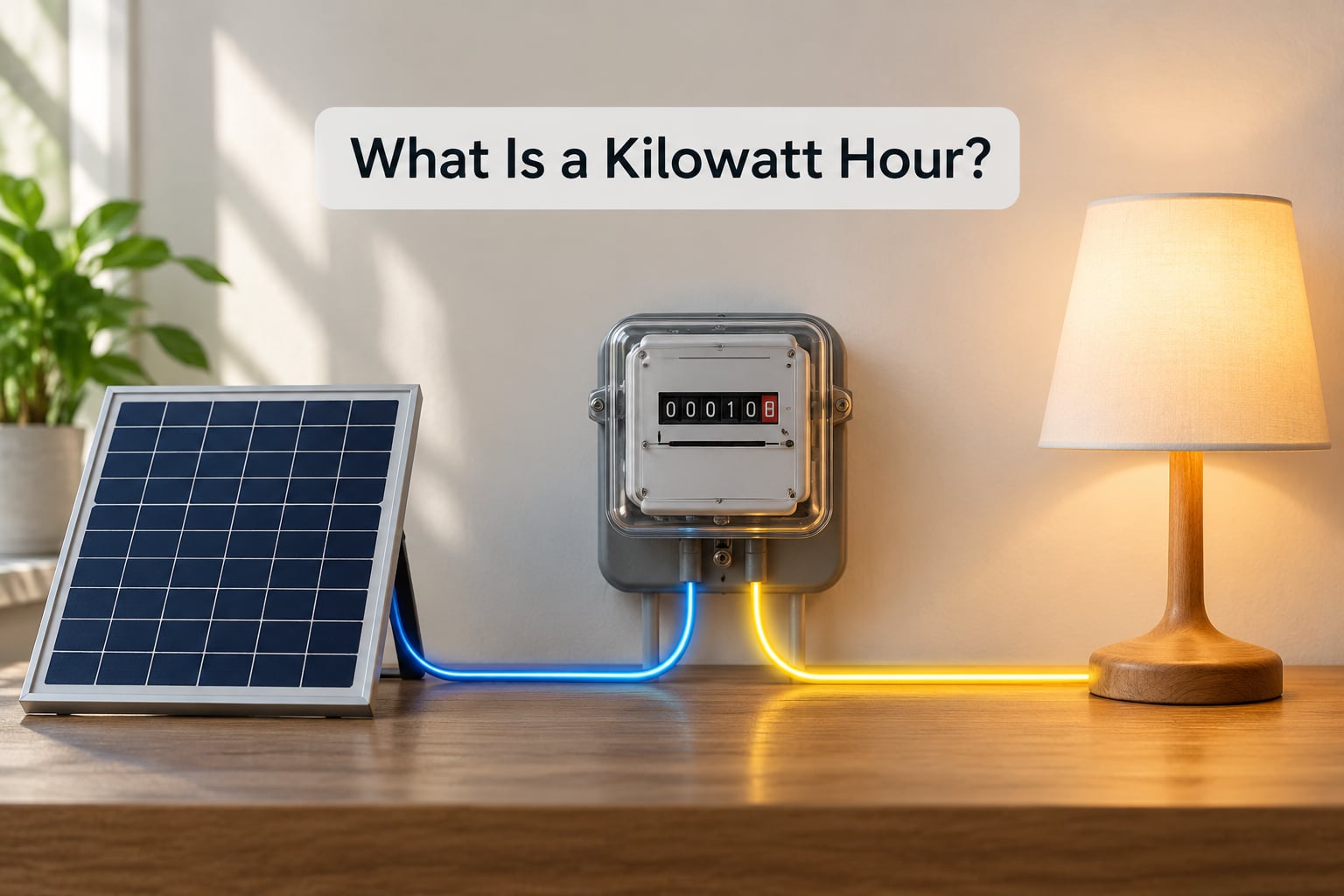
A kilowatt-hour is the amount of electrical energy used when a power of one kilowatt runs for one hour. Written out, that is 1 kW multiplied by 1 h, which equals 1 kWh. The same quantity can be written as 1,000 watt-hours, and in scientific units as 3.6 million joules.
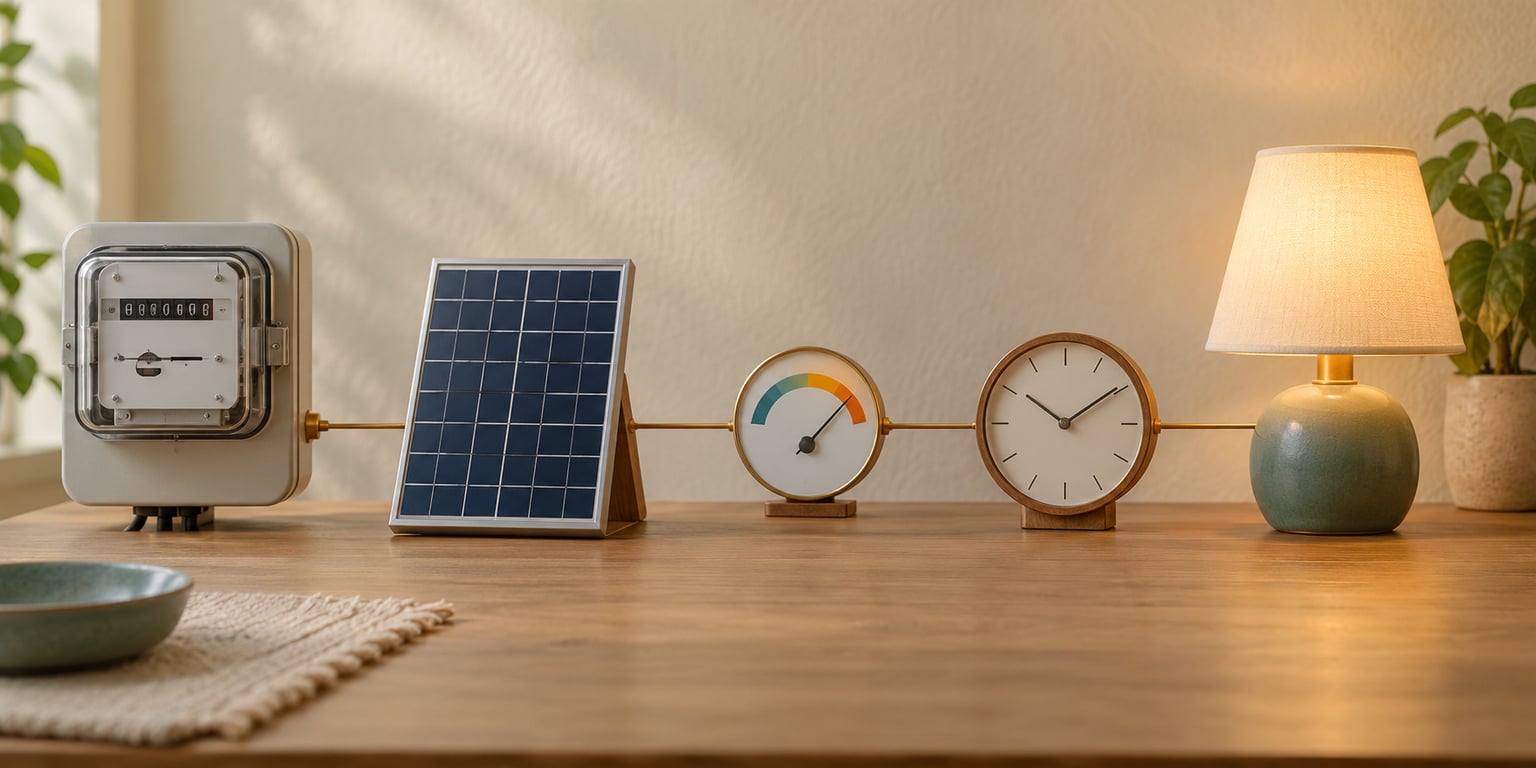
Watts and kilowatt-hours get mixed up because the names look related and because both show up on the same bill. A watt is a rate, like miles per hour. A kilowatt-hour is a distance, like miles driven. Ask how fast the car was going and you get a speed; ask how far it went and you need both the speed and the time.
What one kilowatt hour equals in other units
Conversions come up when you compare electricity with gas, food calories, or car batteries. One kilowatt-hour is the same energy as one large household meal, or roughly the energy in a litre of petrol, which is why a small battery and a big one are easier to compare once you convert.
| Unit | Equivalent of 1 kWh |
|---|---|
| Watt-hours (Wh) | 1,000 Wh |
| Joules (J) | 3,600,000 J |
| Megajoules (MJ) | 3.6 MJ |
| British thermal units (BTU) | about 3,412 BTU |
| Food kilocalories (kcal) | about 860 kcal |
| Megawatt-hours (MWh) | 0.001 MWh |
Megawatt-hours are worth knowing about because grid scale is quoted that way. A large solar farm might produce 20 MWh on a sunny day, which is 20,000 kWh, or roughly what a few US homes use in a month.
Why kWh per hour is not a real thing
You will sometimes see kW/h or kWh/h written down, and it is not a faster unit. A kilowatt-hour already includes the time element, so dividing it by an hour cancels the time out and tells you nothing. If you need a rate, use kilowatts, which is kW.
This one causes genuine arguments on forums, and the reason is that dividing watts by 1,000 does not give kilowatt-hours. It gives kilowatts. The hours still have to be multiplied in afterwards.
How Is a Kilowatt-Hour Used on an Electricity Bill?
Your utility measures electricity by recording how much energy passed through your meter over a billing period, then charging a rate for each kilowatt-hour used. Every residential bill does the same arithmetic in a different layout.
Smart meters send readings automatically. If you have an old analog meter, the dial is actually a kilowatt-hour counter, so the numbers you write down are the numbers that get billed.
What each line on the bill means
Bills vary by region, but most contain the same pieces, and knowing which is which stops a lot of confusion.
- Usage line. Total kWh consumed this period, usually shown alongside the previous period’s figure so you can compare.
- Rate. Price per kWh, which is multiplied by the usage line to produce the energy charge. Rates differ widely by region and change over time, so use the number printed on your own bill. US residential averages sit in the mid-teens cents per kWh according to the Energy Information Administration, and many older articles still quote figures from a decade ago.
- Supply and delivery. Some bills split the charge in two. Delivery covers the wires and the meter; supply covers the energy itself. You cannot avoid either, but only the usage responds to what you switch off.
- Fixed charges. Daily or monthly service fees, unaffected by your behaviour.
- Demand charge. A charge based on the highest power drawn at one moment, more common on business tariffs than residential ones.
- Taxes and credits. Applied last, and sometimes offset by rebates or solar export credits.
If your usage jumps in summer, a window air conditioner or a fan is usually the cause. Peaks in the evening often point to oven use, a dryer run, or a space heater running for a few hours, because a handful of high-power appliances can add up quickly.
How to read kWh off your meter yourself
Check the meter face for a label reading kWh. On an analog meter, read the register exactly as you would a clock, including the last red or partial digit. On a digital meter, record the total kWh reading shown, not the instantaneous demand reading, because the latter changes constantly.
Read it on two separate days, subtract the first reading from the second, and you have your real kWh use for that period. This is exactly the workflow solar installers ask customers to do, because it produces actual consumption rather than a rule of thumb. Comparing a photograph of your meter against your bill also shows which figures are yours to control.
Reading a bill when you have solar panels
Solar households often get a bill in two halves, a grid import figure and an export figure, and a net metering credit for what they push back. Credits may be valued at the full retail rate or at a lower buy-back rate depending on the utility and the state, which is the usual reason someone with a working array still sees a bill worth explaining.
Solar offsets only what you actually consume. If a system is sized for your daytime usage, surplus midday generation earns credit, while a large evening draw still has to be bought back from the grid.
How Many Watts Are in a Kilowatt?
Exactly 1,000 watts, and that simple conversion is the whole answer. The catch is that watts measure power while kilowatt-hours measure energy, so the number of watts in a kilowatt never tells you how long anything runs.
| Quantity | Measures | Symbol | Example |
|---|---|---|---|
| Watt (W) | Power, the rate of energy use | W | A 10 W LED bulb draws 10 W whenever it is on |
| Kilowatt (kW) | Power, in thousands of watts | kW | A 6 kW solar array at full sun |
| Watt-hour (Wh) | Energy over time | Wh | That LED bulb uses 1 Wh every 6 minutes |
| Kilowatt-hour (kWh) | Energy, in thousands of watt-hours | kWh | 1 kWh is one billable unit |
Two devices with very different wattage can use the same amount of energy. A 100 W television for 10 hours equals 1 kWh, and a 1,000 W microwave for 1 hour equals 1 kWh. What changes the bill is power multiplied by time, in that order.
What a full 1 kW of load looks like at home
A whole 1 kW of draw is unusual in a house and more typical of a workshop, a commercial kitchen, or a fast EV charger. A kettle at 1,800 W is close on its own, and running it for a few minutes is a measurable slice of a monthly bill.
This is also where kVA enters the picture. Electricians size generators and inverters in kVA, which accounts for the extra current a motor needs during startup, so a device can draw more kVA than its running wattage. Panel and inverter ratings are usually quoted in watts for the same reason: they describe an instantaneous limit, not an energy total.
Common Kilowatt-Hour Examples for the Home
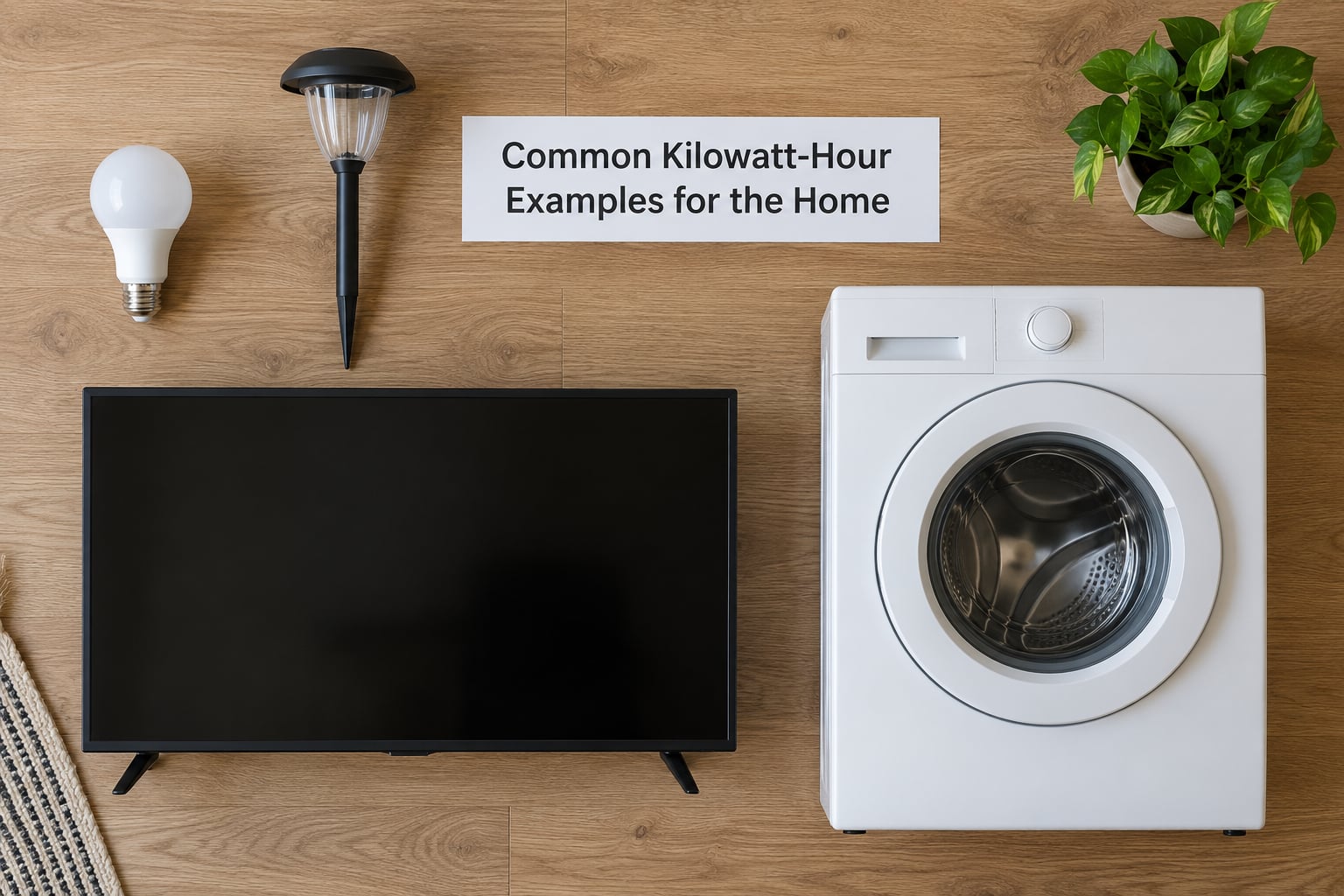
To work out how long one kilowatt-hour lasts on a device, divide 1,000 by its wattage. That gives hours of runtime from a single kWh, assuming the load stays constant.
| Device | Typical watts | Hours on 1 kWh |
|---|---|---|
| Solar path light (LED) | 0.5 W | about 2,000 h |
| Porch or halogen bulb | 60 W | about 17 h |
| LED ceiling bulb | 10 W | about 100 h |
| Wi-Fi router | 15 W | about 66 h |
| Laptop | 60 W | about 17 h |
| 100 W television | 100 W | 10 h |
| Refrigerator (running) | 150 W | about 7 h of compressor time |
| Washing machine | 500 W | 2 h |
| Dishwasher | 1,200 W | about 50 min |
| Space heater | 1,500 W | about 40 min |
| Microwave | 1,000 W | 1 h |
| Kettle | 1,800 W | about 33 min |
The comparison at the top and bottom of that list is the useful one. A halogen path light burns through 1 kWh in a little under 17 hours, while a solar LED path light can run for weeks on the same energy, absorbed from the sun rather than the grid.
What the same appliances cost over a day and a month
Multiply watts by hours per day to get daily kWh, then multiply by 30 for a rough monthly figure. Use the nameplate rating printed on the device, since the figure on the box is usually the highest draw rather than the average.
| Device | Watts | Hours per day | kWh per day | kWh per month |
|---|---|---|---|---|
| LED living room lamps | 30 W | 5 | 0.15 | 4.5 |
| Router and set-top box | 25 W | 24 | 0.6 | 18 |
| Refrigerator | 150 W | 8 | 1.2 | 36 |
| Television | 100 W | 4 | 0.4 | 12 |
| Washing machine | 500 W | 1 | 0.5 | 15 |
| Dishwasher | 1,200 W | 1 | 1.2 | 36 |
| Space heater in winter | 1,500 W | 5 | 7.5 | about 340 over a 68-day season |
The washing machine entry is lower than most people expect, because the heater and motor do not run for the whole cycle. The space heater entry is much higher, and a few hundred hours of it will show up clearly in a winter bill.
For scale, a US household uses roughly 900 kWh in a typical month, or about 30 kWh a day, though that figure swings widely with climate, size and electric heating. 40 kWh a day is high but not unusual for a large home with an electric heater, an older fridge and a tumble dryer.
How to Calculate Your Own Energy Use
Take the watts printed on the appliance, divide by 1,000 to get kilowatts, then multiply by the hours it runs. That gives kWh for the period you care about.
For example, a 1,500 W space heater running 5 hours a day uses 1.5 kW multiplied by 5 h, or 7.5 kWh a day, and about 225 kWh over a 30-day month.
If you know the voltage and current instead of the wattage, multiply them: 120 V at 5 A is 600 W. The same rule works on any appliance, and it is how you check a device that has lost its label.
Bigger appliances often draw more power for a short burst than for the cycle. A dishwasher rated at 1,200 W that runs 80 minutes actually uses 1.6 kWh, not 24 kWh. The nameplate is a ceiling, not an average, so short high-wattage tasks deserve a careful look.
The arithmetic mistake almost everyone makes once
Dividing 1,500 W by 1,000 gives 1.5 kW, not 1.5 kWh. Those are two different quantities, and several popular explainers on the web skip the step that turns one into the other. If your estimate comes out ten times smaller than expected, this is why.
Turn a daily figure into a monthly one
Multiply your daily kWh by 30 for a rough month, or by 365 for a year. For a season, use the number of days you actually expect to run the device, which is why a heater figure for winter is more honest than one spread across the year.
Now compare that estimate with your bill. If the numbers are far apart, the gap is usually standby loads, heating and cooling, or devices running longer than you assumed. A clamp meter on the circuit or a plug-in energy monitor will show you which, without any wiring changes.
How Does This Relate to Solar Energy?
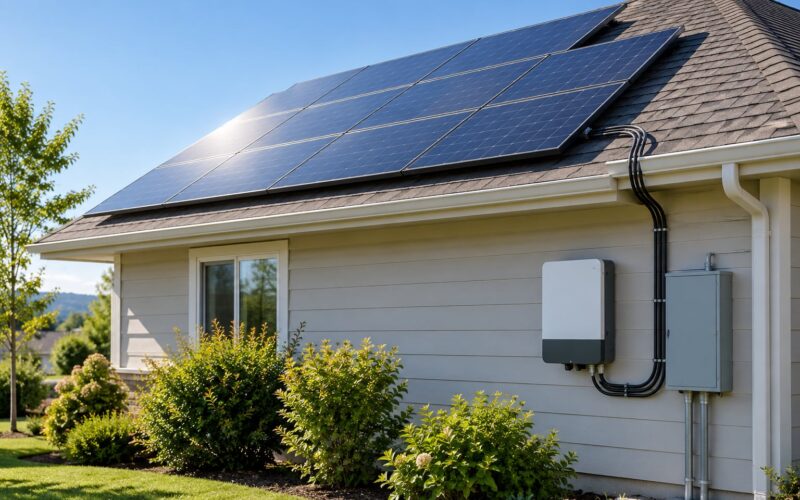
Solar panels are rated in watts, which is peak output at full sunlight, while what you care about is the kilowatt-hours they produce over a day. Panel size tells you the ceiling; peak sun hours tell you what you can expect to reach it.
A typical site gets 4 to 6 peak sun hours a day, varying by latitude, season, roof angle and shading. Output is not flat through the day either. Production peaks near midday, so a home using most of its electricity in the evening captures less of what the array makes.
From your bill to a solar array, step by step
- Collect 12 months of bills. Add up the kWh on each usage line for a full year. This is your annual consumption.
- Divide by 365. That gives daily kWh use, which is the figure a solar system has to match.
- Divide by your peak sun hours. For example, 30 kWh a day over 5 peak sun hours needs about 6 kW, which is roughly 6,000 W of panel capacity.
- Add a margin. Real output is reduced by heat, dust, shading, wiring losses and age, so installers size a system above the bare minimum. Ask for the loss assumptions in writing.
Owners do this arithmetic in DIY forums constantly, and the annual-to-daily step is the part most people get wrong. Dividing annual kWh by 365 rather than by 30 is what turns an over- or undersized quote into a sensible one.
Nameplate battery kWh is not usable kWh
Batteries are also sold in kWh, and here the advertised number flatters them. A 10 kWh battery might deliver 8 to 9 kWh before it hits its low cutoff, and the inverter is rated in kW, so a battery can hold plenty of energy and still deliver it slowly.
Depth of discharge is the share of capacity a battery allows you to use on a normal cycle, and manufacturers rarely promise the full amount. A lithium pack should not be emptied to nothing regularly, either. Ask for usable kWh at a specific discharge rate, not just the label number.
The same two-number logic applies to EV charging. A 7 kW home charger adds 7 kWh in an hour, and a 100 kW public charger adds 100 kWh in an hour, but only if the car can accept that much, which depends on battery temperature and state of charge. Charging time is capacity divided by power, with the car’s acceptance rate setting the real limit.
Simple Ways to Save Kilowatt-Hours
The biggest wins come from changing what runs for the longest, not from fiddling with settings. Work down this list in order.
- Replace halogen with LED. A 60 W halogen bulb doing the same job as a 6 W LED cuts usage by 90 percent. On a socket that runs six hours a night, that difference adds up to a few hundred kWh a year.
- Let solar handle outdoor lighting. A solar path light draws a fraction of a watt and gets that energy from the sun, so a dozen of them around a garden cost nothing from the grid and no wiring. Mains-lit equivalents, or halogen solar lamps, work out far more expensive per year.
- Kill standby loads. Televisions, set-top boxes, game consoles and chargers in standby can total tens of watts around the clock. Switching a power strip off at the wall when nobody is home is the easiest version of this.
- Wash cooler and fuller. A washing machine uses most of its energy heating water, so cooler cycles, fuller loads and line drying cut kWh per item of laundry sharply.
- Manage heating instead of guessing. A 1,500 W space heater adds 7.5 kWh a day while it runs, which is more than most of your appliances combined. Lowering the thermostat a degree or two and closing off unused rooms beats running an extra heater in an open-plan space.
- Shift flexible loads. On time-of-use tariffs, running the dishwasher, dryer or EV charger overnight or mid-afternoon moves the same kWh to a cheaper period without using less.
- Measure before you invest. A plug-in monitor on the fridge, washer or entertainment corner tells you which appliance actually leads the list, which is often not the one people assume.
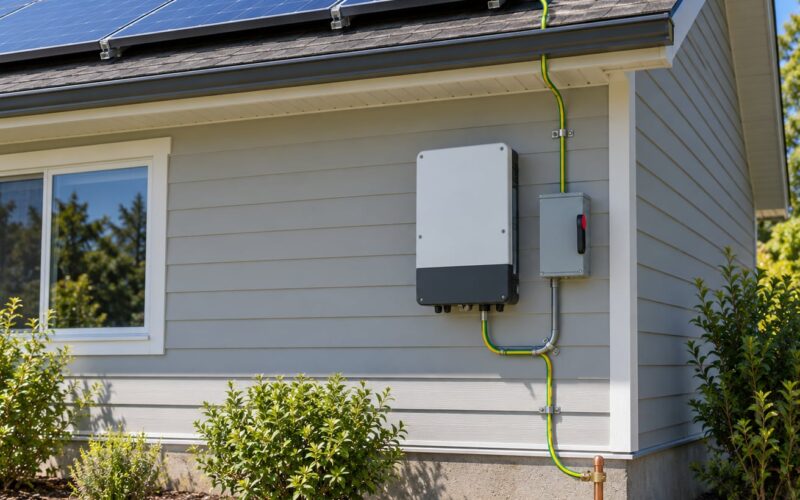
For anything involving panels, new circuits, meter changes or a battery installation, use a licensed electrician and follow the manufacturer’s specifications. Opening a meter or rewiring a socket is not a DIY job.
Frequently Asked Questions
What is the difference between a kilowatt (kW) and a kilowatt-hour (kWh)?
A kilowatt is a unit of power, meaning the rate at which a device uses energy. A kilowatt-hour is a unit of energy, meaning the total used over time. Multiply kilowatts by hours to get kilowatt-hours, the way speed multiplied by time gives distance.
How long does 1 kWh last?
Divide 1,000 by the device wattage. A 10 W LED bulb runs about 100 hours on 1 kWh, a 100 W television about 10 hours, a 1,000 W microwave one hour, and a 1,800 W kettle about 33 minutes. A fridge uses 1 kWh in roughly seven hours of compressor running.
How do I calculate kWh from appliance wattage?
Divide the wattage by 1,000 to get kilowatts, then multiply by the hours the appliance runs. A 1,500 W heater for 5 hours uses 7.5 kWh. If you only know voltage and current, multiply those together for watts, then follow the same steps. The hourly figure, not the daily one, is the correct result for a single session.
How much kWh per day is normal for a household?
A typical US household uses around 30 kWh a day, or roughly 900 kWh in a month, according to the Energy Information Administration. 40 kWh a day is on the high side but common in large homes using electric heating. Always compare your own figure with your own bills, since climate and household size change everything.
Why is my electricity bill still high when I have solar panels?
Solar offsets only the energy you use, and often less than that, because panels peak at midday while household demand peaks in the evening. Export credit may be valued below your retail rate, and supply, delivery and fixed charges are unaffected by panels. Start by comparing your metered import kWh with the kWh your system generated.
How do I pronounce kWh?
Say the letters separately and give the h a light touch: kay-watt-hour. In everyday speech most people say kilowatt-hour straight through. The symbol is just an abbreviation, so nothing changes about the maths if you say it the long way.
Start With One Number From Your Bill
A kilowatt-hour is simply power multiplied by time, and almost everything in this topic follows from that one relationship. Take your latest bill and write down the kWh usage figure, then divide it by 30 to get a daily number you can work with.
From there, check two things: how many hours your highest-wattage appliance runs each day, and how much of your total use is standby. Those two answers usually point straight at where the savings are, and they cost nothing to find. We have kept this guide rate-free on purpose, because your utility’s price per kWh changes over time and only the figure on your own bill is accurate for you.
If you are planning solar next, the same number does double duty: annual kWh from twelve bills, divided by 365, divided by your local peak sun hours, gives the array size an installer should be quoting from.