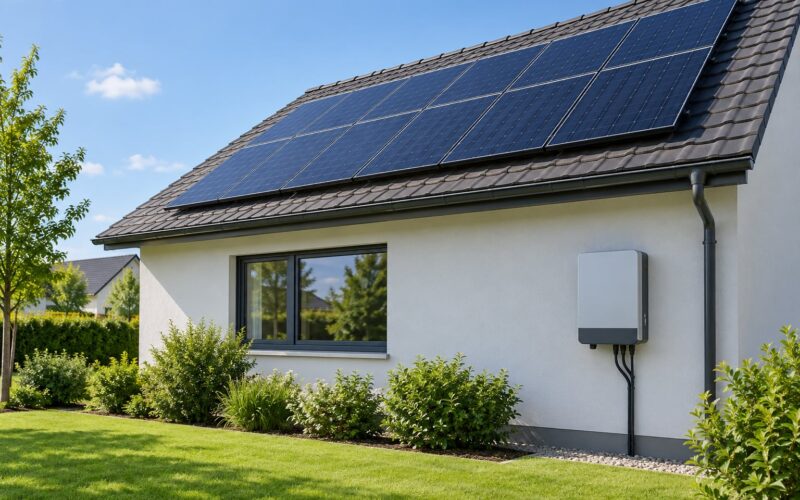
To calculate home solar system size, divide your annual kilowatt-hours by your local peak sun hours multiplied by 365 and a 0.80 efficiency factor, then divide the resulting kilowatts by your panel wattage. That single chain of math gives you a defensible number to take to installers instead of guessing.
It takes about twenty minutes with a bill and a calculator. This guide walks through each number in that chain, then shows a complete worked example for a fictional household, including inverter sizing and an optional battery.
One thing up front: what follows is a planning estimate, not an engineering design. Shade, roof structure, electrical service and local interconnection rules can all change the answer, so treat the result as a solid range and confirm it with a qualified installer.
Table of Contents
- What You Need
- Step-by-Step: How to Calculate Home Solar System Size
- 1. Define Your Energy Goal
- 2. Find Your Average Daily Electricity Use
- 3. Account for Solar Losses and Local Production
- 4. Convert Required Energy Into Panel Count
- 5. Size the Inverter and Consider Battery Storage
- 6. Check the Roof and Finalize the Design
- Common Mistakes
- Frequently Asked Questions
- How many solar panels does a typical 2,000 kWh home need?
- Can I calculate solar system size from my roof area alone?
- Do I need a battery for a standard grid-tied solar system?
- Should I size my solar system for backup or annual electricity savings?
- Why is my solar installer’s system size different from my calculation?
- Conclusion: Start With Your Energy Bill
What You Need
You can run the whole calculation with a phone calculator. The accuracy comes from the inputs, not the tool.
- Twelve months of utility bills. Total the kilowatt-hours shown on each one. A single month misleads you badly in any climate with air conditioning or heat.
- Interval or hourly usage data, if your utility offers it. This is optional but valuable, because it shows when your household actually uses power.
- An energy goal. A percentage of your bill to offset, a specific load to run, or backup capability during an outage.
- Your local peak sun hours. The number of equivalent full-sun hours per day at your address, not a national average.
- Panel specifications. Most current residential modules sit in the 400W to 450W range.
- Roof measurements. Usable south-facing area, pitch, and where shade falls across the day.
- Your backup loads, if you plan storage. The appliances and outlets that must stay running in an outage.
Households that add up all twelve months consistently land closer to their real number than those who estimate from square footage, and they tend to be happier with the outcome. If your utility portal keeps a usage history, that is the fastest source.
Step-by-Step: How to Calculate Home Solar System Size
Six steps, in this order: set the goal, find daily consumption, adjust for local production and losses, convert energy into panels, size the inverter, then check the roof. Skipping straight to panel count is where most bad estimates come from.
1. Define Your Energy Goal
Decide what the system is for before you touch a number, because each goal produces a different system. An 80% bill offset is a bill-savings project. Running a well pump or a workshop off-grid is a load project. Keeping the refrigerator and medical equipment alive through an outage is a backup project, and it can demand a large battery with a fairly modest array.
The same household can reasonably end up with three different answers. That is normal, not a contradiction. Writing the goal down in one sentence keeps the rest of the calculation honest.
2. Find Your Average Daily Electricity Use
Add the kilowatt-hours from all twelve bills, then divide by 365. A typical US household lands somewhere around 10,000 to 12,000 kWh a year, which is roughly 28 to 33 kWh per day.
Worked through: if your twelve bills total 13,800 kWh, your average daily consumption is 13,800 ÷ 365 = 37.8 kWh. Monthly figures work too, but average daily keeps the units aligned with peak sun hours later.
Pay attention to the seasonal shape. Summer air conditioning can push one month to double the winter figure, and a house that heats with electric resistance heat does the same thing in January. Production is also bell-shaped across the year, which means a perfectly sized annual system still leaves you buying power in the shoulder months and selling or wasting it in the peak ones.
Peak evening demand deserves a look too. Solar generation tracks daytime consumption closely, so a household using most of its power from 6pm to 10pm gets less real value from each panel than one with steady daytime base load.
3. Account for Solar Losses and Local Production
Peak sun hours, often abbreviated PSH, is the number of hours per day of full-intensity sunlight your location receives, expressed as the equivalent hours at a reference irradiance of 1,000 W per square meter. It is the single number that separates a Phoenix array from a Seattle one.
Approximate planning ranges by US region look like this. Treat them as starting points and check a specific address with a tool such as NREL PVWatts or your utility’s own estimator.
| Region | Typical peak sun hours per day |
|---|---|
| Southwest (AZ, NV, southern NM) | 5.5 to 6.5 |
| Southern California, southern Texas | 5.0 to 5.8 |
| Southeast (GA, FL, NC, SC) | 4.5 to 5.3 |
| Midwest (OH, IN, IL, IA) | 3.8 to 4.5 |
| Mid-Atlantic (PA, MD, VA, NY) | 3.6 to 4.3 |
| Pacific Northwest (WA, OR) | 2.8 to 3.6 |
| Upper Midwest and New England | 2.8 to 3.6 |
Then apply the efficiency factor. Panel output drops as cell temperature climbs above the cool test conditions, wiring and connections lose a little, the inverter converts DC to AC at about 96 to 98 percent, and dust, soiling and early-life degradation take the rest. Real systems deliver roughly 80 percent of their nameplate in the first year, so 0.80 is the working number most sizing guides use.
The complete formula, in one line:
System size (kW) = Annual kWh ÷ (peak sun hours × 365 × 0.80)
Using the fictional household at 13,800 kWh a year and 5.2 peak sun hours: 13,800 ÷ (5.2 × 365 × 0.80) = 13,800 ÷ 1,518 = 9.09 kW. Same household in a 3.4 peak sun hour location needs 13,900 kWh of annual yield, or about 13.9 kW. Location alone moved the system more than 50 percent.
4. Convert Required Energy Into Panel Count
Panel count is your system size in watts divided by the wattage of one module. The rule for how to calculate home solar system size is complete only once you land on an integer, because you cannot buy half a panel.
Continuing the example at 9.09 kW with 440W modules: 9,090 ÷ 440 = 20.7, so round up to 21 panels. That array is 9,240 W, or 9.24 kW, slightly above the 9.09 kW target. Rounding up is always safe; rounding down leaves you short.
Roof space follows the same arithmetic. A typical 60-cell residential panel is about 21 feet wide by 41 inches tall, roughly 6.5 to 7.5 square feet of itself, and needs about 18.5 square feet of roof surface once you allow for row spacing, setbacks and fire pathways. Twenty-one panels land near 390 square feet of usable roof.
5. Size the Inverter and Consider Battery Storage
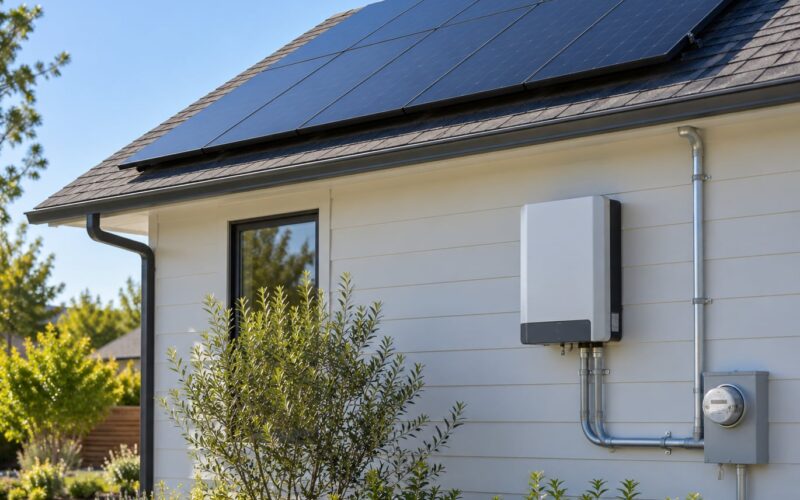
The inverter converts the panels’ direct current into the alternating current your house runs on, and it sets a ceiling on how large your array can be. A grid-tied array is usually sized somewhat smaller than the panels. In the example, 21 panels of 440W can feed a 7.5 kW inverter, a DC-to-AC ratio near 1.23 that is common and efficient.
Shading changes the picture. With microinverters or power optimizers, each panel or string gets its own maximum power point tracking, so one shaded panel no longer drags down the whole array. A string inverter is cheaper but needs a single unshaded plane of panels. On a roof with a chimney or a big tree, per-panel electronics usually produce more energy over the year.
If you want storage, size the battery from the loads you need to keep alive, not from the size of your array. Take the fictional backup list: 1.2 kW of continuous load, such as a refrigerator, internet router, lighting and a medical device, for four hours. That is 1.2 × 4 = 4.8 kWh. Divide by a depth of discharge of 0.8, since batteries should not be emptied fully, for 6.0 kWh usable, and add roughly 15 percent for inverter losses and aging headroom, landing near a 7 kWh battery.
An array much larger than the battery can charge creates a bottleneck, where midday production exceeds what the battery can absorb and the excess is curtailed or exported. Note also that backup sizing depends on continuous output and surge, since motors and compressors draw a spike at startup. A 5 kW continuous rating that can surge to 10 kW covers far more than a flat 5 kW unit.
6. Check the Roof and Finalize the Design
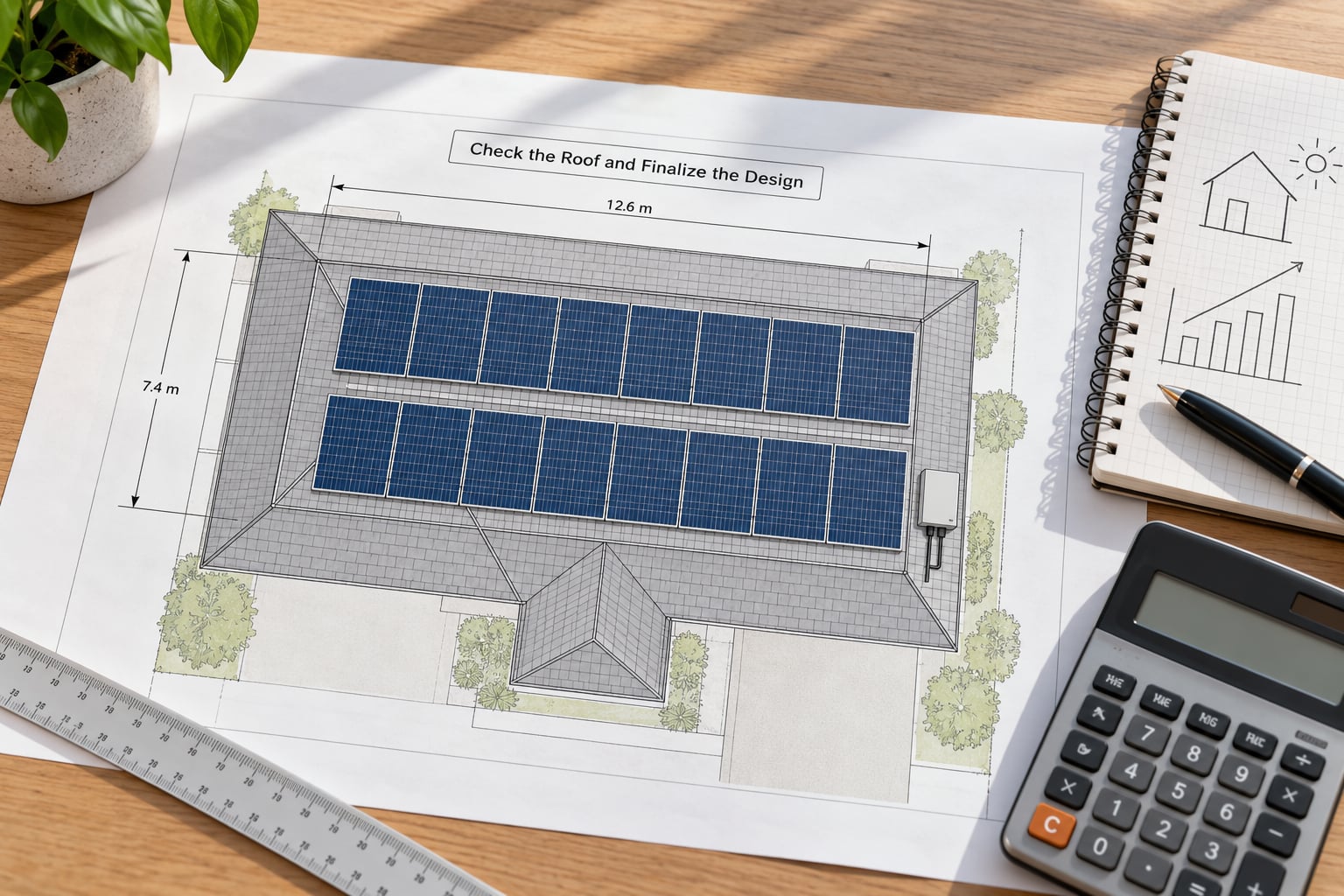
Now test the 21-panel answer against the building. South-facing roof at a pitch between roughly 15 and 40 degrees performs best. East- and west-facing arrays usually lose 10 to 20 percent of annual yield compared with south, and east-west layouts can perform nearly as well as south when the goal is covering evening demand instead of maximizing annual production.
Map the shade. A tree, chimney or neighboring building that crosses the array between 9am and 3pm does more damage than its size suggests, and that is the single biggest reason production estimates come in optimistic.
Three more constraints worth knowing about. Roofs add roughly 3 to 4 pounds per square foot of load, and if your shingles have under 15 years of life, re-roofing first avoids paying twice to remove the array later. Many utilities cap interconnection at around 120 percent of what your average peak demand allows, which can become the real limit on a large system. Local rules also change what happens to exported power, and in states with weaker net metering credits an oversized array earns less for every kilowatt-hour it sends back.
Adjust for the future too. If an electric vehicle, a heat pump or induction cooking is on the way, add its expected annual consumption to the 13,800 kWh figure before you do step two, not after. Sizing for loads you are certain about, then planning for expansion, is cheaper than redoing the array later.
Your finished estimate for the fictional household: 13,800 kWh a year, 5.2 peak sun hours, 0.80 efficiency, roughly 9.1 kW, 21 panels, about 390 square feet of roof, a 7.5 kW inverter and an optional 7 kWh battery. A reasonable range to carry into quotes is 8.5 to 9.5 kW. Get three proposals, compare production estimates rather than headline price, and ask each one which assumptions they used.
Common Mistakes
- Sizing from square footage. A 1,200 square foot home can use 6,000 or 20,000 kWh a year depending on occupants, appliances and climate. Fix: size from metered energy, always.
- Using a household average instead of your own bills. The national average is a starting point, not a design input. Fix: total all twelve bills, and re-total if you get a smart meter that shows hourly data.
- Picking panels and ignoring the inverter. The inverter caps the array, and the wrong architecture wastes energy on shaded roofs. Fix: decide the inverter approach before you commit to a panel count.
- Assuming every watt of panel capacity is usable. Nameplate ratings are measured under cool, clean laboratory conditions. Fix: keep the 0.80 factor in the formula and use conservative production estimates.
- Overlooking season and shade. A flat annual number hides a heavy summer month and a shaded winter roof. Fix: compare production month by month against consumption month by month.
- Designing for backup without checking load duration. A battery that covers four hours of essential loads is not a whole-home system. Fix: list the loads, sum their running and surge watts, then multiply by the hours you need covered.
Before installation, confirm that you have 12 months of usage, a named offset target, a local production figure for your actual address, and a roof that is unshaded, in good condition and oriented reasonably. Add an interconnection check with your utility, because that limit can cap your maximum system size before physics ever gets a vote.
Frequently Asked Questions
How many solar panels does a typical 2,000 kWh home need?
A home using 2,000 kWh a month is well above the US average of roughly 900 kWh a month, so it needs a much larger array. At 24,000 kWh a year, a location with 5.2 peak sun hours needs about 15.8 kW, or roughly 36 panels at 440W. Drop to 3.4 peak sun hours and the same household needs about 47 panels.
Can I calculate solar system size from my roof area alone?
You can estimate the maximum a roof can hold, but not the system you actually want. Roof area only tells you the ceiling, since panel count comes from consumption and local sunlight. A large roof in a low-sun state may suit a modest system, while a small unshaded roof in a high-sun state can carry more panels than the household needs.
Do I need a battery for a standard grid-tied solar system?
No. A grid-tied system without storage works normally and sends surplus power to the utility under your net metering rules. A battery only adds value if you want backup during an outage, protection from time-of-use rates, or a way to use more of your own midday generation instead of exporting it at a reduced credit.
Should I size my solar system for backup or annual electricity savings?
Bill savings is the simpler goal, and the sizing formula in this guide covers it directly. Backup is a different design problem, because the array matters less than the battery and the inverter’s continuous and surge ratings. Many homeowners start with bill savings and add storage later, which keeps the first decision easier to get right.
Why is my solar installer’s system size different from my calculation?
Most often it is a different loss assumption, a different production estimate, or a design built for a different goal such as an EV or backup capability. Installers also account for roof layout and shading in ways a worksheet cannot. If the gap is large, ask them to show the hourly production estimate and the offset percentage they are designing for.
Conclusion: Start With Your Energy Bill
To calculate home solar system size, total twelve months of kilowatt-hours, divide by 365 for daily use, then divide by your local peak sun hours multiplied by 365 and 0.80. That gives kilowatts. Divide by panel wattage for a count, size the inverter below the array, and size any battery from the loads you want running.
Start tonight by pulling twelve months of usage from your utility portal. Pick an offset goal, check a production estimate for your actual address, and only then ask installers for quotes built around your own numbers instead of a national average.